Hass exam bruh
 Call Kai
 Learn
Learn Practice Test
 Spaced Repetition
 Match
Match Flashcards
 Knowt Play
1/16

There's no tags or description
Looks like no tags are added yet.
Name | Mastery | Learn | Test | Matching | Spaced | Call with Kai |
|---|
No analytics yet
Send a link to your students to track their progress
17 Terms
BOLTSS
Border, Orientation, Legend, Title, Scale, Source
SPICESS
Space - How and where things are located on Earth’s surface, spacial distribution
Place - Part of Earth’s surface given meaning by people
Interconnection - The links between biotic and abiotic factors, societies and resources, showing that no place exists in isolation.
Change - How landforms, cultures, and people change over time
Environment - The physical and biological world, and the relationships that humans have with their surroundings.
Sustainability - The idea of meeting the needs of the present while managing resources for future generations.
Scale -How things can take place on different spacial levels and how things can have local and global impacts
Ecosystem services
The many and varied benefits that humans get from the natural environment and a functioning ecosystem
Sources(Provisioning services) - natural products that can be used or converted to be used by humans(Eg. trees give wood and fruit) Is it a product?
Sinks(Regulating services) - Processes that get rid of our waste(Eg. water purification, decomposition) Is it regulating a natural system?
Services(Supporting services) - Things done for us by the ecosystem that arent physical resources(Eg. nutrient cycling, water cycling, soil formation) Is it a background ecological process?
Spiritual(Cultural services) - The personal relationships humans have with the environment(Eg. Recreation, inspiration, indigenous connection to the land) Is it about human meaning or enjoyment?
Drivers of change
Direct drivers - directly damages ecosystems (Eg. deforestation, pollution, climate change, invasive species
Indirect drivers - Why those damaging actions happen, or factors that put futher strain on ecosystems (Eg. population growth → higher demand for food → more farming → deforestation.
Climate change → changing ecosystems → some animals can’t live there anymore and migrate to other ecosystems → invasive species
also economic development and technology)
Human changing environments
Land - Deforestation, farming and urban development → habitat loss, soil erosion and land degredation
Atmosphere - Burning fossil fuels releases pollutants and greenhouse gases, → air pollution and climate change
Water - Damming and irrigation, reduce water quality and ecosystem health. Climate change shifts temperature and salinity, reducing biodiversity.
Ecosystem collapse
Loss of key features
Loss of plants and animals
Loss of vital ecosystem services
Size shrinking
Climate change
The gradual change in the Earth’s climate, involving rising temperatures and sea levels, causing extreme weather, loss of food security, etc.
PQE
Pattern – Look at the source for patterns within the source. (There is a desert in the centre of a map)
Quantify – Elaborate on those patterns using locations, numbers, and statistics. (The desert at the centre stretches across approximately 2500 square kilometres.
Exceptions – What doesn’t fit the original pattern? (There is a small patch of temperate forest in the centre, which is an exception to the pattern) If there are no exceptions, then just say something like ‘there are no notable exceptions.’
Pulses and Presses
Pulses - short term events that change ecosystems (Eg. bushfires, floods)
Presses - long term changes that change ecosystems(Eg. temperature, salinity
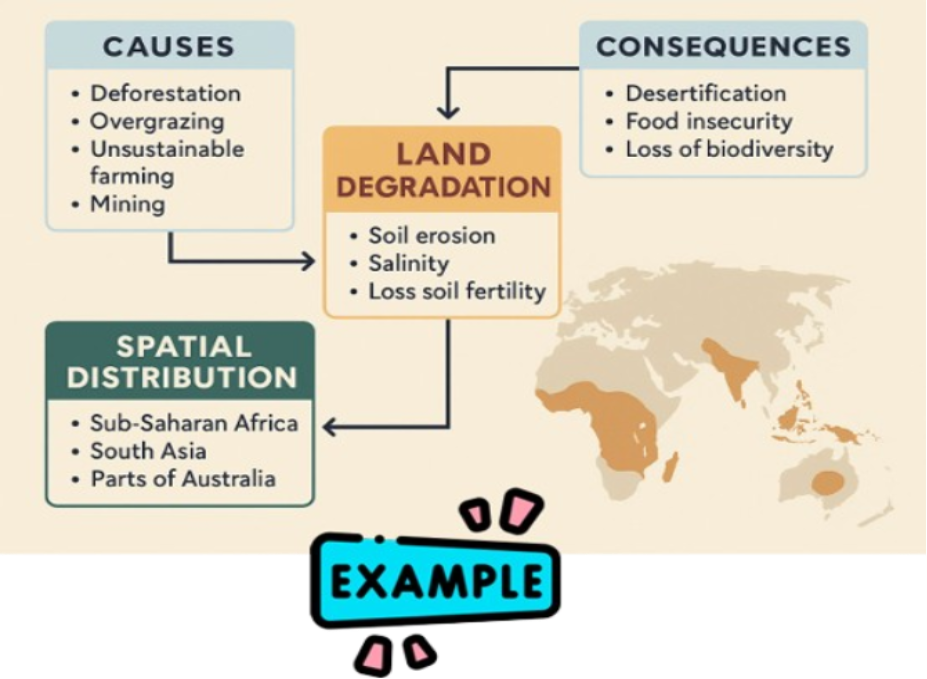
Causes consequences and spacial ditribution
Identifying Human‑Induced Change: Urbanisation
Causes: population growth, housing demand, transport expansion, and economic development.
Consequences: habitat fragmentation, increased pollution, heat‑island effect, and higher flood risk due to impermeable surfaces.
Spatial distribution: concentrated around major cities such as Perth, Sydney, Melbourne, with rapid expansion occurring on city fringes and coastal zones.
different worldviews
Anthropocentric - Human centred world view. Care about things only if it prioritieses humans and their needs and progress
Egocentric - Self centred world view. Things only matter tothe extent that stuff impacts or supports them and their lifestyle
Ecocentric - Ecosystem centred world view. All live matters and reducing human impace and maintaining ecological balance is the most important thing
Biocentric - Living things centred worldview. Animals have equal rights and stuff
Why do views differ
Where we live - environments shape our values
Culture and religion - beliefs influence how we feel about nature
Education - affects understanding of environmental issues
Standard of living - needs and priorities differ
Personal experiences - shape how we see the natural environment
People and ecosystems interconnection
People depend on the natural environment | People impact the natural environment | Human choices and behaviour respond to natural environments |
|---|---|---|
We rely on the environment for survival, comfort, and economic activity. | Human activities also change natural systems — mostly negatively, but sometimes positively. | Environmental characteristics shape how people live and organise their communities. |
Resources | Land use change | Climate |
Ecosystem services | Pollution | Terrain |
Cultural and spiritual values | Climate change | Natural hazards |
Recreation and wellbeing | Conservation efforts | Biodiversity |
Custodial responsibility
The obligation of indigenous communities to care for the land, resources, and life forms (called ‘country’), ensuring sustainability while passing down traditions and knowledge for future generations.
Sustainable practices include firestick farming or controlled burns to prevent forest fires from becoming too destructive, seasonal hunting to prevent exploitation and loss of biodiversity.
The Birriliburu rangers carry out their custodial responsibility through their partnership with Bush Heritage, which gives them access to satellite technology and databases, making their efforts more effective and efficient (Two way learning)
Caring for country
The activities done by indigenous people to protect, maintain and heal the land
Natural causes climate change
volcanic eruptions | eruptions release ash and gas | in short term ash can block the sun and cool the planet and in the long term volcanic C02 contributes to warming |
Solar variation | Suns energy output changes over time | they can warm or cool the earth |
Consequences of Climate change