Week 4: Lecture 2 What is childhood for?
 Call Kai
 Learn
Learn Practice Test
 Spaced Repetition
 Match
Match Flashcards
 Knowt Play
1/7

There's no tags or description
Looks like no tags are added yet.
Name | Mastery | Learn | Test | Matching | Spaced | Call with Kai | Chat |
|---|
No analytics yet
Send a link to your students to track their progress
8 Terms
Why is human childhood strange?
Humans have a FAR longer period of ‘childhood’ than other animals This may be because of our brain size and our intelligent functioning. Generally, the bigger the brain the longer the childhood as a percentage of an individual's lifespan.
22.8% of our lifespan childhood is Longer childhood = higher intelligence and flexibility

Explain the explore-exploit dilemma as a reason for childhood?
Hypothesis that childhood is evolution’s way to resolving the explore-exploit dilemma → as childhood is a period of extended exploration and therefore helps us to exploit knowledge in a highly complex dynamic environment. The explore-exploit dilemma describing the choice between exploring and exploiting our explorations. (choosing to forage on the same food or different food; to explore or to exploit (use existing information)
Evd - childhood is a period of extended exploration → as kids have naturally curious personalities
What is the prediction associated with the explore-exploit dilemma?
Children will have an advantage tin solving problems that do not have the ‘obvious’ solution (i.e. where more exploration is needed to find the right solution.
Describe the Zaff (Blicket) experiment?
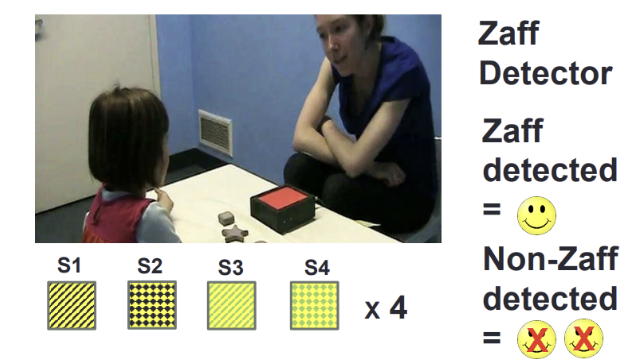
Task in which children explore or don’t explore things for rewards → tasks naturally rewards more exploration → found that kids explore more = evidence for the ‘childhood as a way to resolve the explore-exploit dilemma’
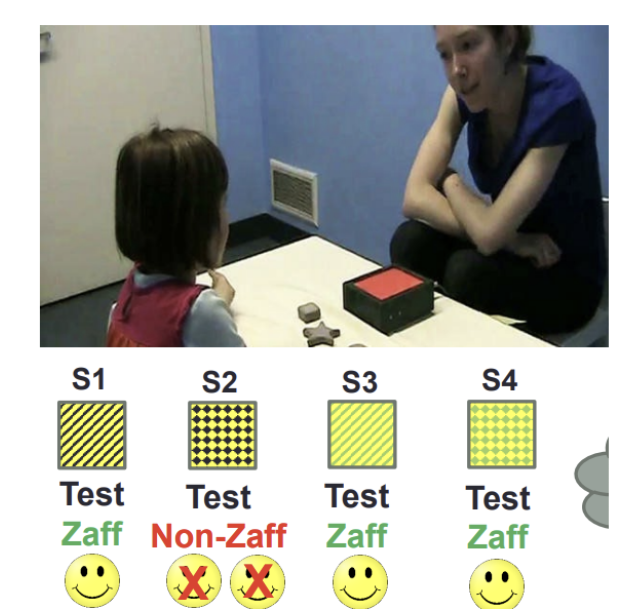
In the task - children choose which block to test, (if you avoid it, then you don’t get to find out if it's a Zaff + no gain/loss).
Test and pass = sticker, Test and fail = lose 2 x stickers There are two hypothetical rules → 1D rule - pattern - Strips vs. Spot, 2D rules - pattern and colour.
They are asked to test 4 x objects → DV = response in S4 Children are more likely to learn the 2D rules and therefore do better in the task, whereas adults are more likely to not . → that is, kids are more likely to explore more. They found that 4-5 years and 6-7 years old are more likely to explore and learn the 2D dimension.
Adults fall into a learning trap.
What are other things to consider in the exploit-explore dilemma?
The influence of protection and nurturing Aka if Parent-present or Parent-absent Number of carers and parents.
Describe the Tottenham task?
Used a similar Zaff structure, except added or did not add parents - Found that in the parent-present structure – when the parents were absent, individuals used exploit strategy earlier, compared to when parents were not there.
What is something ‘special’ about human caregiving?
The triple threat in human parenting compared to other animals. → aka, the use in human society of pair-bonded parents, grandparents and alloparents in caring for children.
What is childhood for?
• A period for extended exploration of the environment with less focus on immediate exploitation of knowledge • Humans have an extended childhood – helps explain ability to understand/control the environment • Exhibited in curiosity, play, exploration of less obvious solutions, etc • Lab example