Paolo OLED
 Call Kai
 Learn
Learn Practice Test
 Spaced Repetition
 Match
Match Flashcards
 Knowt Play
1/66

There's no tags or description
Looks like no tags are added yet.
Name | Mastery | Learn | Test | Matching | Spaced | Call with Kai | Chat |
|---|
No analytics yet
Send a link to your students to track their progress
67 Terms
what does OLED stand for
organic light emitting diode
what is LCD and whats the difference between OLED and LCD and why
OLED has wider viewing angle, look from side and see good brightness, colour and contrast.
LCD, as viewing angle increases, colour shifts, brightness decreases, contrasts drop. Liquid crystal display
this is because light in OLED is emitted directly from each pixel rather than passing through liquid crystal and filter layers
Why are LCD viewing typically worse, in terms of function
LCD mechanism is backlight → polariser→liquid crystal→ colour filter and viewer. when viewed from angle, light scatters, polarisation changes. colour distorts. Oled just goes from OLED→ viewer, example being curved tv, samsung fold
why can OLEDS bend
organic layers are extremely thin, can be deposited on plastic. Glass substrate → rigid. plastic→ flexible
How does LCD work in terms of filtering out a colour
LCD starts with white light, if you want red, goes from red gets filtered→ only red passes, blue and green are wasted. Thats why LCD need backlight on continously. LCD even if blackscreen is constantly generating light
OLED is a form of additive display. how does this work
each pixel will contain R G B, if red, just turn it on, yellow turn on r+g. oled ends up saving power and when black pixel, its off, hence why dark mode often saves battery
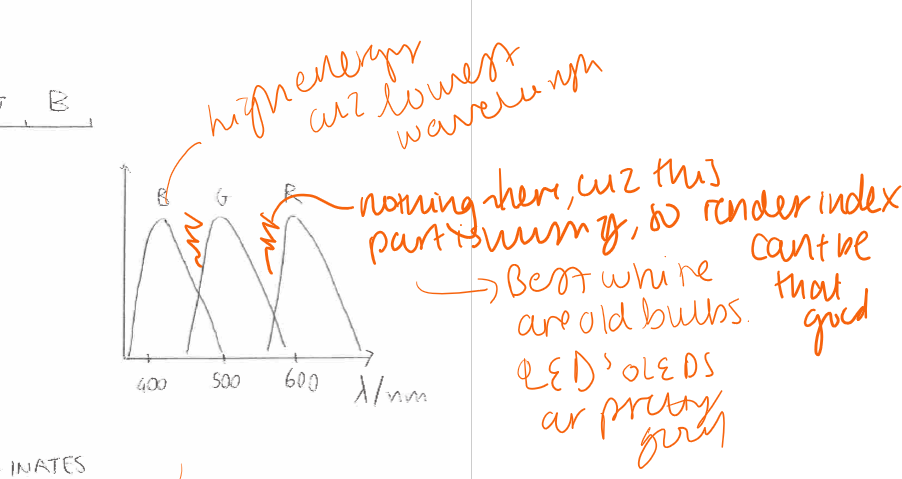
what colour is highest energy in wavelength between rg b
blue cuz lowest wavelength
whats colour rendering index
how accurately colours appear
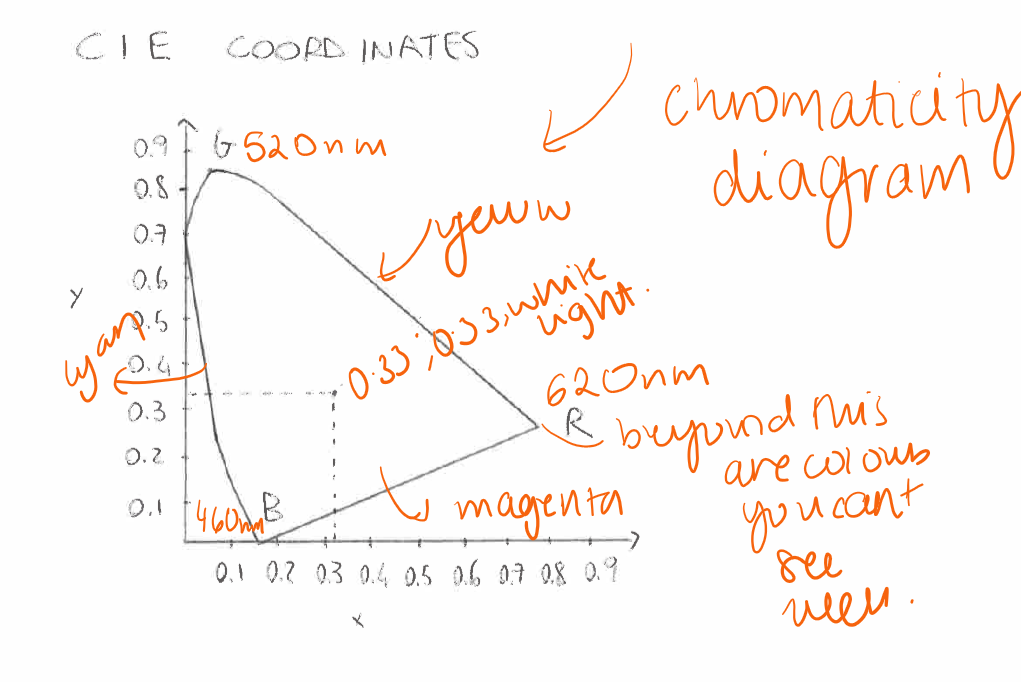
whats a chromaticity diagram and gamut
every visible colour shown, the edges are pure colours, centre is white
white light, x and y usually 0.33
gamut is the triangle formed inside rgb, here more colours are available, you want a big triangle
Draw out the structure of a pixel OLED
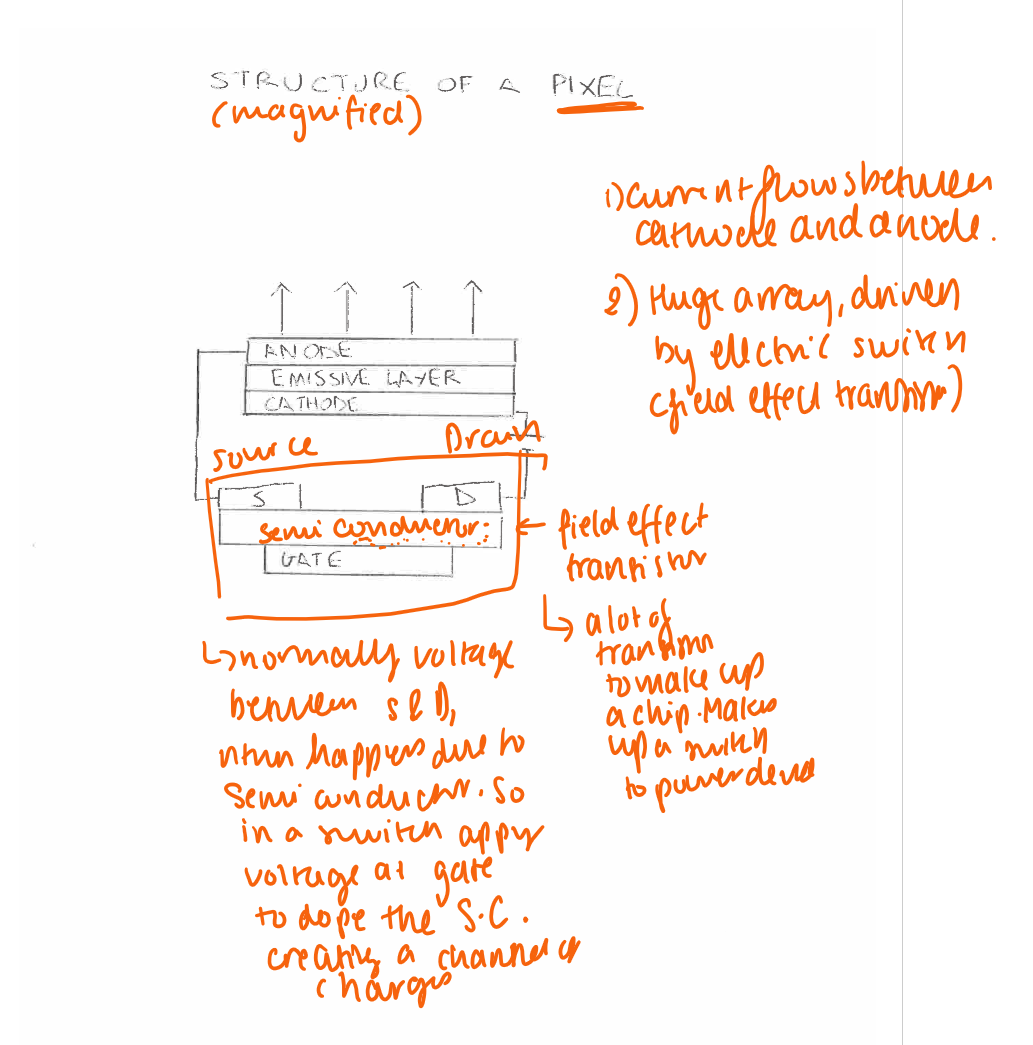
what does the strucutre of a pixel work
its basically an OLED light source with transistor switch, top part has anode, emissive layer, then cathode, here yiou apply voltage and electron +hole will be exitons and then become light, light leaves thru here.
Bottom half, thin film transistor this is the switch controlling oled.
theres a source, drain and gate, gate allows voltage to pass
whats the field effect transistor
the gate creates an electric field, it then changes conductivity, hence field effect transistor
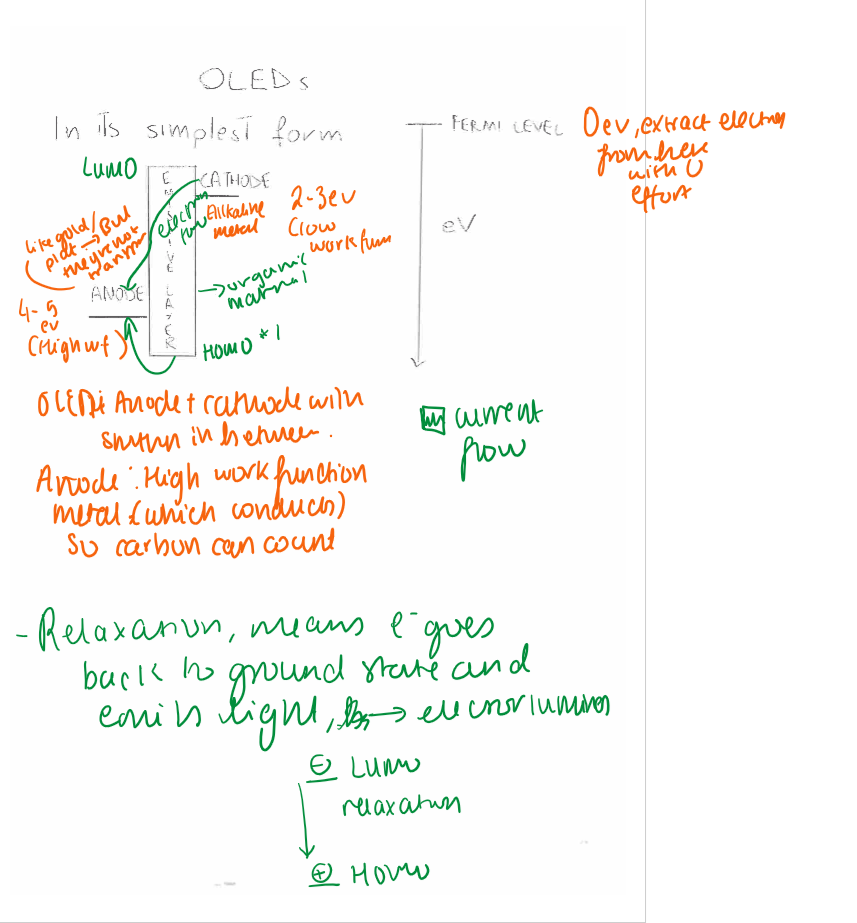
top layer of oled, what is going on in terms of homo and lumo
voltage is applied in between and from cathode, you have lumo, cathode is at the top, because it injects electrons into the lumo, and is forced to have a low work function (eaasier to remove electrons)around 2-3ev.
anode is at the boittom with homo, removing an electron leaves a hole, so anode injects hole and you need high function materials 4-5ev, for example ITO. t
The electron and hole then move closer to eachother, making electron + hole (exicton), then relaxation occurs where electron drops from lumo to homo, this gap determines the colour
large gap= blue etc
while oled sounds great whats the limitation
electrons hate entering the organic material and holes. consequence of this is fewer electrons enter, fewer excitons form, less light,more voltage. there is an energy barrier they have to overcome
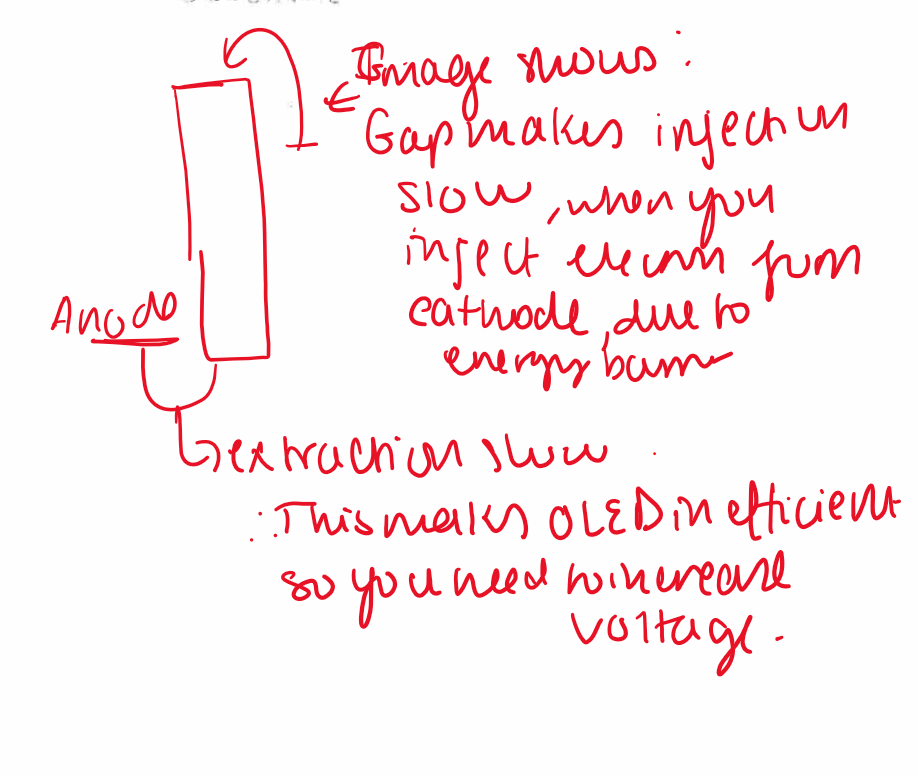
whats the solution to oled limitation
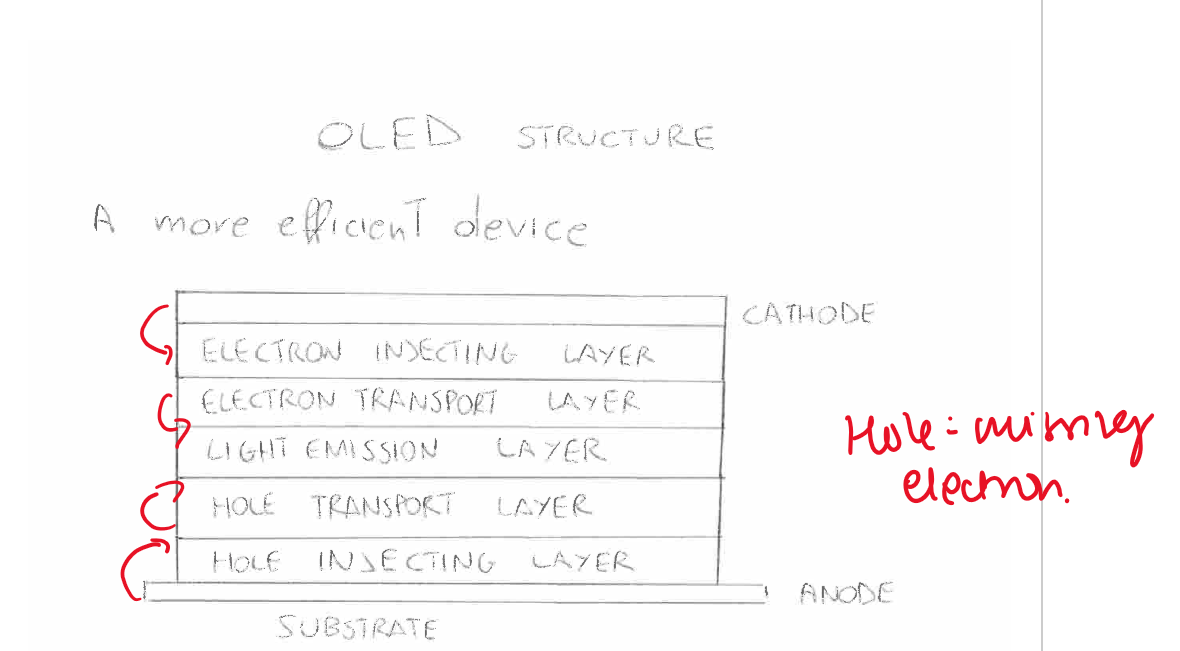
add more layers.
the electron injecting layer, helps ease of electrons
electron transport layer, move electrons to emission layer
hole injecting layer, helps holes enter
hole transport layer, move holes to emission layer
emission layer→ both charge carriers arrive and form an exciton
Why are multiple transport and injection layers used in OLEDs
Injection and transport layers reduce energy barriers for charge injection and improve charge transport to the emissive layer, increasing recombination efficiency and reducing operating voltage.
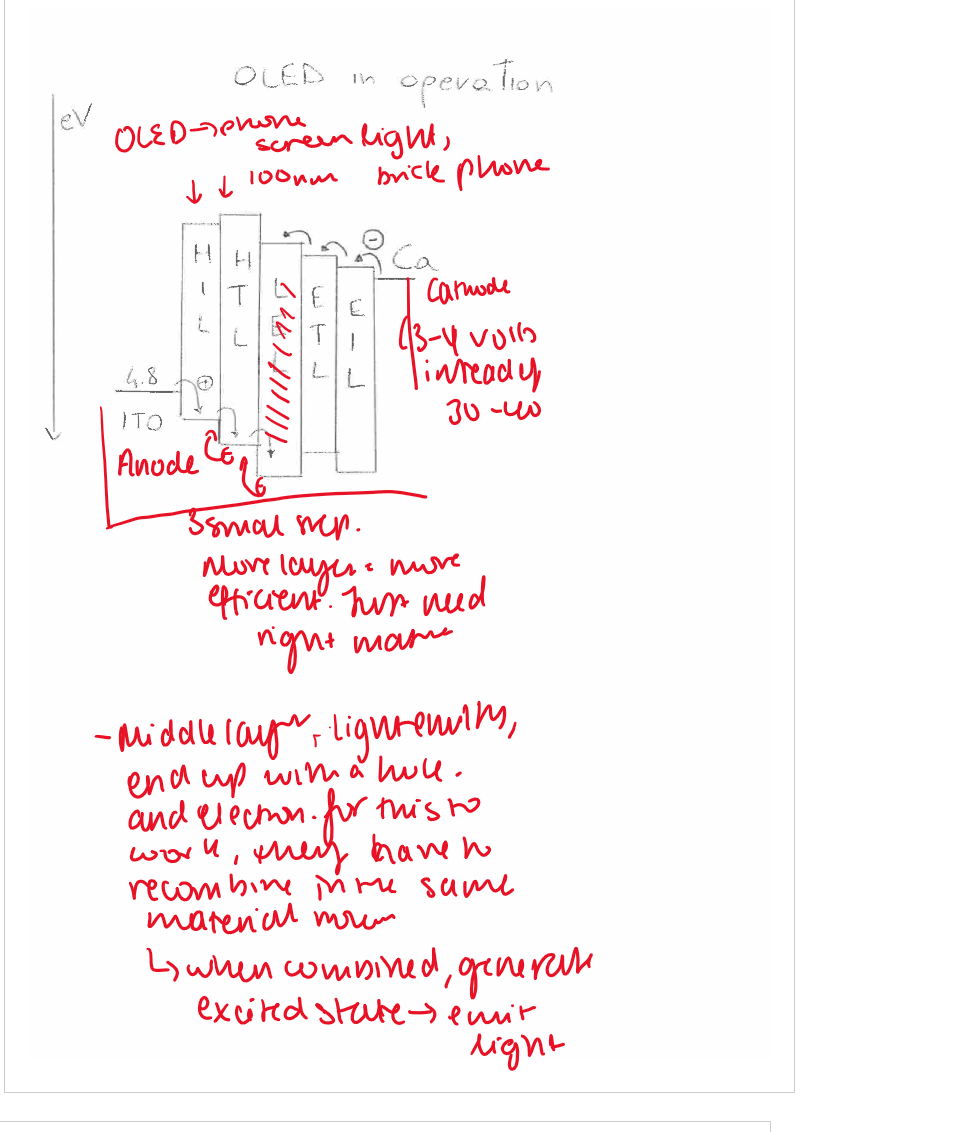
Describe OLED operation
Voltage is applied between anode and cathode.
Holes are injected from the anode into HIL/HTL.
Electrons are injected from the cathode into EIL/ETL.
Charges move toward emissive layer.
Electron-hole recombination forms excitons.
Exciton relaxation emits light.
what is EQE
external quantum efficiency, its a percentage of photons escaped (how much inserted got out) vs electron - hole pairs injected, luminous intensity
whats the units of the following.
current efficiency
power efficiency
luminance
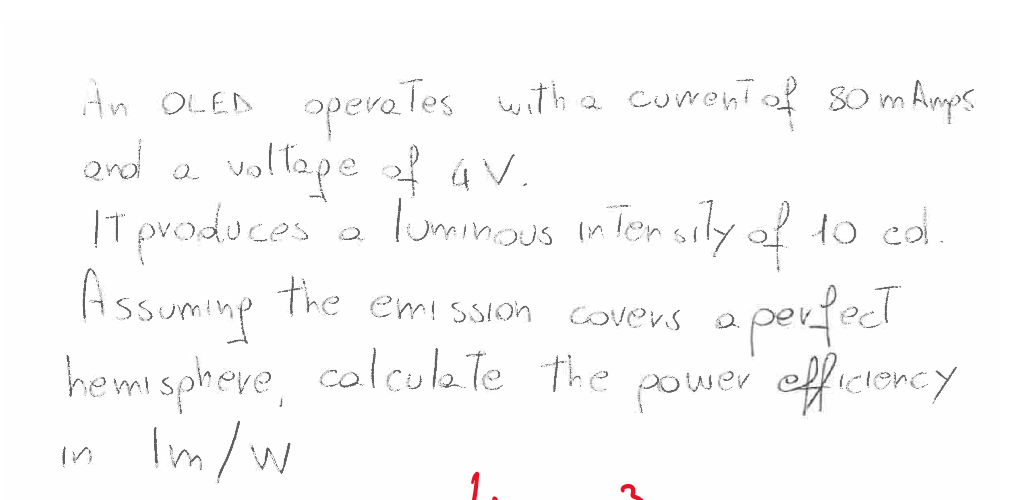
current efficiency in col/a
power efficiency in Im/w
luminance in cd/m"²
IQE vs EQE
IQE internal quantum efficiency → how many charge pairs become photons
Light gets lost in the form of what sometimes
high dispersion, scattering refraction
What is the most common anode material in OLEDs?
indium tin oxide bc High work function
✅ Good electrical conductivity
✅ Optical transparency
Why does doping with tin help?
Pure indium oxide is conductive-ish.
Adding tin improves conductivity a lot.
Why is ITO transparent if it conducts?
Normally:
metals conduct well
but are opaque
ITO is special.
It is a:
Transparent Conducting Oxide (TCO)
Meaning:
conducts electricity
still allows visible light through
That makes it ideal for displays.
Why transparency matters in OLEDs
OLED light must escape through the display.
If the anode blocked light:
❌ dim screen
ITO allows:
✅ charge injection
✅ light transmission
What is sputtering
A thin-film deposition technique.
Process:
Start with target material (ITO target)
Bombard with high-energy ions
Atoms are ejected
Atoms deposit onto substrate
What is CVD?
Thin-film formation from gaseous precursors.
Process:
Gas precursors introduced
React/decompose on surface
Solid film forms
Common ITO Alternatives
ZnO
AZO (Al-doped ZnO)
GZO (Ga-doped ZnO)
FTO (Fluorine-doped tin oxide)
Why ZnO?
ZnO = Zinc Oxide
Useful because:
✅ Transparent in visible region
✅ Wide band gap
✅ Cheap
✅ Abundant
✅ Stable
why would Ga also be of some good fit
cbeause:
similar ionic size to Zn
can fit into ZnO lattice easily
causes less lattice distortion
This is important.
Smaller distortion = better crystal quality.
What makes a good OLED cathode?
A good cathode should have:
✅ Low work function
✅ Good electron injection
✅ Good conductivity
Because electrons must move from cathode into the OLED LUMO.
Smaller energy barrier = easier injection.
What is work function?
Work function = energy needed to remove an electron from a material.
Common OLED Cathode Materials
From your slide:
Al → 4.3 eV
Ca → 3.2 eV
Na → 2.7 eV
Cs → 2.1 eV
Lower number = better electron injection.
Cs > Na > Ca > Al
Why Calcium is commonly used
Your note says:
more stable than sodium or lithium
Exactly.
Calcium gives a good compromise.
Why not pure Aluminium?
Aluminium is:
stable
conductive
But work function is relatively high:
This creates a larger energy barrier.
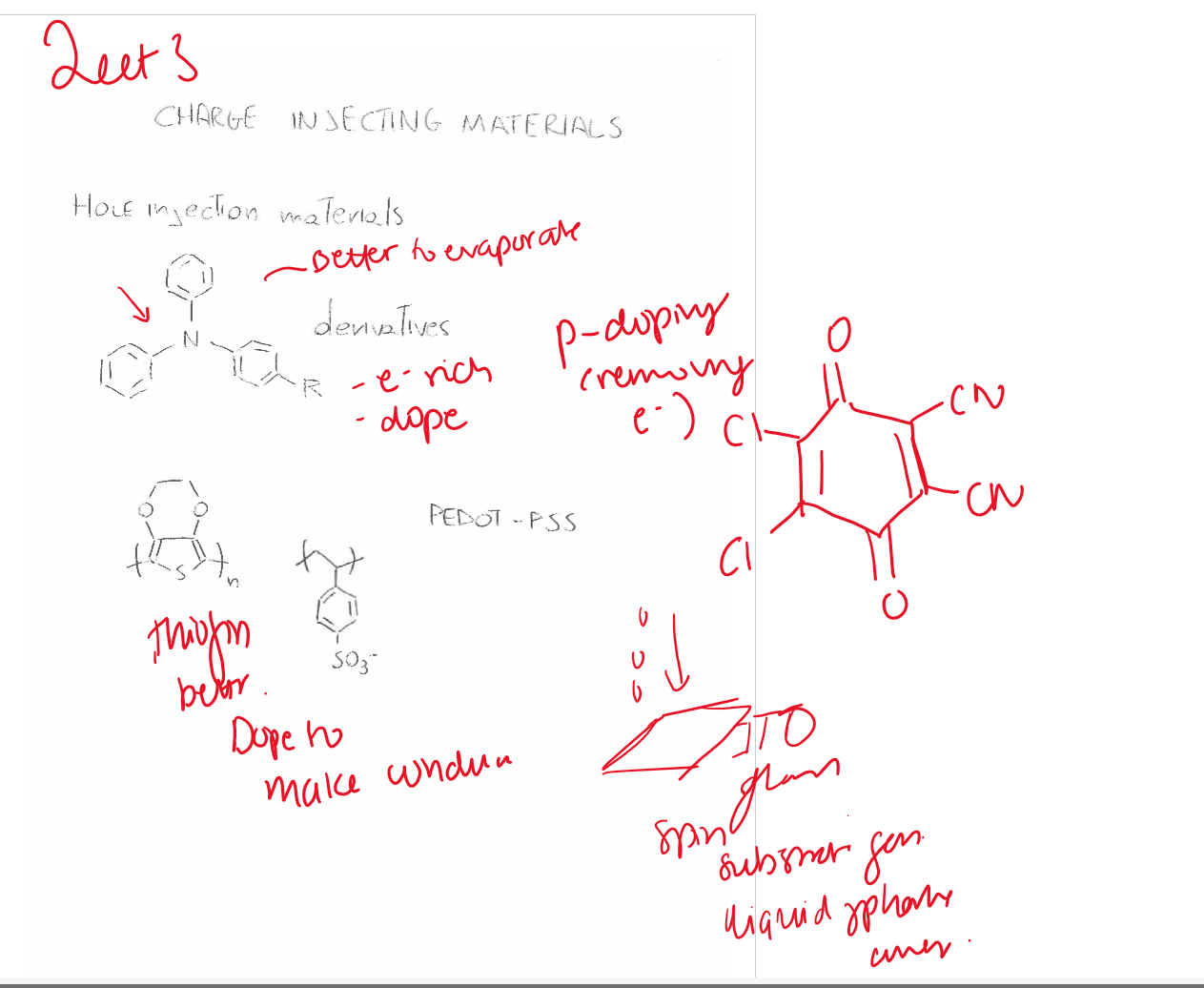
What are charge injection materials?
Charge injection materials help charges move from electrodes into organic layers.
Two types:
Hole injection materials (near anode)
Electron injection materials (near cathode)
Purpose:
✅ Lower energy barrier
✅ Improve charge injection
✅ Reduce operating voltage
✅ Improve efficiency
triphenylamine derivative can be used as charge injecting materials why?
better to evaporate, e rich, can forms hole more easily
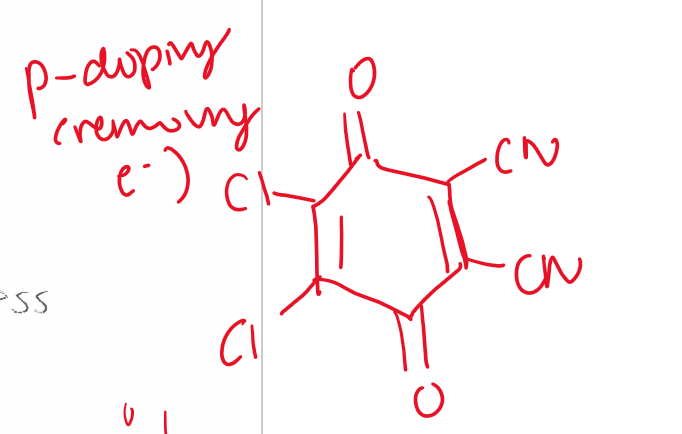
Why is this used as a p-dopant
its a strong electron acceptor, bc they pull electrons from donor molecules
Why PEDOT:PSS is used
PEDOT = conducting polymer
PSS = stabilising counterion/polymer.
Good conductivity
✅ Good transparency
✅ Good film formation
✅ Smooth surface
Useful because it:
improves hole injection
smooths rough ITO surface
improves device stability
whats host guest system
a semiconductor fluorescent /phosphorous.
what is charge recombination
where electron + hole meet in the emissive layer. electron comes from cathode→ LUMO. Hole comes from: anode → homo. When they meet: recombination occurs.
what happens during recombination
electron in lumo falls down to fill hole in homo. energy released as light or heat.
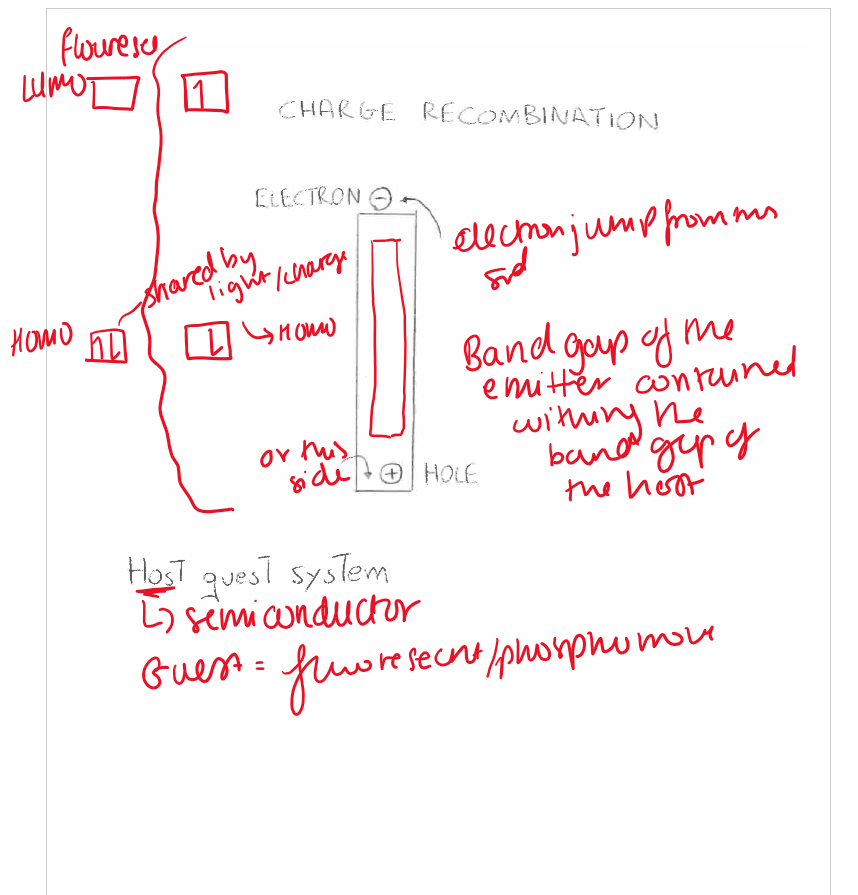
Why is light emitted?
Large gap:host band gap
→ high energy photon
→ blue light
Small gap: guest band gap
→ low energy photon
→ red light
What are PLEDs?
Polymer Light Emitting Diode, a type of OLED where the emissive layer is made from conjugated polymer
Why use polymers?
Polymers are attractive because they can be:
✅ Flexible
✅ Lightweight
✅ Cheap to process
✅ Solution processable
Why conjugated polymers?
Normal polymers are insulating.
Conjugated polymers conduct because they have:
alternating single + double bonds
This creates:
✅ Delocalised π electrons
✅ Charge transport
✅ Light emission
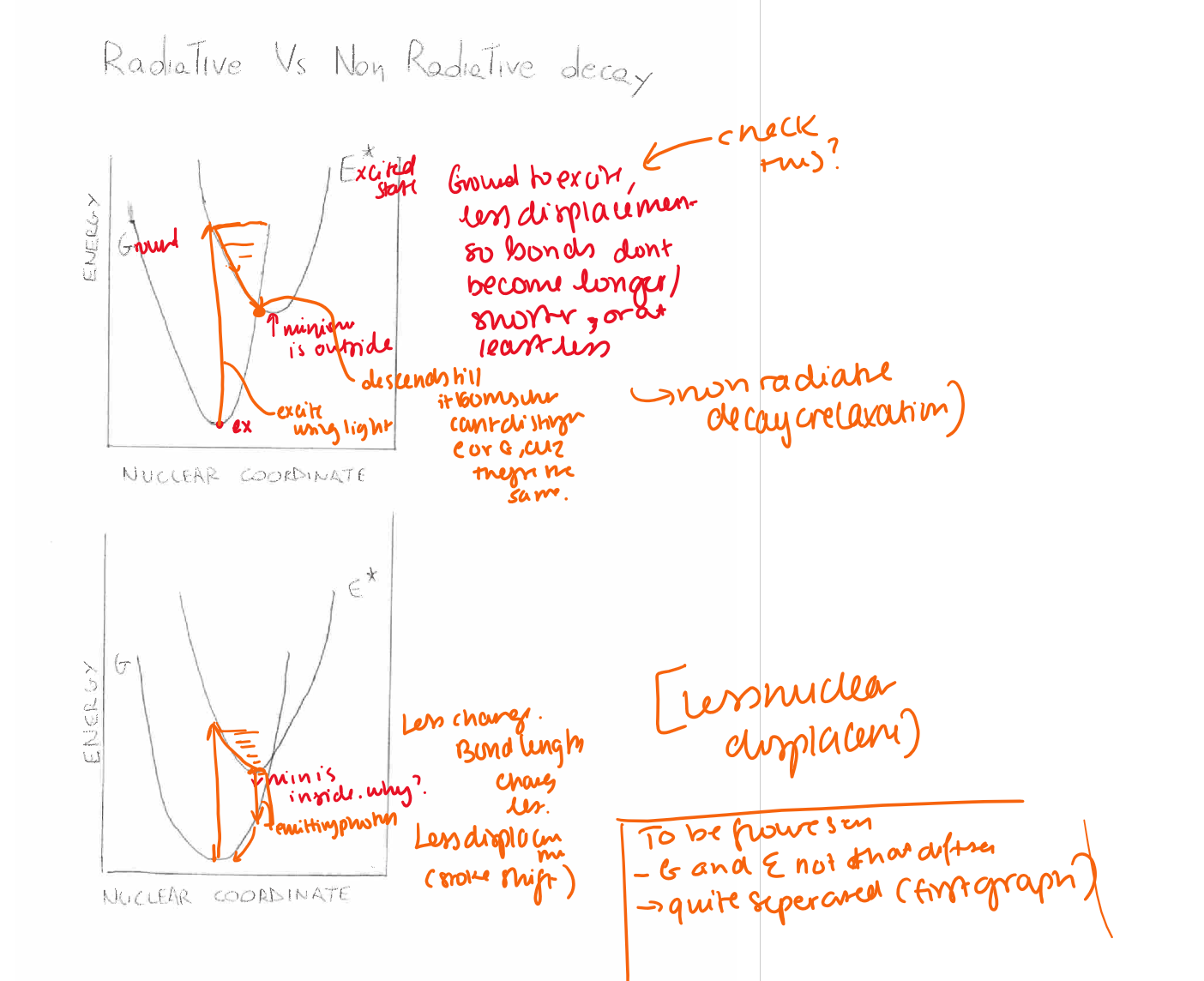
What is a configuration coordinate diagram?
A:
A configuration coordinate diagram plots:
Energy (y-axis)
vsNuclear coordinate (x-axis)
The nuclear coordinate represents changes in molecular geometry such as:
bond lengths
bond angles
atomic positions
It is used to visualise how molecules behave in the ground state and excited state, and whether relaxation occurs via radiative or non-radiative decay.
What is radiative decay?
Radiative decay occurs when an excited molecule returns to the ground state by emitting a photon.
General process:
excited state→ ground state + photon.
the released energy appears as light
in OLED, radiative decay is desirable because it contributes to luminescence and improves device efficiency.
What is non-radiative decay?
:
Non-radiative decay occurs when an excited molecule returns to the ground state without emitting light.
Instead, energy is lost as:
heat
vibrations
molecular motion
General process:
excited →ground state + heat
Non-radiative decay reduces OLED efficiency because energy is wasted rather than converted into light.
Why does large nuclear displacement favour non-radiative decay?
Large nuclear displacement means the molecular geometry changes significantly after excitation.
Examples include:
large bond stretching
major bond angle changes
structural rearrangement
This causes:
increased vibrational relaxation
greater energy loss as heat
easier crossing between excited and ground state surfaces
As a result, non-radiative decay becomes more likely.
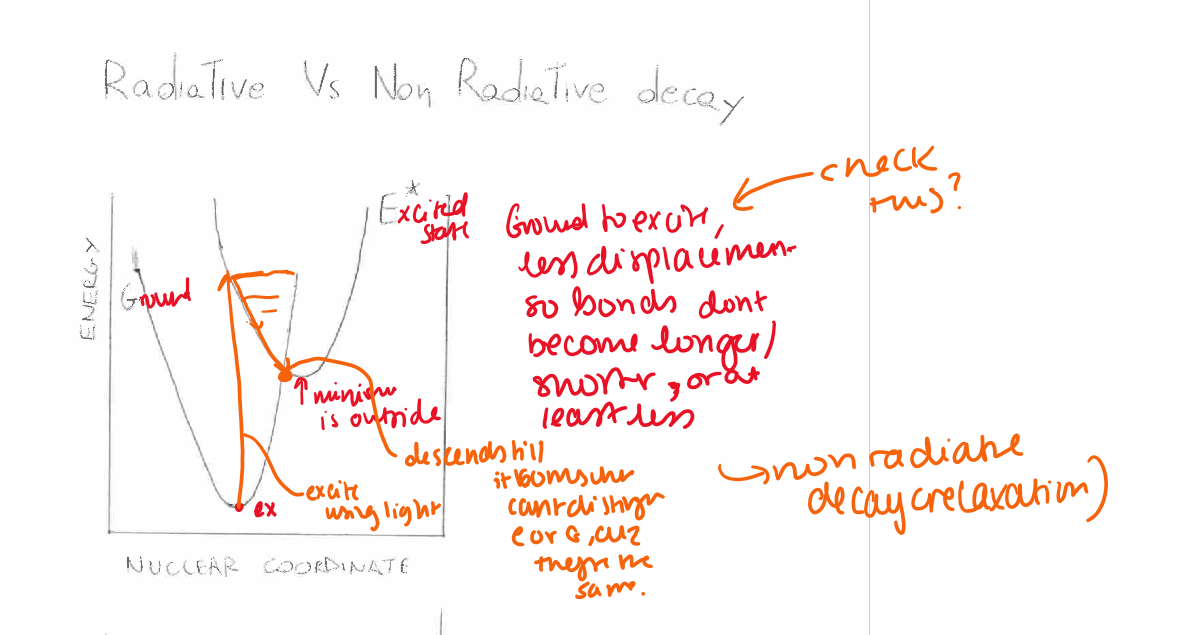
whats the left and right parabola
left is ground state, right excited state, the moving left or right is atoms physically shifting.molecule starts in ground minimum, vertical arrow shows absorption, called franck condon principle, electron move much faster than nuclei,so during excitation: electorn moves instantly, molecule in excited state but unstable, relaxes down the excited - state curves, this is vibrational relaxation, energy lost here as vibration .bc the excited state minimum shifted a lot to the right.
Because now the excited-state minimum is very far from ground-state minimum.
The molecule in excited state looks VERY different from ground state.
That means:
❌ big structural distortion
❌ lots of vibrational modes
❌ easier energy loss as heat
what is E* ≈ G.
When excited and ground state energies become similar: the molecule can “jump” between surfaces.
This jump happens without photon emission.
That’s:
Internal conversion / non-radiative deca
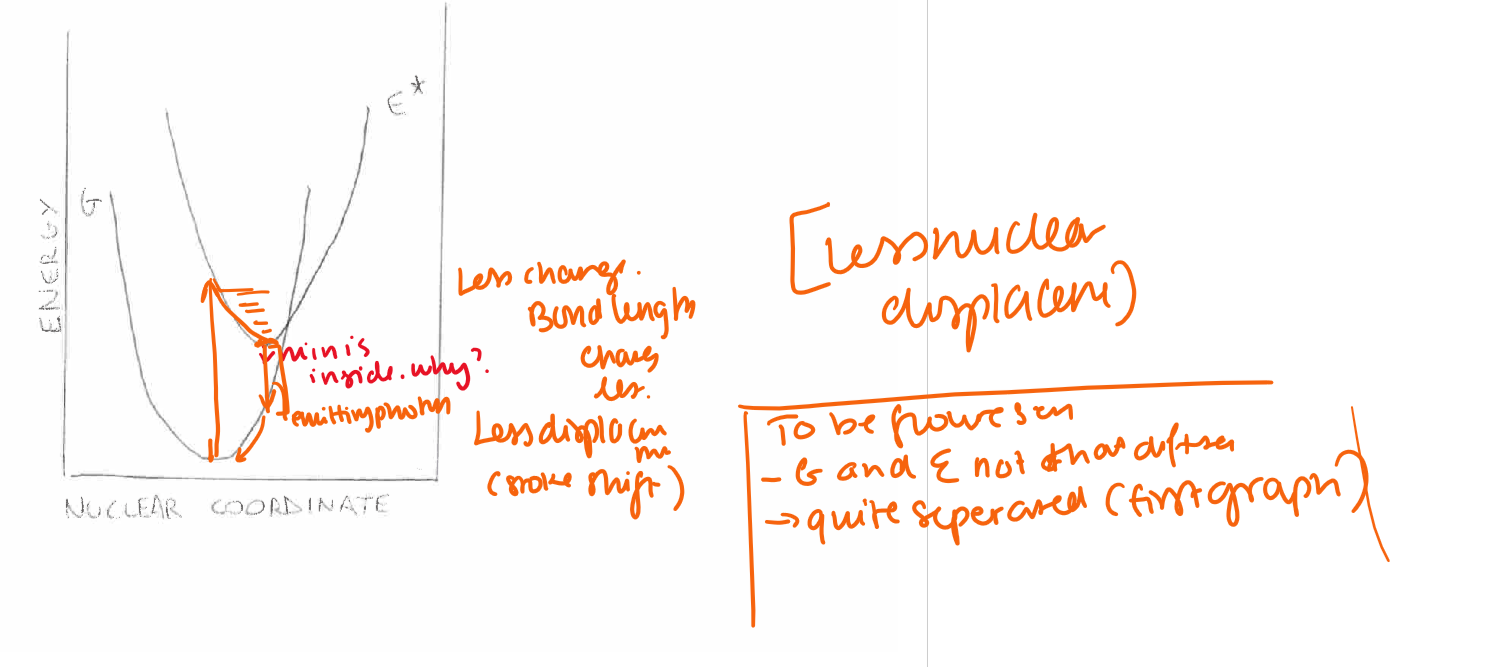
this is a radioactive decay, whats happening in it
At the bottom of the ground state curve (G), the molecule is at its most stable geometry.This is where the molecule naturally sits before excitation.The vertical arrow upward = absorption of energy.
Electron gets promoted to excited state.
Why vertical?
Because of Franck–Condon again:
electron moves instantly
nuclei don’t move during excitation
So geometry initially stays the same.
After excitation, molecule relaxes slightly down the excited-state curve.
This is vibrational relaxation.
Small amount of energy lost as heat.
ook at the minima of the two curves.
They’re much closer together.
That means:
Small nuclear displacement
Translation:
bond lengths don’t change much
geometry barely changes
excited molecule looks similar to ground state molecule
This is the key difference.
Instead of crossing to ground state through heat loss, the molecule relaxes by emitting a photon.
for spins you can get singlet and triplet when? in terms of arrow facing
singlet is when the arrows are pointing away from eachother, triplet is when theyre pointng in the same direction, these spins are the possible ways electron spin in combination in excited state
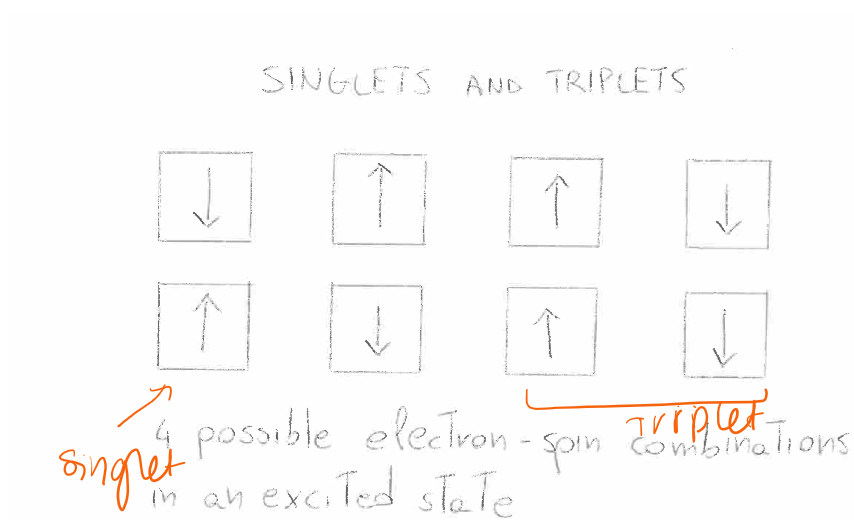
what spin is light and electricitiy
light is 100 percent singlet, electricity is 75 percent singlet 25 triplet
whats special about conjugate molecules in terms of light
conjugate length usually emit something like colours. the more conjugated something is, smaller the homo lumo gap→ longer the wavelength, small wavelength is high energy and vice versa
Benzene, talk about it in terms of conjugated and if its high or low energy
benzene has a small conjugated system, so the humo lumo gap is large, so the wavelength is small wavelength, so high energy (298nm)
what about biphenyl
youd expect large conjugation but because its not fully planar, the two rings twist, because the hydrogens clash at ortho positions, steric hinderance pushes it out of the plane,, so conjugation increase is still small (306nm)
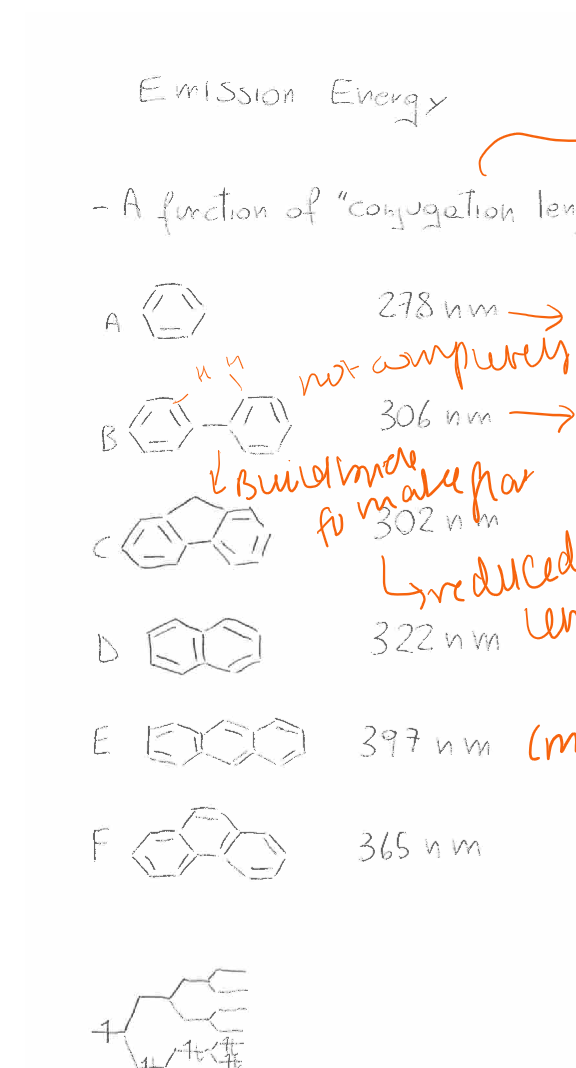
in this list below explain which one are better conjugated vs not
Not, so has high energy
A, B,C
has low energy to over come
D because RIGID
E because planar
F because fused rings/RIGID
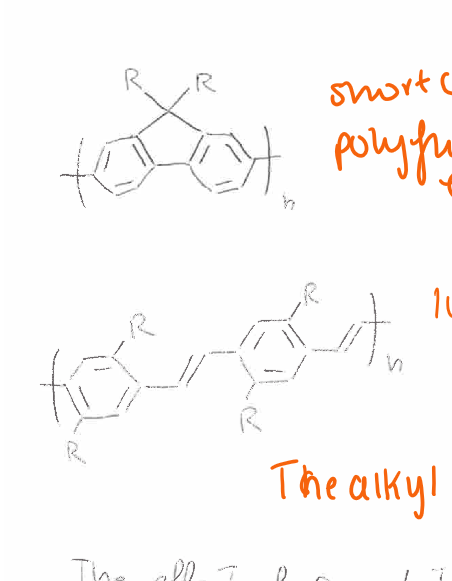
poliflourene and ppv emit different colour lights, can you find out which one and why
poliflourene, is fairly rigid, conjugated but less than pvv, because shorter conjugation, higher energy, so its blue light (380-500)
pvv benzene is connected by vinyl group, this makes conjugated longer, so smaller homo lumo gap, emits green light
R groups can change the substituents conjugation/planarity
what are the effects of substituents (alkyl, halogens)
alkyl are weakly donating, so it decreases the LUMO energy hap, decreasing the lumo and homo gap smaller.
Halogens like flourine however are electron withdrawing, decreasing the LUMO, reducing the homo lumo gap and increasing wavelength. electron donating decreases the homo, further acting same as ew
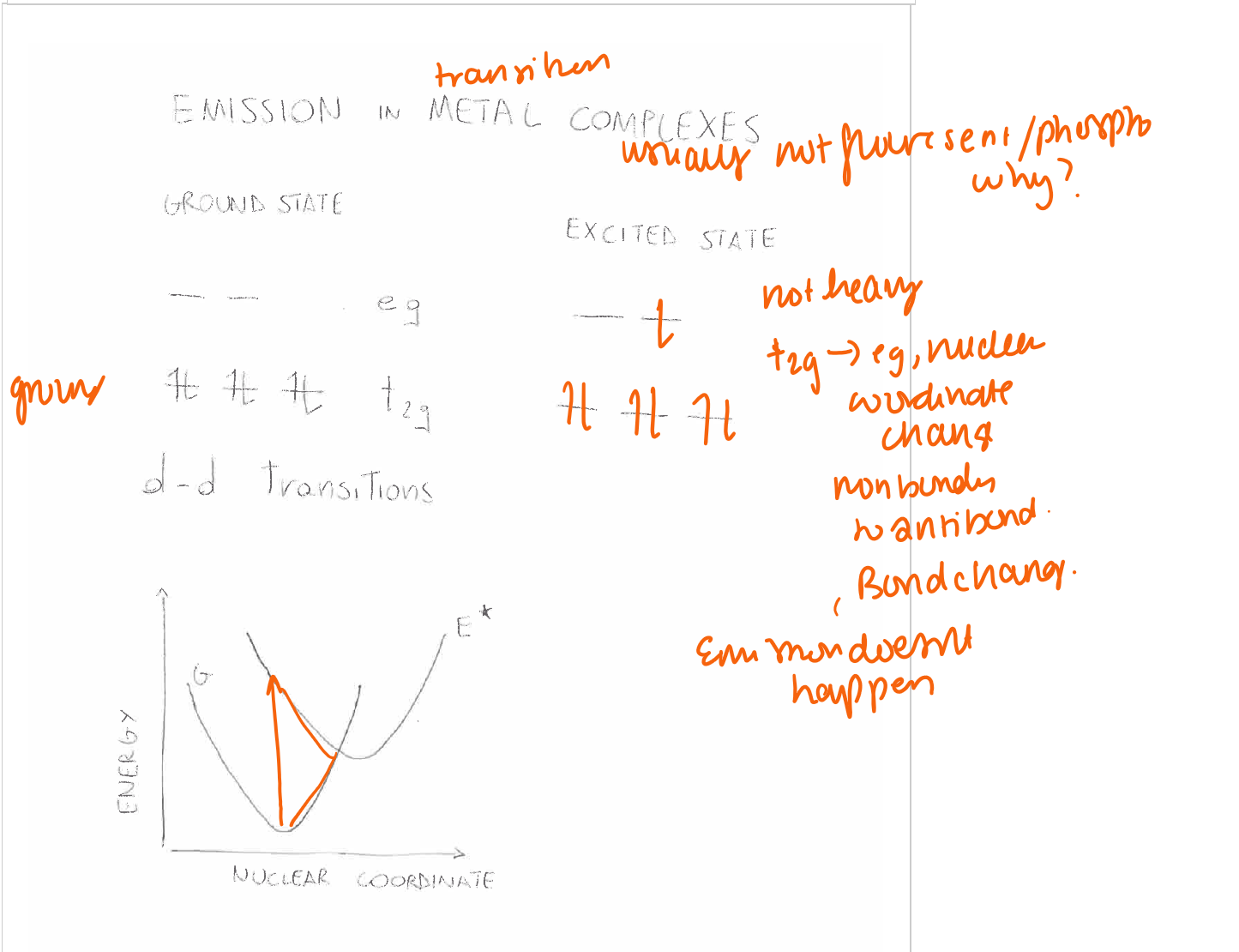
are transition metal (d systems0 aka metal complexes good or bad emittors
mostly are bad emittors, but some like Ir, Pt are amazing oled emittors
why are the d-d transitions usually bad
when filling a octahedral diagram most electrons are in t2g, which is lower energy, thats ground state when one metal gets promoted, one goes to eg this is the d-d transition, eg is antibonding, so its bad for bonding, so if electron goes to eg, metal ligand repulsion increases, bonds weaken, bond length increases
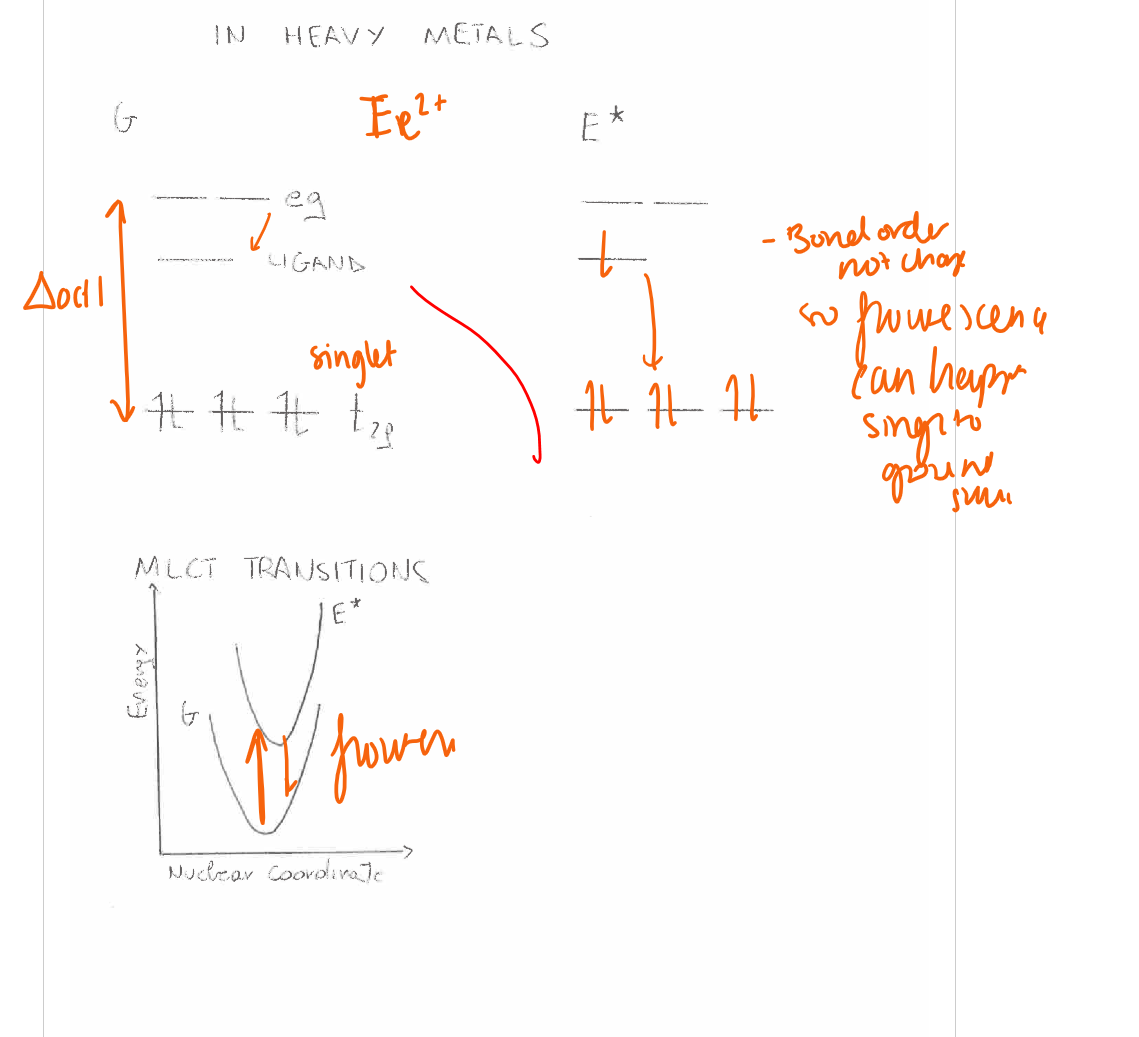
why are heavy metal good emitors in terms of their electron
All electrons paired in t₂g.
Low-spin d⁶.
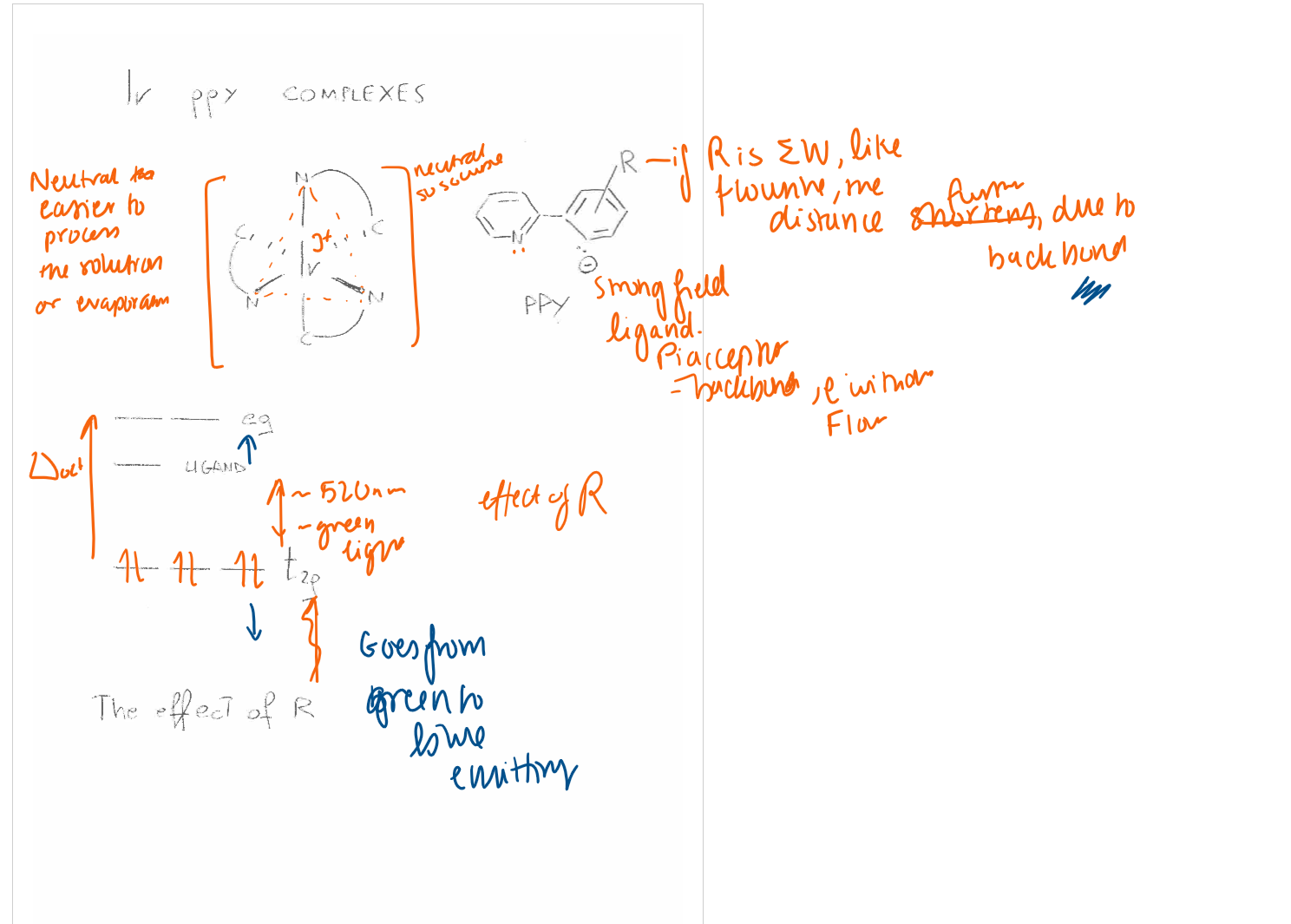
Ground state is stable.MLCT = Metal-to-Ligand Charge Transfer occurs where electron moves from metal (t2g) to ligand (pi *)
mlct is better than d-d because d-d goes to eg which is antibonding,, bond order doesnt change because theres small nuclear displacement, so ground and excited minima is close,
heavy metals are like this IR,plt, osmium have a strong spin orbit coupling, makes spin forbidden and transition easier so singlet and triplet electron mixing happens easier
with IR ligand specifically PPY. it emits green but how can it also emit blue
the aklykl groups on PPY , if ew like flourine, it can pull eg and t2g gap further away, making shorter homo lumo gap, and shorter wavelength and making blue usually mlct
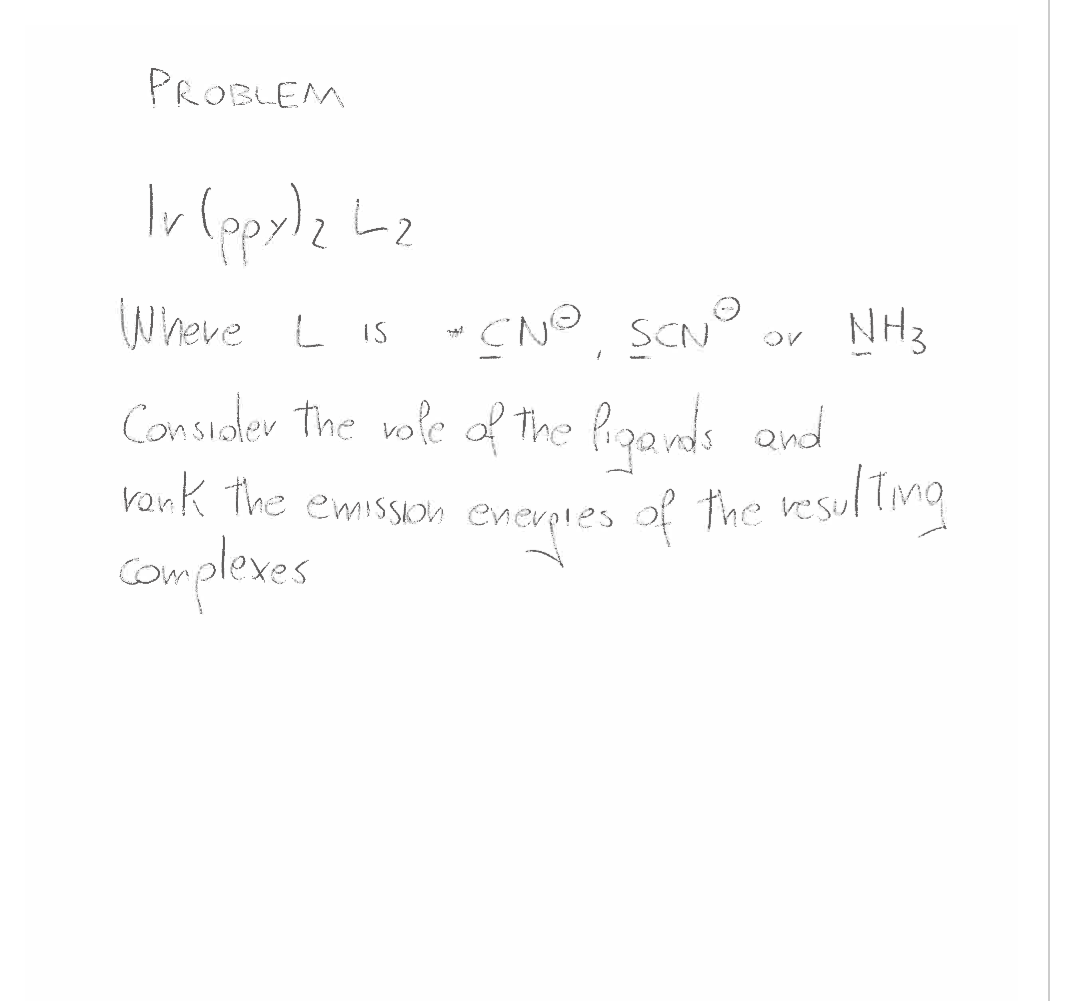
ligand field strength SCN⁻ < NH₃ < CN⁻ weakest to strongest
so best emitting is the other way around, so cn becomes blue, cuz strong emitting is loweer lumo homo gap, and then nh3 is greenish, scn is green