Chapter 2: Plate Tectonics
 Call Kai
 Learn
Learn Practice Test
 Spaced Repetition
 Match
Match Flashcards
 Knowt Play
1/68

There's no tags or description
Looks like no tags are added yet.
Name | Mastery | Learn | Test | Matching | Spaced | Call with Kai | Chat |
|---|
No analytics yet
Send a link to your students to track their progress
69 Terms
Theory of plate tectonics is centered on
crustal movement, crustal deformation and mountain building
founder of geology
envisioned internal heat engine causing upheaval of earth’s crust
James Hutton
paleontologist and geologist
warping of crust makes mountains
James Hall
geologist
shrinking earth caused crust to bend and form mountains
JD Dana
thought earth had been cooling since its formation
planet contracts → surface wrinkles
traverse forces push continental crust sideways
Edward Seuss
Who proposed continental drift?
Alfred Wegener
Continental drift theory
continents used to be the supercontinent Pangea
Alexander (AL) Du Toit; there were two primordial continents:
Laurasia (north) and Gondwana (south)
What is the fossil evidence for continental drift
some fossils from completely different continents were very similar to each other
How do rocks support continental drift?
rocks on opposite sides of the ocean match each other
2 pieces of evidence for past glaciation
glacial deposits
grooves in bedrock
Where were glacial deposits found in?
South America, Africa, India, Australia
Paleomagnetism
study of magnetic property of ancient rocks
Paleoclimate evidence for continental drift: ancient rocks and fossils don’t match their current climate. What are some examples of this?
coal in antarctica
coral reefs in Greenland
glacial deposits in Sahara Desert
What are the 2 components of magnetism?
inclination: horizontal swing
declination: tilt of magnetization
What is declination in a magnet?
compass points to magnetic north
What is inclination in a magnet?
the angle compass makes with earth’s surface, function of latitude
T/F: Magnetic minerals settling through water column become aligned with earth’s magnetic field
true
T/F: Magnetic minerals in volcanic rocks record the direction of Earth’s magnetic field at the time the lava flow crystallized
true
Did magnetic poles wander or did the continents?
the continents
The following characteristics represent what?
deep trenches
immense fracture zones
submerged volcanoes
submarine ocean ridges (mid-ocean ridges)
bathymetry of seafloors
The following are chracteristics of:
extend the length of ocean basins
can be hundreds to thousands of kilometers long
mid ocean ridges
What are mid-ocean ridges?
submarine hot springs where seawater is discharged
Where is the mid-Atlantic ridge exposed above sea level?
Iceland
Ophiolite
slices of oceanic crust “shoved up” on land
Ocean Drilling Project (ODP) did what?
recover cores of oceanic lithosphere from over 2000 sites globally
What is bathymetry?
Measuring the depth of water in oceans, lakes, and other bodies of water
What is a mid-ocean ridge?
A long mountain range on the seafloor created by lava eruptions through earth
How long do mid-ocean ridges extend?
extend entire ocean basins, can be hundreds to thousands of kilometers long
sites of numerous submarine hot springs where heated water is discharged
Mid ocean range (book def)
What is convection?
The transfer of heat from one place to another through heat or gas movement
Why does hot air rise and cool air sink?
hot air has less density than cool air/cool air has more density than hot air
Who proposed that thermal convection was the driving force behind continental drift?
Arthur Holmes
Who proposed that convective motion of the mantle created and transported oceanic lithosphere?
Harry Hess
What do transform boundaries do in ocean basins?
join two segments of mid-ocean ridge
How are mid-ocean ridges broken apart?
by transform faults and fracture zones
What is paleomagnetism?
The direction of Earth’s magnetic field at the site and time of eruption
When lava erupts and cools down, it… (deals with magnetism)
records the direction of the magnetic at the time (normal/reversal)
Where does the youngest oceanic lithosphere occur?
mid-ocean ridges (ridge axis)
Where does the oldest oceanic lithosphere occur?
progressively further away from mid-ocean ridges and towards the margins of the continents
Hot conduits of bouyant mantle rising towards the surface
mantle plume
What can a mantle plume form? What is the most famous example?
hotspots and volcanoes, Hawaiian islands
Is the oldest or youngest island over a hotpot?
youngest (ex: Hawaii island)
What is the Wilson Cycle?
magma rises beneath continental mass —> lifts lithosphere and produces cracks where magma flows outward —> forms rift valley —> rift is flooded by the sea and becomes ocean floor —> ocean floor spreads —> oceanic lithosphere subduct beneath continent’s edge —> ocean closes —> continental masses come together
T/F: Mid-ocean ridges are perpendicular to the direction of seafloor spreading
False (they run parallel)
T/F: Transform faults are oriented parallel to the direction of seafloor spreading
true
T/F: Magnetic stripes are parallel to mid-ocean ridges
True
T/F: In moving farther away from a hot spot, volcanoes become progressively younge
False
T/F: Deep-sea sediment that accumulates on the seafloor is thickest along mid-ocean ridges and becomes thinner when moving farther away from the ridge axis
False
What are the 3 types of plate boundaries?
divergent, convergent, transform
Divergent boundaries are also called ___________ boundaries. They do what?
constructive; move apart from one another (can create subduction zones)
Convergent boundaries are also called ___________ boundaries. They do what?
destructive; collide with each other
Transform boundaries are also called ___________ boundaries. They do what?
lithosphere conserved; slide past one another
Where are active volcanoes and recent earthquakes located?
edge of continents
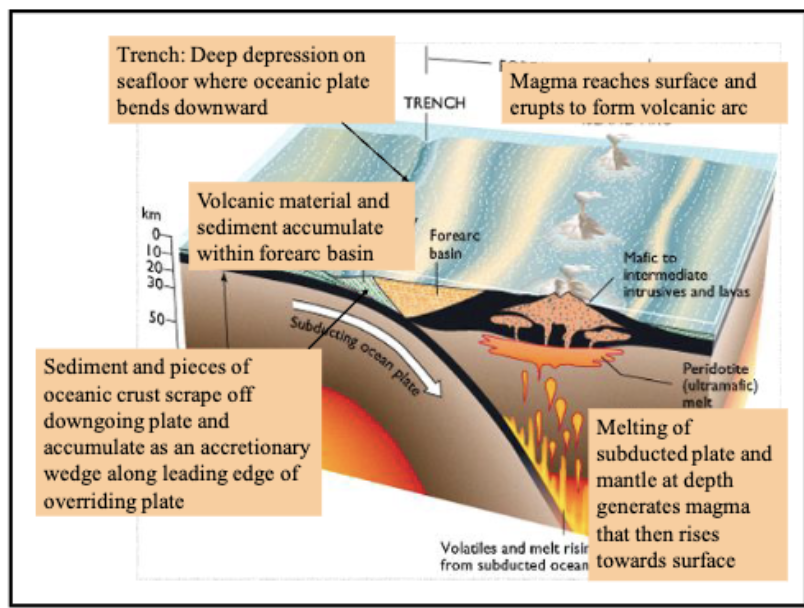
4 parts of a subduction zone
trench, accrectionary wedge, forearc basin, volcanic arc
3 types of convergent plate boundaries
ocean-ocean, ocean-continent, continent-continent
ocean-ocean convergence
ocean lithosphere subducts beneath another oceanic plate
ocean-continent convergence
ocean lithosphere subducts beaneath continental lithosphere
continent-continent convergence
two continental plates collide
what is ocean-ocean convergence chracterized by?
linear chain of volcanoes called island arcs (Aleutian Islands)
Example of ocean-continent convergence?
Andes Mountains
Example of continental collision?
India (40 million years ago)
Assemblage of micro-continents, volcanic arcs, and crustal fragments
Collage tectonics
Blocks of crust added to a land mass at a convergent plate boundary
accretion/accreted terranes
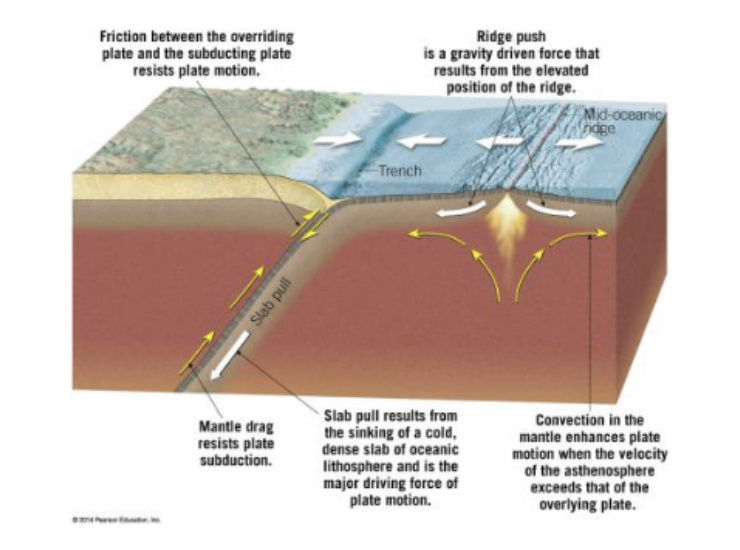
4 driving forces for plate tectonics
slab pull, ridge, push, whole mantle convention, layer-cake convection
cold, dense tectonic plate sinks into mantle at subduction zone
slab pull
ridge push
a gravity driven force that results from elevated position of the ridge
whole mantle convection
cold oceanic lithosphere sinks, hot mantle plumes rise
Two disconnected convective layers; upper layer driven by descending cold lithosphere and ascending hot lower layer
layer cake model