Adaptive deformable mirror
 Call Kai
 Learn
Learn Practice Test
 Spaced Repetition
 Match
Match Flashcards
 Knowt Play
1/15

There's no tags or description
Looks like no tags are added yet.
Name | Mastery | Learn | Test | Matching | Spaced | Call with Kai | Chat |
|---|
No analytics yet
Send a link to your students to track their progress
16 Terms
fitting error
residual wavefront error that remains because the deformable mirror, with its finite number of discrete actuators, can only approximate the true shape of the distorted wavefront
temporal error
residual error that remains because the atmosphere keeps changing while the AO system takes a finite amount of time to measure and correct it
deformable mirror design
→ large number of actuators, high control bandwidth, low total power dissipation

deformable membrane
→ low mass, low out of plane stiffness, low actuator force, low power dissipation
influence function
how much the membrane deforms in response to a single actuator being pushed
coupling
relation between mirror membrane stiffness and actuator stiffness
lower coupling == good (more control)
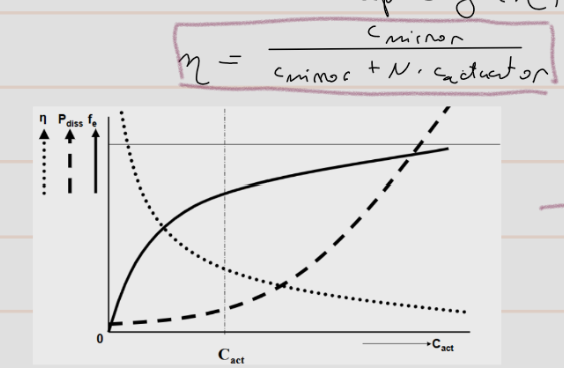
actuator plate goals
low power
extendable to large grids
no hard points if one should fail
actuator plate - concept 1
→ reluctance actuator
magnetic force=srping force
different => net residual parasitic stiffnes that needs to be balanced
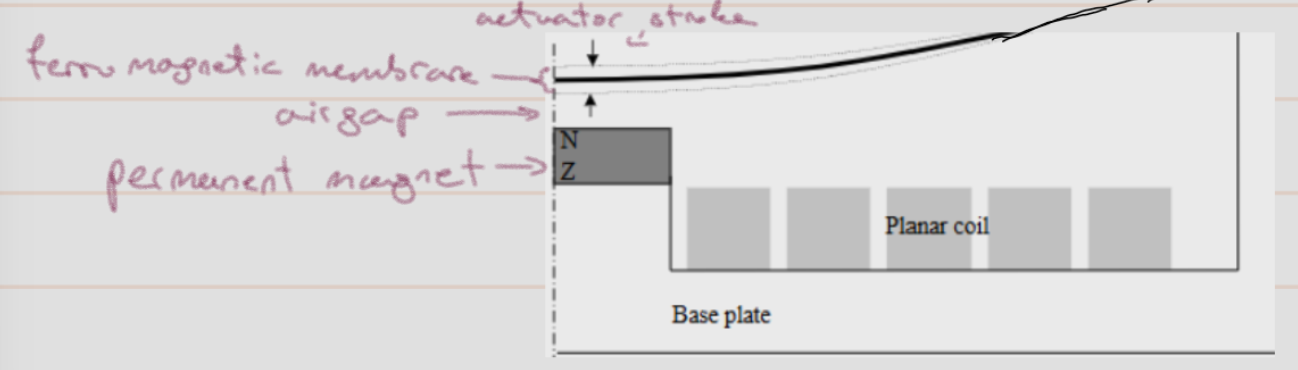
(non) linear stiffness of the actuator membrane with uniform thickness
linear stiffness has cubic dependence on thickness
non-linear term due to non-linear force displacement relationship
→ tune unifrom thickness to manipulate force-displacement
Explain the saturation problem in cocept 1.
To avoid saturation: increase the inital gap and change magnetic material. Improvement, but only a few suitable combinations and combinations are very sensitive.
→ a non-saturated magentic design will result in high parasitic stiffness and hig I_rms and P_rms
→ a mechanical design with low parasitic stiffness will result in a saturated magnetic circuit
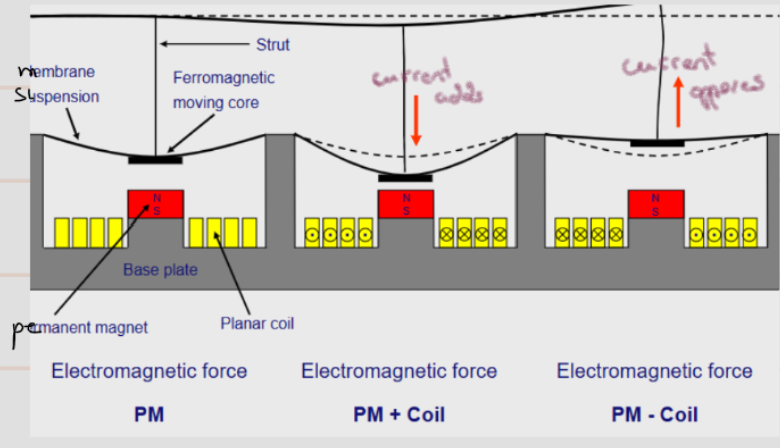
Solution: separation of the magnetic circuit and actuator stiffness in a new actuator design
actuator plate - concept 2
→ variable reluctance actuator - the coild current can add or subtract the permanent magnet’s force, modulating the net force on the moving ferromagnetic core, separated membrane suspension and ferromagnetic core
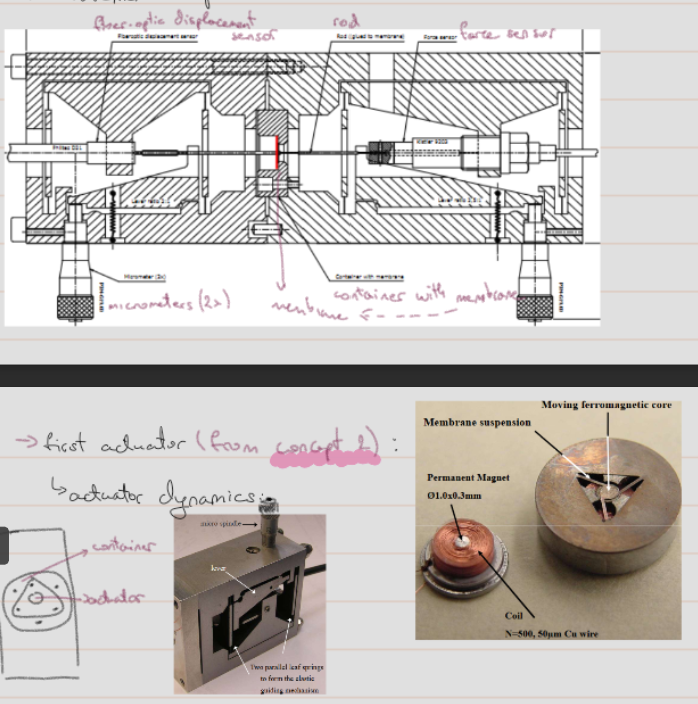
membrane stiffness measurement
measurement of the non-linear stiffness of the membrane suspension
measurement of the dynamic properties of the actuator
*mismatched between measured and predicted f:
stiffness too low
magnetic force lower than expected
measurement of the PM properties
with a Helmholts coil setup couple to a commercial flux matter
fast and reasonably accurate
no desctructive external magnetic field applies
measurement system and measurements are low cost
→ 2 coils in series, magnet causes a flux change, output depends on volume, shape and relative permeability
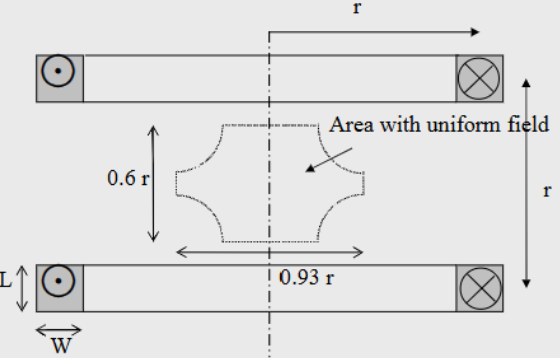
actuator measurements
measurement of each actuator in the grid (f, F, c, motor constat, I, R as a funciton of the position)
spreading in the grid
→ are all actuator consistent with each other
mirror actuator connection
through rods
Is the mirror usable? - raw data correction
correct for the low spatial frequencies
fitting with the analyticla influence function
end up with the non-correctable error