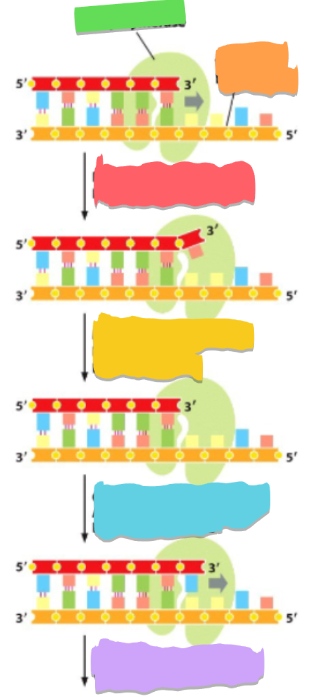
DNA Replication
 Call Kai
 Learn
Learn Practice Test
 Spaced Repetition
 Match
Match Flashcards
 Knowt Play
1/55

There's no tags or description
Looks like no tags are added yet.
Name | Mastery | Learn | Test | Matching | Spaced | Call with Kai | Chat |
|---|
No analytics yet
Send a link to your students to track their progress
56 Terms
Remember: DNA -(__)--> RNA -(__)--> protein
I– (__) -> DNA
transcription, translation
replication
DNA makes __ makes __
RNA : protein
RNA->DNA? __
Rare (viruses)
Protein->RNA: __
no


Associated with cell division, either __ (production of two daughter cells) or __ (produces gametes like sperm and egg cells)
mitosis : meiosis
Bases are ALWAYS added to the _’-end of the DNA strand
3

Remember: DNA is a __ strand
double
__: The synthesis of RNA molecules using DNA as a template. The three main types of RNA in the cell are:
Transcription
The three main types of RNA in the cell are:
I. __ RNA (__): Used as template for translation
II. __ RNA: (__): Component of the ribosome. Protein/RNA complex responsible for translating nRNA to proteins
III. __ RNA (__): bind activated amino acids and bring them to the ribosome to make proteins
Messenger : mRNA
Ribosomal : rRNA
Transfer : tRNA
__: Synthesis of polypeptides (proteins) from mRNA templates (strands)
Translation
Proteins: Key functional units that carry out the vast majority of cellular functions, __ transcription and translation
including
Proteins are composed of __
amino acids (AA)


Each DNA strand of a double helix is an exact __ to the other (recall 5’ to 3’ anti-parallel structure)
complement
During replication each strand can therefore acts as a __
template

DNA replication is __, which means each ‘daughter’ molecule contained one of the parent strands
semi-conservative

DNA double helices are stable and difficult to break apart without extremely hot temperatures (near __)
boiling
How are they split apart during cell replication at ‘normal’ cell temperature (e.g. 37C)?!
-Answer: with specialized __, and with the fact that the hydrogen bonds between each base pair are relatively weak by themselves
enzymes
The sum of many __ gives the overall stability to double-stranded DNA
hydrogen bonds
The positions where DNA is first opened are called __
These origins are approximately __ bp long
replication origins
100
Replication origins are typically enriched with A-T base pairs. Why A-T?
-Answer: A-T pairs share only __ hydrogen bonds, where G-C pairs share three hydrogen bonds; the A-T pairs are therefore easier to split apart
-two : three
Bacteria usually have a __ origin of replication (ORI)
single

The human genome has ~ __ ORIs
10,000
DNA molecules in the process of replication from Y-shaped junctions called __
replication forks
Two forks are formed at each origin that unzip the DNA in opposite directions, which is referred to as __
bidirectional replication
The forks move at a speed of __bp/sec in bacteria and __bp/sec in humans and other eukaryotes
1000 : 100
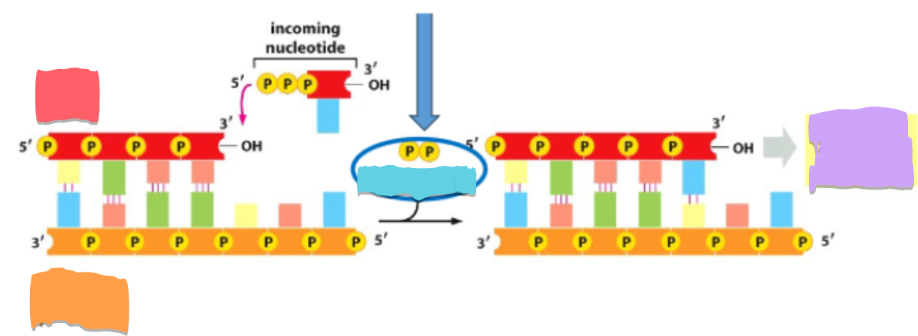
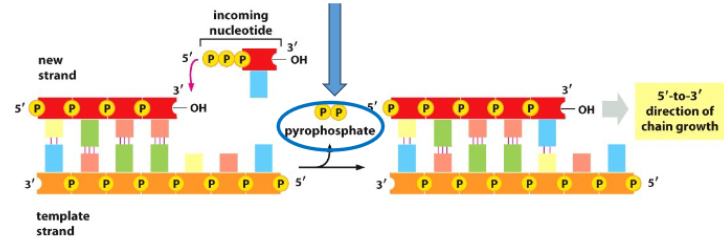
___ catalyzes synthesis of ne DNA strand
-It moves in the __ direction of the __, adding only to the 3’ end of the growing strand
-Nucleotides are added as nucleoside triphosphates, and release __(PPi) during the addition
DNA polymerase
-5’ to 3 : NEW STRAND
-pyrophosphate
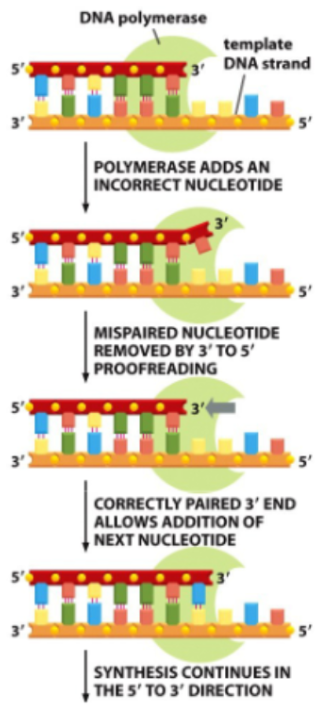
Nobody is perfect: DNA polymerases make about 1 mistake per __ bases incorporated
10^9
__: 3’-5’ exonuclease activity of the polymerase = If the base was a mismatch, polymerase chops it off
Proofreading
The Replication is __
Asymmetrical
DNA polymerase can easily extend one of the new strands (__) into the replication fork, but not the other
leading strand
The ___ needs to be ‘back-stitched’ by growing discontinuously. The discontinuous pieces are called ___ fragments
lagging strand. Okazaki


Lags Behind: Top red
Mechanism of Lagging Strand Synthesis
___: __DNA to start replication
The —— need to be replaced by DNA
RNA primers are __ away and the gaps they leave behind are filled by a polymerase
The nickels are sealed by a ___
RNA Primer
digested
ligase


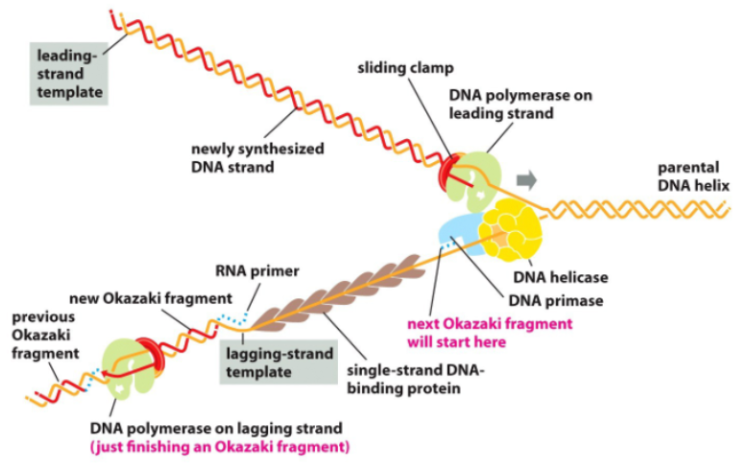
__ + __: Open the double strand
Helicase + Topoisomerase
__: Adds RNA primer for polymerase
Primase
__: Extends DNA and proofreads the new strand
Polymerase
__: Allows Polymerase to slide down the DNA
Sliding Clamp
__: Joins the Okazaki fragments together
Ligase
__: Nucleases removes RNA primer and a repair polymerase fills in the gaps
Helpers
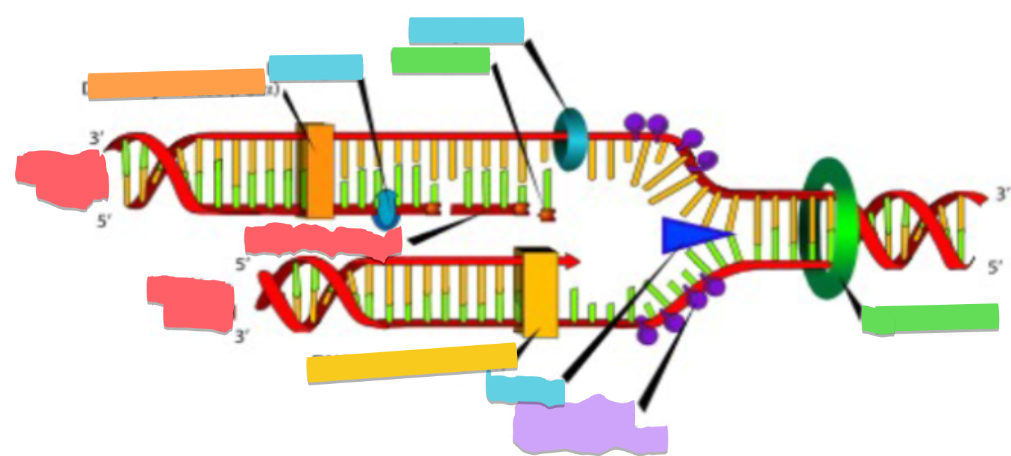

DNA helicase:
-An enzyme that spends energy (__) to unwind the double-strands
-Helicase facilitates the unwinding of the DNA, (___ handles the torsion from the unwinding). Helps __ the DNA
-ATP
-topoisomerase : unwinding
Single-Strand DNA binding proteins:
-Work with helicase from the origin of replication (ORC)
-Both strands are kept separated by single-strand binding proteins
-Target single-stranded DNA and prevent the formation of the . Keeps the DNA
double helix : single-stranded
The polymerases that are used for replicating chromosomal DNA have two main functions:
-__ new strand
-__ the product
-Synthesizes
-Proofreads

DNA polymerase cannot initiate a new strand of DNA- it needs a starter template, otherwise known as a __
primer
An enzyme called __ is able to create a short primer (made from RNA) based on the DNA template
primase
RNA is very similar to DNA expected the sugar is __ instead of deoxyribose
-Also, RNA does not contain thymine (T), instead it uses __(U)
-The __ bond behaves the same way as the __ bond
ribose
-uracil
- A-U : A-T
___ is primed once, __ is primed for each Okazaki fragments
-Primes DNA for __ by attaching small RNA “primers”
Leading strand : lagging strand
-Polymerase
The lagging strand made from discontinuous Okazaki fragments requires __ additional enzymes to form a continuous stretch of DNA
__- separates the DNA from RNA
__ - replaces RNA with DNA
__- joins the DNA fragments together
three
nuclease
Repair polymerase
DNA ligase
DNA polymerase makes about 1 error every __ nucleotides
-Eros are corrected as they occur in a process known as __
-The removal of erroneous nucleotides is performed by __ domain of the polymerase, which works in the 3’-5’ direction
10^7
-proofreading
-nuclease