calc 1 review
 Call Kai
 Learn
Learn Practice Test
 Spaced Repetition
 Match
Match Flashcards
 Knowt Play
1/59

There's no tags or description
Looks like no tags are added yet.
Name | Mastery | Learn | Test | Matching | Spaced | Call with Kai | Chat |
|---|
No analytics yet
Send a link to your students to track their progress
60 Terms
sinx right angle definition
opposite/ hypotenuse
cosθ right triangle definition
adjacent/hypotenuse
tanθ right triangle definition
opposite/adjacent
cscx right triangle definition
hypotenuse/opposite
secθ right triangle definition
hypotenuse/adjacent
cotθ right triangle definition
adjacent/opposite
domain of y=sin⁻¹x
[−1,1],
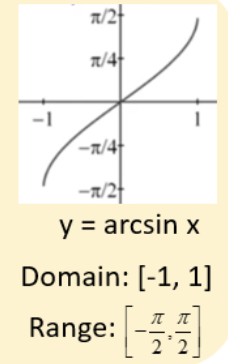
range of y=sin⁻¹x
[-π/2, π/2]
domain arccosx
[-1,1]
![<p>[-1,1]</p>](https://assets.knowt.com/user-attachments/64d5caba-30a4-4171-8ebd-d9125a9e43a8.png)
range arccosx
[0,π]
![<p>[0,π]</p>](https://assets.knowt.com/user-attachments/bd8089ac-3d31-4b73-8ef7-a933ccb9c111.png)
cscθ reciprocal identity
1/sinθ
secθ reciprocal identity
1/cosθ
of the trig functions, which are odd and even?
all trig functions are odd EXCEPT for:
cosθ
secθ
sec(-θ)=1/cosθ
sin²θ + cos²θ =
1
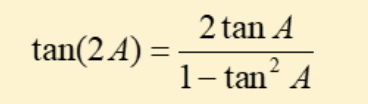
tangent double angle formula
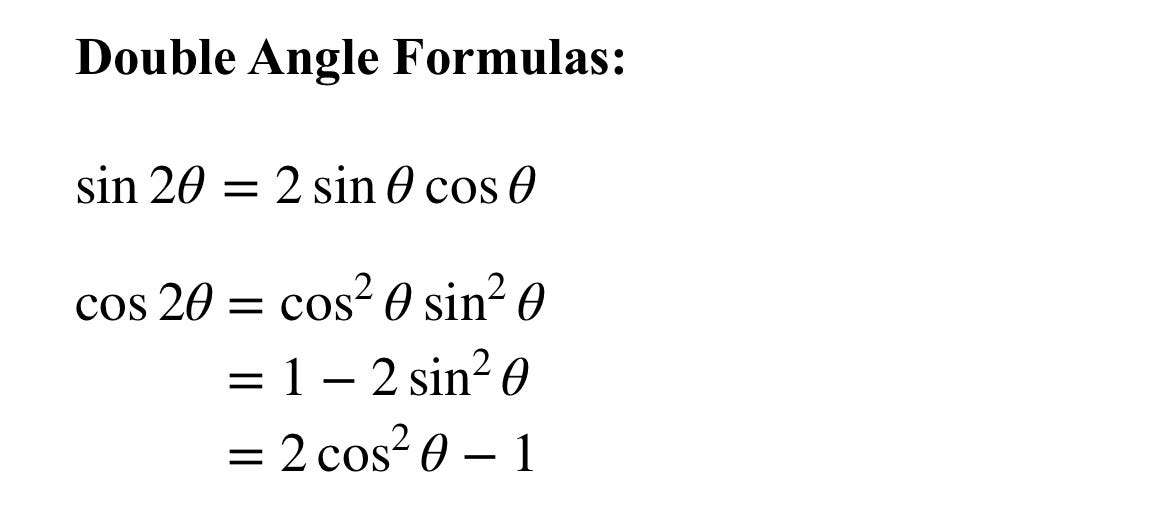
sin(2θ) double angle formula
sin(2θ)= 2sinθcosθ
cos(2θ) double angle formula(s)
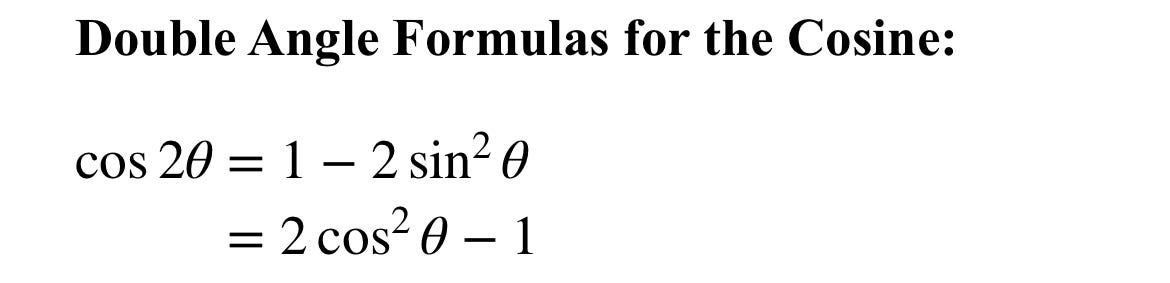
double angle formulas
Double-angle formulas are trigonometric identities that show how to find the trig values of twice an angle (2θ) using the single angle (θ)
half angle formulas
used for finding the exact value of trig function for a value that is not on the unit circle (e.g finding 15º when 30º exists)
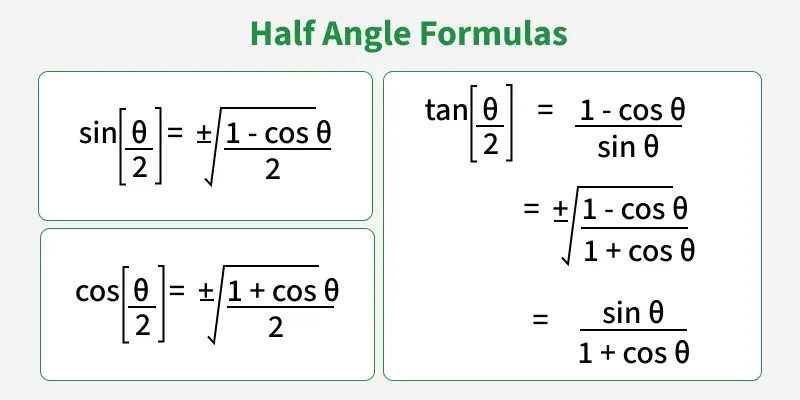
sin(θ/2) and cos(θ/2) are the same ±√(1±cosθ)/2, only numerator of sin is 1-cosθ
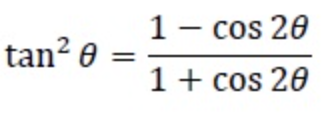
power reducing formula tan
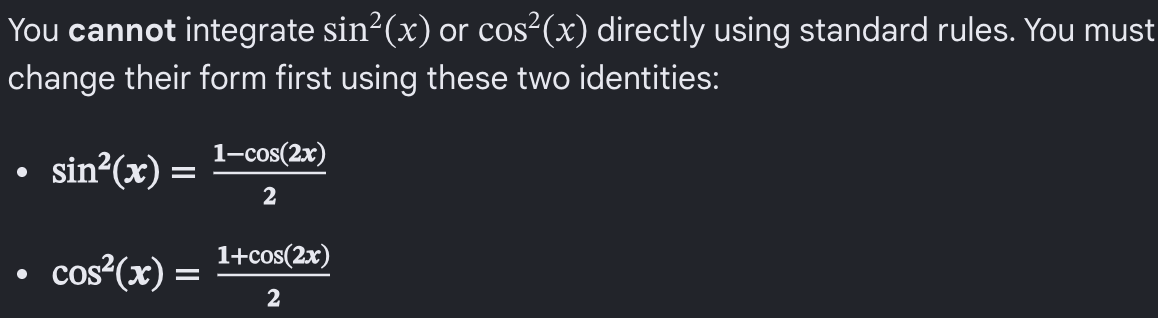
power reducing formula sin and cos
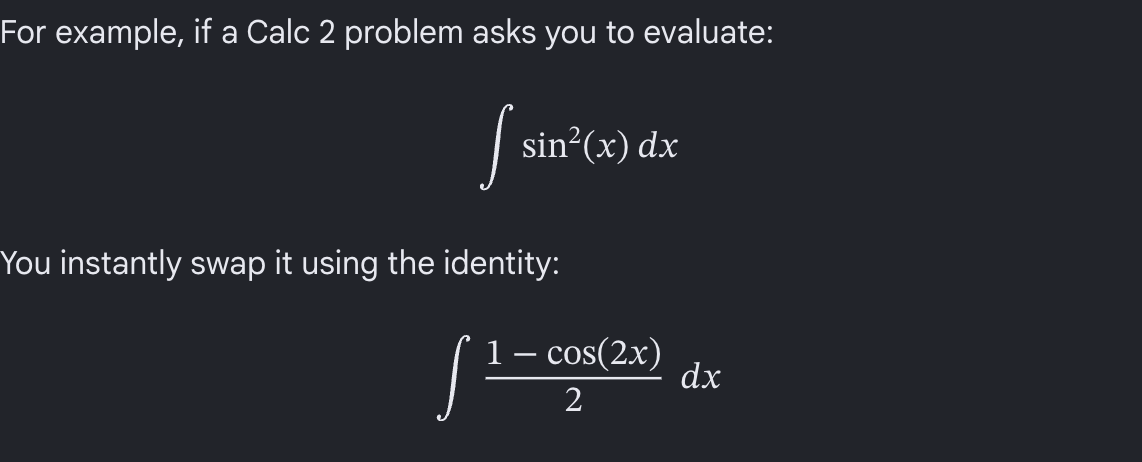
tangent half angle formulas
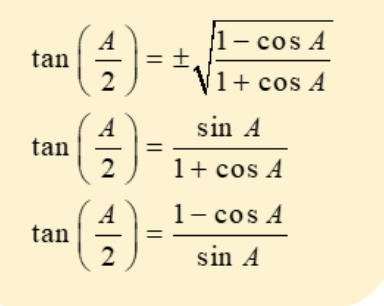
tan²θ + 1 =
sec²θ
1 + cot²θ =
csc²θ
chain rule
used for differentiating composite functions (functions within functions). If you have a function y=f(g(x)), the chain rule states:
dx/dy=f ′ (g(x))⋅g ′ (x)
Derivative of the outer function (evaluated at the inner function) multiplied by the derivative of the inner function.
power rule
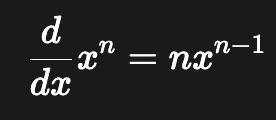
Differentiating functions of the form f(x)=xⁿ, where n is a real number.
differentiating a constant
0
because no change shawty
![FREE] Graph the equation y = 2. - brainly.com](https://us-static.z-dn.net/files/db3/00eba592fe9e73f2e877d6386c07b654.png)
product rule

used for differentiating products of two functions.
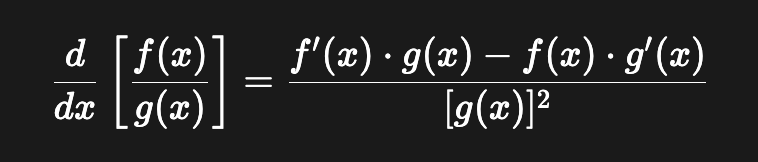
quotient rule
use for Differentiating ratios of two functions
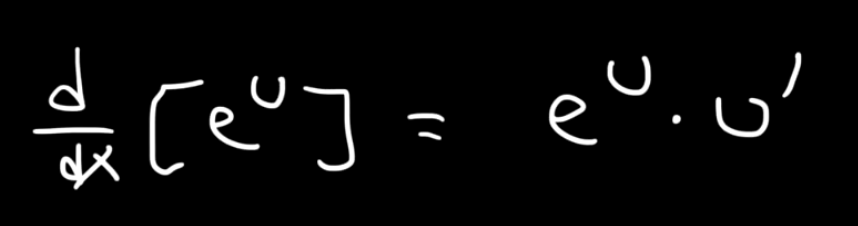
base e exponential derivative rule
essentially the chain rule
non base e exponential derivative rule
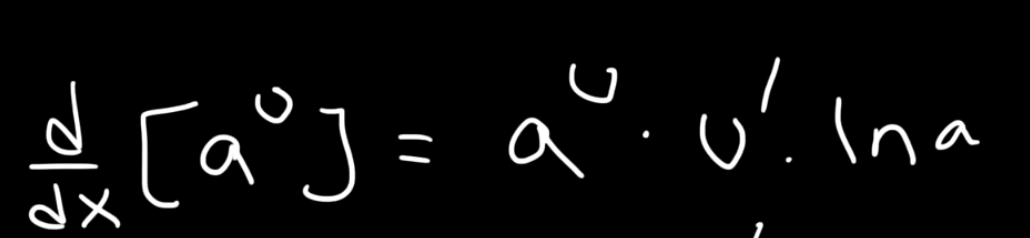
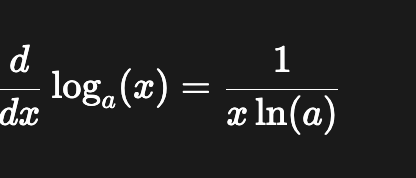
derivative of a logarithm rule
derivative of sinx
cosx
derivative of cosx
-sinx
derivative of tanx
sec²x
derivative of cotx
-csc²x
derivative of secx
secxtanx
derivative of cscx
-cscxcotx
domain of arctan
all real numbers
(-∞,∞)
range arctan
(-π/2,π/2)
NOT INCLUDING**
derivative of arctan
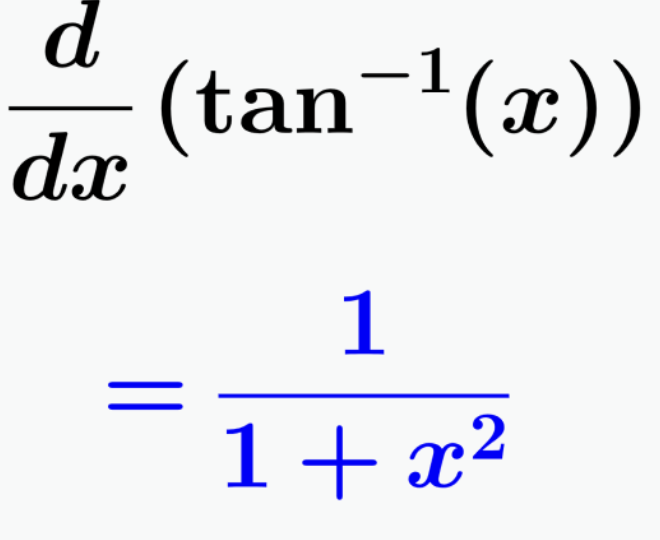
derivative of arccot is the same thing but negative -1/(1+x²)
derivative of arcsin
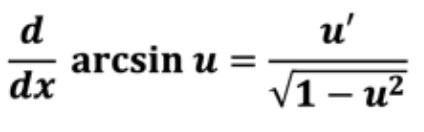
arccos is the same thing but negative -u’/√1-u²
derivative of arcsec
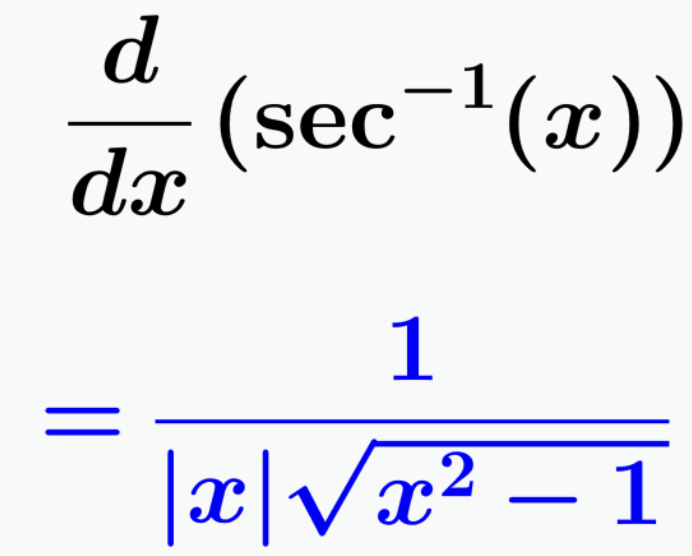
arccsc is the same but negative
how many antiderivatives of a given function are there
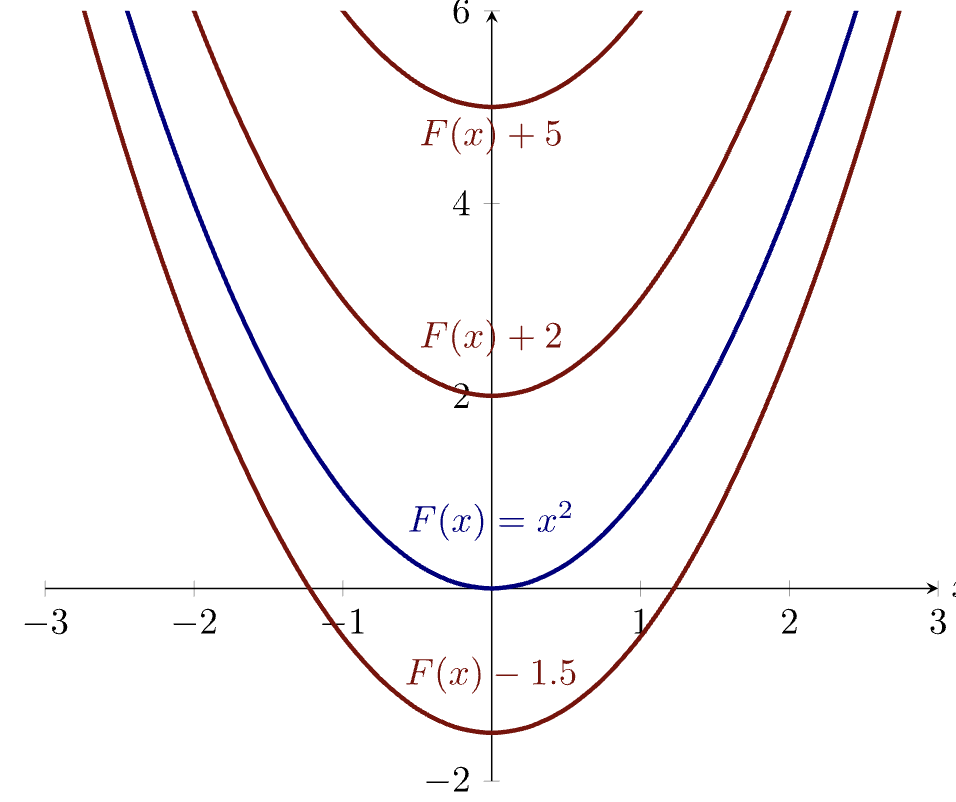
infinetely many
antiderivative
a mathematical function that reverses the process of differentiation. If you take the derivative of a function and get a specific result, the antiderivative is the original function you started with.
When we write F(x)+C, we denote the entire family of antiderivatives of f.
∫1/x dx=
ln|x|+C
power rule of integration

∫ex dx=
ex+C
∫axdx=
axln(a)+C
∫cos(x)dx=
sin(x)+C
∫sin(x)dx=
−cos(x)+C
∫sec2(x)dx=
tan(x)+C
∫csc2(x)dx=
−cot(x)+C
∫sec(x)tan(x)dx=
sec(x)+C
∫csc(x)cot(x)dx=
−csc(x)+C
∫1/x²+1 dx=
arctan(x)+C
∫1/√1-x² dx=
arcsin(x)+C
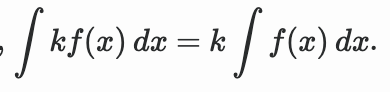
How do you integrate a constant times a function?
move it before the integral symbol then integrate
can you integrate a factor x factor?
NOO
