Chemistry - Inorganic
 Call Kai
 Learn
Learn Practice Test
 Spaced Repetition
 Match
Match Flashcards
 Knowt Play
1/146

There's no tags or description
Looks like no tags are added yet.
Name | Mastery | Learn | Test | Matching | Spaced | Call with Kai |
|---|
No analytics yet
Send a link to your students to track their progress
147 Terms
What is a transition metal?
An element that has an incomplete d subshell in either its atom or one of its common ions
What catalyst is used in the Haber Process?
Iron
What are the 4 properties of transition metals?
Form complexes, coloured ions, variable oxidation states and good catalysts.
In titrations, why is it important to rinse the burette with the solution you’re titrating with?
Prevents water from diluting the concentration of the solution
What is the electron structure of chromium (in shorthand)?
[Ar] 4s1 3d5
What is the electron structure of copper (in shorthand)?
[Ar] 4s1 3d10
How do you find the maxmimum oxidation state for a transition metal?
Sum its outermost s and d orbital electrons
What is a ligand?
An ion or molecul with a lone pair of electrons that can form a coordinate bond to a transition metal
What is a complex?
A metal ion which has co-ordinately bonded ligands
What is the co-ordination number?
The number of co-ordinate bonds from ligands to metal ion
How do transition metal complexes appear coloured?
They absorb particular wavelengths of visible light that excite electrons in the d-orbital. The remaining wavelengths of light are then transmitted.
What type of isomerism do a bidentate ligand complex show?
Optical isomerism
What is colorimetry?
A process used to determine the concentration of coloured solutions by measuring their absorbance of visible light.
How does colorimetry work?
Measure absorbance for a range of concentrations and plot a graph of absorbance against concentration. Use the graph by reading the concentration for its respective absorbance.
What can affect the colour of a transition metal complex?
Co-ordination number, oxidation state, ligand
What are the lone pair of electrons on the ligand used for?
Forming a coordinate bond with the transition metal ion
What is the co-ordination number and angle of a linear complex?
2, 180 degrees
What is the co-ordination number and angle of a square planar complex?
4, 90 degrees
What is the co-ordination number and angle of a tetrahedral complex?
4, 109.5 degrees
What is the co-ordination number and angle of a octahedral complex?
6, 90 degrees
What metal ion occurs in a linear complex?
Ag+
What metal ion occurs in a square planar complex?
Platinum 2+
What ligand occurs in a tetrahedral complex?
Chloride
What are the 3 unidentate ligands?
OH-, H2O, NH3
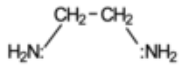
What is this bidentate ligand?
1,2 - diaminoethane (en)
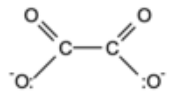
What is this bidentate ligand?
the ethanedioate ion
How many co-ordinate bonds do bidentate ligands need to make?
6
Give an example of a multidentate ligand (that is not haem)
EDTA 4-
What is Haem?
An iron complex with a multidentate ligand and one of them being bonded to globin (a protein)
How is oxygen transported around the body in terms of the bonding in haemoglobin?
Oxygen forms a co-ordinate bond to iron in haem
Why is carbon monoxide so toxic to humans?
It can easily replace oxygen and become strongly bonded to the iron in haemoglobin without being readily replaced itself.
What is a homogenous catalyst?
A catalyst in the same phase as the reactant species.
What is a heterogenous catalyst?
A catalyst in a different phase to the reactant species
What catalyst is used in the Contact Process?
V2O5
What type of catalyst is used in the contact process?
Heterogenous
What is the equation for the reaction between V2O5 and the SO2?
V2O5 + SO2 → V2O4 + SO3
How is the catalyst V2O5 regenerated after the reaction with SO2?
Reacts with ½ O2 forming V2O5
Why is the strength of adsorption being too strong a problem for catalysts?
The reactants cannot move around the surface and cannot desorb.
Why is the strength of adsorption being too weak a problem for catalysts?
Reactants cannot be adsorbed properly
How does a catalyst become poisoned?
Impurities block active sites and prevent desorbtion. There is now less surface area that the reactants can bind to, slowing down the reaction.
What are the consequences of a poisoned catalyst?
Less yield, replacements are needed frequently, cost of reaction process increases
How does a catalyst work in 3 steps?
adsorption - reactants adsorb onto the surface of the catalyst
Reaction - bonds in reactant species weaken to form new bonds through a lower activation energy in the products
desorption - products desorb and leave the catalyst
For the reaction between S2O8 2- and 2I- what is the catalyst?
Fe2+
What type of catalyst is used in the reaction between S2O8 2- and 2I-?
Homogenous
Why is this specific catalyst used for the reaction between S2O8 2- and 2I- ?
It is a positive ion so attracts the negative ions and can form variable oxidation states.
What is the activation energy for the reaction between S2O8 2- and 2I- and why is it that?
The activation energy is high because of the strong repulsion between negatively charged ions.
How do you balance half equations in alkaline solutions?
Balance oxidation states with electrons, balance charge with OH-, balance atoms with H2O
What is autocatalysis?
A form of homogenous catalysis where the product of a reaction becomes a catalyst, speeding up its own formation.
In the reaction between permanganate and the ethanedioate ion, what is the catalyst formed?
a homogeous catalyst of Mn2+
How does the rate of reaction change in an autocatalysis reaction?
The production of the catalyst increases so the rate of reaction increases
What are the common oxidation states for vanadium and the common ions the element exists as those oxidation states in? (oxidation states decreasing from 5+)
V+5 (VO2 +) , V4+ (VO 2+) , V3+ (octahedral monodentate complex), V2+ (octahedral monodentate complex)
What are the colours of the vanadiums and their oxidation states (decreasing from 5)
Yellow, blue, green, violet
What is the best reducing agent to form vanadium species in these oxidation states?
Zinc
When is it easier to oxidise a transition metal?
In alkaline conditions
When is it easier to reduce a transition metal?
Acidic conditions
What is the equation for the reaction between tollens reagent and an aldehyde [Ag(NH3 )2 ]+ ?
RCHO + 2[Ag(NH3 )2 ]+ + 3OH- → 2Ag + RCOO- + 4NH3 + 2H2O
In ligand subsitution reactions, most of them are reversible, what is an example of a reaction that isnt?
Chelation
What is chelation?
Swapping a monodentate ligand for a bi/multi dentate ligand because the increase in entropy forms a more stable complex.
Why is chelation important?
Forms stronger and more stable complexes
When stronger complexes are formed from chelation, what 4 things must you reference in the explanation?
Enthalpy change, entropy change, T x entropy change and free energy change
Where is the s-block on the PT?
Group 1 and 2
Where is the p-block on the PT?
Group 3-7
Where is the d-block on the PT?
Transition metals
Explain what happens to atomic radius as you go across a period?
The number of protons increase so the strength of the positive charge increases. This pulls electrons closer to the nucleus so atomic radius decreases.
What is the trend in ionisation energy across a period?
Increases as there is an increased attraction between the outer shell elecrons and the nucleus which has an increasingly positive charge.
Why does ionisation energy decrease from group 2-3?
The outer electron for group 3 elements occurs in the next p-orbital that has a higher energy than the last s-orbital and is further away from the nucleus so less energy is needed to remove it.
Why does ionisation energy decrease from group 5-6?
In group 6, the last electron is placed into an already occupied p-orbital, meaning there is electron-electron repulsion in an orbital, causing it to be easier to remove one of these two electrons.
How does the melting point change when you go down group 2?
It generally decreases (except for magnesium) because the metal atoms have a larger ionic radius so delocalised electrons are further away from the nucleus and feel less attraction. Less energy is needed to break the bonds.
When the group 2 metals react with water what is formed?
Metal hydroxide and hydrogen
How can you test for ammonia?
Hold damp red litmus paper against the gas, it will turn blue if ammonia gas is present.
Magnesium has a very low reactivity, but what will it react rapidly with?
Steam
How does solubility change for group 2 hydroxides?
It increases down the group
How does solubility change for group 2 sulphates?
It decreases down the group
What colour are all solid group 2 hydroxides/sulphates?
white
What is the test for sulphate ions?
Acidify the solution with HCl to remove any impurities. Add BaCl2 and a white ppt of BaSO4 will be formed.
What is calcium hydroxide used for?
Neutralise acidic soils
What is the use for magnesium hydroxide?
In indigestion tablets to neutralise excess stomach acid
What is barium sulphate used for?
In barium meals to help identify problems in the body
What is magnesium by itself used for?
Extracting titanium from its ore of titanium oxide
How does boiling points of halogens change as you go down the group?
Boiling point increases as the atomic radius increases so number VDW forces increase and get stronger.
How does electronegativity of the halogens change as you down the group?
It decreases as atomic radius increases going down the group, outer shell is further away from the nucleus so it is harder to gain an electron due to the weak attraction and shielding.
What two substances can be mixed to make bleach?
Chlorine gas with cold aqueous sodium hydroxide
In the halide reactions with sulphuric acid, what 3 sulphur products are mainly formed in order of their appearance?
Sulphur dioxide, Sulphur, Hydrogen sulphide
What products are always formed in the last 2 reactions of halides with sulphuric acid?
Halide molecule and water
Why can the hydorgen fluoride and choride not continue to react with sulphuric acid again?
They are not strong enough reducing agents
How would you test for Halides?
Add dilute nitric acid to remove any impurities and add drops of silver nitrate solution. The formation of the ppt gets quicker as you go down the group.
How can you check the results for the test for halides?
Add dilute then concentrated ammonia solution where solubility with the solution decreases down the group.
If a halide ion solution doesn’t form a ppt in a solution of silver nitrate and ammonia, what ion must it be?
Fluoride
If a halide ion solution doesnt dissolve in either concentrated or dilute ammonia solutions, what ion must it be?
Iodide
If a halide ion solution dissolves in concentrated but not dilute ammonia solution, what ion must it be?
Bromide
If a halide ion solution dissolves in all test solutions, what ion must it be?
Chloride
How does reducing power of the halides change as you go down the group?
Increases
How does oxidising power of the halides change as you go down the group?
Decreases
How does the solubility of the silver halides in ammonia change as you go from chlorine to iodine (and what colour are each)?
Solubility decreases, a white then cream then yellow ppt is formed
Chlorine water will displace a solution containing bromide ions to give what observation?
An orange solution
A solution containing iodide ions will be displaced by chlorine and bromine water to give what observation?
A brown solution
In Ligand substitution, if a monodentate ligand is being swapped for another monodentate ligand and both are of similar size and charge, what will happen to the shape of the complex?
It will remain the same
What is incomplete ligand substitution?
Only some of the ligands surrounding a central transition metal ion are replaced by new ligands.
What transition metal ion does incomplete ligand substitution work for?
Cu2+
What is the largest monodentate ligand?
Cl-