Chapter 5: Learning
0.0(0)
Studied by 8 people Call Kai
 Learn
Learn Practice Test
 Spaced Repetition
 Match
Match Flashcards
 Knowt Play
Card Sorting
1/58

Earn XP
Description and Tags
Last updated 7:07 PM on 2/25/25
Name | Mastery | Learn | Test | Matching | Spaced | Call with Kai |
|---|
No analytics yet
Send a link to your students to track their progress
59 Terms
1
New cards
Learning
Learning is a relatively permanent change in behavior or knowledge due to experience
2
New cards
Four basic learning processes
non-associative conditioning
classical conditioning
operant conditioning
cognitive and observational learning
classical conditioning
operant conditioning
cognitive and observational learning
3
New cards
behaviorism
assumes there are laws of learning that apply to virtually all organisms
learning is explained in directly observable events, and avoids speculating about an organisms unobservable mental states
learning is explained in directly observable events, and avoids speculating about an organisms unobservable mental states
4
New cards
Habituation
a decrease in the strength of response to repeated or unchanging stimulus
5
New cards
Sensitization
increase in responsiveness to a stimulus due to experience
6
New cards
Classical Conditioning
a neutral stimulus is repeatedly paired with a stimulus (UCS) that triggers an instinctive response until the neutral stimulus alone becomes (CS)
7
New cards
Ivan Pavlov
studied digestive secretions in dogs, the dogs salivated at the ring of a bell because they were conditioned
8
New cards
extinction
a process in which the CS is presented repeatedly in the absence of UCS, causing CR to weaken and disappear
9
New cards
Biological preparedness
biological predisposition to learn associations between stimuli, response, and reinforcers
10
New cards
Contra preparedness
some stimuli, despite repeated pairings, cannot become associated with a specific unconditioned stimulus
11
New cards
Stimulus Generalization
behavior becomes more probable in the presence of one stimulus or situation as a result of being reinforced in the presence of another stimulus or situation
12
New cards
Stimulus generalization example
Little Albert
13
New cards
Stimulus discrimination
distinguish between one stimulus and similar stimuli
14
New cards
Forward Conditioning
conditioned stimulus is before unconditioned stimulus
15
New cards
Backward Conditioning
unconditioned stimulus is before conditioned stimulus
16
New cards
Timing
the idea that forward conditioning is better than backward conditioning and that
17
New cards
predictability
it is not enough for Conditioned stimulus to come before UCS, conditioning proceeds most rapidly when Conditioned stimulus always signals UCS
18
New cards
Intensity
a conditioned response will be learned more rapidly if the unconditioned stimulus is strong
19
New cards
Attention
intensity of attention paid to the unconditioned stimulus will create a more intense conditioned response
20
New cards
operant conditioning
learning process where behavior becomes controlled by its consequences
21
New cards
Edward L. Thorndike
Law of Effect-if the response is followed by a satisfying effect the response will be repeated under similar circumstances and vis versa
22
New cards
b.F skinner
elaborated on thorndike's law and proposed that the consequences of behavior are critical for learning and additionally developed the principles of reinforcement
23
New cards
operant conditioning
the process whereby behavior becomes controlled by its consequences
24
New cards
operant behavior
behavior that has some effect on the world
25
New cards
operant conditioning
utilization of reinforcers and punishments to condition certain response
26
New cards
reinforcer
a consequence that has the effect of increasing likelihood behavior will happen again
27
New cards
punishment
a consequence of decreasing the likelihood that a target behavior will occur again
28
New cards
Principles of operant conditioning
when an element is added, a positive effect has occurred
when an item is removed a negative effect has occurred
when an item is removed a negative effect has occurred
29
New cards
Positive reinforcement
a desirable stimulus is added as a consequence of a behavior and the chance the behavior will reoccur increases
30
New cards
negative reinforcement
occurs when an aversive event or stimulus is removed as a consequence of behavior and the chance that the behavior will reoccur increases
31
New cards
Positive Punishment
aversive event or stimulus is added as a consequence of a behavior and the chance of it reoccurring decreases
32
New cards
Negative Punishment
a desirable event or stimulus is removed as a consequence of a behavior and the chance that this behavior will reoccur decreases
33
New cards
Chart Operant conditioning
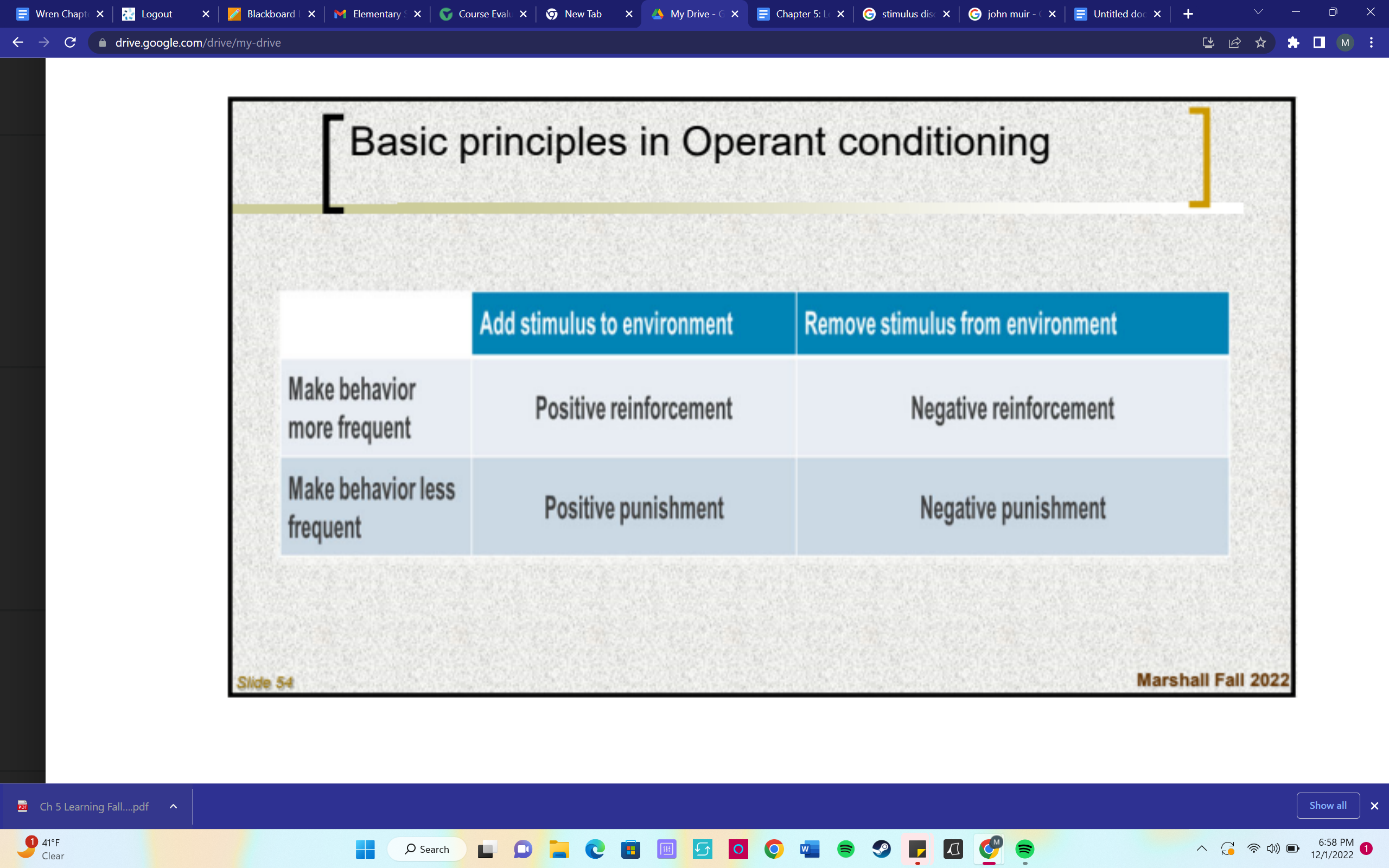
34
New cards
Reinforcement
increases the chance of a target behavior
35
New cards
punishment
decreases chance of a target behavior
36
New cards
positive
adding stimulus
37
New cards
negative
remove a stimulus
38
New cards
escape learning
perform a response to decrease or stop an occurring aversive stimulus
39
New cards
shaping
operant conditioning where reinforcers guide behavior towards desired goal
40
New cards
differential reinforcement
some behaviors are reinforced but others are not
41
New cards
Successive approximations
progression of reinforcement for behaviors that gradually and incrementally approximate the target behavior
42
New cards
partial reinforcement
reinforcing a response only part of the time
results in slower acquisition
greater resistance to extinction
results in slower acquisition
greater resistance to extinction
43
New cards
ratio schedule
a certain percentage of responses are reinforced based on number of responses
44
New cards
interval schedule
a certain amount of time must elapse between reinforcements, regardless of how many responses occur
45
New cards
random schedule
no systematic pattern
46
New cards
fixed ratio
reinforcements only after a specific number of responses
47
New cards
variable ratio
reinforcement after an unpredictable number of responses
48
New cards
fixed interval
reinforcement of the first response after a specified time has elapsed
49
New cards
variable interval
reinforcement of the first response after an unpredictable time interval
50
New cards
Punishment side effects
freezing/behavior suppression
trigger strong emotional response that disrupt normal functioning
may lead to aggression
fear of person who controls punishment
trigger strong emotional response that disrupt normal functioning
may lead to aggression
fear of person who controls punishment
51
New cards
Latent learning
learning that occurs but is not apparent until there is an incentive to demonstrate it
52
New cards
cognitive maps
mental representation of the layout of one's enviornment
53
New cards
Edward Tolman
studies about rat cognitive maps
54
New cards
WolfGang Kohler
insight learning
55
New cards
insight learning
suddenly grasping and incorporating new knowledge
56
New cards
Bandura
social cognitive learning theory
we can learn by observing others and without direct reward or punishment
we can learn by observing others and without direct reward or punishment
57
New cards
Social cognitive learning theory
learning by observing behavior of models: bobo doll
58
New cards
Necessary mechanisms for observational learning
attention
retention
procedure
motivation
retention
procedure
motivation
59
New cards
Self Efficacy
belief they have the capability to perform behaviors that will produce the desired outcome.