Genomics
 Call Kai
 Learn
Learn Practice Test
 Spaced Repetition
 Match
Match Flashcards
 Knowt Play
1/18

There's no tags or description
Looks like no tags are added yet.
Name | Mastery | Learn | Test | Matching | Spaced | Call with Kai | Chat |
|---|
No analytics yet
Send a link to your students to track their progress
19 Terms
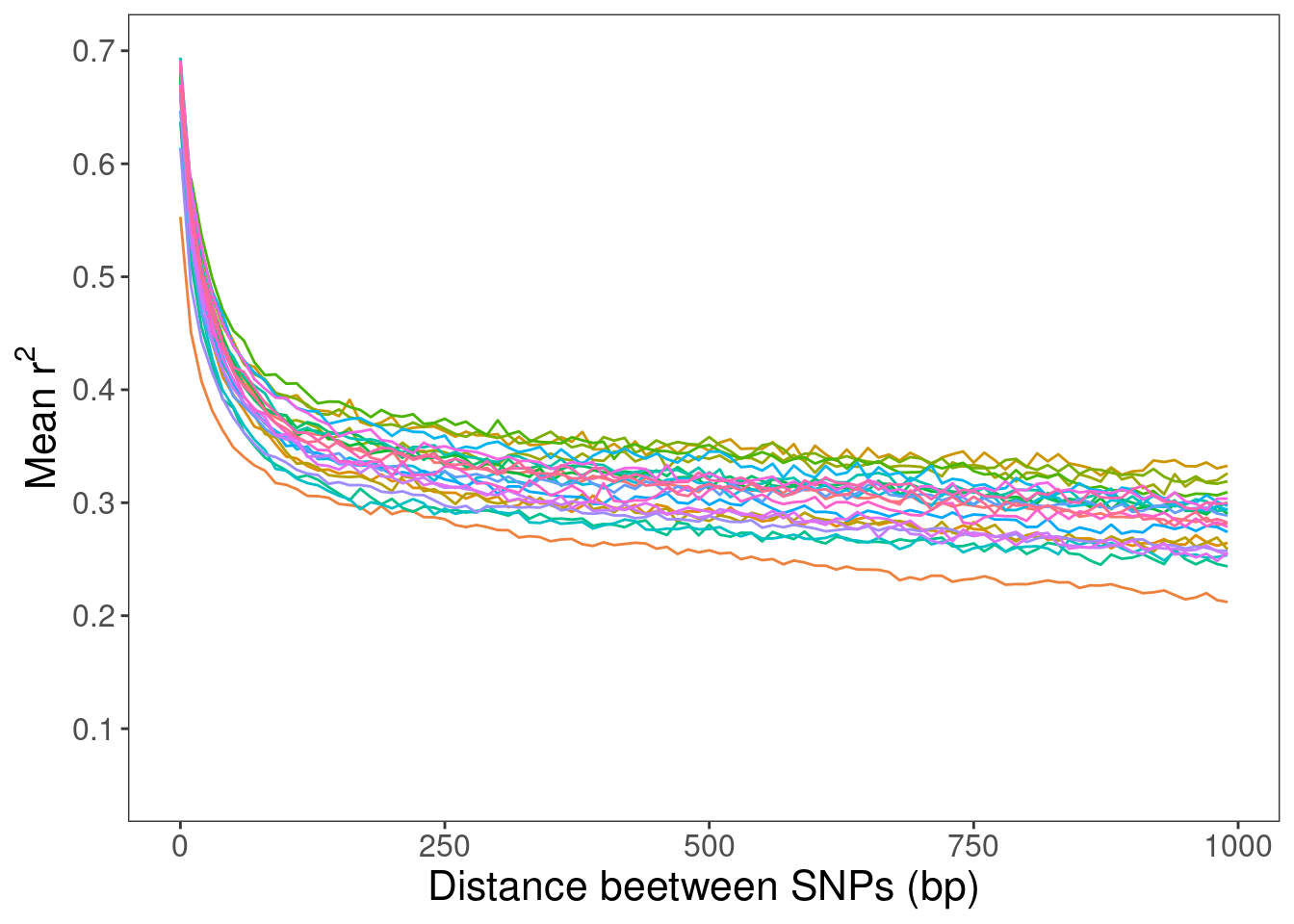
Linkage Disequilibrium Decay
the phenomenon where LD is high for genetic markers that are physically close together, but decays (drops toward zero) as the physical distance (in kilobases or megabases) between loci increases. measured by parameters like r² over increasing genetic distance.
Tajima’s D
Tajima’s D = Nucleotide Diversity - Watterson’s Theta
a population genetic statistic that is used to test if a population is evolving neutrally or evolving under a non-random process, including directional selection or balancing selection, demographic expansion or contraction, genetic hitchhiking, or introgression.
Negative Tajima’s D
Tajima’s D = Nucleotide Diversity - Watterson’s Theta
Occurs when Watterson’s Theta is greater than nucleotide diversity (𝜃S > 𝜃π).
Excess of low frequency alleles. May suggest positive selection, recent deleterious alleles, or population expansion.
Positive Tajima’s D
Tajima’s D = Nucleotide Diversity - Watterson’s Theta
Occurs when nucleotide diversity is greater than Watterson’s theta (𝜃π > 𝜃S).
Excess of intermediate frequency alleles. May suggest balancing selection, partial sweep, or population bottleneck.
Selective Sweep
a process where beneficial mutation rises in frequency until it is fixed in the population. Leads to the reduction or elimination of genetic variation among nucleotide sequences that are near the mutation (genetic hitchhiking)
Hard Sweep
when a single mutation event generates one new allele, which generates a beneficial/adaptive allele. When adaptive, the allele becomes fixed in a population and also drags along with it other alleles that are closely linked.
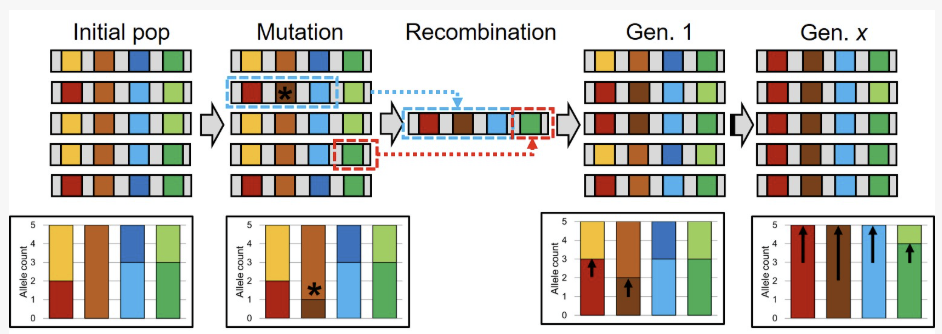
Soft Sweep
occurs from from standing genetic variation (an allele was already floating around in the population) or multiple independent mutations at the exact same site (same mutation pops up independently in different individuals around the same time). Retains genetic varaition around the locus.
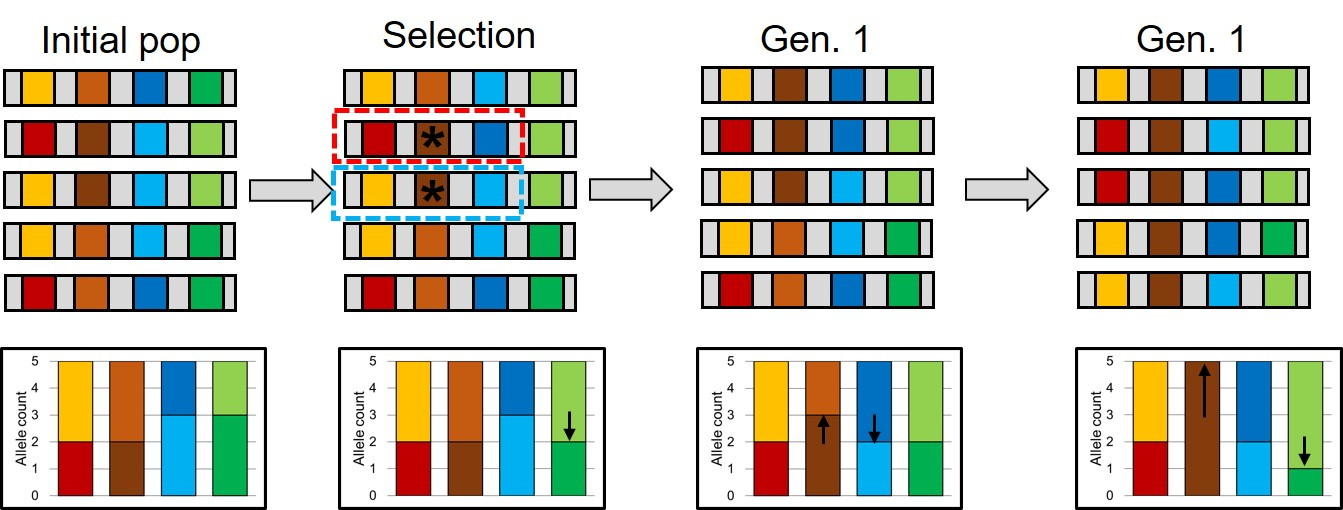
Balancing Selection
a type of natural selection that keeps multiple versions of a gene, or alleles, active in a population. Its main mechanisms are heterozygote advantage and frequency-dependent selection.
Frequency-Dependent Selection
the fitness of a trait depends on how common or rare it is in the population.
Negative Frequency-Dependent Selection
When rare phenotypes have more fitness. Fitness will decrease as a phenotype becomes more common.
Example: Immune systems target common strains of bacteria or viruses, leaving rare microbial strains free to infect hosts and thrive
Positive Frequency-Dependent Selection
When common phenotypes have more fitness. Fitness increases as a phenotype becomes more common, while rare variants are penalized and driven out.
Example: Common stripe patterns in herd animals (like zebras) confuse predators through sheer uniformity; an individual with a bizarre or rare visual mutation stands out from the group and suffers higher rates of predation
Watterson’s Theta
quantifies the number of segregating or polymorphic sites within a cohort, scaled by a constant. The higher this statistic, the more sites are found to be polymorphic.
Since Watterson’s theta counts all segregating sites (S) equally, it is strongly influenced by rare alleles.
Nucleotide Diversity
Average proportion of nucleotides that differs between any randomly paired set of sequences. The higher this statistic, the more differences you will expect to see between any pair of randomly sampled DNA sequences.
DNA methylation
where small chemical tags called methyl groups (CH3) attach to DNA, repressing gene transcription (i.e., turning genes off) without changing the actual genetic code
Genetic Swamping
process that happens when a small group of organisms, with unique genetic traits, mixes with a much larger group of organisms of the same species through gene flow. Over time, the unique genes of the smaller group get diluted and eventually disappear because the genes of the larger group become dominant.
Paralogs
homologous genes that share a common ancestral origin. Genes inside the same genome that were created by a gene duplication event
Orthologs
homologous genes that share a common ancestral origin. Genes in different species that evolved from a single common ancestral gene during a speciation event
Relative Fitness
the absolute fitness of an individual divided by the absolute fitness across all individuals within a community
the fitness of an individual, phenotype, or genotype compared with others in the population. Relative fitness can be calculated by dividing the individual’s fitness by either (1) the mean fitness of the individuals in the population, or (2) the highest individual fitness found in the population.
Absolute Fitness
quantity of offspring produced by an individual organism per unit of time