ACT Math
 Call Kai
 Learn
Learn Practice Test
 Spaced Repetition
 Match
Match Flashcards
 Knowt Play
1/52

There's no tags or description
Looks like no tags are added yet.
Name | Mastery | Learn | Test | Matching | Spaced | Call with Kai | Chat |
|---|
No analytics yet
Send a link to your students to track their progress
53 Terms
Sequences
Sequence with a constant c
arithmetic sequence
geometric sequence
Arithmetic sequence
an = a1 + c(n-1)
for example, in (3, 7, 11, 15, …), the common difference is +4
Geometric sequence
an = a1(c)n-1
for example, in (2, 6, 18, 54, …), each step multiplies by 3
Logarithms
tells you what power you need to raise a base number to get another number. For example,
log10(100) =2 —- because 10² = 100
loga b = c
ac = b
Function notation
fog(x)
f(g(x))
π radians (degree and radian conversion)
180 degrees

Percents
a% of b
a/100 × b = a × b/100
for example,
Find 20% of 50
Method 1: 20/100 times 50 = 10
Method 2: 50 /100 times 20 = 10
Both ways give the same answer of 10
percent change
change / original
Statistics
mean (average)
sum of terms / number of terms
median
middle number (or average of 2 middle numbers)
mode
most common number
range
biggest – smallest
Probability
number of desired outcomes / total number of outcomes
P(event happens) + P(event doesn’t happen)
1
P(A and B)
P(A) × P(B)
Linear graphs
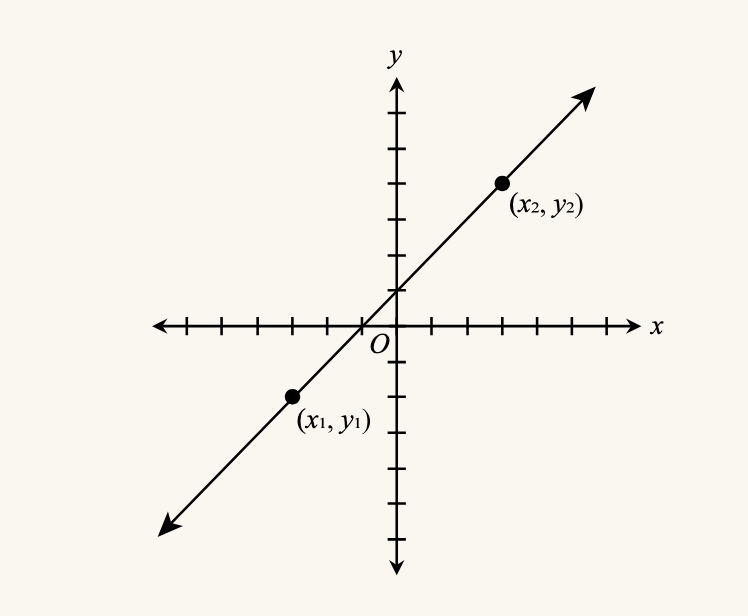
Slope intercept form
y = mx + b
m (slope)
(y2-y1) / (x2-x1)
b
y - intercept
distance formula
√( (y2-y1)2 + (x2-x1)2 )
Midpoint formula
( [x1 + x2] / 2 , [y1 + y2] / 2)
Quadratics
discriminant
b2 - 4ac in quadratic formula
if
discriminant > 0, 2 solutions
discriminant = 0, 1 solution
discriminant < 0, 0 solutions
Lines and angles
Supplementary
angles add up to 180
Complementary
angles add up to 90
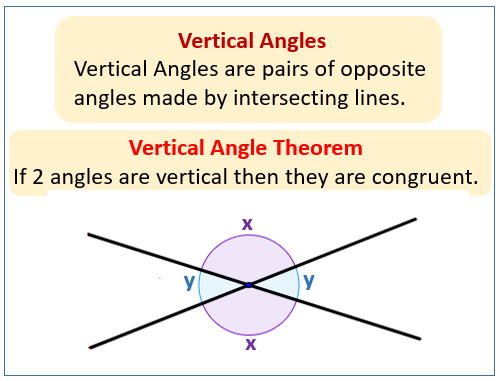
Vertical Angles
Triangles
Pythagorean
a2 + b2 = c2
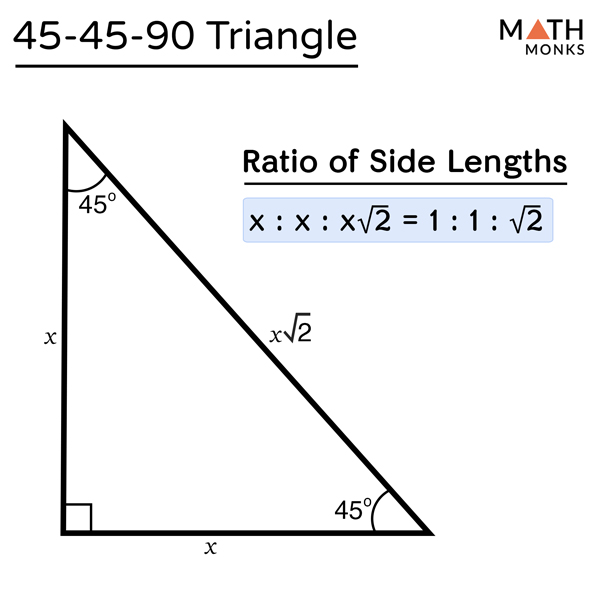
45 - 45 - 90
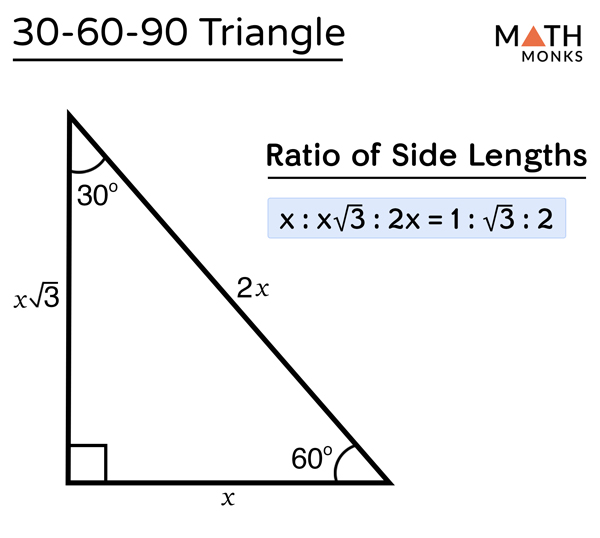
30 - 60 - 90
Polygons
Trapezoid Area
height * (base1 + base2 ) / 2
Parallelogram Area
base * height
Sum of angles in n-sided figure
(n - 2) * 180 degrees
Circles
Circle Area
πr²
Circumference
2πr
Arc Length
(central angle / 360) * circumference
Sector Area
(central angle / 360) * area
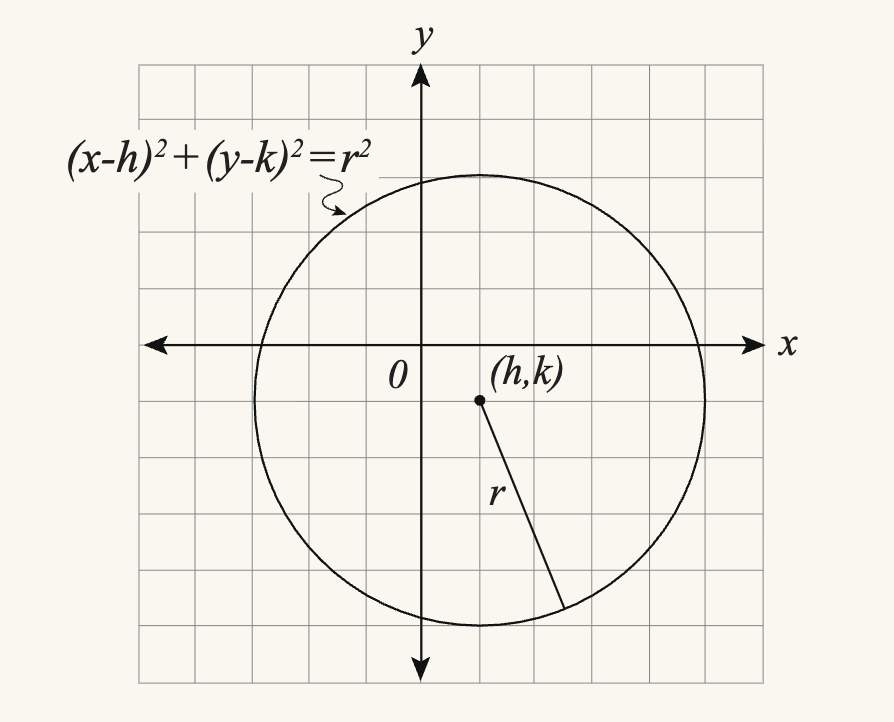
Circle Center
(h,k)
r2
(x-h)2 + (y-k)2 = r2
any point (x, y) that's exactly distance r from the center (h, k) is on the circle. That's literally the distance formula squared — (x−h)2+(y−k)2(x-h)^2+(y-k)^2 (x−h)2+(y−k)2 is the squared distance from (x,y) to (h,k), and setting it equal to r2r^2 r2 forces every point on the circle to be exactly r away from center.
Parabolas
3D figures
Surface area of rectangular prism
2 (length * width + length * height + width * height)
Volume of a right cylinder
πr2h
Trigonometry
sin2(x) + cos2(x)
1