Anatomy and Physiology Chapter 3
 Call Kai
 Learn
Learn Practice Test
 Spaced Repetition
 Match
Match Flashcards
 Knowt Play
1/49

There's no tags or description
Looks like no tags are added yet.
Name | Mastery | Learn | Test | Matching | Spaced | Call with Kai | Chat |
|---|
No analytics yet
Send a link to your students to track their progress
50 Terms
Cells that are thick in the middle and tapered toward the end are called_________ cells.
fusiform
The flat-shaped cells found covering the skin are_________ in shape.
Squamous
The fluid outside of a cell is called_________.
Extracellular fluid
Which of the following is not one of the three basic components of a cell?
A. Cytoplasm
B.Nucleus
C. Plasma membrane
D. Interstitial fluid
Interstitial fluid
The most abundant molecules in the plasma membrane are________.
Phospholipids
Membrane proteins that bind to signals by which cells communicate are called_________.
Receptors
In its second-messenger role, cAMP activates enzymes called_________, whose job is to regulate other enzymes by adding phosphate groups to them.
Kinases
In the glycocalyx,_________ act like identification tags that enable the body to distinguish its own cells from foreign and diseased cells.
Glycoproteins
The fuzzy coat of carbohydrates on the outer surface of the plasma membrane that functions in cell identification is called the_________.
Glycocalyx
Which of the following does not affect the rate of diffusion?
A. Temperature
B. Size of molecules
C. Presence of enzymes
D. Steepness of gradient
Presence of enzymes
The term_________ refers to a membrane that allows some things to pass through it, but not others.
Selectively Permeable
_________ is the process in which_________ forces water and small solutes, such as salts, through narrow clefts between capillary cells.
Filtration; hydrostatic pressure
Water flows through a selectively permeable membrane in a process called_________, but water molecules cross the membrane more easily through channels of transmembrane proteins called_________.
osmosis; aquaporins
The number of particles of a solute in a solution is described by its_________. The ability of a solution to affect the fluid volume in a cell is referred to as its_________.
osmolarity; tonicity
A red blood cell is placed in a hypertonic solution. This means the concentration of solutes in the solution is_________ than the concentration of solutes in the intracellular fluid and will cause the cell to_________.
higher; shrink
Insulin is taken up, via endocytosis, by the endothelial cells that line blood capillaries. Then, it's transported across the cell to the other side, where it is released. This transport is called_________.
transcyotsis
Sodium and glucose are transported together from the intestinal lumen into an intestinal cell. The carrier protein is a(n)_________ and the process is called_________.
symport; contransport
The sodium-potassium pump transports both sodium and potassium_________ their concentration gradients in a process called_________.
up, active transport
What do facilitated diffusion and active transport have in common?
Both are examples of carrier-mediated transport.
Which of the following processes requires the use of energy?
Active transport
Which of the following processes only occurs in the plasma membrane of a living cell?
Active transport
Which of the following is not a method by which particles can leave a cell?
Option A
Active transport
Option B
Exocytosis
Option C
Simple diffusion
Option D
An antiport system
Option E
Pinocytosis
Pinocytosis
White blood cells engulf bacteria by means of which process_________.
Phagocytosis
Which of the following is not a function of the Sodium-Potassium pump?
Option A
Heat production
Option B
Transport of Sodium into the cell and Potassium out of the cell
Option C
Secondary active transport
Option D
Regulation of cell volume
Option E
Maintenance of membrane potential
transport of sodium into the cell and potassium out of the cell
Which of these is an example of active transport?
Option A
The diffusion of oxygen from a place of high concentration to a place of lower concentration
Option B
The facilitated diffusion of Potassium (K+)
Option C
The transport of glucose down its concentration gradient
Option D
The transport of sodium (Na+) from a place of low concentration to a place of higher concentration
Option E
The transport of Chloride (Cl-) following its concentration gradient
the transport of sodium from place of low concentration to a place of higher concentration
Which of these processes brings droplets of extracellular fluid into a cell?
Option A
Phagocytosis
Option B
Receptor-mediated endocytosis
Option C
Transcytosis
Option D
Pinocytosis
Option E
Exocytosis
Pinocytosis :)
Which type of solution contains higher than normal amounts of osmotically active solutes?
Hypertonic Solution
Two solutions are separated by a selectively permeable membrane. If solution A has a higher concentration of a nonpermeating solute than solution B, then_________
water will pass down its concentration gradient from solution B to A
A red blood cell is placed in a hypertonic solution. This means the concentration of solutes in the solution is_________ than the concentration of solutes in the intracellular fluid, and will cause the cell to_________.
higher; shrink
A patient was severely dehydrated, losing a large amount of fluid. The patient was given intravenous fluids of normal saline. Normal saline is_________ to your blood cells and is _________ sodium chloride (Na+Cl-) in water.
isotonic; 0.9%
True or False: Facilitated diffusion requires energy to transport molecules against a concentration gradient
False
True or False: The greater the concentration gradient the faster diffusion occurs.
True
True or False: Temperature of a solution causes the particles to diffuse more rapidly.
True
True or False: Particles diffuse at the same rate down a gradient despite the concentration difference.
False
True or False: Heavy molecules such as as proteins diffuse more slowly than a light particle such as an electrolyte.
True
True or False: Filtration is a process in which physical pressure forces fluid through a selectively permeable membrane.
True

Which protein would be used to tell an immune system cell if a body cell is "self" or "not self" (foreign)?
Option A
A
Option B
B
Option C
C
Option D
D
Option E
E
Option E

Which protein would bind a chemical messenger like the neurotransmitter acetylcholine?
Option A
A
Option B
B
Option C
C
Option D
D
Option E
E
Option A
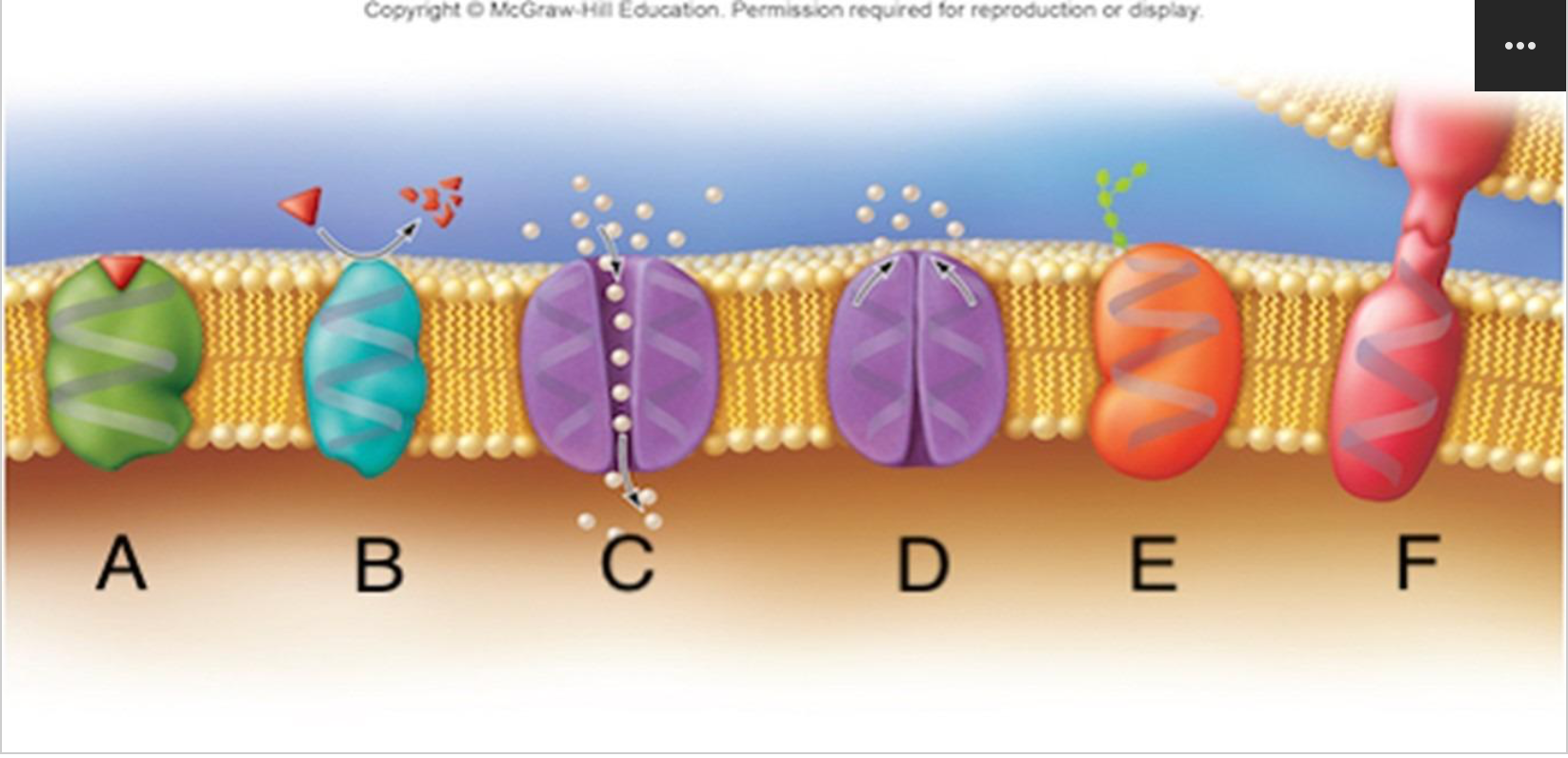
Which protein would only open at certain voltages?
Option A
A
Option B
B
Option C
C
Option D
D
Option E
E
Option D

Solution A is __________ compared to solution B.
hypotonic

Solution B is __________ compared to solution A.
hypertonic
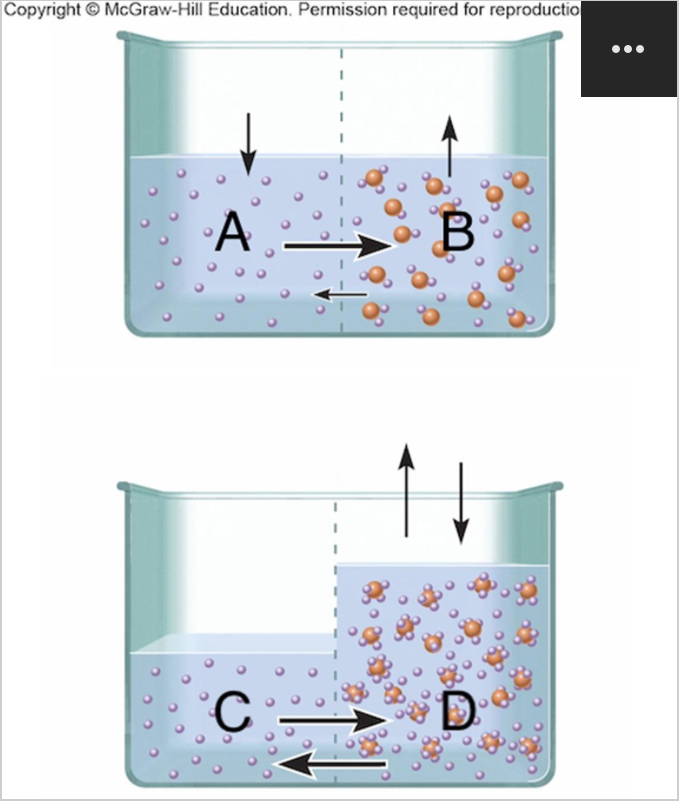
Which solutions are in equilibrium?
C and D

What molecule is found at the letter A?
Sodium (Na+)

Which type of transport is pictured here?
Active transport
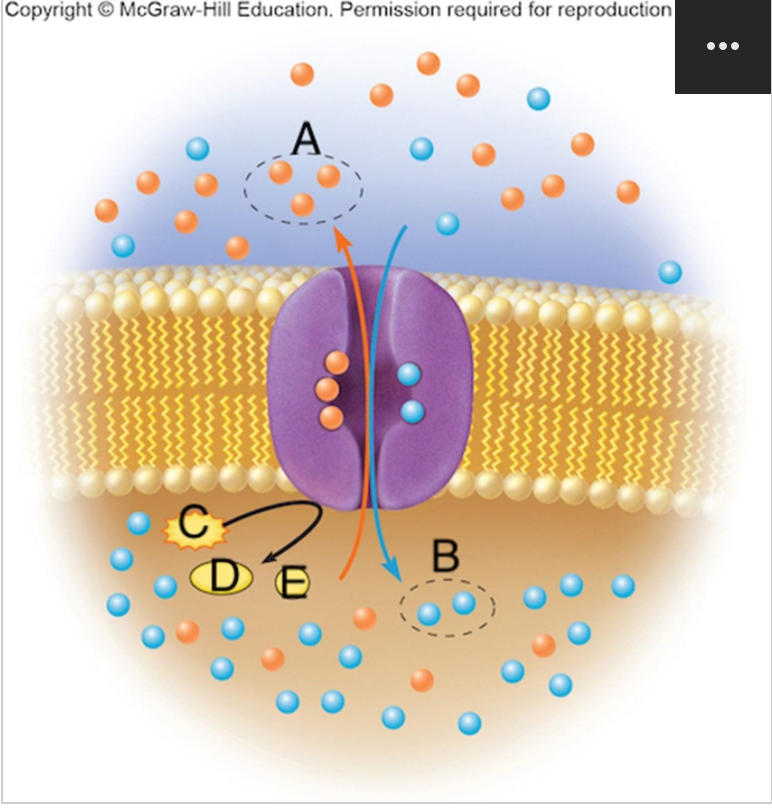
What molecule is found at the letter C ?
ATP
The fluid inside of a cell is called?
Cytosol
Which of the following statement(s) is/are true regarding Microvilli on cell surfaces.
Option A
they are extensions of the plasma membrane
Option B
they increase the available cell surface area
Option C
they may appear as a “fringe” called a brush border
Option D
they may serve as sensory receptors on some cells
Option E
all of the above are correct
all of the above
Aquaporins in the cell membrane promote which function?
Osmosis
Which statement best describes the function of Gated Channels in a cell membrane?
Option A
acts as a cell identity marker
Option B
is constantly open to allow solutes through
Option C
breaks down neurotransmitters
Option D
binds to circulating hormones
Option E
open and close at certain times to allow solute to pass through
open and close at certain times to allow solute to pass through
When a hormone cannot enter a cell, it activates the formation of a/an _____inside the cell.
Second messanger