Basic Marketing Unit 1
 Call Kai
 Learn
Learn Practice Test
 Spaced Repetition
 Match
Match Flashcards
 Knowt Play
1/22

There's no tags or description
Looks like no tags are added yet.
Name | Mastery | Learn | Test | Matching | Spaced | Call with Kai | Chat |
|---|
No analytics yet
Send a link to your students to track their progress
23 Terms
WHAT IS MARKETING? (Different views of what
marketing is?) (TESTED)
Production Orientation/Focus
Sales Orientation/Focus
Marketing Orientation/Focus
Marketing Concept
Societal Orientation/Focus
MARKETING CONCEPT, Do all companies view marketing the same way?
Marketing Concept ---> Develop
products based on what
customers need and want.
Almost anything can be
marketed, e.g., Red Cross, Water.
No. Companies may use production, sales, marketing, or societal orientations. Technology companies and Patagonia are examples of companies with different marketing orientations.
Different Orientations Towards Marketing
Not every company feels that this
is what marketing is all about.
Tech. companies
Patagonia
CUSTOMER VALUE (TESTED)
Smart marketers understand customers so well that they figure out what customers need and offer something even before customers express a need for a product or service. These are usually “extremely” successful products or services in the marketplace. (The picture, Customer value is when customers compare what they gain from a product (benefits) with what they give up to get it (costs). More benefits and fewer costs mean greater customer value.)
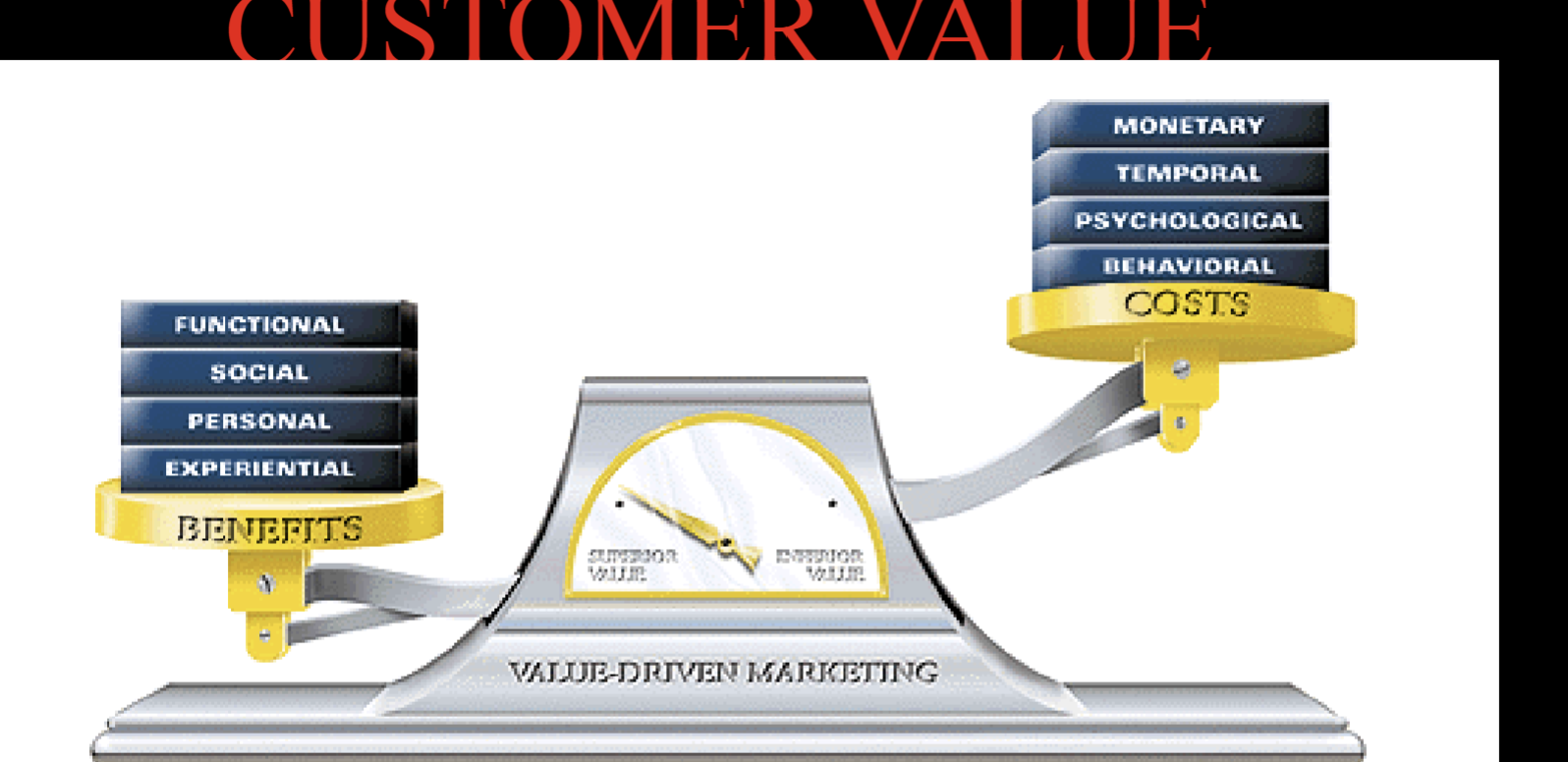

Superior customer value makes customers satisfied, which builds customer loyalty and creates long-term profitable relationships for the company.
Customer Value, how do IKEA and career planning demonstrate the marketing concept?
Ikea furniture --> Designer furniture at
regular price. How did they do it?
How can you apply the Marketing Concept
to your career?
IKEA gives customers designer-style furniture at regular prices. For your career, learn what employers need and develop skills that provide value to them.
More Marketing Jargon/Terms, What is Customer Lifetime Value?
The total value a customer brings to a company throughout their entire relationship.
More Marketing Jargon/Terms, What is Customer Equity?
The total combined lifetime value of all the company’s current and potential customers.
More Marketing Jargon/Terms, What is Return on Marketing Investment (ROMI)?
A measurement of how much profit a company earns from the money it spends on marketing.
(TESTED) Definition of marketing (AMA):
marketing is the activity, set of institutions, and processes, for creating communicating, delivering, and exchanging offerings that have value for customers, clients, partners, and society at large. Look for key words...
What does good marketing mean?
Understanding customers’ needs, knowing the benefits they want, anticipating their needs, and providing superior customer value.
What does the customer-value scale show?
Customers compare the benefits they receive with the costs they must give up. Greater benefits and lower costs create superior customer value.
What are the four types of customer benefits?
Functional, social, personal, and experiential benefits.
What are functional benefits?
How well the product performs its purpose. Example: a phone with a good camera.
What are social benefits?
How the product helps someone connect with others or improve their social image. Example: wearing a popular brand.
What are personal benefits?
How the product provides personal satisfaction or helps someone express themselves. Example: clothing that makes someone feel confident.
What are experiential benefits?
The enjoyment or experience of using the product. Example: enjoying the atmosphere at Starbucks.
What are the four types of customer costs?
Monetary, temporal, psychological, and behavioral costs.
What are monetary costs?
The money spent to purchase and use the product.
What are temporal costs?
The time spent finding, buying, waiting for, or using the product.
What are psychological costs?
The stress, worry, or mental effort involved in purchasing or using the product.
What are behavioral costs?
The physical effort required to obtain or use the product.
When does a product provide superior customer value?
When customers believe the product’s total benefits are greater than its total costs.