PKP Kap. 10
 Call Kai
 Learn
Learn Practice Test
 Spaced Repetition
 Match
Match Flashcards
 Knowt Play
1/4

There's no tags or description
Looks like no tags are added yet.
Name | Mastery | Learn | Test | Matching | Spaced | Call with Kai | Chat |
|---|
No analytics yet
Send a link to your students to track their progress
5 Terms
Describe the foundations of behaviorism and evaluate the theory set.
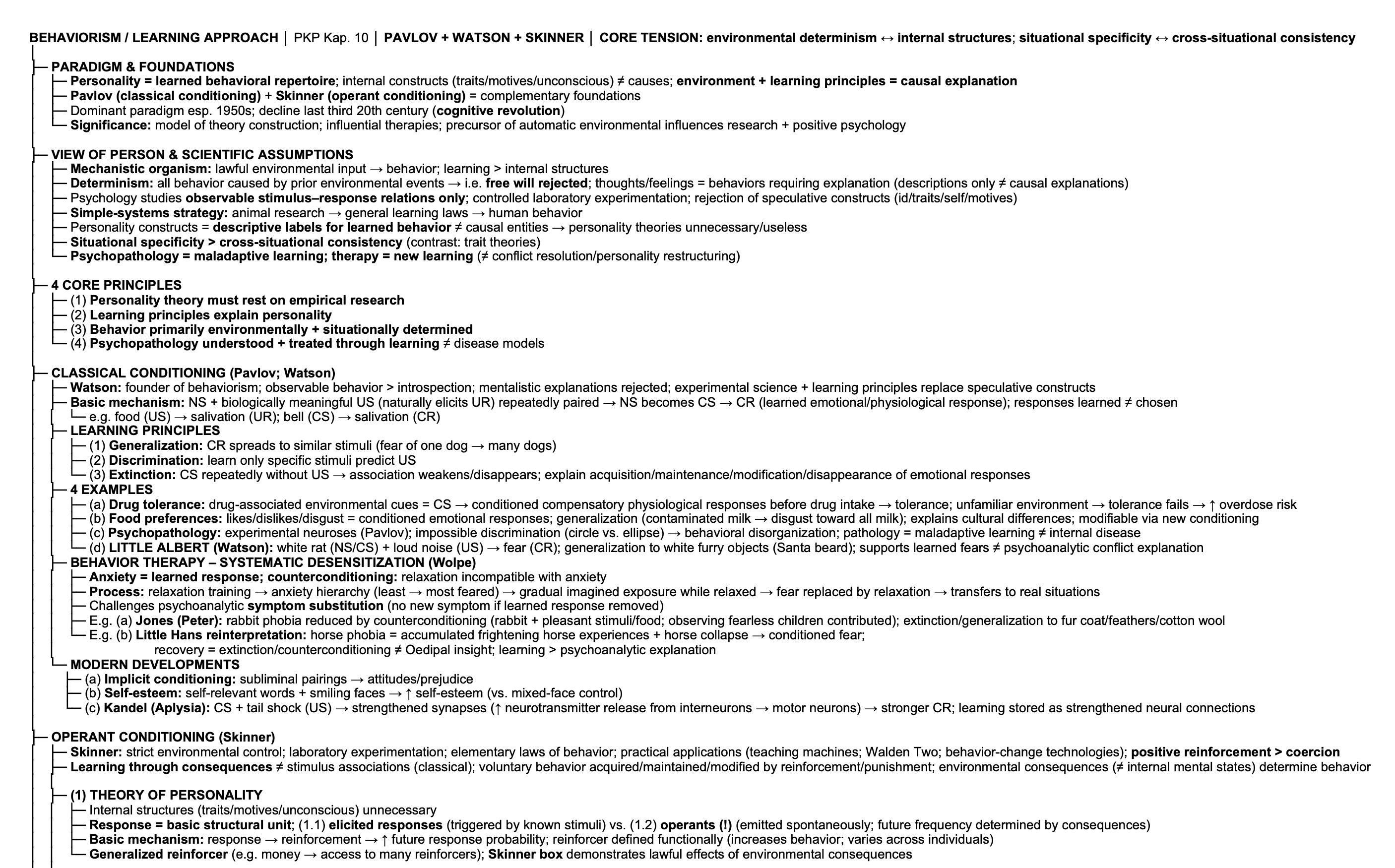
Behaviorism (learning approach); personality = learned behavioral repertoire;
Internal constructs (traits; motives; unconscious) ≠ causes; environment + learning principles = causal explanation;
Pavlov (classical conditioning) + Skinner (operant conditioning) = complementary foundations;
Dominant paradigm (especially 1950s; decline in last third of 20th century);
Significance: model of theory construction; influential therapies; precursor of research on automatic environmental influences and positive psychology.
View of person:
Mechanistic organism; lawful environmental input → behavior; learning > internal structures;
Determinism (all behavior caused by prior environmental events); free will rejected; thoughts/feelings = behaviors requiring explanation (i.e. only descriptions), not causal explanations.
Scientific assumptions: environmental determinism;
psychology studies observable stimulus–response relations only; controlled laboratory experimentation; observable variables; rejection of speculative constructs (id; traits; self; motives);
Simple-systems strategy (animal research → general learning laws → human behavior);
Personality theories unnecessary/useless (personality constructs = descriptive labels for learned behavior, not causal entities);
Situational specificity > cross-situational consistency (contrast: trait theories);
Psychopathology = maladaptive learning; therapy = new learning experiences, not conflict resolution/personality restructuring.
4 Core assumptions/principles: (1) personality theory must rest on empirical research; (2) learning principles explain personality; (3) behavior primarily environmentally and situationally determined; (4) psychopathology understood and treated through learning rather than disease models.
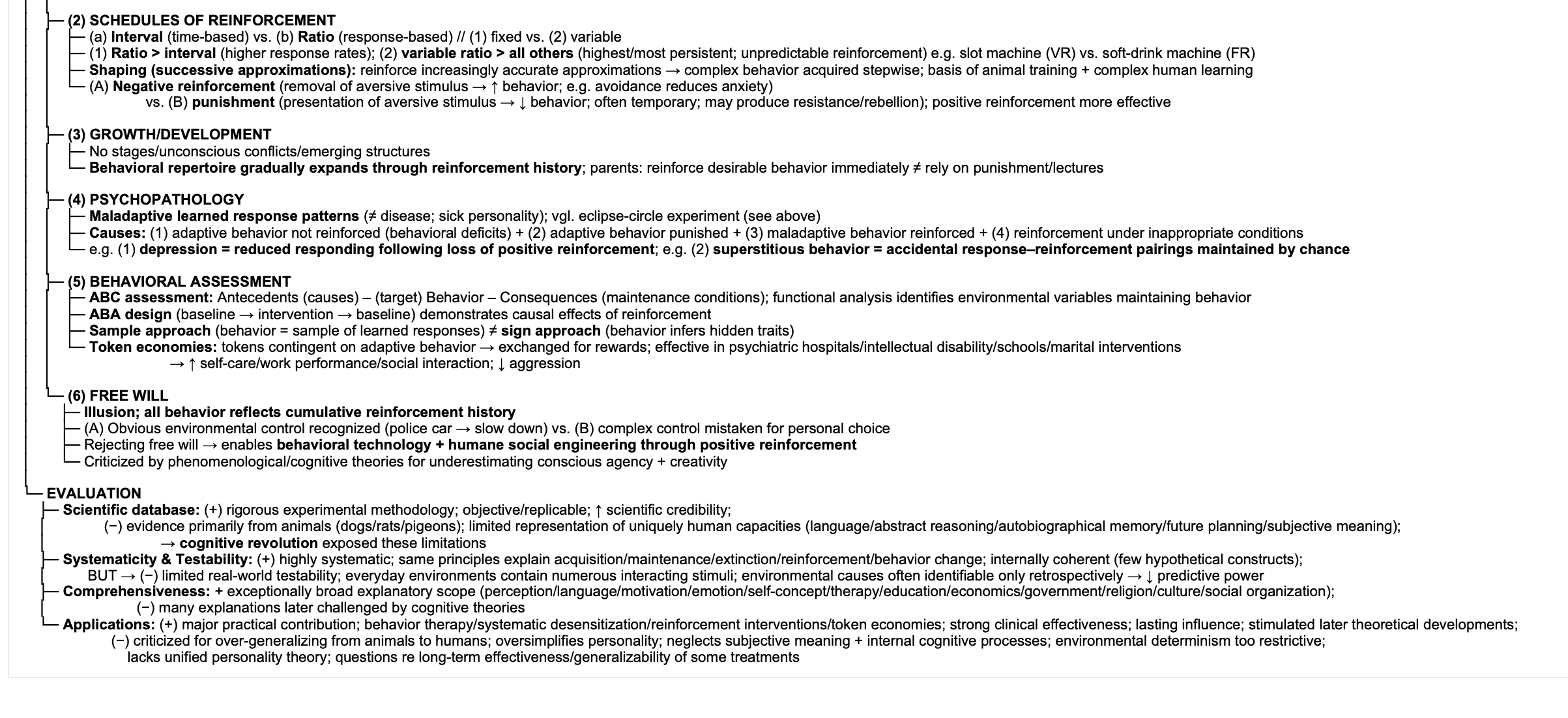
Evaluation
Scientific database:
+ rigorous experimental methodology; objective, replicable evidence; strengthened psychology’s scientific credibility.
− evidence primarily from animals (dogs; rats; pigeons); limited representation of uniquely human capacities (language; abstract reasoning; autobiographical memory; future planning; subjective meaning!!); cognitive revolution exposed these limitations.
Systematicity & Testability:
+ highly systematic; same learning principles explain acquisition; maintenance; extinction; reinforcement; behavior change; internally coherent partly because few hypothetical constructs.
− limited real-world testability; laboratory predictions strong, but everyday environments contain numerous interacting stimuli; environmental causes often identifiable only retrospectively (e.g. through asking) → reduced predictive power.
Comprehensiveness:
+ exceptionally broad explanatory scope; applied learning principles to perception; language; motivation; emotion; self-concept; psychotherapy; education; economics; government; religion; culture; social organization.
− many explanations later challenged by cognitive theories.
Applications:
+ major practical contribution; behavior therapy; systematic desensitization; reinforcement-based interventions; token economies; strong clinical effectiveness; lasting influence on modern treatment; stimulated later theoretical developments.
− criticized for generalizing too readily from animal research to humans; oversimplifies personality; neglects subjective meaning and internal cognitive processes; environmental determinism too restrictive; lacks a fully unified personality theory; questions remain regarding long-term effectiveness/generalizability of some treatments.
Describe classical conditioning.
Classical conditioning (Pavlov); learning by association; foundation of behaviorism (Watson) and explanation of personality/emotional development.
Watson: founder of behaviorism; observable behavior > introspection; mentalistic explanations rejected; experimental science + learning principles replace speculative constructs.
Basic mechanism: NS + biologically meaningful US (naturally elicits UR) repeatedly paired → NS becomes CS; CS → CR (learned emotional/physiological response); responses learned, not chosen; e.g., food (US) → salivation (UR); bell (CS) → salivation (CR).
Learning principles: (1) Generalization (CR spreads to similar stimuli; fear of one dog → many dogs); (2) discrimination (learn only specific stimuli predict US); (3) extinction (CS repeatedly without US → association weakens/disappears) // explain acquisition; maintenance; modification; disappearance of emotional responses.
Applications:
(E.g.) Physiology: drug tolerance; drug-associated environmental cues = CS → conditioned compensatory physiological responses before drug intake → tolerance; BUT in unfamiliar environment → failure of tolerance → increased overdose risk.
(E.g.) Food preferences: likes; dislikes; disgust = conditioned emotional responses; generalization (contaminated milk → disgust toward all milk); explains cultural differences; modifiable through new conditioning.
(!) Psychopathology: experimental/acute neuroses (Pavlov); impossible discrimination (circle vs. ellipse) → behavioral disorganization; pathology = maladaptive learning, not internal disease.
Little Albert: conditioned emotional response; white rat (NS/CS) + loud noise (US) → fear (CR); generalization to white furry objects (e.g., Santa beard); supports learned fears vs. psychoanalytic conflict explanation.
Behavior therapy – Systematic desensitization (Wolpe): anxiety = learned response; counterconditioning (relaxation incompatible with anxiety); relaxation training → anxiety hierarchy (least → most feared) → gradual imagined exposure while relaxed → fear replaced by relaxation; transfers to real situations; challenges symptom substitution of psychoanalysts! (no new symptom if learned response removed).
(E.g.) Jones (Peter); rabbit phobia reduced by counterconditioning (rabbit + pleasant stimuli/food; observing fearless children also contributed); extinction/generalization of improvement to fur coat; feathers; cotton wool.
(E.g.) Little Hans reinterpretation: horse phobia = accumulated frightening horse experiences + horse collapse → conditioned fear; recovery = extinction/counterconditioning, not Oedipal conflict or insight; learning explanation > psychoanalytic explanation.
(!) Modern developments:
Implicit conditioning (subliminal pairings → attitudes/prejudice);
Self-esteem (self-relevant words + smiling faces → increased self-esteem vs. mixed-face control);
Kandel (Aplysia): repeated CS + tail shock (US; natural gill withdrawal = UR) → strengthened synapses (↑ neurotransmitter release from interneurons → motor neurons) → stronger CR; learning stored as strengthened neural connections.
Describe operant conditioning.
Operant conditioning (Skinner);
Skinner transformed behaviorism into comprehensive philosophy of human behavior; strict environmental control; laboratory experimentation; elementary laws of behavior; practical applications (teaching machines; Walden Two; behavior-change technologies); positive reinforcement > coercion.
Learning through consequences of behavior (≠ stimulus associations in classical conditioning); voluntary behavior acquired, maintained, modified by reinforcement/punishment;
Environmental consequences (≠ internal mental states) determine behavior → basis for personality, psychopathology, assessment, behavior change, free will.
Theory of personality: internal structures (traits; motives; unconscious) unnecessary;
(1) Response = basic structural unit; (1.1) elicited responses (triggered by known stimuli) vs. (1.2) operants (emitted spontaneously; future frequency determined by consequences); learning = selection/strengthening of emitted behaviors.
Basic mechanism: response → reinforcement → ↑ future response probability; reinforcer defined functionally (increases behavior; varies across individuals); generalized reinforcer (!) (e.g., money → access to many reinforcers); Skinner box demonstrates lawful effects of environmental consequences.
Schedules of reinforcement: (a) interval (time-based) vs. (b) ratio (response-based);
(1) fixed vs. (2) variable // ratio > interval (higher response rates) // variable ratio > all others (highest, most persistent responding; unpredictable reinforcement); e.g. slot machine (variable ratio) vs. soft-drink machine (fixed ratio).
Shaping (successive approximations): reinforce increasingly accurate approximations → complex behavior acquired stepwise; basis of animal training and complex human learning.
Negative reinforcement vs. punishment: negative reinforcement = removal of aversive stimulus → ↑ behavior (e.g., avoidance reduces anxiety); punishment = presentation of aversive stimulus → ↓ behavior; punishment often temporary; may produce resistance/rebellion; positive reinforcement more effective.
Growth/development: no stages; unconscious conflicts; or emerging structures; behavioral repertoire gradually expands through reinforcement history; parents should reinforce desirable behavior immediately rather than rely on punishment/lectures.
Psychopathology: maladaptive learned response patterns (≠ disease; sick personality); causes: (1) adaptive behavior not reinforced (behavioral deficits); (2) maladaptive behavior reinforced; (3) adaptive behavior punished; (4) reinforcement under inappropriate conditions
E.g. 1: depression = reduced responding following loss of positive reinforcement; E.g. 2: superstitious behavior = accidental response–reinforcement pairings maintained by chance.
Behavioral assessment: ABC assessment (Antecedents (causes) – (target) Behavior– Consequences (maintenance conditions)); functional analysis identifies environmental variables maintaining target behavior;
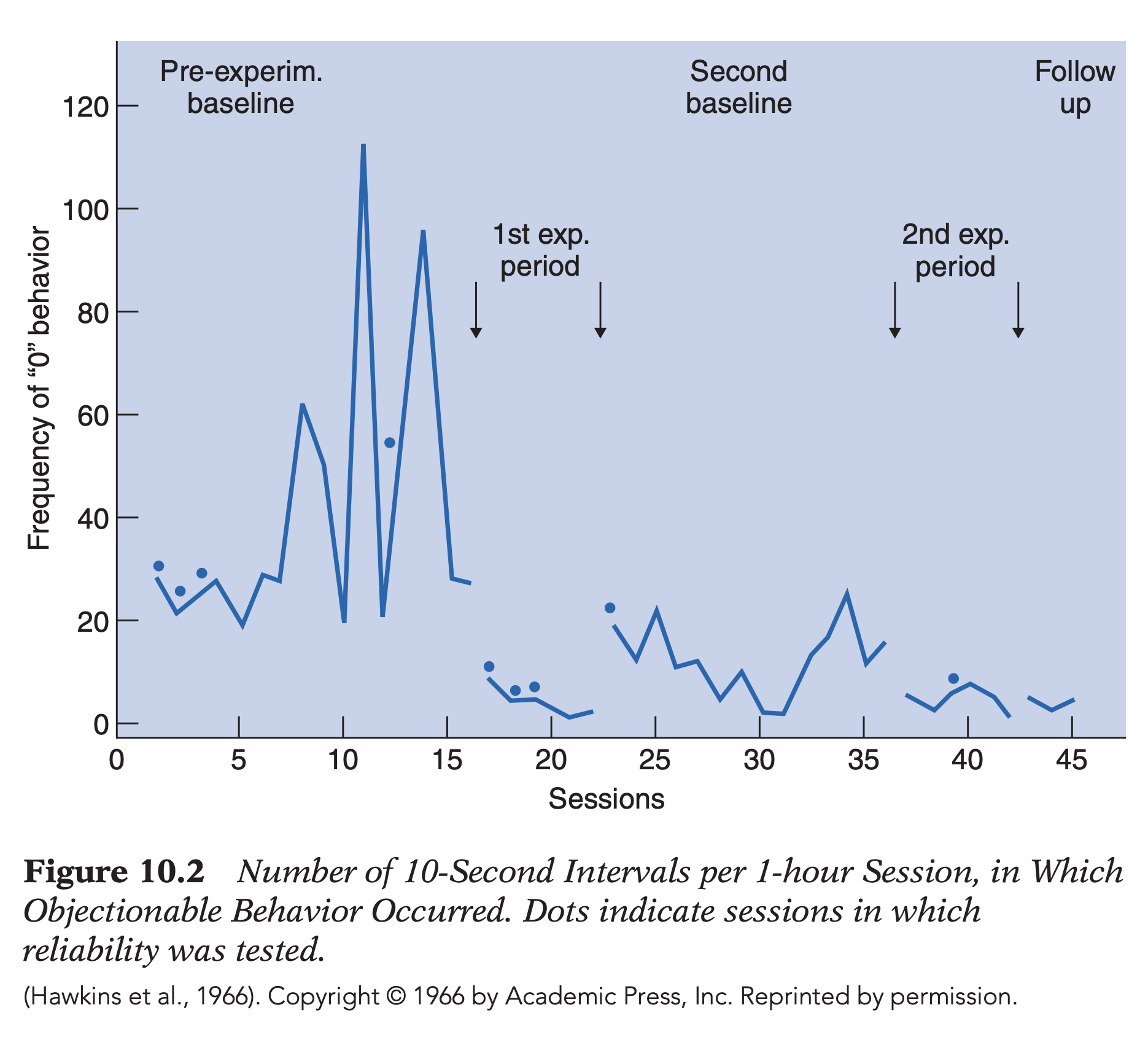
ABA design (baseline → intervention → baseline) demonstrates causal effects of reinforcement; (1) sample approach (behavior = sample of learned responses) ≠ (2) sign approach (behavior infers hidden traits).
Behavior change: token economies (tokens contingent on adaptive behavior → exchanged for rewards); effective in psychiatric hospitals; intellectual disability; schools; marital interventions; ↑ self-care; work performance; social interaction; ↓ aggression; environment redesigned to reinforce desired behaviors.
Free will: illusion; all behavior reflects cumulative reinforcement history; obvious environmental control recognized (e.g., police car → slow down), complex control mistaken for personal choice; rejecting free will enables behavioral technology and humane social engineering through positive reinforcement; criticized by phenomenological/cognitive theories for underestimating conscious agency and creativity.
Tree (PKP Ch. 10) 1/2
Tree (PKP Ch. 10) 2/2