Molecular Genetics Causes of Aneuploidy and Translocation
 Studied by 10 people
 Call Kai
 Learn
Learn Practice Test
 Spaced Repetition
 Match
Match Flashcards
 Knowt Play
1/15

There's no tags or description
Looks like no tags are added yet.
Name | Mastery | Learn | Test | Matching | Spaced |
|---|
No study sessions yet.
16 Terms
Normal M1 division
Homologous chromosomes separate during MI. One of the pair of homologous chromosomes ends up in a bar body and the other ends up in what will be the egg.

What is a polar body?
Polar bodies are formed during oogenesis (a type of meiosis). The result of oogenesis is one usable egg and three unusable polar bodies that have the DNA from the other three sister chromatids.
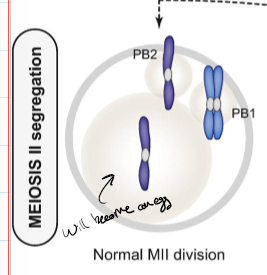
Normal MII division
Of the pair of sister chromatids, one ends up in a usable ovum and the other ends up in a second bar body.
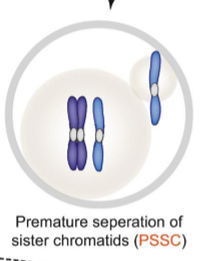
Premature separation of sister chromatids (PSSC)
three chromatids end up in what will become the ovum and the one polar body (that should have a pair of sister chromatids) only has one chromatid. One pair of sister chromatids separated too early and creates a trisomy.
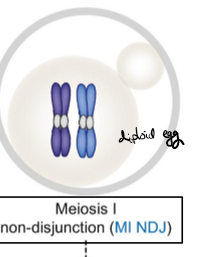
Meiosis I non-jisjunction (MI NDJ)
The two pairs of homologous chromosomes don’t separate, and the ovum ends up with all 4 chromatids. The polar body ends up with nothing. The egg is diplid
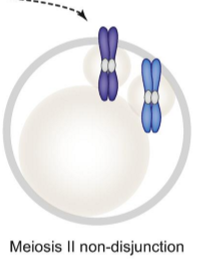
Meiosis II non-disjunction
One pair of sister chromatids didn’t separate like it should. So the two polar bodies that are present at the end of MII have all 4 chromatids and the ovum has no DNA at all. This happens have a normal meiosis I
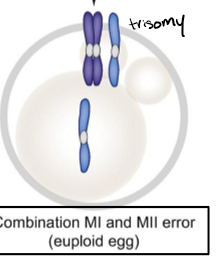
Combination MI and MII error (euploid egg)
After meiosis I non-disjunction, one pair of sister chromatids separates like it should but the other three chromatids end up in one polar body. This will create a normal egg with the correct amount of DNA but the polar body will have a trisomy.
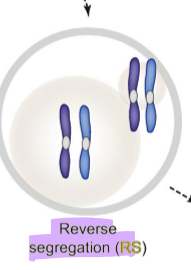
Reverse segregation (RS)
Sister chromatids separate first during Meiosis I instead of the homologous chromosomes. In the ovum, there is one chromatid from each pair of sister chromatids, the polar body also has one of chromatid from each pair of sister chromatids.
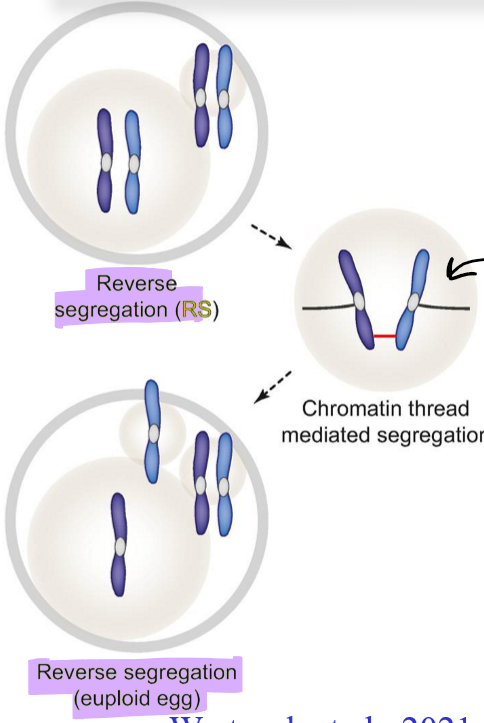
Reverse segregation: euploid egg
After the sister chromatids separated and one from each pair was placed into the ovum and polar body, meiosis 2 continues as normal. Two chromatids end up in one polar body, and one chromatid ends up in the second polar body. The ovum also has the correct amount of DNA (one chromatid).
Chromatin thread mediated segregation
Happens after reverse segregation and causes a euploid (normal) egg. DNA between the two non-sister chromatids gets tangled up and the two chromatids end up getting dragged together to a polar body. This results in the correct amount of DNA in both polar bodies and the ovum.
Reciprocal Translocation
One pair of sister chromatids end up in an egg.
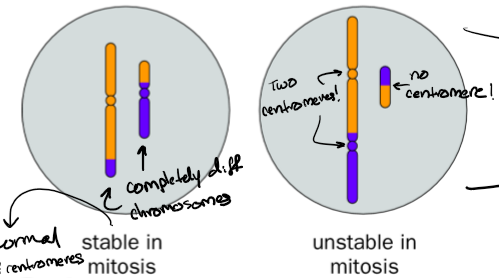
acentric fragments exchange: It looks like crossing over happens. If only acentric fragments are exchanged, both chromatids are stable in mitosis because they both end up with a centromere
centric and acentric fragment exchanged: after crossing over happens (I think that’s what’s going on), one chromatid will end up with two centromeres and the other chromatid will end up with no centromeres. The little chunk with no centromeres is unstable during mitosis because it can’t separate properly
Robertsonian Translocation
Recombination happens between centric and acentric regions. One chromatid is stable (has two centromeres), and one will be lost (doesn’t have any centromeres at all). The chromatid with the centromeres have them touching in the center. While the other chunk is made up of two satellites (I’m not really sure what these are)

How does triploidy happen in humans?
two sperm fertilize one egg
a 2n egg (has twice as much genetic material as it should) gets fertilized by a normal (n) sperm
a normal egg is fertilized by a 2n sperm (the sperm has twice as much genetic material as it should)
What is aneuploidy?
An umbrella term for an abnormal number of chromosomes
Ways to get a triploid genome?
two (normal) sperms fertilize an egg with the correct number of chromosomes **most common
a diploid (2n) egg gets fertilized by a normal (n) sperm
a normal egg (n) gets fertilized by a diploid sperm (2n)
How to get a tetraploid genome?
haploid sperm fertilizes haploid egg (everything is normal so far). Then endomitosis happens: the chromosomes duplicate normally, but the cells don’t undergo cytokinesis and one cells now has twice as much DNA as it should (4n)