Union Test Prep Electronics Information Part 3
 Call Kai
 Learn
Learn Practice Test
 Spaced Repetition
 Match
Match Flashcards
 Knowt Play
1/51

There's no tags or description
Looks like no tags are added yet.
Name | Mastery | Learn | Test | Matching | Spaced | Call with Kai | Chat |
|---|
No analytics yet
Send a link to your students to track their progress
52 Terms
What is a half-wave rectifier?
A circuit that uses a diode to allow only the positive half of an AC wave to pass, converting AC into pulsating DC.
What is a full-wave rectifier?
A circuit that uses two diodes and a center-tapped transformer to convert AC into pulsating DC by using both the positive and negative halves of the AC wave.
Why is it called "pulsating DC"?
The output is not smooth DC like a battery, and it is only positive pulses:
What are the parts of a half-wave rectifier?
AC source → provides alternating electricity
Diode → blocks one direction
Load resistor → uses the converted electricity
What is a center-tapped transformer?
A transformer with a special connection in the middle of its secondary coil. It allows the circuit to use both halves of the AC wave separately.
Why is the output called "pulsating DC"?
The electricity is always moving in the same direction, but it is not perfectly smooth.
What do diodes control?
They control the direction of the current.
What are transistors?
They are three-terminal semiconductor components used to regulate current and voltage in a circuit.
What do transistors do?
They amplify current and act as electrical switches.
What is a solid-state device?
Solid-state refers to the use of a solid material to control electrons or electron flow.
What is an example of a solid-state device?
The transistor since it is made from solid silicon.
What is a NPN transistor?
A transistor made up of a thin layer of P-type material sandwiched between two layers of N-type material.
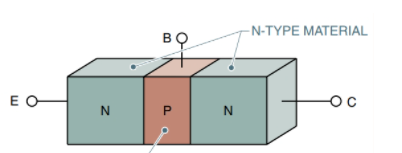
What type of transistor is this?
NPN transistor
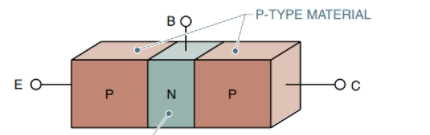
What type of transistor is this?
PNP transistor
What is a PNP transistor?
A transistor made up of a thin layer of N-type material sandwiched between two layers of P-type material.
What is the base?
The region between the collector and emitter that acts as a control switch. A small current at the base allows a much larger current to flow from the emitter to the collector.
What does the base control?
It controls the flow between the emitter and collector.
What is the collector?
The region that attracts and collects charge carriers. Current flows from the emitter to the collector and then leaves the transistor to power the circuit.
In what order does current flow for: emitter, and collector?
The current flows from the emitter to the collector and then out from the collector.
What is the emitter?
The part of a transistor that sends charge carriers through the base toward the collector.
What is electricity?
The energy produced from the motion of charged particles.
What creates magnetic fields?
Moving charged particles
What makes up the electromagnetic force?
The force that combines electricity and magnetism because they are two parts of the same phenomenon.
What causes a magnetic fields?
A magnetic field is created by the motion of charged particles, such as electrons.
Where do magnetic fields occur at a atomic scale?
They occur inside atoms as electrons move around the nucleus.
Where do magnetic fields occur at a macroscopic scale?
They occur in circuits as electric current flows through wires.
What is an electromagnet?
It is a a coil of wire wrapped around a metal core.
What happens to the electromagnets you turn the electricity off?
There is no current. It only works when electricity is flowing.
What is the makeup of an inductor?
They are made of a core that is usually magnetic with a conductive wire wrapped around it
What type of electrical component is an inductor?
They are a passive electrical component
How do inductors interact with currents?
They oppose currents through the generation of a counter-electromotive force (EMF)
What happens when a large current reaches an inductor?
The inductor creates a proportionally large, opposing EMF that diminishes the current.
What is inductance?
It is the capacity with which the inductor creates a proportionally large, opposing EMF that diminishes the current reaching an inductor
What is impedance?
The total opposition to AC current. that is caused by resistance, inductors, and capacitors. It is the AC equivalent of resistance in a DC circuit.
What is a transformer?
A device that changes AC voltage by using changing magnetic fields between two coils.
What is the makeup composition of a transformer?
They consist of two inductors in close proximity that differ in the number of wrapped coils.
What does the difference in the number of coils on a transformer result in?
The number of coils determines the output voltage. A changing magnetic field transfers energy from the primary coil to the secondary coil.
Transformers convert high voltage to….
low voltage
Transformers convert low voltage to….
high voltage
What is a motor?
A machine that converts electric energy into mechanical energy
What is a generator?
A machine that converts mechanical energy to electric energy
How are motors and generators related to each other?
They are intrinsically linked because they are opposites that convert energy between electrical and mechanical forms.
How does an electric motor convert electrical energy into mechanical energy?
A motor uses a looped wire carrying current placed inside a magnetic field. The magnetic field creates a force on the wire, causing it to rotate and produce mechanical motion.
What causes the wire inside a motor to rotate?
The force from a magnetic field acting on a current-carrying wire causes the wire to rotate.
What is a commutator?
A part of a motor that switches the direction of current in the wire loop, allowing the motor to continue rotating in the same direction.
What is an electrical energy generator?
a machine that converts mechanical energy into electrical energy by rotating a current-carrying wire inside a magnetic field.
What is Ohm’s law?
An electrical law describing the relationship between voltage, amperage, and resistance.
What metal is the best conductor?
Copper
What is the best conductor of electricity?
Silver
Copper is used in most wires because it is:
Highly conductive
Affordable
Easy to bend
What is a circuit?
A complete path that electricity travels through.
What is an electrical circuit?
A complete path that allows electric current to flow.