Chapter 12 Nonrenewable Energy Resources (Modules 34-36)
 Call Kai
 Learn
Learn Practice Test
 Spaced Repetition
 Match
Match Flashcards
 Knowt Play
1/31

There's no tags or description
Looks like no tags are added yet.
Name | Mastery | Learn | Test | Matching | Spaced | Call with Kai |
|---|
No analytics yet
Send a link to your students to track their progress
32 Terms
Fossil Fuel Vs Nuclear Fuel
Fossil: a fuel deroved from biologiccal material that became fozilized millions of years ago
Nuclear: fuel derived from radioactive materials that give off energy
Commercial vs Subsistence Energy Source
Commercial: an energy source that is bought and sold (coal, oil, natural gas, can be wood/ charcoal)
Subsistence: an energy source gathered by individuals for their own immediate needs
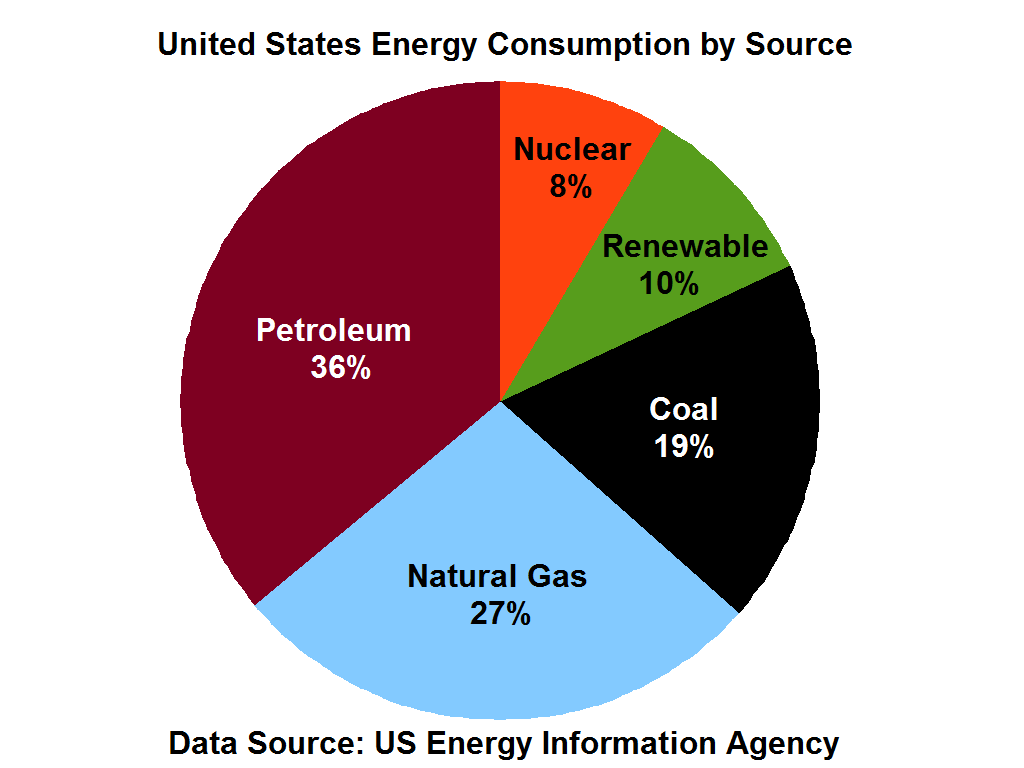
US energy supplies from highest % to lowest %
Oil, Natural Gas, Coal, Renewable Energy, Nuclear Fuel
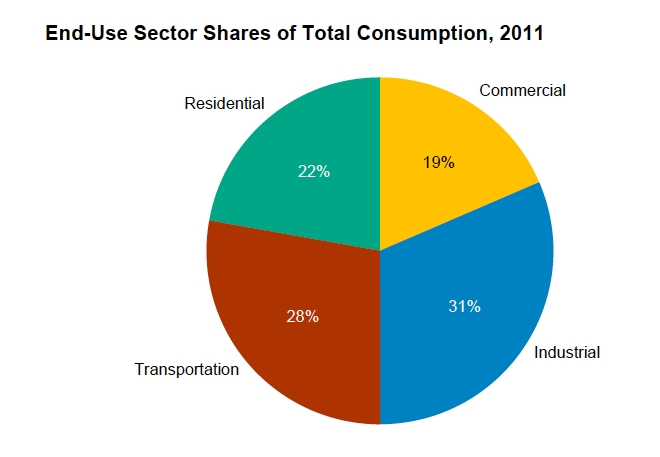
US Energy Usage from highest % to lowest %
Industrial, Transportation, Residential, Commercial
EROEI
Energy Return On Energy Investment: the amount of energy we get out of an energy source for every unit of energy expended on its production.
EROEI= (energy obtained from the fuel) / (energy invested to obtain the fuel)
higher values mean high efficiency
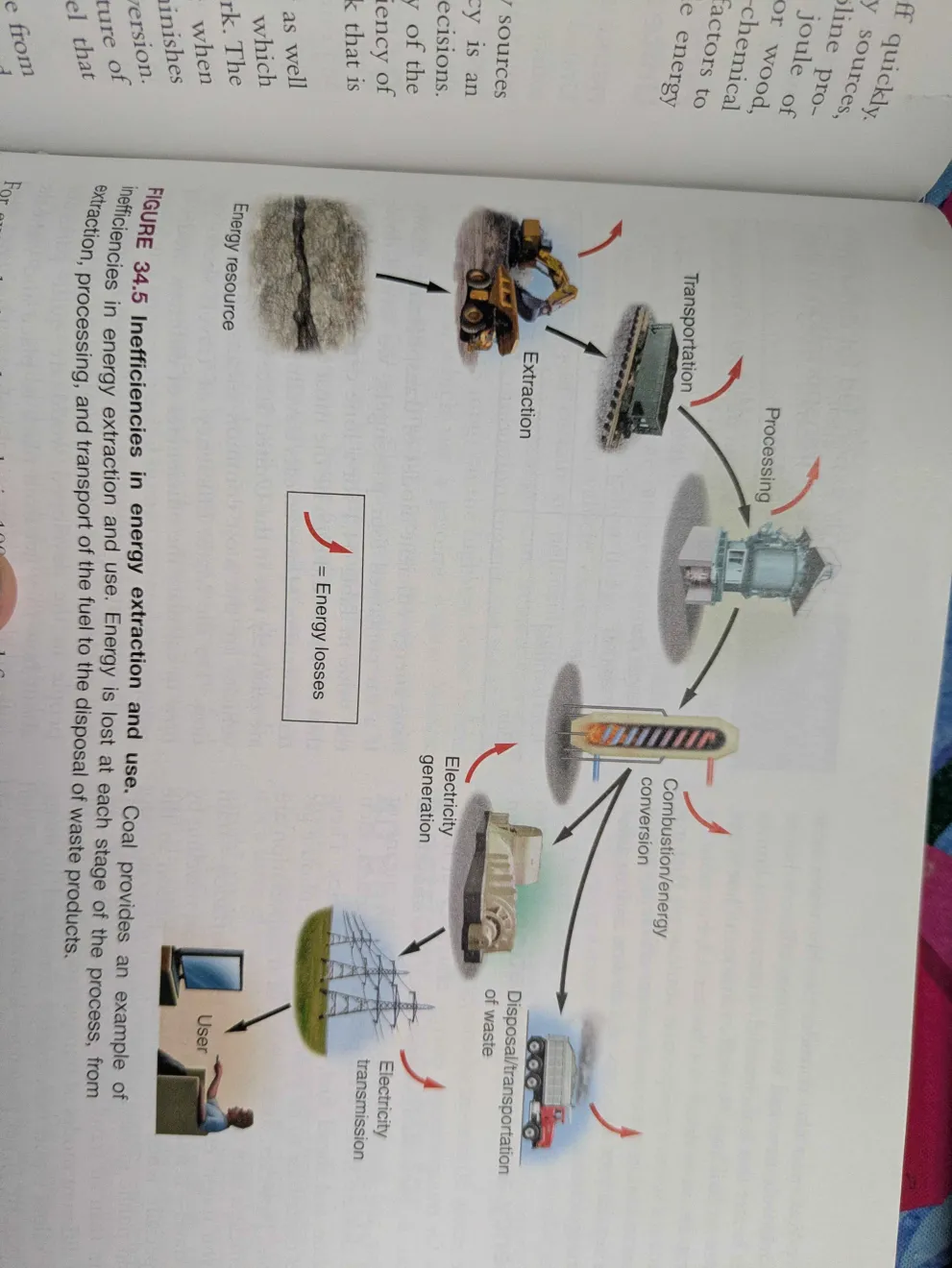
Energy Loss Examples
What mode of transportation do we expend the most energy on in the US
Passenger Car (driver alone)
Energy Carrier
Something that cam move and deliver energy in a convenient, usable form to end users. Electricity is one.
Coal Energy Production Process

Turbine: a device that can be turned by water, steam, or wind to produce power
Electrical Grid: a network of interconnected transmission lines that joins power plants together and links them with end users of electricity
Combined Cycle
A power plant that used both exhaust gases and steam turbines to generate electricity. Up to 60% efficient
Capacity and Capacity Factor
Capacity: in reference to an electricity-generating plant, the maximum electrical output.
Capacity Factor: the fraction of time a power plant operates in a year.
Cogeneration
AKA Combined Heat and Power. The use of a fuel to generate electricity and produce heat.
Which Energy Source does not originate from the sun?
A. Coal
B. Solar
C. Oil
D. Nuclear
D. Nuclear
Which is a secondary energy source?
A. Solar
B. Coal
C. Electricity
D. Nuclear
C. Electricity
Coal
A solid fuel formed primarily of the remains of trees, ferns, and other plant materials preserved 280 million to 360 million years ago. There are three types:
Peat: 0 years, 50m thick. Ancient forests cover the surface. Vegetation dies and is buried, forming peat (partially decomposed organic matter)
Lignite: Millions of years, 10m thick. As peat becomes buried, it is compressed into lignite.
Bituminous Coal: Hundreds of Millions of years, 5m thick. Increased pressure as lignite is buried further compresses into soft bituminous coal.
Anthracite: 280-360 million years, 3m thick. More pressure turns soft bituminous into harder anthracite. Sub-bituminous is sometimes between the two.
Coal Advantages and Disadvantages
Advantages: It is easy to extract through surface mining which takes little resources. It takes little refining before it can be burned. Easy to transport. Readily available in many places. Fairly inexpensive.
Disadvantages: Mining tailings hurt the environment. Subsurface mining will need to be used eventually; hurts human health and is excpensive. Burning releases harmful chemicals into atmosphere.Chemicals used to wash off coal chemicals may be toxic. Coal ash spills happen.
Petroleum
A widely used fossil fuel that occurs in underground deposits, composed of a liquid mixture of hydrocarbons, water, and sulfur. It is made from the remains of ocean-dwelling phytoplankton that dies 50-150 million years ago.
Crude Oil: liquid petroleum removed from the ground
Petroleum Advantages and Disadvantages
Advantages: Easy to transport and use because of liquid for (good for mobile use in transportation). Cleaner than oil. Releases less CO2 than coal.
Disadvantages: expensive to refine and remove sulfur, lead, mercury, and arsenic traces that are released when burning. Oil extraction greatly increases oil leakage, and oil spills are detrimental. It can cause fires, hurt people, and kill of entire species.
Natural Gas
The lighter, less dense part of oil that floats to the top of pockets to be extracted. Usually extracted along with petroleum. LPG (liquid petroleum gas) is a less energy dense substitute.
Natural Gas Advantages and Disadvantages
Advantages: Because of connected vast natural gas pipelines across the US, over half of homes use it for power. It is the cleanest of the fossil fuels because it has few impurities. LPG can be used where NG doesn’t reach.
Disadvantages: Unburned gas escapes as methane, a horrible and potent greenhouse gas that is very good at trapping UV heat :(. The process of obtaining it, often fracking, is also horrible on the environment.
Oil Sands & Liquid Coal
Oil Sands: slow-flowing, viscous deposits of bitumen (a degreaded petroleum that forms when petroleum migrates to the surface of Earth and is modified by bacteria), sand, water, and clay.
Liquid Coal: CTL (coal to liquid) converts solid coal into liquid fuel. Technology has been around for decades.
Energy Intensity
The energy use per unit of gross domestic product (GDP).
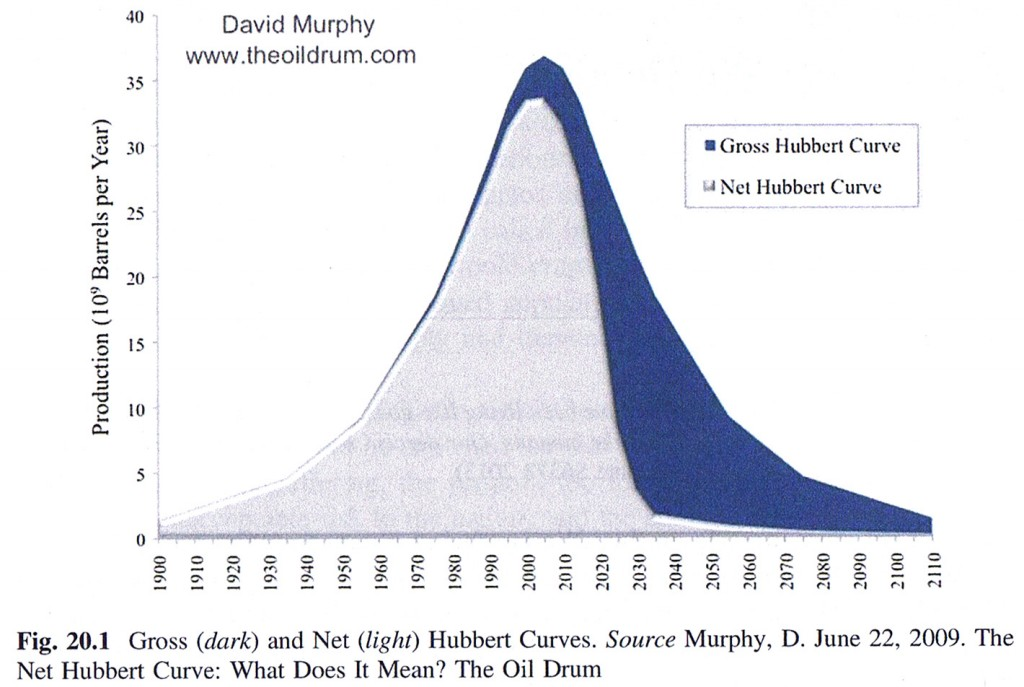
Hubbert Curve
A bell-shaped representing oil use and projecting when world oil production will reach a maximum and when the world will run out of oil.
Peak Oil: the point at which half the total known oil supply is used up.
Natural Gas is Primarily:
A.ethane
B. propane
C. Butane
D. Methane
D. Mehtane
Nuclear Power Generation

Fission:A nuclear reaction in which a neutron strikes a relatively large atomic nucleus, which then splits into two or more parts, releasing additional neutrons and energy in the form of heat.
Fuel Rod: a cylindrical tube that encloses nuclear fuel within a nuclear reactor.
Control Rod: a cylindrical device inserted between the fuel rods in a nuclear reactor to absorb excess neutrons and slow or stop the fission reaction.
Radioactive Waste
Nuclear fuel that can no longer produce enough heat to be useful in a power plant but continues to emit radioactivity. Three kinds: high-level waste like used fuel rods, low-level waste like contaminated clothes, tools, rags, and other items, and uranium mine tailings.
Units of Radiation
Becquerel (Bq): unit that measures the rate at which a sample of radioactive material decays; 1 Bq= decay of 1 atom or nucleus per second.
Curie: a unit of measure for radiation; 1 curie= 37 billion decays per second.
Nuclear Fission
a reaction that occurs when lighter nuclei are forced together to make heavier nuclei. is what happens inside the sun. requires heating material to 10x the temp inside the sun, so it will take decades to advance enough to use.
Nonrenewable Energy Fuels Comparison

Control rods slow nuclear reactions by:
A. reducing the amount of fuel available
B. Absorbing the heat produced
C. increasing the rate heat transfers to the water
D. absorbing excess neutrons
D. absorbing excess neutrons
Interest in nuclear power has recently increased because of:
A. low energy costs
B. lack of significant accidents
C. low carbon dioxide emissions
D. new solutions for waste disposal
C. low carbon dioxide emissions
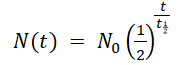
Half Life Calculations
N(t)= how much of a substance remains
N0=original amount
t= amount of time passed
t1/2= half-life