L14-ATP
 Call Kai
 Learn
Learn Practice Test
 Spaced Repetition
 Match
Match Flashcards
 Knowt Play
1/5

There's no tags or description
Looks like no tags are added yet.
Name | Mastery | Learn | Test | Matching | Spaced | Call with Kai | Chat |
|---|
No analytics yet
Send a link to your students to track their progress
6 Terms
What does ATP stand for?
What is ATPs structure?
What is the enzyme that breaks down ATP?
4.What is ATP broken down into?
5.What is the definition of Metabolism/metabolic reactions?
6.What are anabolic reactions?
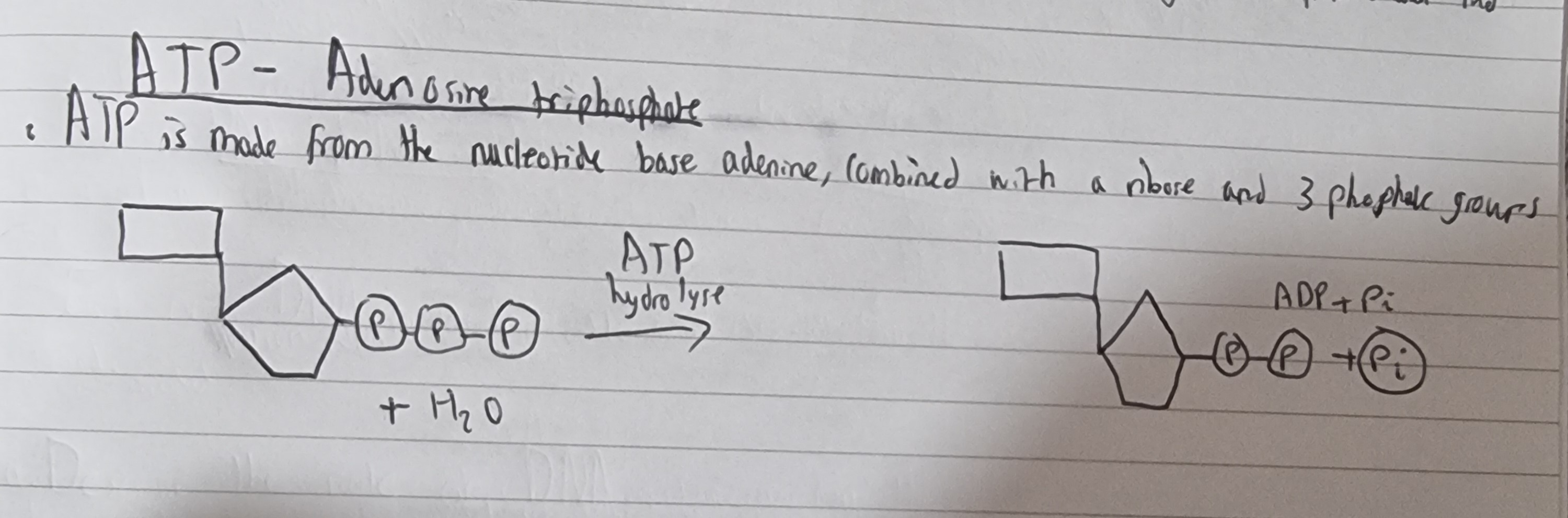
Adenosine triphosphate (ATP)
2.A nucleotide base adenine,combined with a ribose sugar and 3 phosphate groups.
ATP hydrolase
ADP + Pi
All chemical reactions that take place within living cells.
Metabolic reactions where large molecules are synthesised(made) from smaller molecules
•Plant and animal cells release energy from glucose in a process called respiration.
• A cell can't get its energy direct from glucose. So, in respiration, the energy released from glucose is used to make ATP.
What is energy?
Where is energy stored?give 3 examples.
What is light energy converted to during photosynthesis?
During respiration, energy is released from organic molecules to be used to make …4? for driving biological processes.
Name 5 processes that require ATP?
1.The capacity to do work.
In complex organic molecules e.g. lipids carbohydrates and proteins.
3.chemical energy
ATP
Endocytosis, exocytosis, protein synthesis, dna replication, active transport
Making and using ATP:
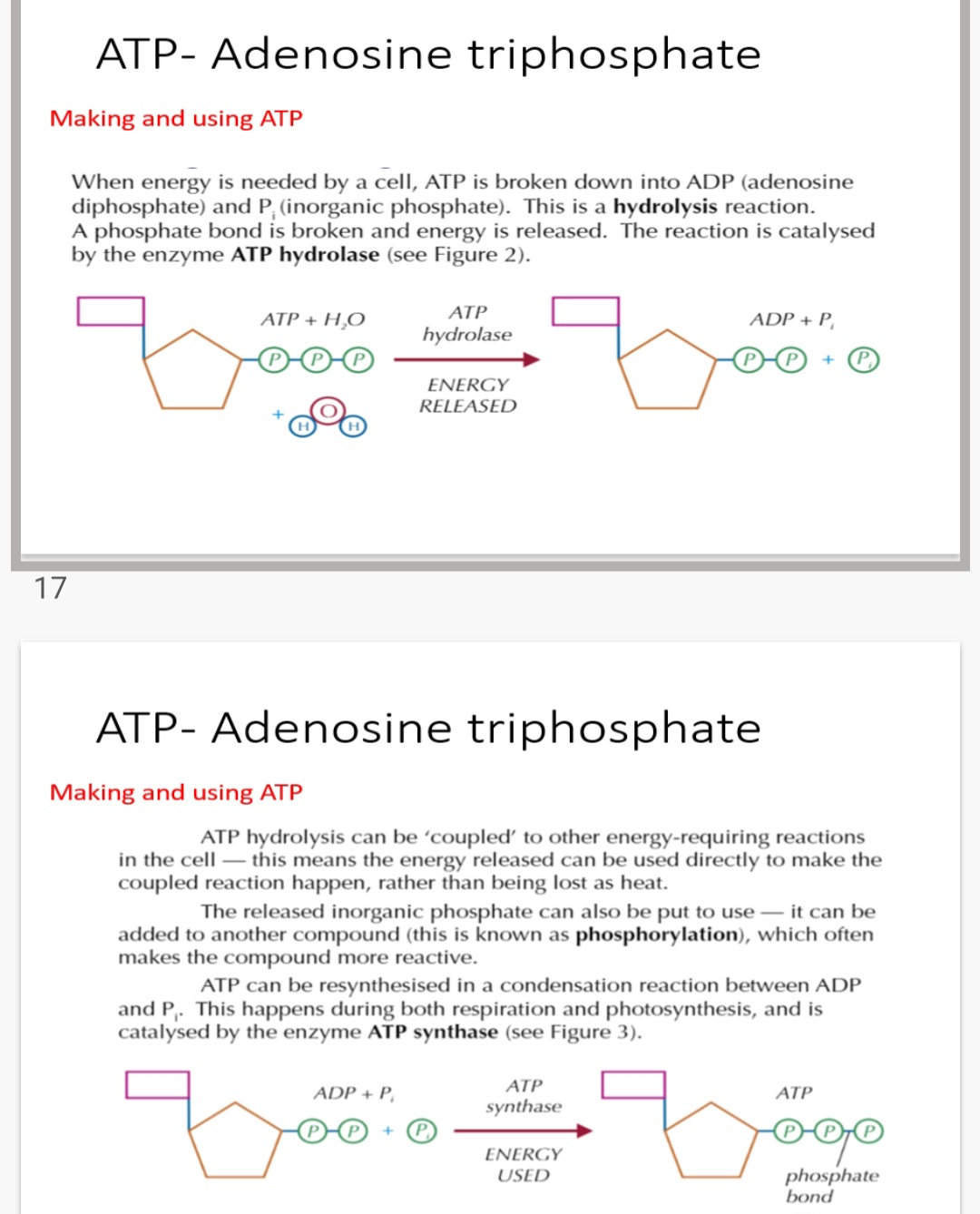
When energy is needed by a cell, ATP is broken down into ADP (adenosine diphosphate) and Pi, (inorganic phosphate). This is a hydrolysis reaction. A …1? bond is broken and energy is released. The reaction is Catalysed by the enzyme ATP …2?.
ATP hydrolysis can be '…*?' to other energy-requiring reactions in the cell - this means the energy released can be used directly to make the coupled reaction happen, rather than being lost as heat.
The released inorganic phosphate can also be put to use - it can be added to another compound (this is known as phosphorylation), which often makes the compound more …3?.
ATP can be resynthesised in a condensation reaction between …4? and Pi. This happens during both respiration and photosynthesis, and is catalysed by the enzyme ATP …5?
1.phosphate. 2.hydrolase. *coupled 3.reactive
4.ADP. 5.synthase
Info: •ATP is a phosphorylated nucleotide.
ATP Usage
I. State what is the intermediate energy source for metabolic ATP reactions? (1 mark)
2. State what happens when ATp is hydrolysed (1 mark)?
3.Describe the advantages of this hydrolysis (2 marks)?
4.Describe why ATP is referred to as the universal energy currency (2 marks)?
5. Explain why the inefficient heat from respiration hydrolysis isnt wasteful (2 marks)?
I. ATP
2.When ATP is hydrolysed to ADP+ Pi, a smail quantity of energy is released
3.ATP hydrolysis allows the cells to obtain the energy they need for a process in small manageable amounts that will not cause damage or be wasteful
4.ATP is referred to as the universal energy currency because it occurs in all living cells and is a source of energy that can be used by cells in small quantities.
5.Heat energy released from respiration and ATP hydrolysis enables enzyme-catalysed reactions by helping them stay on or near their optimum rate.
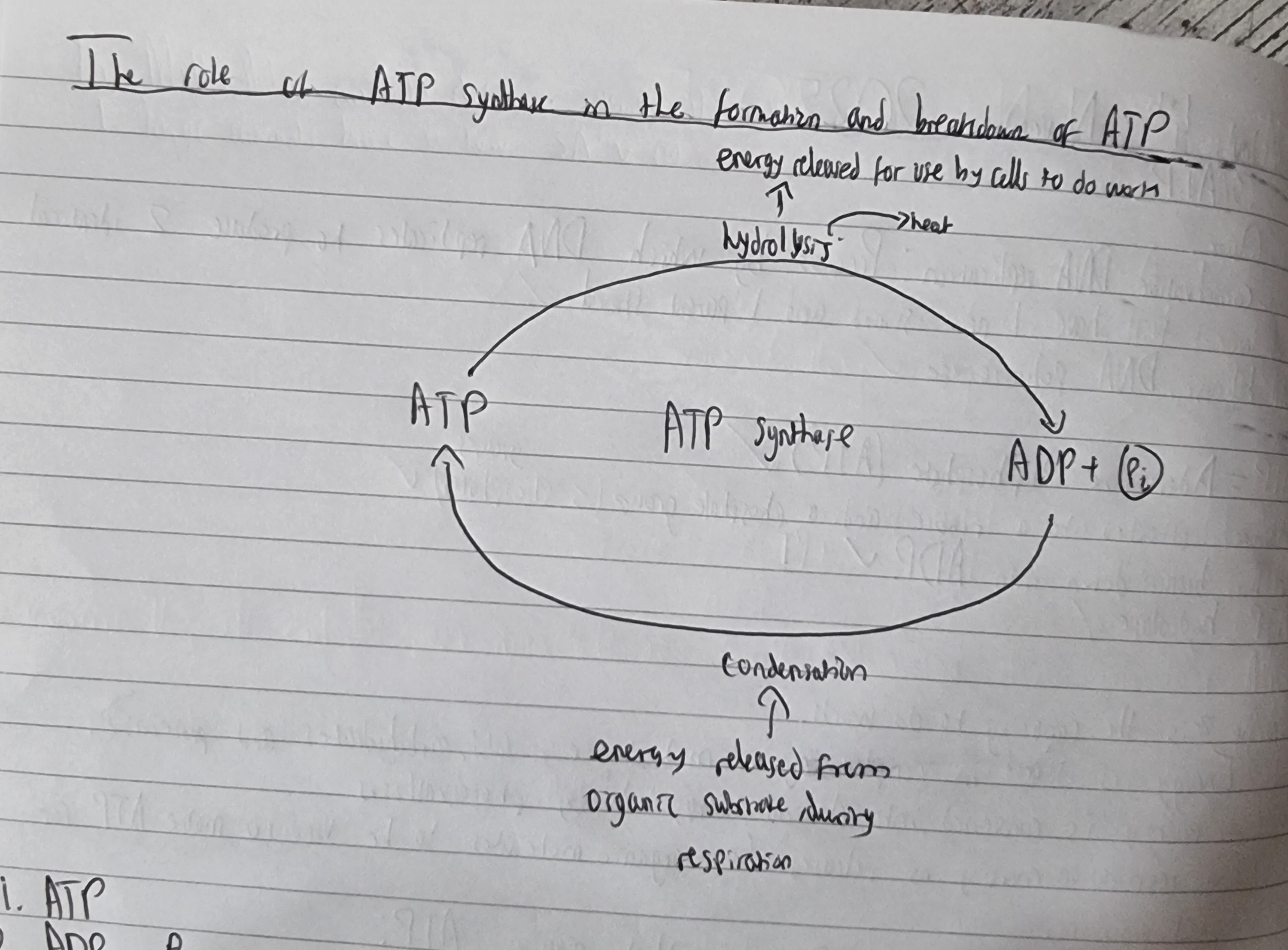
The role of ATP synthase in the formation and breakdown of ATP:
1. ATP → ADP + Pi (Hydrolysis):
This reaction breaks down ATP into ADP (adenosine diphosphate) and Pi (inorganic phosphate).
The enzyme ATP hydrolase catalyses this reaction.
Energy is …1? when the bond between the second and third phosphate group is broken.
The released energy is used by cells for processes like:
Muscle contraction
Active transport
Protein synthesis
Equation: ATP → ADP + Pi + energy
2. ADP + Pi → ATP (Condensation):
•This is the formation of ATP from ADP and inorganic phosphate.
•The enzyme ATP …2? catalyses this reaction.
•It requires energy, which usually comes from respiration (energy released from organic substrates).
•This is a …3? reaction because water is released when the phosphate bonds form
Equation:
👉 ADP + Pi + energy → ATP + H₂O
•This cycle of processes happen constantly in cells to provide continuous supply of energy.
1.released. 2.synthase. 3.condensation
Name 4 advantages of ATP and 3 disadvantages?
A:
• Immediate energy source: ATP releases energy very quickly through hydrolysis, making it ideal for processes that need instant energy (e.g. muscle contraction).
•Releases small, manageable amounts of energy: This prevents energy loss as heat and avoids damaging cells.
•Easily regenerated: ATP can be rapidly reformed from ADP and Pi during respiration, ensuring a constant supply.
•Universal energy carrier: All cells use ATP, so it acts as a common “energy currency” in all living organisms.
D:
•Not suitable for long-term energy storage: ATP can only store small amounts of energy and must be continually regenerated.
•Small energy yield per molecule: Each molecule of ATP releases only a small amount of energy, so large amounts are needed for big energy demands.
•Constant production needed: Because ATP breaks down quickly, cells rely on continuous respiration to maintain ATP levels.