Paul Wilson
 Call Kai
 Learn
Learn Practice Test
 Spaced Repetition
 Match
Match Flashcards
 Knowt Play
1/80

Earn XP
Description and Tags
about organic conjugated polymers
Name | Mastery | Learn | Test | Matching | Spaced | Call with Kai | Chat |
|---|
No analytics yet
Send a link to your students to track their progress
81 Terms
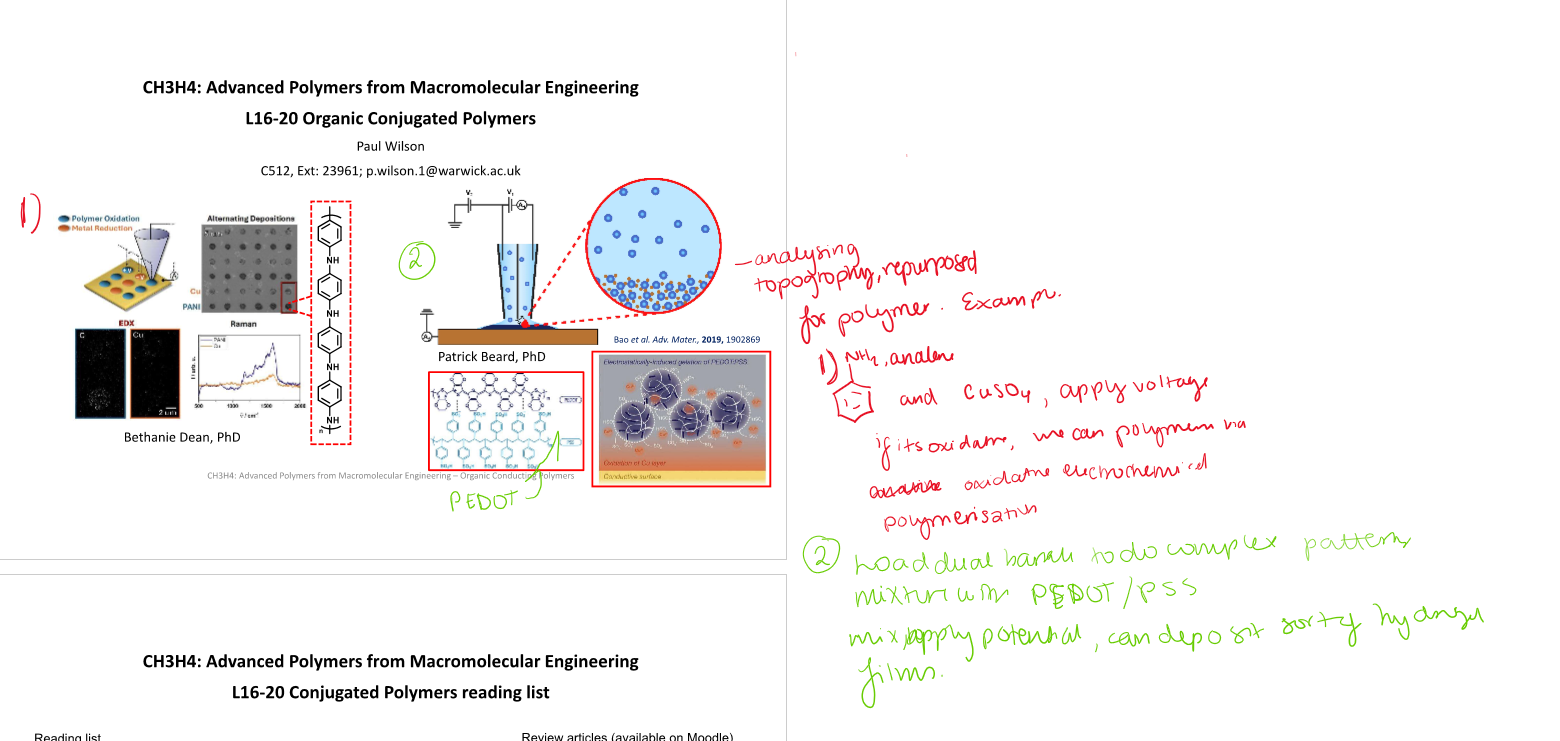
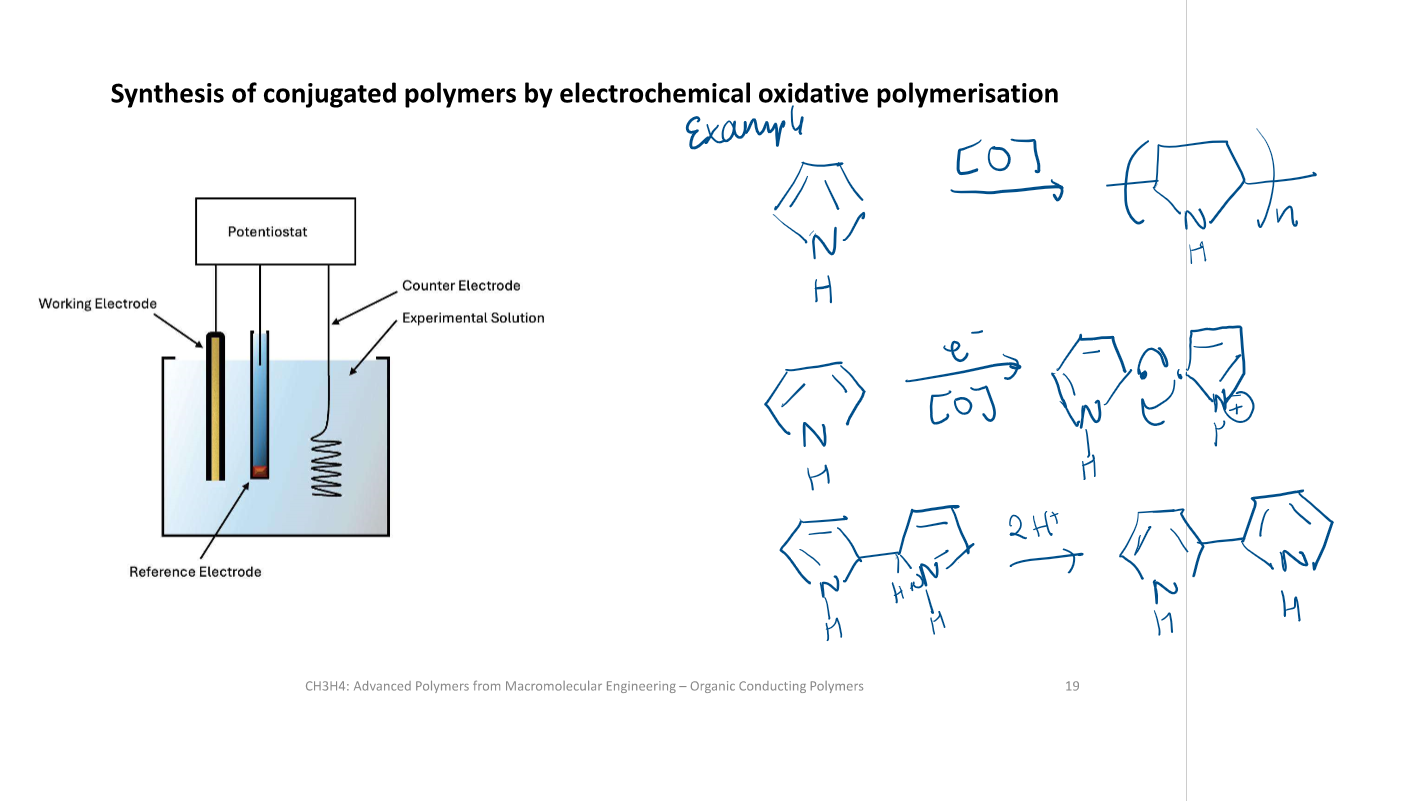
What is electrochemical oxidative polymerisation?
Polymerisation initiated by applying a voltage. The monomer is oxidised to radical cations, which couple together to form a conjugated polymer directly on an electrode surface.
Why is PEDOT:PSS widely used?
PEDOT is electrically conductive, while PSS disperses it in water and makes it processable into thin conductive films by printing, coating or spraying
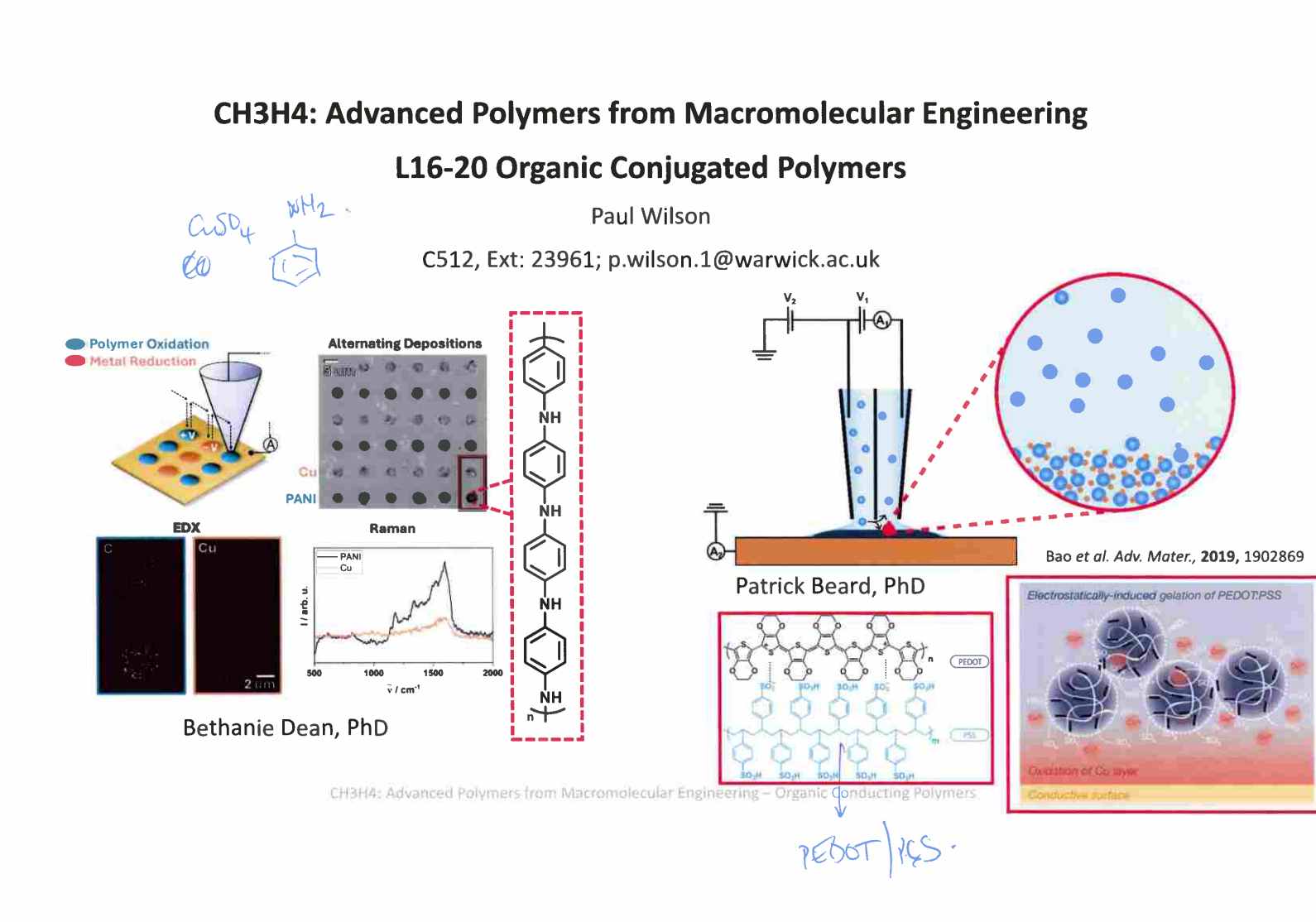
Advantages of electrochemical polymerisation?
No chemical initiator required.
Polymer grows directly on electrodes.
Excellent spatial control.
Thin conductive coatings.
Useful for electronic devices.
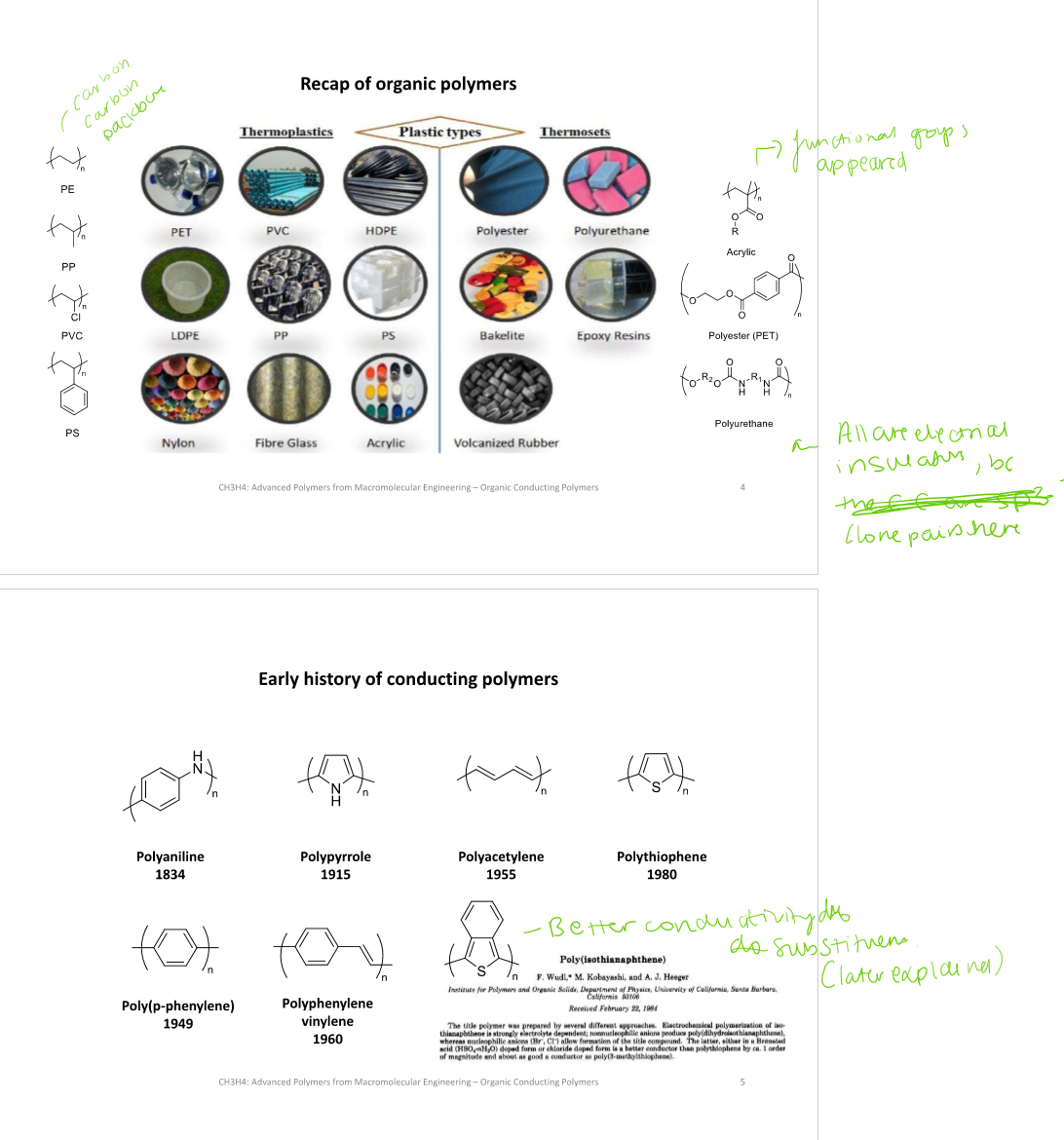
why are molecules with carbon carbon back bone electrical insulators and whats the difference between the right and left side
Each carbon is sp³ hybridised.
That means:
electrons are locked inside σ bonds
electrons cannot move
no delocalisation
therefore electricity cannot flow
On the right side, you have acrylic or functional group added stuff.
but they dont conduct, bc the back bone isnt conjugated, so still therefore electrical insultaors
why cant diamond generate charge carriers but graphene can
Diamond is sp3 so each carbon atom is connected to another carbon
graphene is sp2, meaning theres an electron free to move
polyethylene
polyacetylene
polydiacetylene
using these three comapre electronic strucutre
polyethylene has sp3 in polymer
acetylene has sp2 in polymer, bc unsaturated, pi system introduces charge carriers
polydiacetylene has sp and sp2, bc adjacent pi system illicit electric type properties
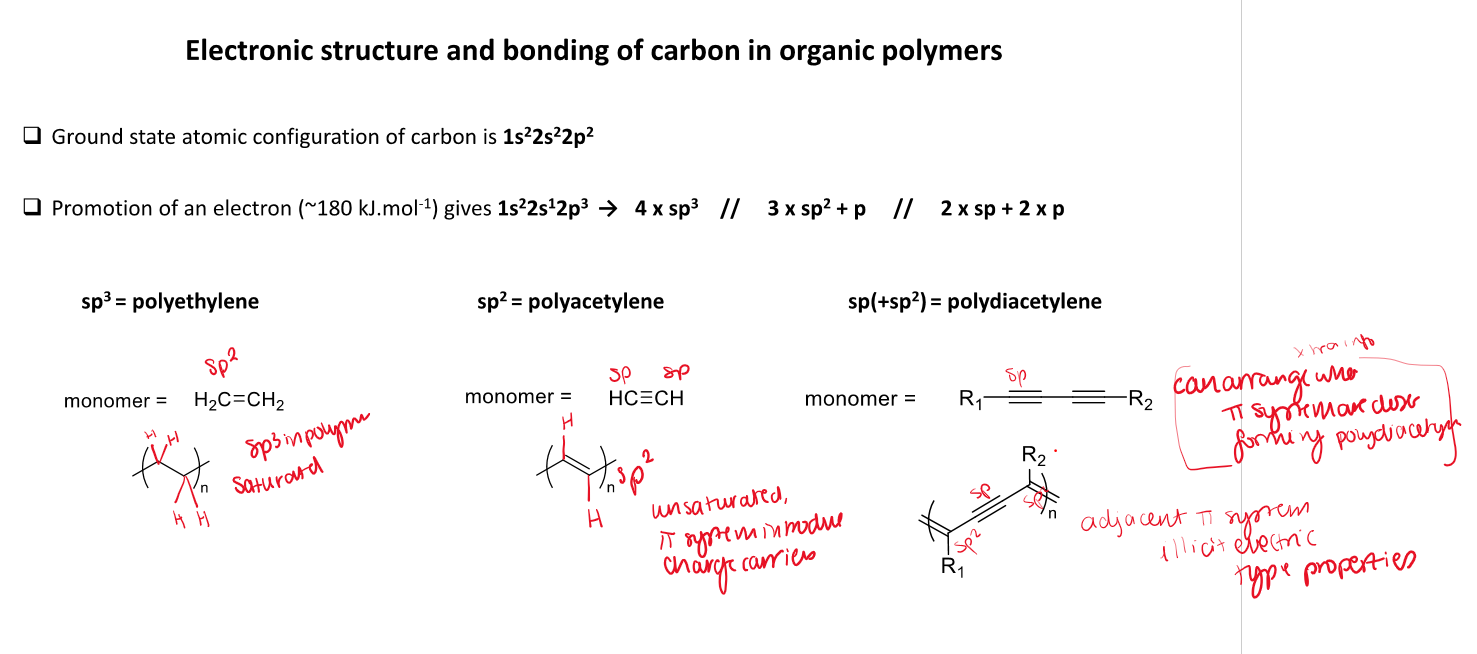
Why can adjacent p orbitals overlap in polyacetylene?
Every carbon atom in polyacetylene is sp² hybridised, meaning it uses three sp² orbitals to form σ bonds and has one unhybridised p orbital remaining. These p orbitals are all parallel and overlap sideways with neighbouring p orbitals, creating one continuous π-electron system (conjugation) along the entire polymer chain.
Why is conjugation important?
Conjugation is a continuous sequence of overlapping p orbitals created by alternating single and double bonds. Instead of electrons being trapped in one double bond, the π electrons become delocalised across many atoms, allowing electrons to move much more freely through the polymer and giving rise to electrical conductivity after doping.
Why does polyacetylene contain alternating single and double bonds?
The alternating bonds keep every carbon atom sp² hybridised. This means every carbon contributes one p orbital to the conjugated system. If consecutive single bonds were present (sp³ carbons), the p orbital would be lost and conjugation would be interrupted.
Think:
What happens when many p orbitals overlap in a conjugated polymer?
Rather than forming many isolated π bonds, all the overlapping p orbitals combine into one extended π-electron system. This behaves like one enormous molecular orbital spread across the polymer chain, allowing electrons to be delocalised over hundreds or even thousands of carbon atoms.
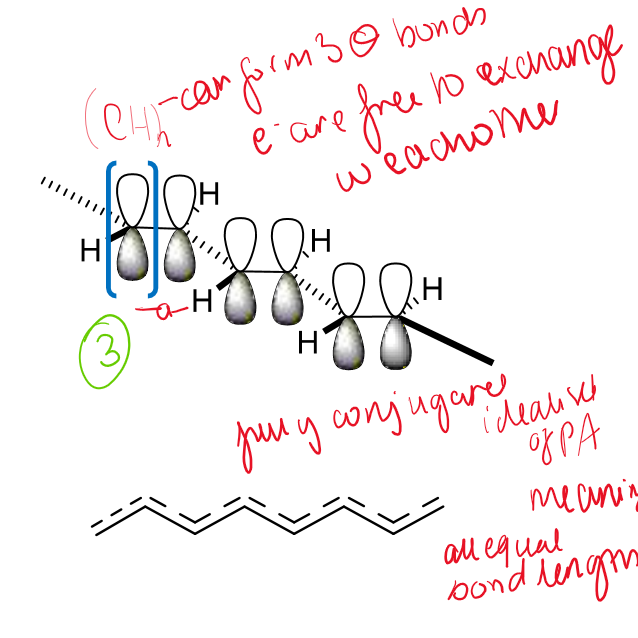
Why do the molecular orbitals have different energies?
The p orbitals can combine in different ways. Orbitals where the electron waves reinforce each other (constructive interference) have lower energy and are more stable. Orbitals with more sign changes (nodes) have higher energy because electron density is less effectively shared.
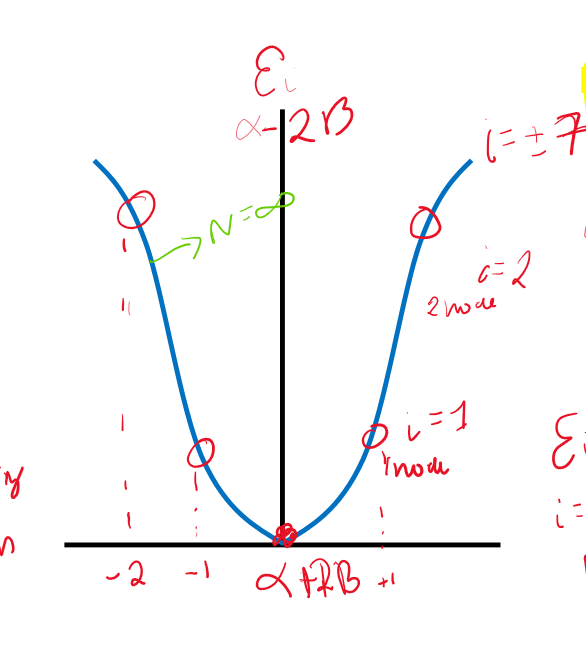
What information does the equation
Ei=α+2βcos(2πi/N)
give?
It predicts the energy of each π molecular orbital in the conjugated chain.
Where:
α = average energy of an isolated p orbital
β = interaction (overlap) between neighbouring p orbitals
N = number of carbon atoms in the conjugated chain
i = molecular orbital number
You don't usually need to derive it—just know what each term means.
Why is the number of carbon atoms (N) important?
Increasing N increases the number of molecular orbitals while decreasing the energy spacing between them. As N becomes very large (like in polymers), these orbitals merge into continuous energy bands, giving polymers semiconductor-like behaviour.
What is the wave vector k and why is it introduced?
he wave vector k describes the electron wave travelling through the repeating polymer structure (the crystal lattice). It replaces simply numbering molecular orbitals and allows the electronic states of an infinitely long polymer to be described using band theory.
k=2πi/Nα
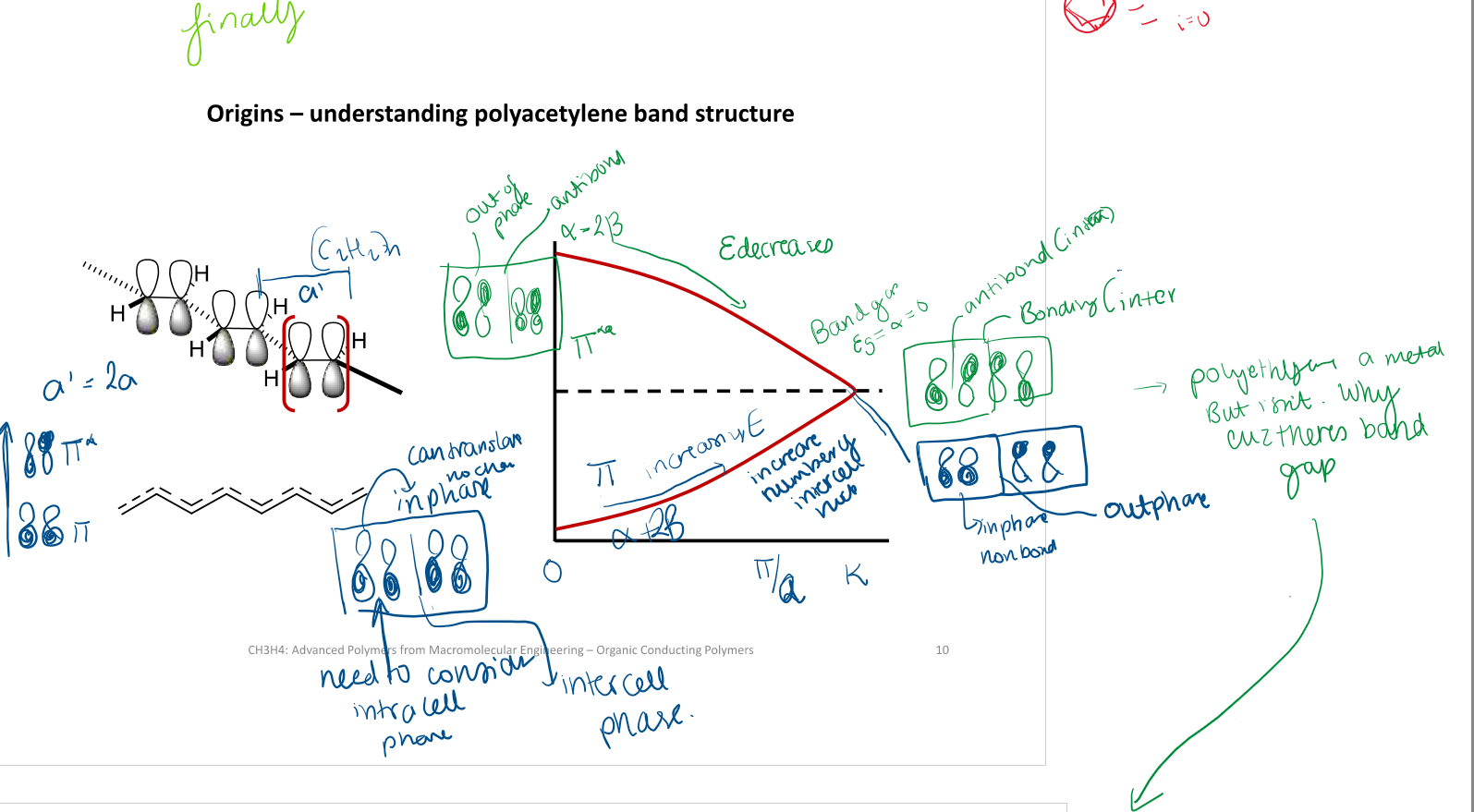
Why does polyacetylene form one continuous π-electron system instead of separate double bonds?
Every carbon atom in polyacetylene is sp² hybridised, leaving one unhybridised p orbital on each carbon. These p orbitals are all parallel and overlap sideways with neighbouring p orbitals, so instead of many isolated π bonds, they form one continuous delocalised π system across the whole polymer.
Think:
One p orbital per carbon
↓
All overlap together
↓
One giant π cloud
Why does overlapping p orbitals create both bonding (π) and antibonding (π*) orbitals?
Orbitals can overlap in two ways:
In phase → electron waves reinforce each other → electron density forms between the nuclei → bonding π orbital (low energy).
Out of phase → electron waves cancel → node forms between nuclei → antibonding π orbital (high energy).*
So every overlap always creates one bonding and one antibonding orbital.
Why are there continuous π and π* bands instead of just one π and one π* orbital?
Two carbon atoms only produce 2 molecular orbitals. However, a polymer contains thousands of carbon atoms, so thousands of p orbitals combine to produce thousands of molecular orbitals. These orbitals become so closely spaced that they appear as continuous energy bands, shown as the red curves.
Rule:
Number of p orbitals = Number of molecular orbitals formed.
Why does the energy change as you move from left to right across the band structure?
Moving across the graph changes the phase relationship between neighbouring p orbitals.
Left side → orbitals are almost completely in phase → maximum bonding → lowest energy.
Middle → overlap becomes weaker → energy changes.
Right side → orbitals become out of phase → antibonding interactions increase → highest energy.
So the graph shows how different electron wave patterns have different energies.
What do the parameters α and β represent in the band structure?
α = energy of an isolated p orbital before it interacts with neighbouring atoms.
β = strength of overlap (interaction) between neighbouring p orbitals.
A larger β means stronger overlap, greater splitting between π and π* bands, and better electron delocalisation.
What is the meaning of the wave vector, kkk, on the x-axis?
The x-axis is not distance along the polymer. Instead, k labels the different standing electron waves that can exist in the repeating polymer chain. Different values of k correspond to different phase relationships between neighbouring p orbitals, producing different energies.
Looking only at this graph, why would an ideal polyacetylene chain be expected to behave like a metal?
In the ideal case, the π (bonding) band and π (antibonding) band meet in the middle*, meaning there is no band gap. Electrons could move into empty energy states without needing extra energy, which is exactly how a metal behaves
If the π and π* bands touch, why is real polyacetylene not metallic?
Real polyacetylene undergoes bond alternation (Peierls distortion). Instead of all C–C bonds being identical, alternating single and double bonds have slightly different lengths. This causes the touching π and π* bands to separate, creating a band gap. Because electrons now need energy to cross this gap, polyacetylene behaves as a semiconductor rather than a metal.
What is Peierls distortion?
Peierls distortion is the spontaneous change in bond lengths in a one-dimensional conjugated polymer. Instead of every bond being identical, the polymer alternates between shorter double-bond-like (~1.35 Å) and longer single-bond-like (~1.45 Å) bonds because this lowers the total energy of the system.
This is exactly what your lecturer has labelled:
How does Peierls distortion change the π and π* bands?
In the ideal polymer, the π (bonding) and π (antibonding)* bands touch, meaning there is no band gap. After Peierls distortion, the alternating bond lengths split these bands apart, creating an energy gap (Eg) of approximately 1.5 eV.
Why does the band gap stop polyacetylene behaving like a metal?
A metal has no band gap, so electrons can move into empty energy states with almost no energy. In polyacetylene, Peierls distortion creates a band gap, meaning electrons must first gain enough energy to move from the π (HOMO/valence band) into the π (LUMO/conduction band)*. This makes polyacetylene a semiconductor, not a metal.
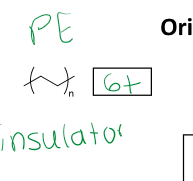
Why is polyethylene (PE) an electrical insulator while polyacetylene is a semiconductor?
PE only contains σ bonds (sp³ carbons).
-C-C-C-C-C-The electrons are trapped in localised σ bonds, so they cannot move along the chain.
Polyacetylene contains alternating single and double bonds (sp² carbons).
-C=C-C=C-C-
Each carbon contributes one p orbital, producing a delocalised π-electron system.
However, because Peierls distortion opens a band gap (Eg), electrons still need energy to conduct, so polyacetylene behaves as a semiconductor rather than a metal.
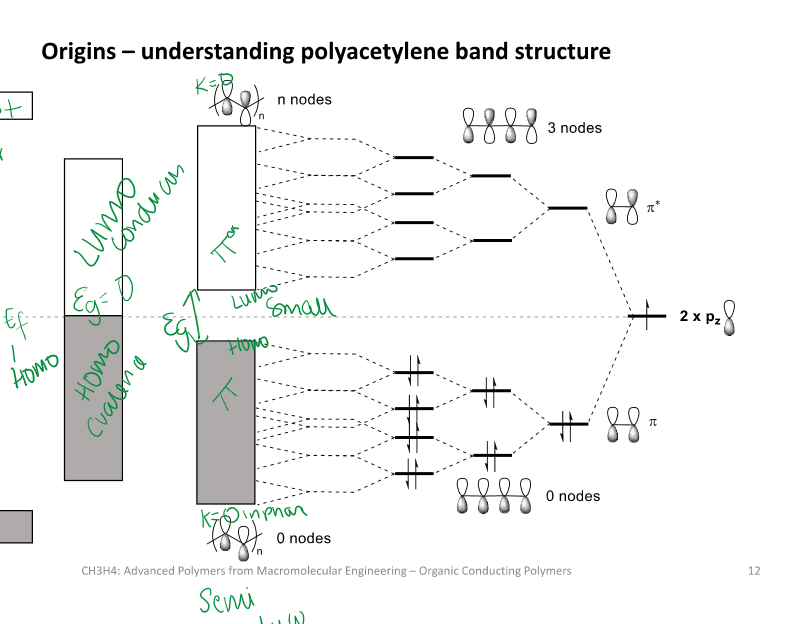
Explain how isolated p orbitals eventually become the HOMO and LUMO bands shown on the slide.
Start with one carbon atom.
1 carbon
↓
1 p orbital
Now bring two carbons together.
2 p orbitals
↓
π
π*
Now imagine hundreds of carbons.
Eventually,
the energy spacing becomes extremely small,
so the orbitals merge into continuous bands.
These become
π band (HOMO / valence band)
π band (LUMO / conduction band)*
What are the HOMO and LUMO in the band diagram of polyacetylene?
The individual molecular orbitals merge into two bands:
HOMO (Highest Occupied Molecular Orbital) = the top of the π (bonding/valence) band, where electrons normally reside.
LUMO (Lowest Unoccupied Molecular Orbital) = the bottom of the π (antibonding/conduction) band*, which is empty until electrons are excited into it.
The energy difference between them is the band gap (Eg).
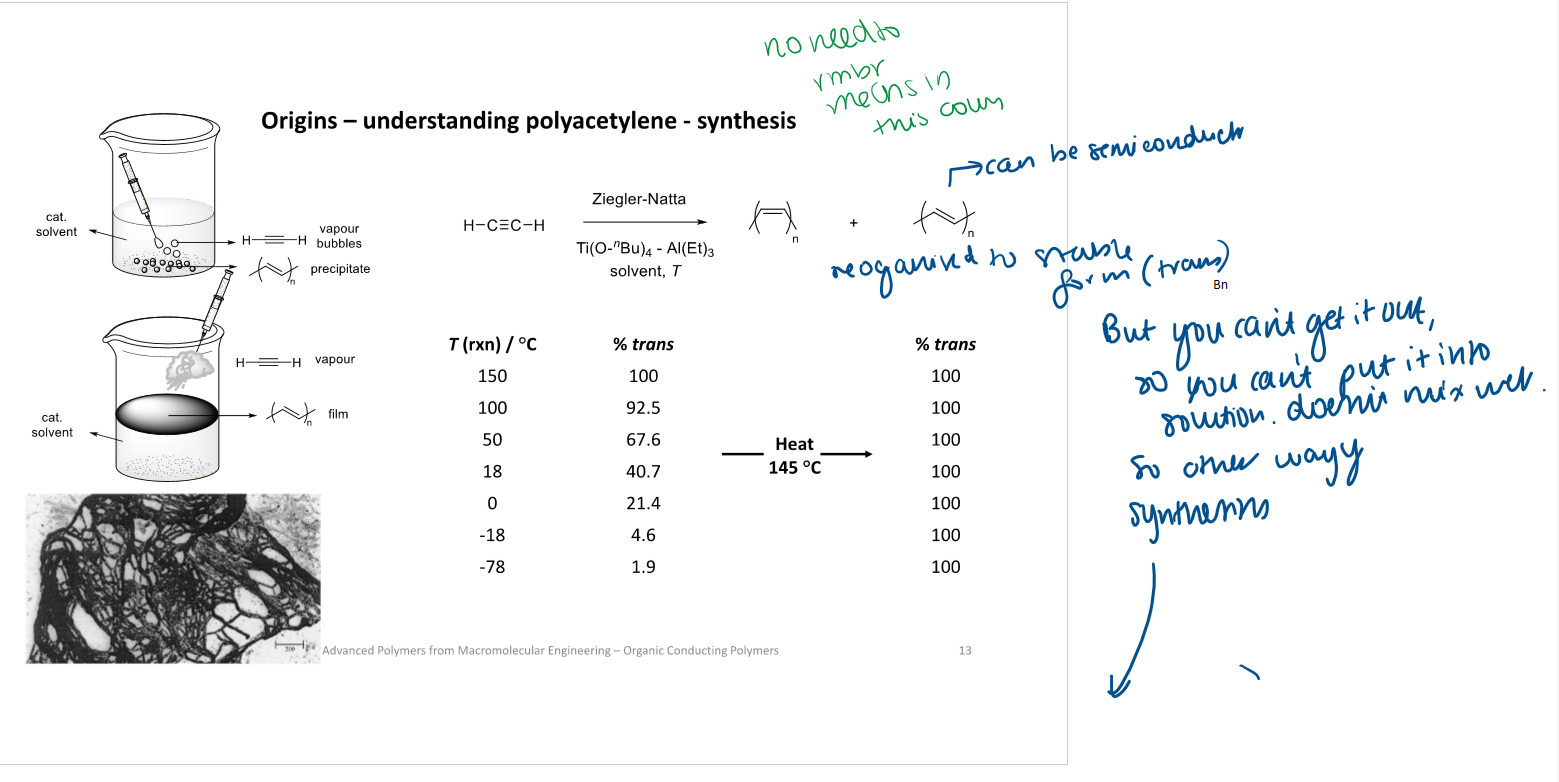
How does polymerisation temperature affect the cis/trans structure of polyacetylene?
At low temperatures, more cis-polyacetylene forms.
As the reaction temperature increases, the amount of trans-polyacetylene increases.
Heating the polymer to about 145°C converts almost all of the polymer into the trans form (≈100% trans).
The trans form is more thermodynamically stable.
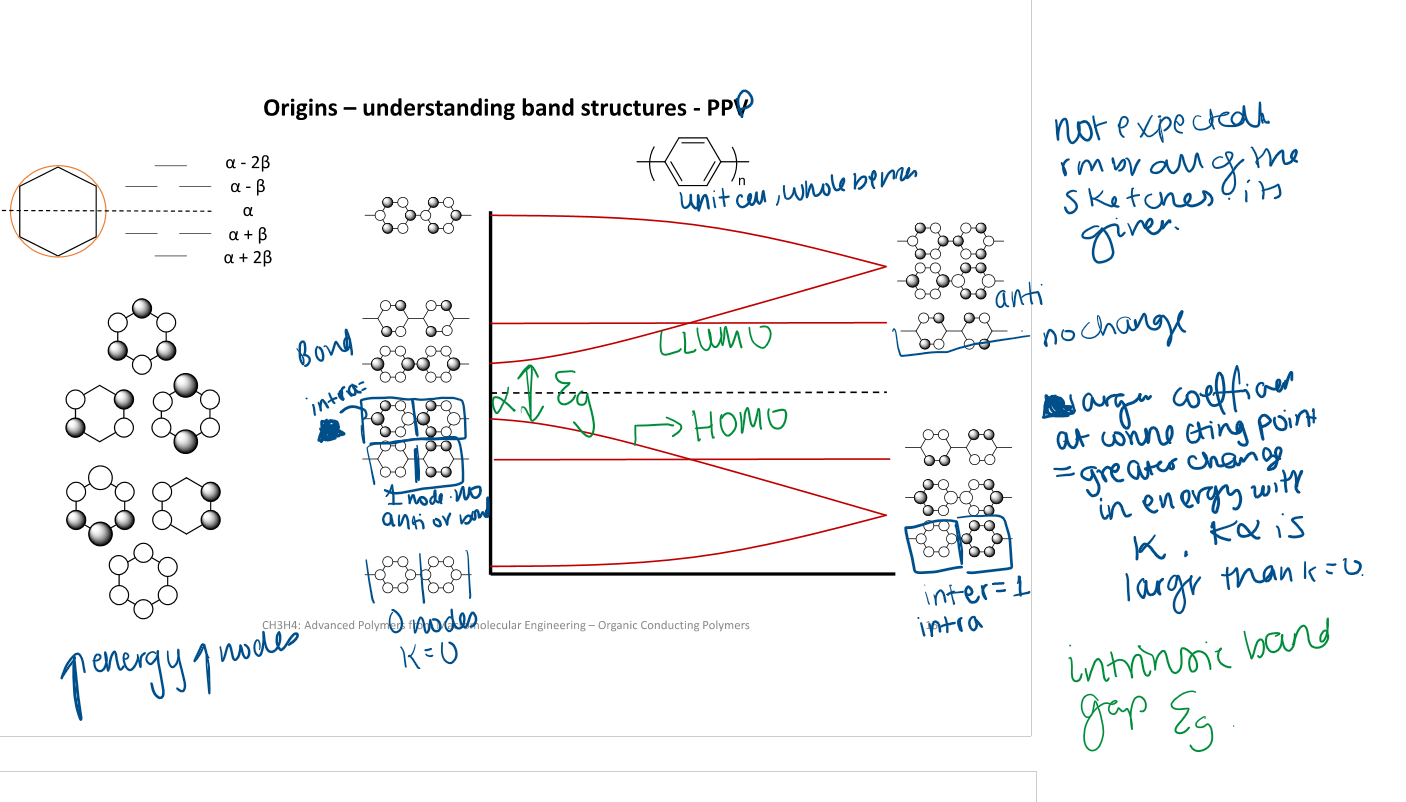
Why is the band structure of poly(p-phenylene) (PPP) more complicated than polyacetylene?
n polyacetylene, each repeat unit contributes one p orbital, giving one π band and one π* band.
In PPP, each repeat unit is a benzene ring containing six p orbitals, so many more molecular orbitals are produced.
Instead of:
polyacetylene
π
π*
PPP produces multiple bonding and antibonding bands.
Key idea:
More p orbitals in the repeat unit → more molecular orbitals → more energy bands.
What do the molecular orbital diagrams on the left represent
They show the π molecular orbitals of a single benzene ring.
Each benzene ring has:
6 p orbitals
which combine to form 6 π molecular orbitals
These orbitals have different energies:
lowest-energy = most bonding
highest-energy = most antibonding
As the number of nodes increases, the orbital energy increases.
Easy rule:
more nodes→more energy cuz more antibodning
How do the molecular orbitals of benzene become the bands shown in PPP?
Every benzene ring contributes its six π molecular orbitals.
When thousands of benzene rings join together to form PPP, each molecular orbital spreads into an energy band.
For example:
One benzene HOMO
↓
Many benzene HOMOs interacting
↓
One HOMO band
Why do some bands change very little with k, while others spread out significantly?
Band width depends on how strongly neighbouring benzene rings interact.
Orbitals with large orbital coefficients at the connecting carbon atoms overlap strongly between neighbouring rings.
Strong overlap causes the energy to change a lot as k changes → wide bands.
Orbitals with very little electron density at the connecting atoms overlap poorly → almost flat bands.
Key sentence (matches your lecturer's note):
Large orbital coefficients at the connecting atoms = greater change in energy with k.
What is the difference between intra-cell and inter-cell interactions in PPP?
Intra-cell interactions occur within one benzene ring, where the six p orbitals combine to form the benzene molecular orbitals.
Inter-cell interactions occur between neighbouring benzene rings along the polymer chain, causing those molecular orbitals to spread into energy bands.
Think of it as a two-step process:
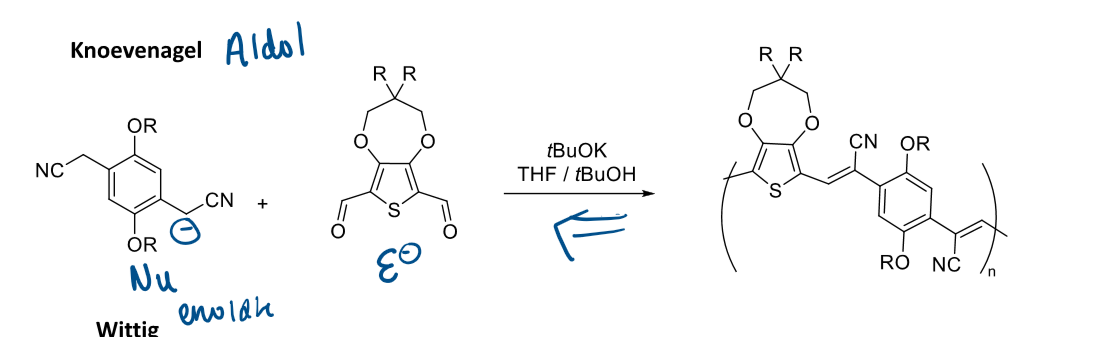
What happens during the Knoevenagel polycondensation shown on the slide?
The reaction joins an electron-poor carbonyl compound with an activated methylene compound (containing electron-withdrawing groups such as CN).
The base removes a proton to form a nucleophile, which attacks the carbonyl carbon. After elimination of water, a new C=C bond forms.
Repeating this reaction creates a fully conjugated polymer backbone.
Exam point:
The important thing isn't the mechanism.
creates conjugated C=C bonds between repeating units.
How does the Wittig reaction produce conjugated polymers?
The Wittig reaction uses:
an aldehyde/ketone, and
a phosphonium ylide.
The ylide reacts with the carbonyl group to replace the C=O bond with a new carbon-carbon double bond (C=C).
Repeating this reaction along both ends of the monomers produces a conjugated polymer.
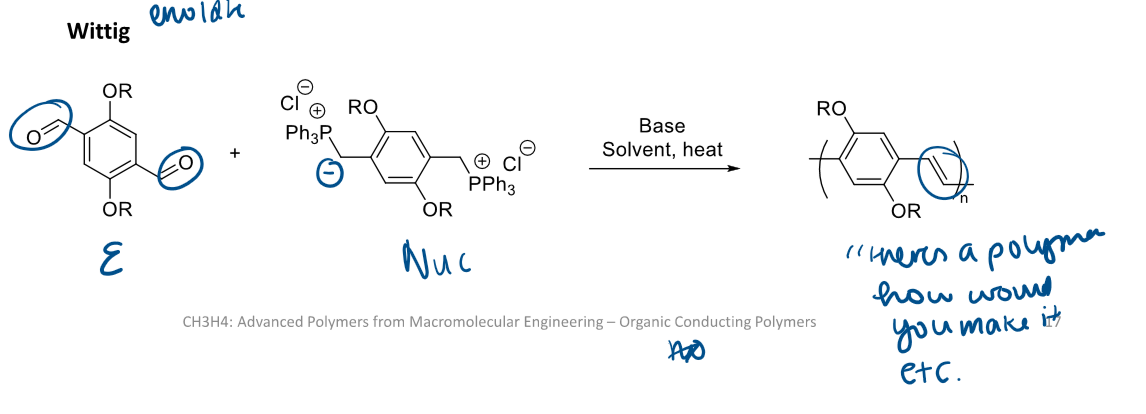
Why are Knoevenagel and Wittig polymerisations useful for conjugated polymer synthesis?
Both reactions form carbon-carbon double bonds, allowing highly conjugated polymer backbones to be built with carefully designed repeat units.
Compared with direct oxidative polymerisation, polycondensation offers much greater control over:
polymer structure,
functional groups,
electronic properties.
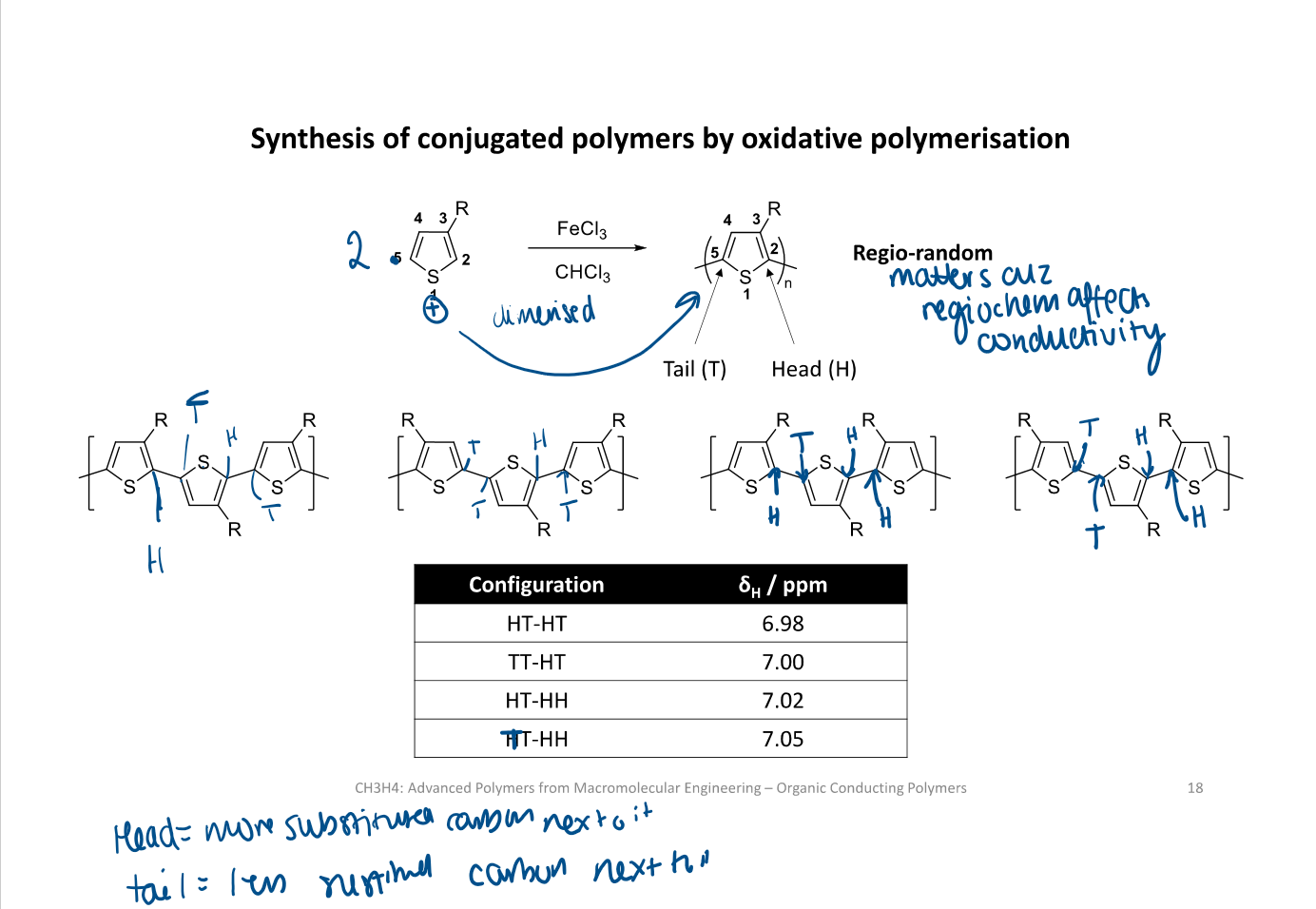
What is oxidative polymerisation?
A: Oxidative polymerisation forms conjugated polymers by oxidising electron-rich aromatic monomers (such as thiophene) into radical cations.
These radicals couple together to form new carbon-carbon bonds, producing a conjugated polymer chain.
What is meant by the "head" and "tail" of a substituted thiophene monomer?
Head (H) = the carbon next to the substituent (R group).
Tail (T) = the opposite α-carbon without the substituent.
Why does regioregularity affect the properties of polythiophene?
If the monomers connect randomly (regio-random polymer), the polymer backbone becomes irregular.
This reduces:
chain packing,
π-orbital overlap,
electron delocalisation,
leading to lower electrical conductivity.
In contrast,
a highly head-to-tail regular polymer packs more efficiently, giving better conjugation and higher conductivity.
how is oxidative polymerisation usually formed
Why are transition metal catalysts widely used to synthesise conjugated polymers?
Transition metal catalysts (usually Pd or Ni) catalyse carbon-carbon bond formation between monomers. This allows chemists to build highly conjugated polymer backbones with:
high yield,
high molecular weight,
excellent control over the repeat unit,
fewer structural defects.
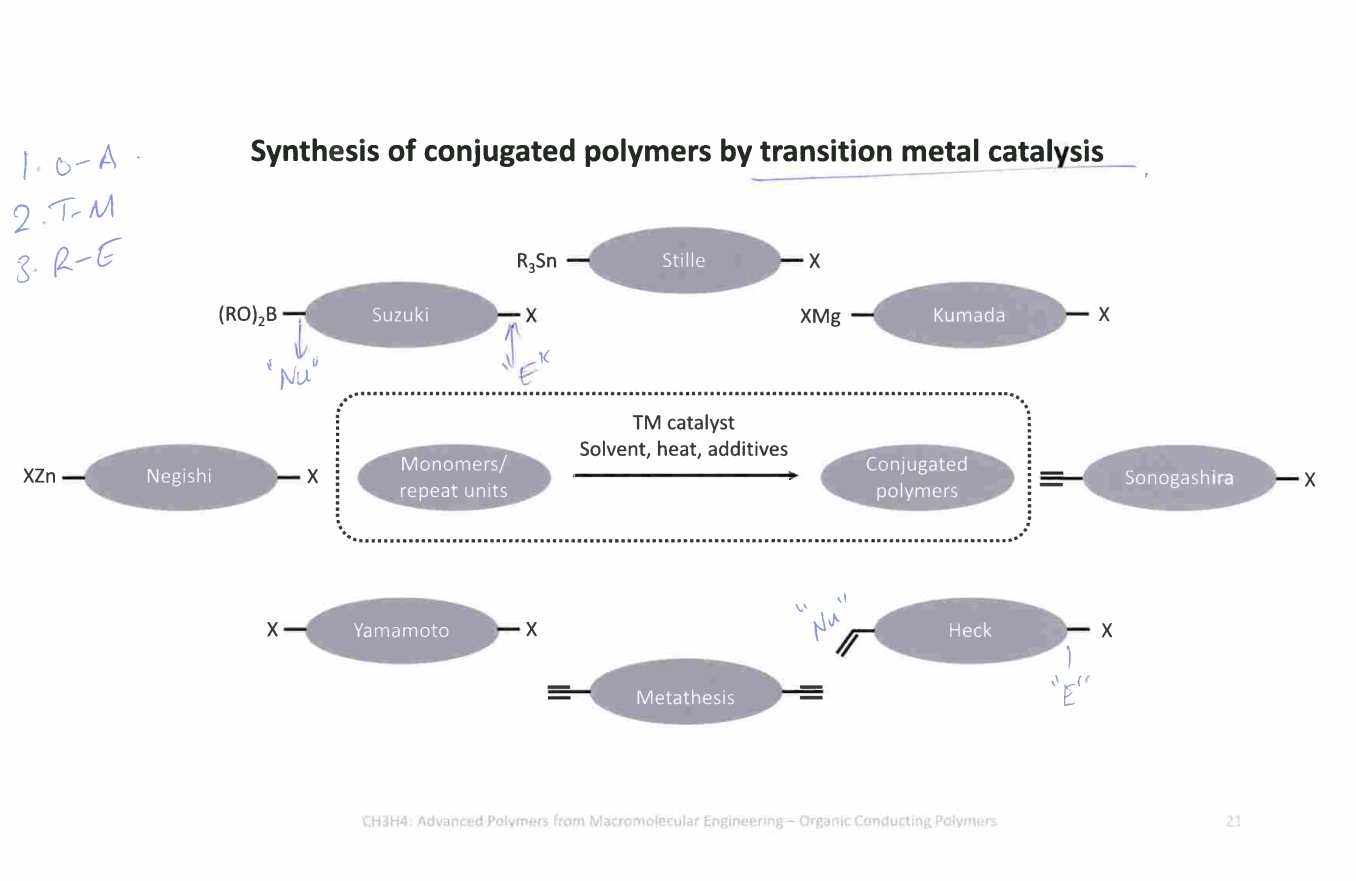
What do Suzuki, Stille, Negishi, Kumada, Heck and Sonogashira reactions all have in common?
They are all transition-metal-catalysed cross-coupling reactions.
Although they use different starting functional groups, they all have the same goal:
Join two carbon atoms together to extend the conjugated polymer chain.
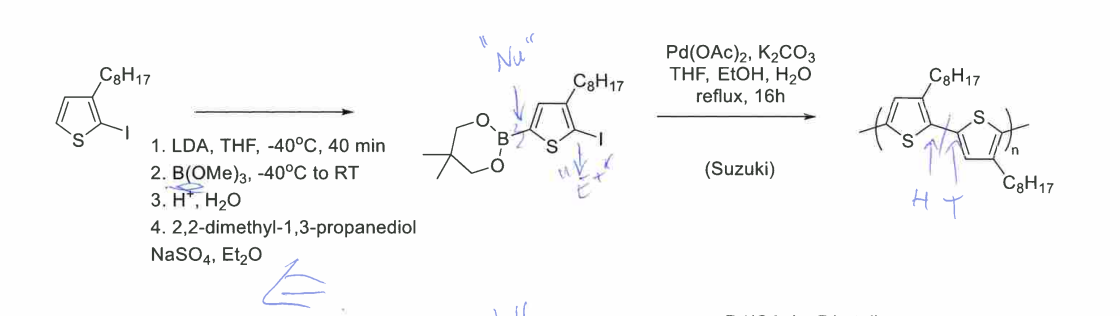
What is the purpose of the Suzuki coupling shown at the top of the slide?
A: The first few steps convert the thiophene into a boronic ester (contains B).
The boronic ester then reacts with the iodinated thiophene in the presence of a Pd catalyst.
This forms a new carbon-carbon bond between the two thiophenes.
Repeating this reaction produces a head-to-tail polythiophene.
Recognition tip:
Contains BORON
        ↓
Suzuki coupling
        ↓
Forms new C-C bond
Exam focus: Know where the new bond forms, not the detailed reagent sequence.
Why is Suzuki coupling preferred over simple oxidative polymerisation for this polymer?
Suzuki coupling gives much better control over regiochemistry.
Instead of producing random HH, HT and TT linkages, Suzuki mainly forms the desired head-to-tail (HT) arrangement.
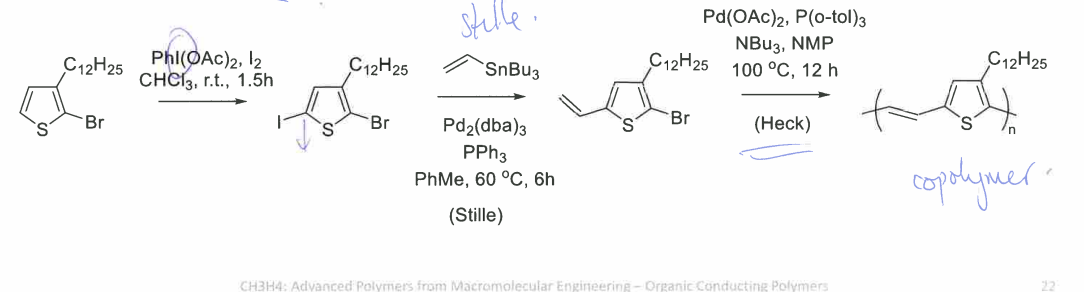
Why are both a Stille and Heck reaction used in the lower synthesis?
Each reaction builds a different part of the polymer.
Stille coupling (recognised by SnBu₃) inserts a vinyl (C=C) group onto the thiophene.
Heck coupling then polymerises these functionalised monomers into a conjugated polymer.
So rather than making simple polythiophene, this route creates a different conjugated backbone with an alkene incorporated.
snBu3→ stille → add carbon→ heck→ build polymer
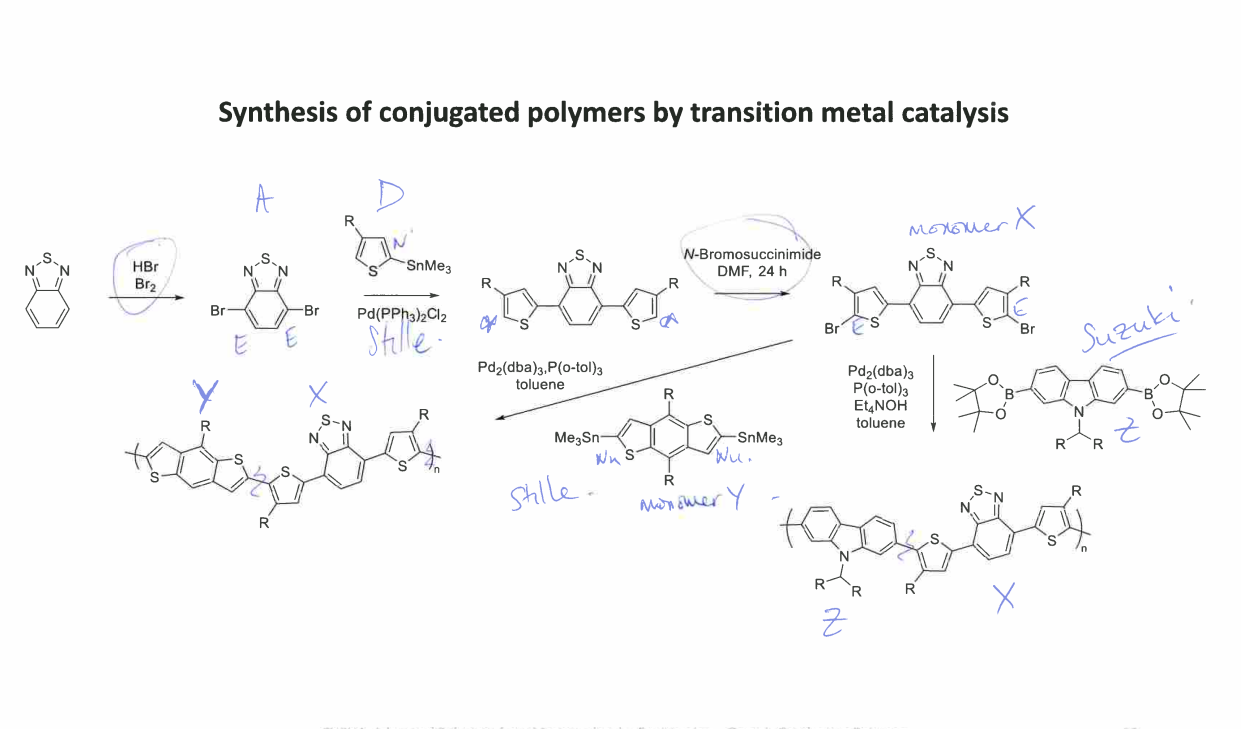
Why is the first step simply bromination?
Before a monomer can undergo transition-metal coupling, it needs a reactive carbon.
The first reaction uses Br₂/HBr to install two bromine atoms.
These brominated carbons become the electrophilic sites that will later form new C–C bonds during polymerisation.
Simple picture
Step 1 Brominate aromatic ring ↓ Step 2 Join donor + acceptor (Stille or Suzuki) ↓ Step 3 Brominate again ↓ Step 4 Polymerise ↓ Donor-acceptor conjugated polymer
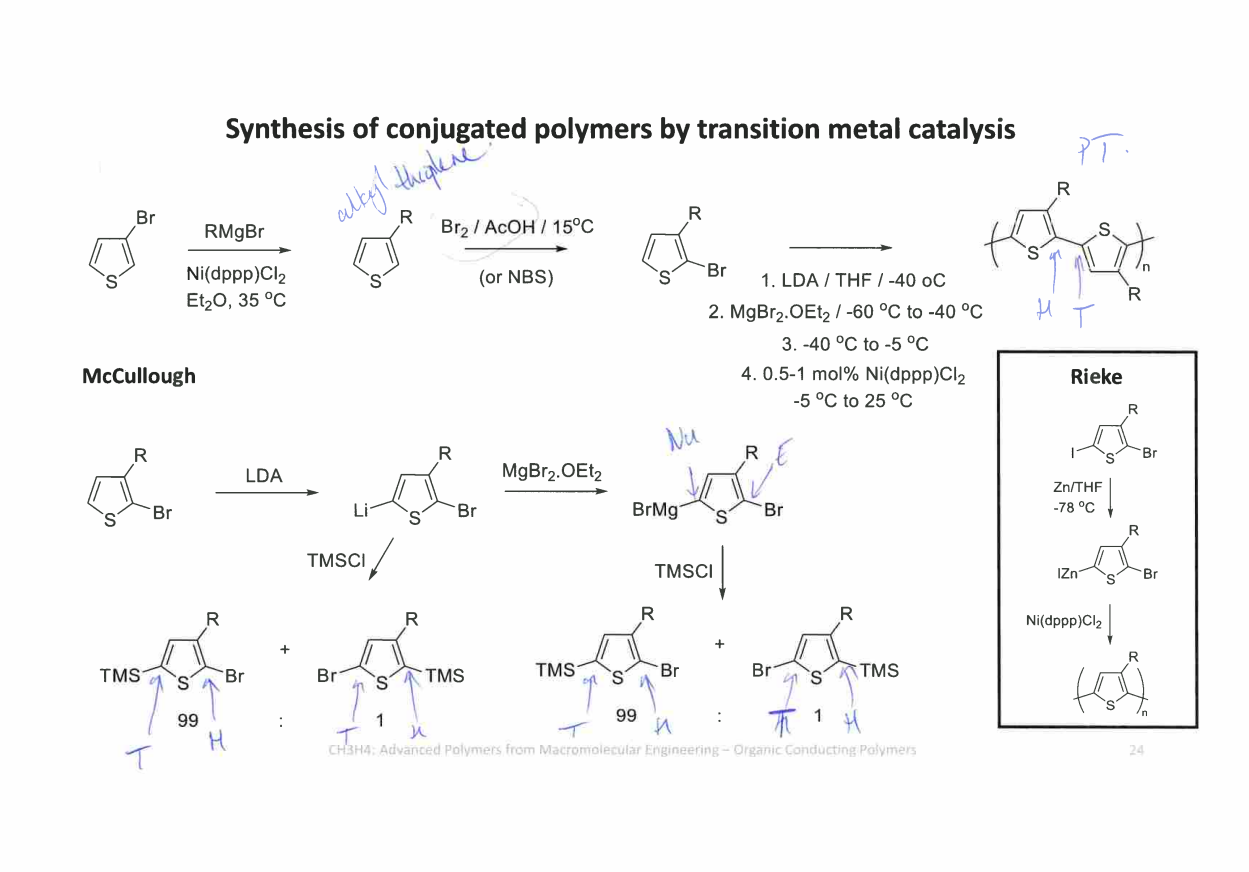
What is the McCullough method used for?
The McCullough method is a transition-metal-catalysed polymerisation used to make highly regioregular head-to-tail (HT) polythiophene.
The monomer is first modified to introduce the correct reactive groups (Grignard reagent), then a Ni catalyst couples the monomers together.
Why it's important:
Instead of random linkages, it gives almost entirely HT linkages, producing:
better chain packing,
better π-overlap,
higher conductivity.
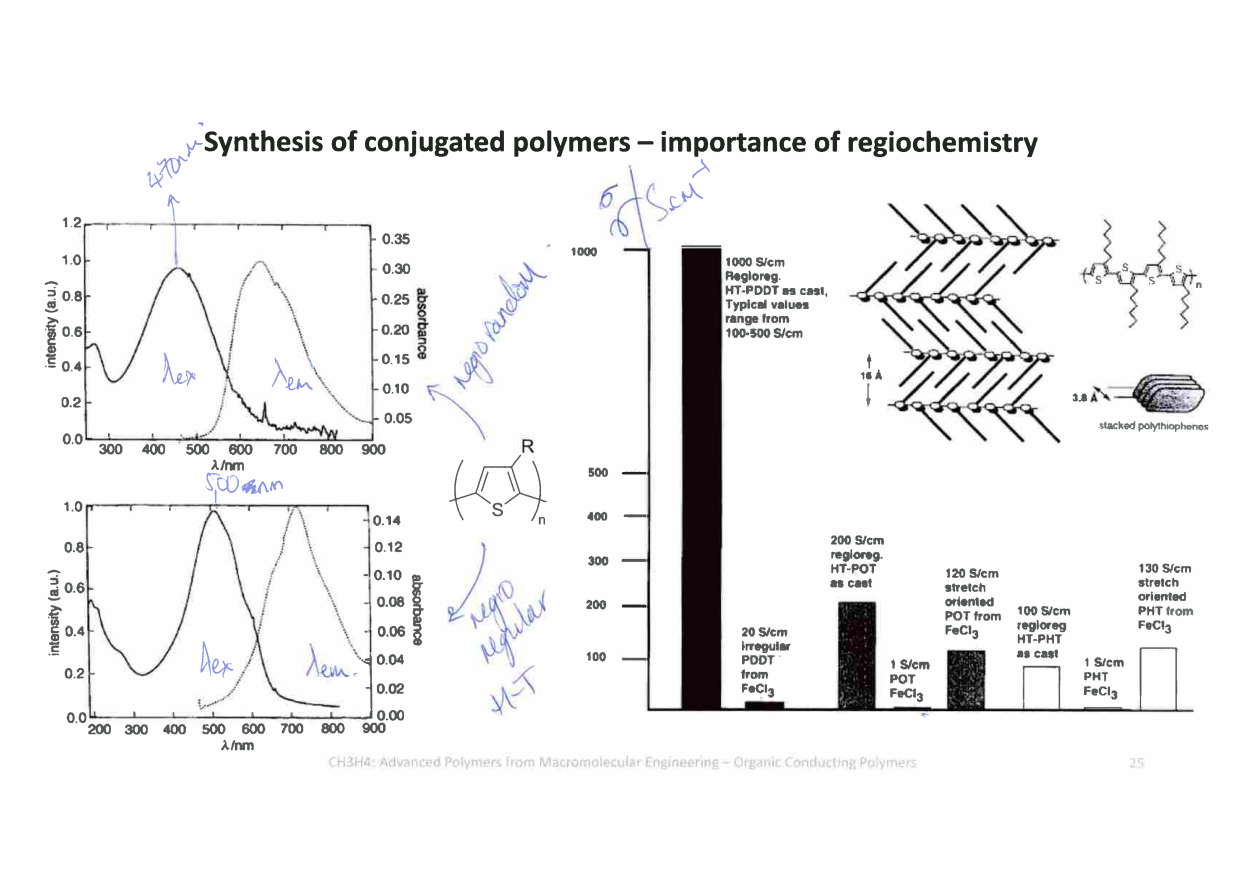
whats shown here
showing regioselectively matters
What does the conductivity graph tell us about regioregularity?
he graph shows that conductivity increases dramatically as the polymer becomes more ordered.
Examples from the slide:
Irregular PDDT ≈ 20 S/cm
Regioregular HT-POT ≈ 200 S/cm
Regioregular HT-PDDT ≈ 1000 S/cm
This demonstrates that regioregularity can improve conductivity by more than an order of magnitude.
How can we make them conduct even better?"
y reducing the HOMO-LUMO (band) gap.
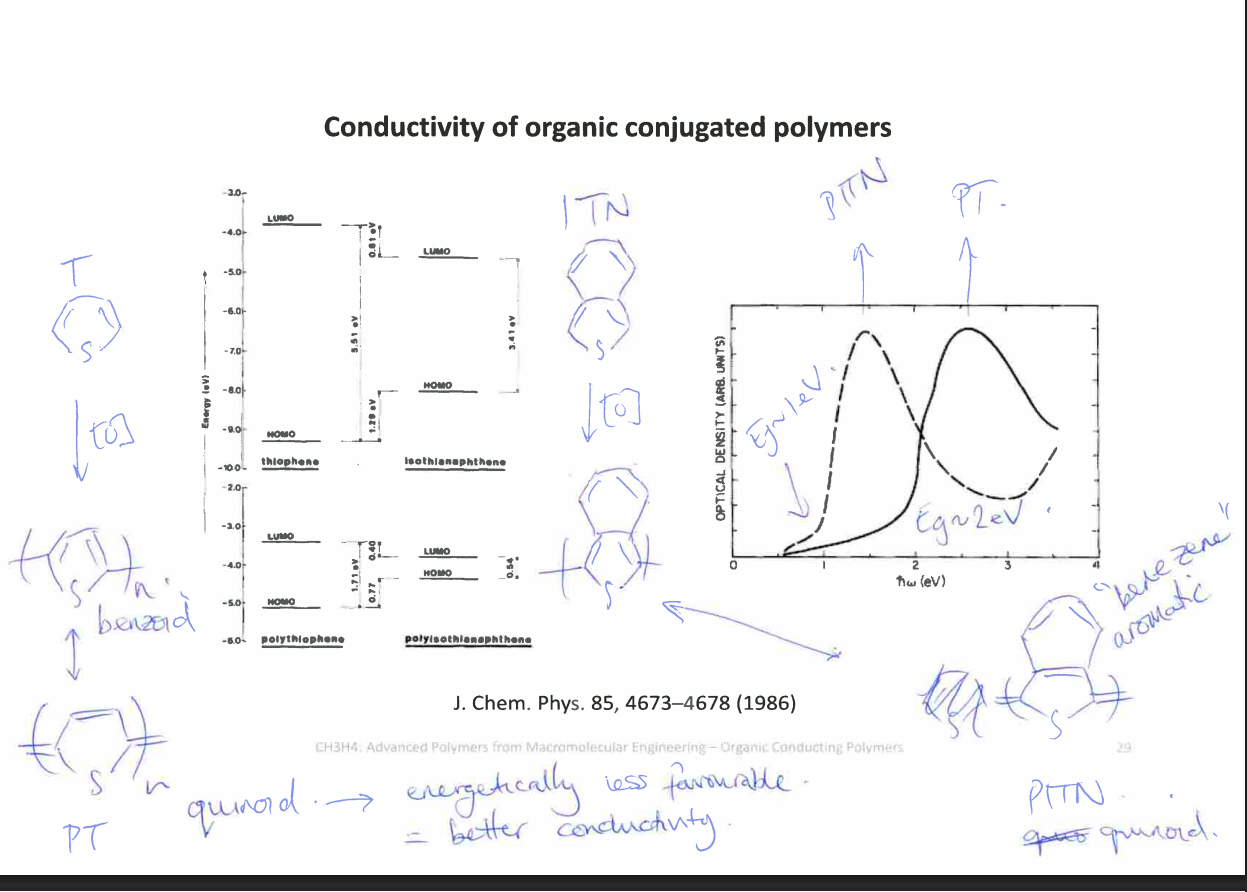
Why does polyisothianaphthene (PITN) conduct electricity better than polythiophene (PT)?
Adding the extra fused benzene ring changes the electronic structure.
Compared with PT:
PT has a band gap of about 2 eV
PITN has a band gap of about 1 eV
Because PITN has the smaller band gap, electrons require less energy to move, so PITN is much more conductive.
Why does adding the extra fused ring lower the band gap?
A:
It's not just because there's more conjugation.
The extra fused ring makes the quinoid resonance form much more favourable.
In normal thiophene:
becoming quinoid destroys aromaticity, which costs a lot of energy.
In isothianaphthene:
when it becomes quinoid, the fused six-membered ring becomes benzene-like (aromatic).
This gives back stability.
Therefore the polymer spends more time in the quinoid form, giving:
greater π-electron delocalisation
smaller band gap
higher conductivity
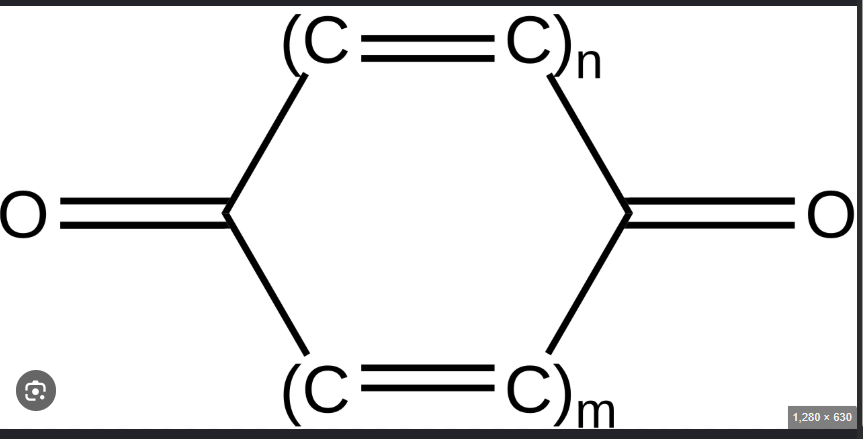
What is the difference between the benzoid and quinoid forms?
Benzoid form
More aromatic
More stable (lower energy)
Less electron delocalisation
Larger band gap
Lower conductivity
Quinoid form
Less aromatic
Less stable (higher energy)
Better electron delocalisation
Smaller band gap
Higher conductivity
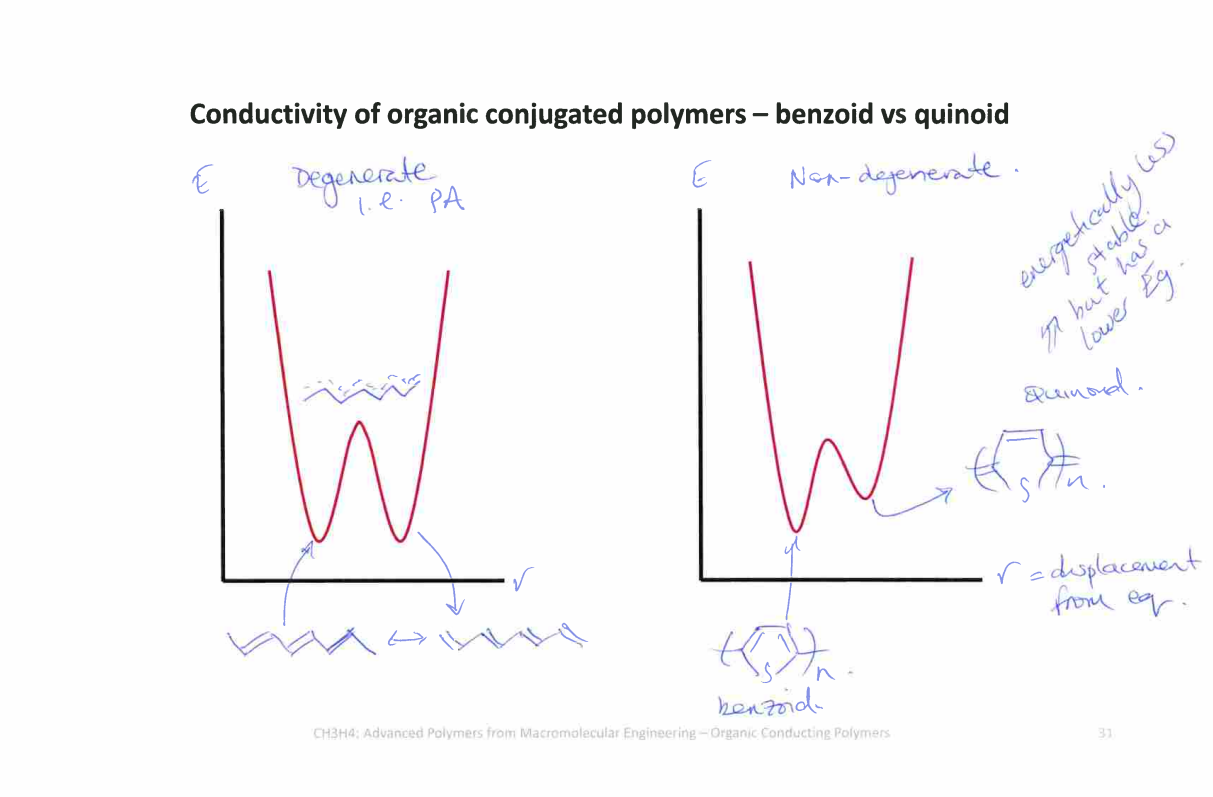
What is the difference between a degenerate and a non-degenerate conducting polymer?
The graphs show the potential energy of different polymer structures.
Degenerate system (left)
Example: Polyacetylene (PA)
There are two equally stable (same energy) structures.
oth have the same energy, so the polymer can exist as either structure equally easily.
This is why the graph has two valleys of equal depth.
There are still two possible resonance forms:
Benzoid
Quinoid
BUT...
they do not have the same energy.
The benzoid form is much lower in energy, so it is favoured.
The quinoid form is higher in energy, so less of the polymer exists like this.
That's why one valley is much deeper than the other.
Why is the benzoid form usually more stable than the quinoid form?
The benzoid form keeps aromaticity.
Aromatic rings are very stable because their π electrons are delocalised around the ring.
The quinoid form breaks some of this aromaticity, so it costs energy to form.
Therefore:
Benzoid = lower energy = more stable
Quinoid = higher energy = less stable
This is why most polymers naturally prefer the benzoid form.
If the quinoid form is less stable, why do we want more of it
Although the quinoid form is less energetically favourable, it has better π-electron delocalisation.
This causes:
HOMO energy ↑
LUMO energy ↓
So the band gap becomes smaller.
Smaller band gap
↓
Electrons move more easily
↓
Higher conductivity.
This is why polymer chemists try to design polymers that favour the quinoid form, even though it is less stable.
What does the graph actually represent?
A:
The y-axis is energy.
The x-axis is the displacement from equilibrium (the structural arrangement of the polymer).
Each valley represents a stable structure.
Degenerate (polyacetylene)
      /\

    \/  \/
Two valleys are the same depth
↓
Both structures are equally stable.
Non-degenerate (polythiophene)
      /\

    \/   \_
One valley is much lower
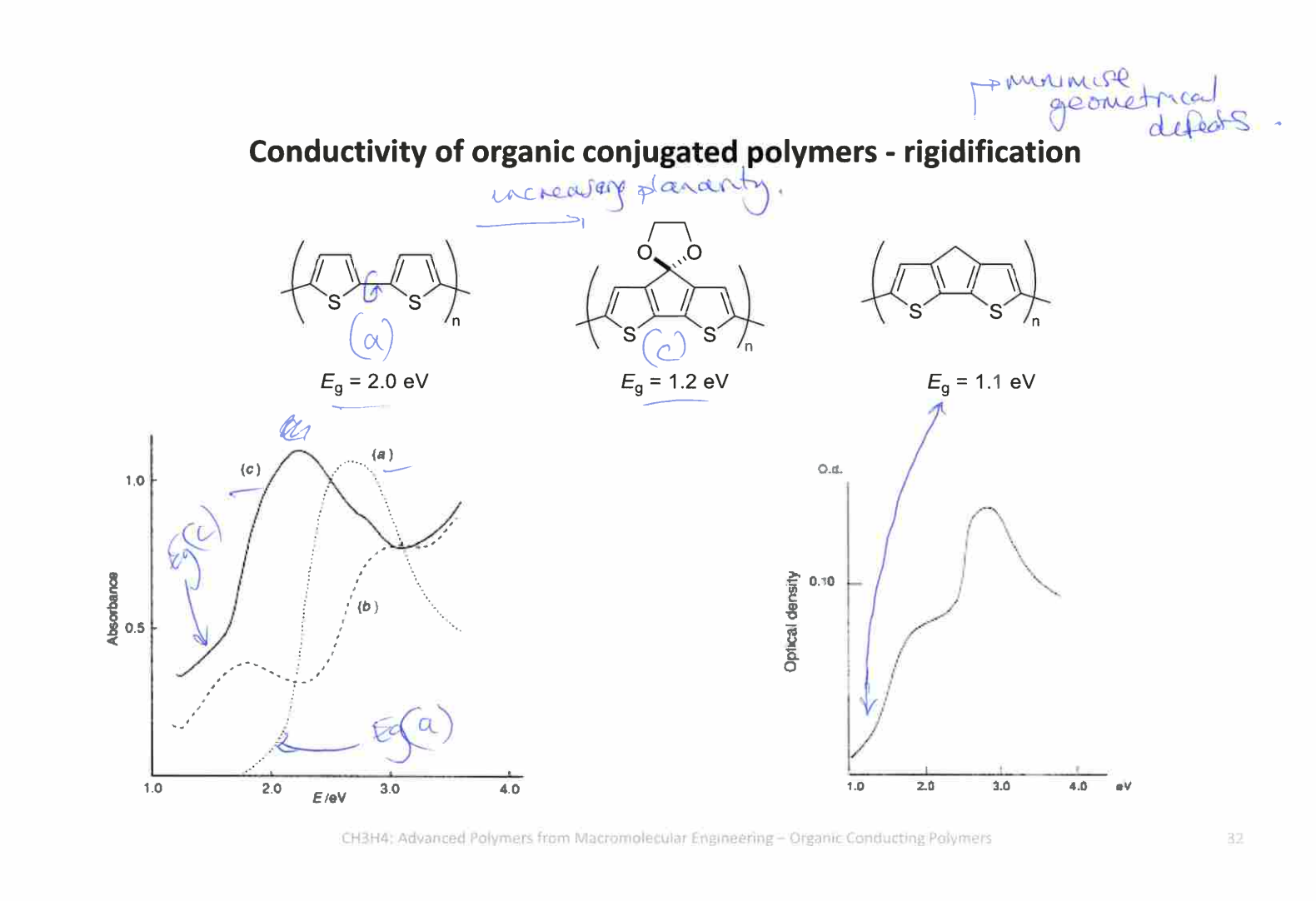
How can we physically change a polymer so electrons can travel further?
Make the polymer more rigid (more planar).
Why does making a polymer more rigid increase its conductivity?
Normally, conjugated polymers are not perfectly flat.
Between two thiophene rings is a single bond, and single bonds can rotate.
That means the polymer chain twists like this:
When the chain twists:
p orbitals no longer line up properly
conjugation is interrupted
electrons cannot delocalise as far
the band gap becomes larger.
Rigidification locks the rings into the same plane, preventing twisting.
This gives:
better orbital overlap
longer effective conjugation
smaller band gap
Why do conjugated polymers twist in the first place
The rings are connected by single bonds.
Single bonds can rotate.
If the rings contain substituents (or simply due to steric crowding), the molecule twists to reduce steric strain.
Unfortunately this twisting reduces π-orbital overlap.
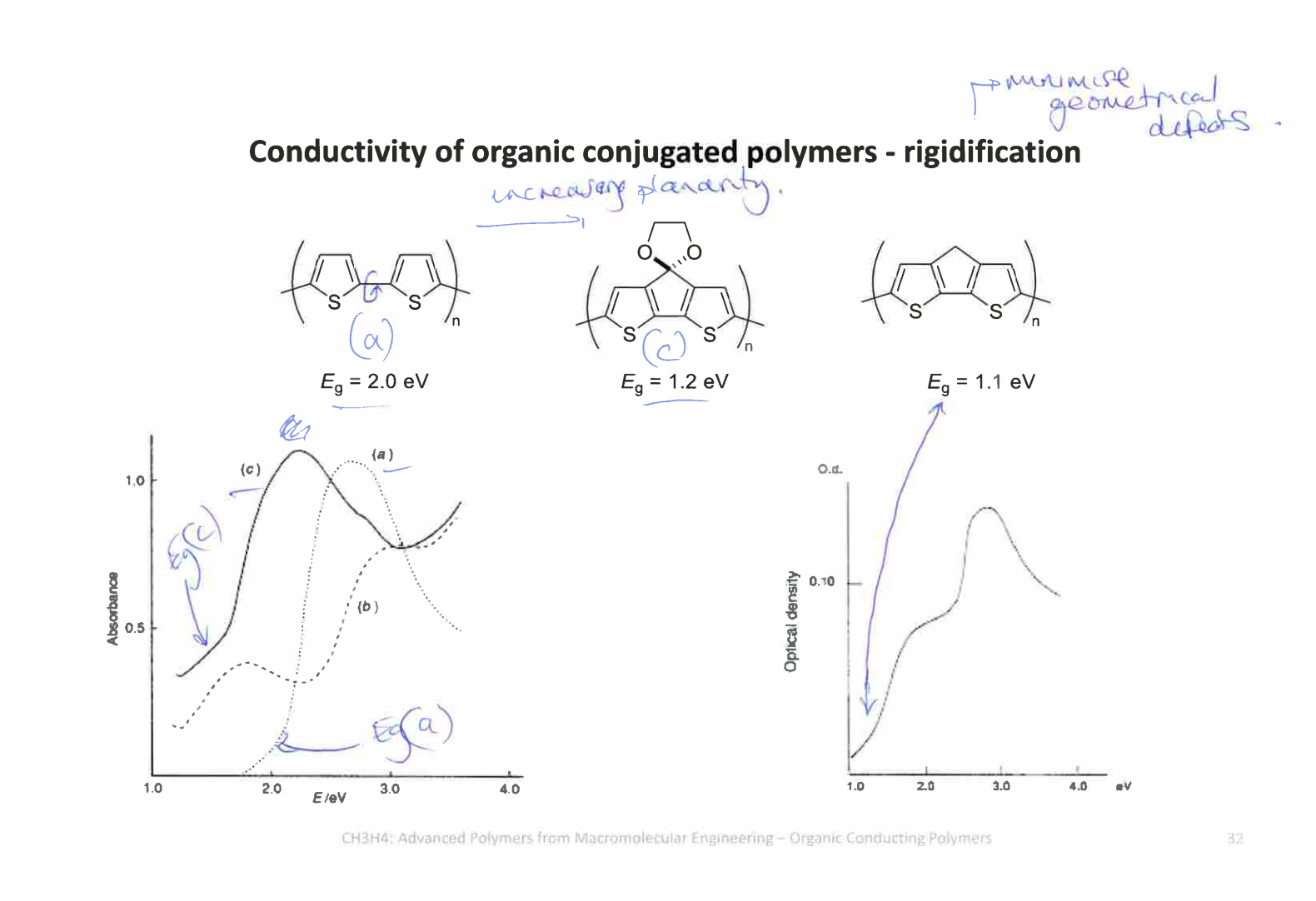
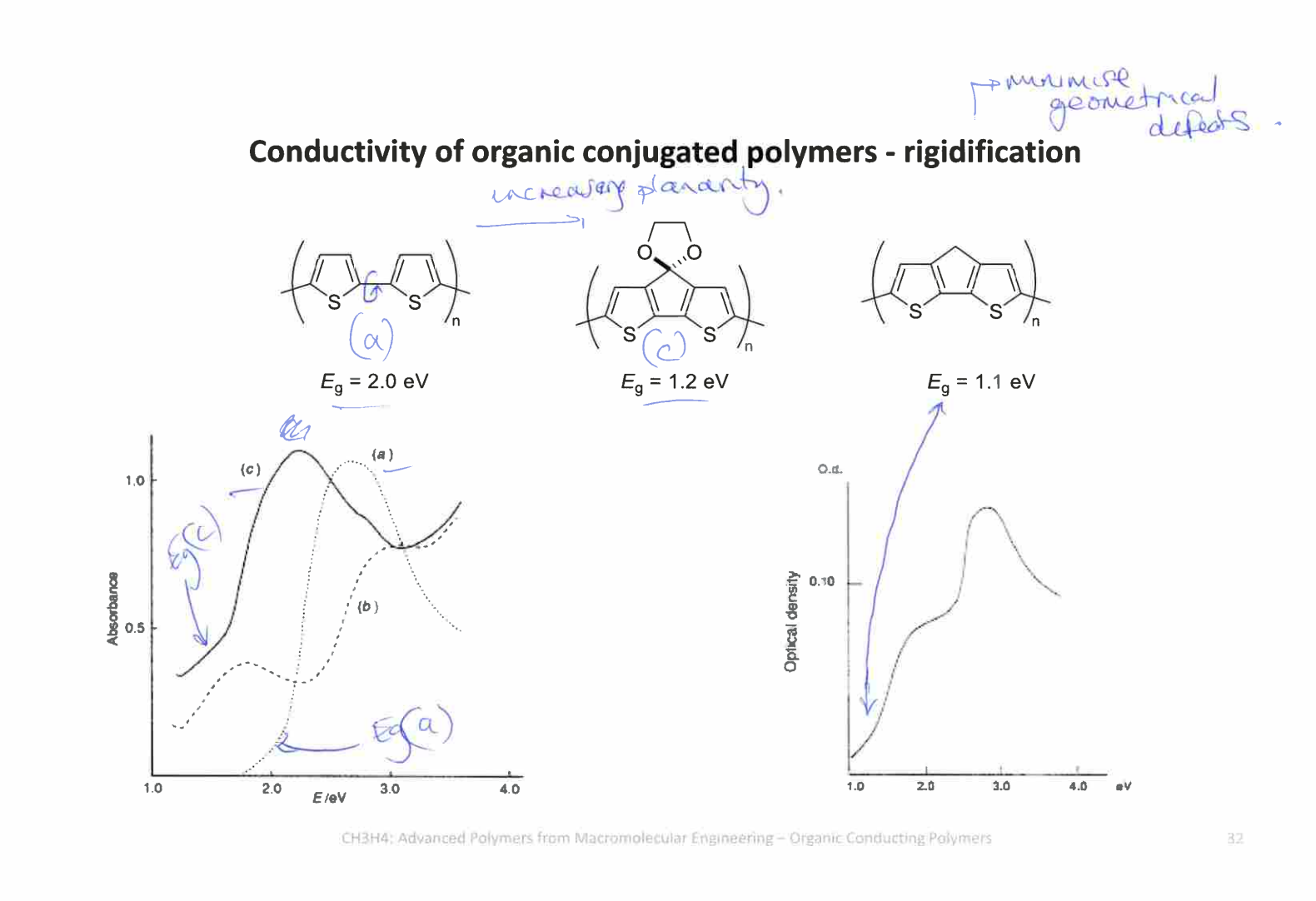
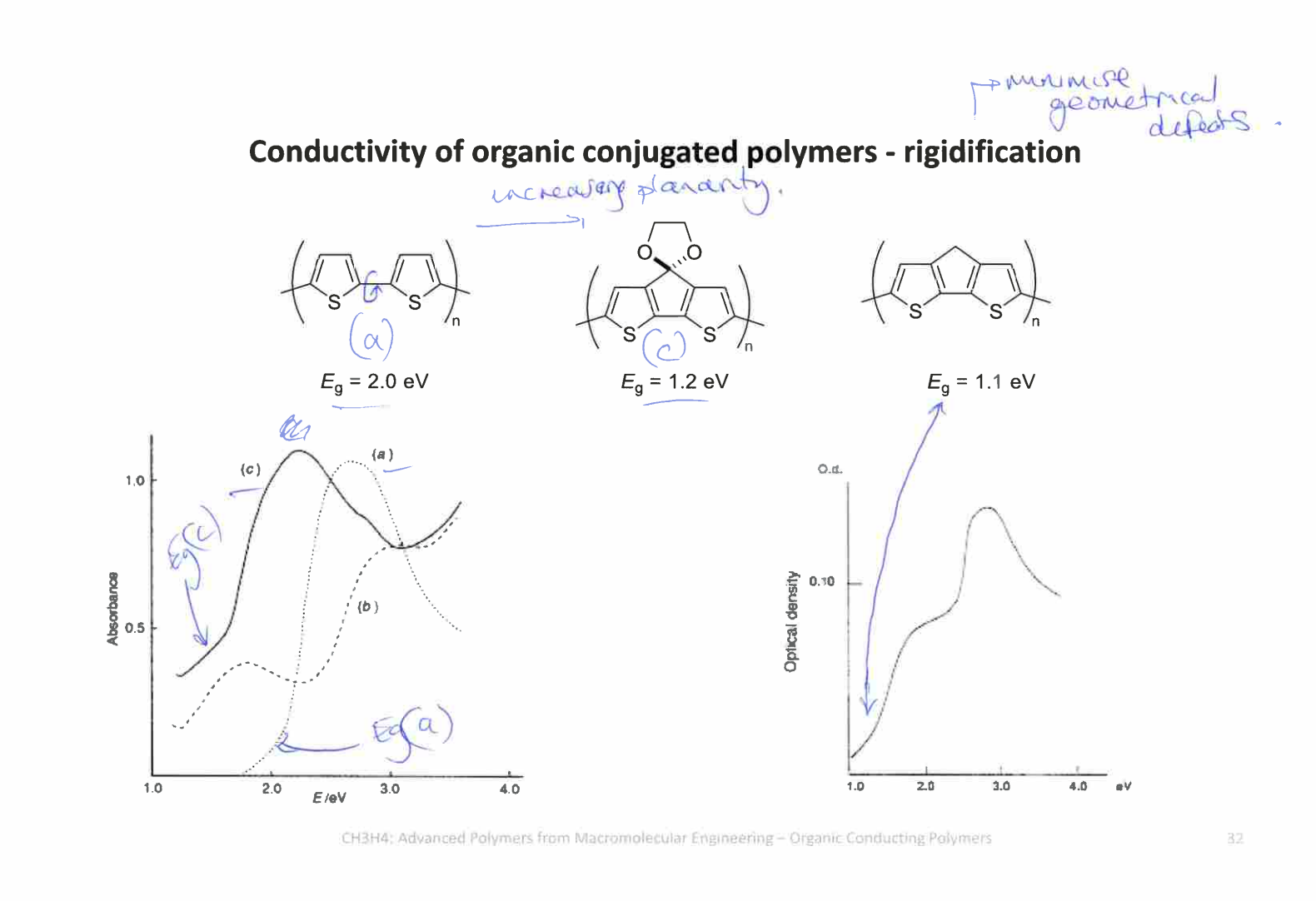
What is rigidification
Rigidification means adding a bridge between neighbouring rings so they cannot rotate independently
What are the UV-Vis graphs proving?
The graphs provide experimental evidence that rigidification lowers the band gap.
What is the main idea of this slide?
his slide introduces the donor–acceptor strategy for designing conducting polymers.
Instead of using identical monomers, we alternate:
Electron-donating monomer (D)
Electron-withdrawing (acceptor) monomer (A)
Which monomer is the donor and which is the acceptor in this slide?
Your lecturer labels them as two different monomers.
Monomer A
Contains NO₂ (nitro) groups
Nitro groups are strong electron-withdrawing groups (EWGs).
➡ Therefore A is the acceptor.
Monomer B
After deprotection it contains NH₂ groups
Amino groups have lone pairs that donate electron density.
➡ Therefore B is the donor.
The polymer produced is therefore an alternating donor–acceptor copolymer.
Why does alternating donor and acceptor units reduce the band gap?
Donor groups and acceptor groups affect molecular orbitals differently.
Donor (NH₂)
pushes electron density into the π-system
raises the HOMO energy
Acceptor (NO₂)
pulls electron density away
lowers the LUMO energy
Since:
HOMO moves up
LUMO moves down
the distance between them (the band gap) becomes smaller.
Why is the polymer protonated (H⁺) after polymerisation?
Adding H⁺ protonates the amino groups.
This changes the electron distribution and promotes the quinoid resonance form.
Remember:
Benzoid = more stable
Quinoid = more conductive
So protonation shifts the polymer towards the quinoid structure, further lowering the band gap.
The slide shows:
Benzoid ⇌ QuinoidAfter protonation, the equilibrium shifts towards the quinoid side.
Which donor and acceptor monomers should I recognise for the exam?
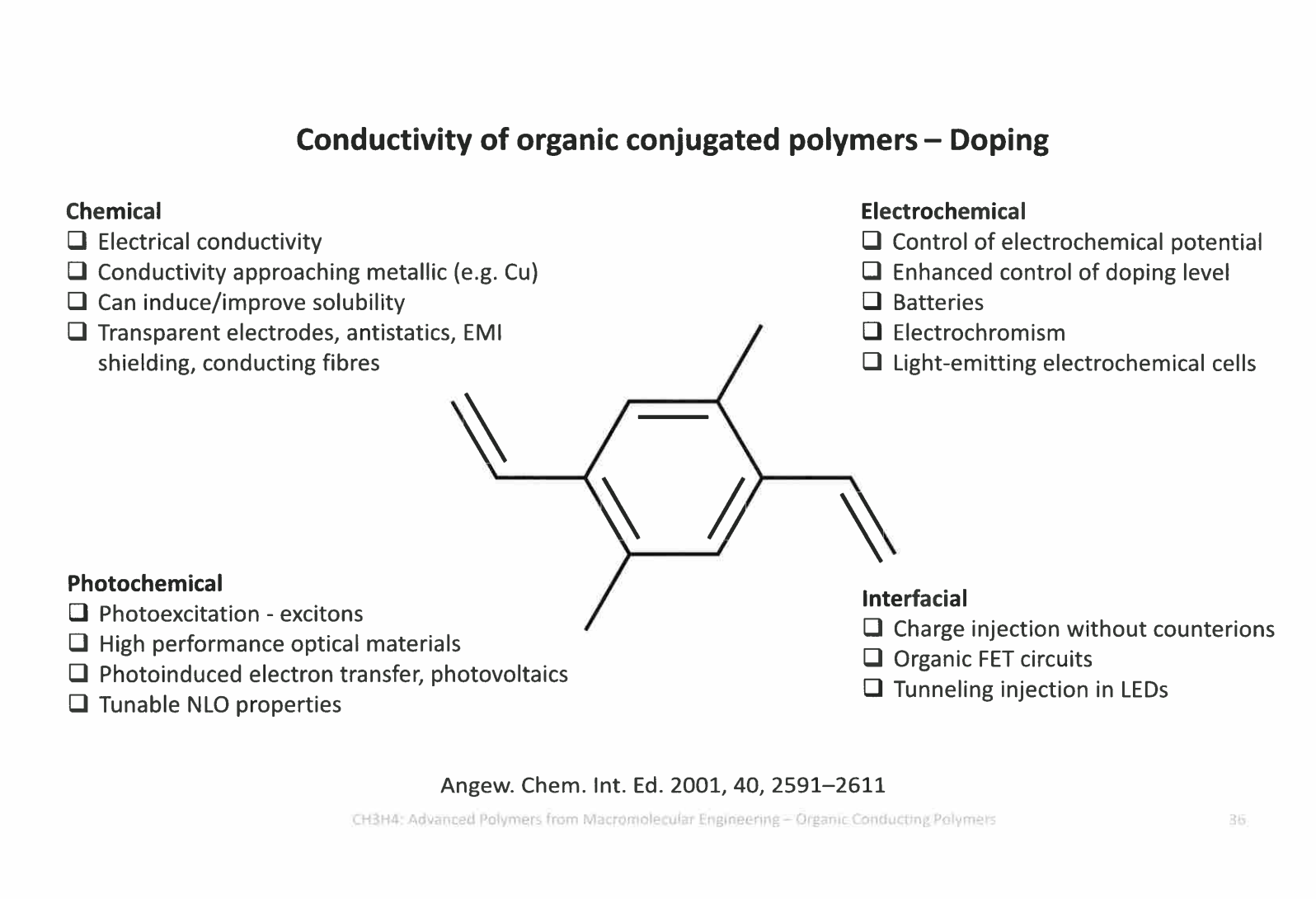
What are the four types of doping in conducting polymers?
chemical and electrochemical seems to be of the importance ones
What is doping in conducting polymers?
Doping is simply a redox (oxidation–reduction) process.
Unlike silicon doping (adding impurity atoms), polymer doping works by transferring electrons between the polymer and another chemical.
There are two possibilities:
Oxidation (lose electrons)
Polymer → Polymer⁺ + e⁻➡ Produces positive charge carriers (holes)
➡ Called p-type doping
Reduction (gain electrons)
Polymer + e⁻ → Polymer⁻➡ Produces negative charge carriers (electrons)
➡ Called n-type doping
The whole goal is to create mobile charge carriers so the polymer conducts electricity much better. Your lecturer even says all doping is essentially redox doping
Why are counterions needed during doping?
A:
Whenever the polymer gains a charge, nature wants to keep the overall material electrically neutral.
Examples:
P-type
Polymer⁺needs
I₃⁻
or
PF₆⁻
nearby.
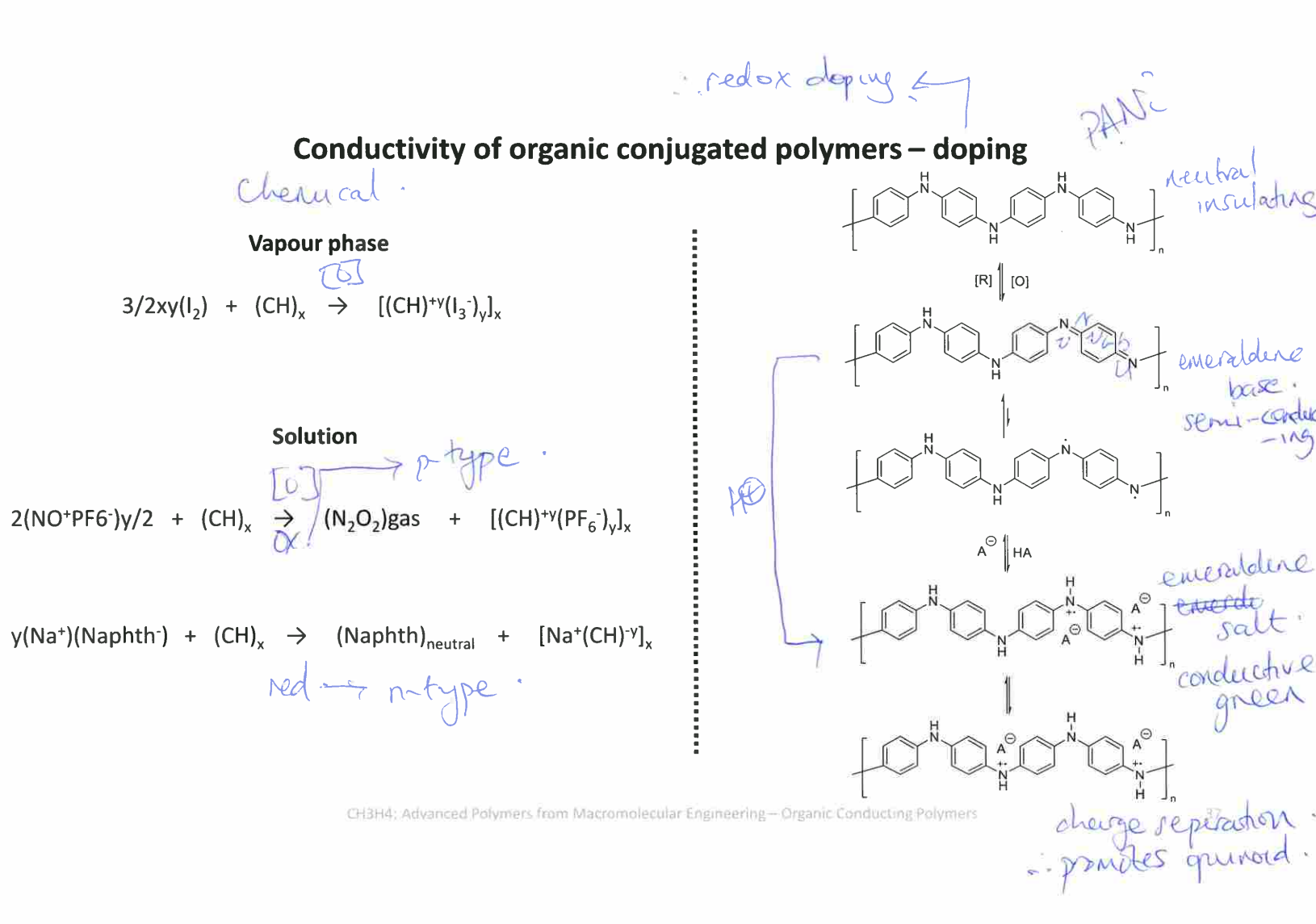
How does polyaniline become conductive?
Polyaniline goes through several forms.
Step 1
Neutral polyaniline
insulating
poor conductor
↓
Step 2
Oxidation
↓
Emeraldine base
partially oxidised
semiconducting
↓Step 3
Protonation (add H⁺)
↓
Emeraldine salt
highly conductive
green colour
The emeraldine salt is the useful conducting form.
Your lecturer points out that, unlike many other polymers, polyaniline becomes conductive during its synthesis, rather than requiring a separate post-treatme
whats a technical way to perfrom doping
electrochemistry
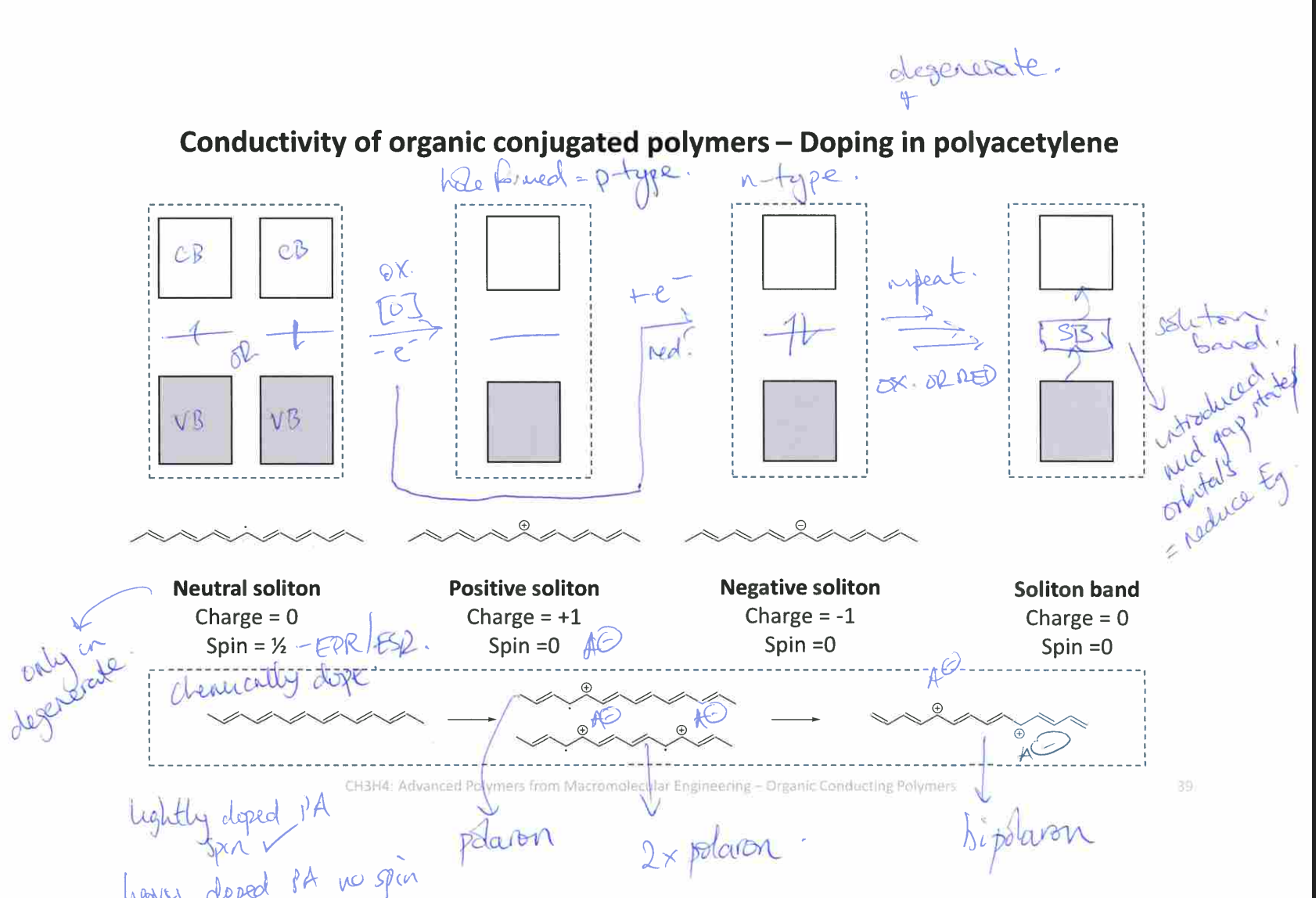
What happens to the band structure when polyacetylene is doped?
Undoped polyacetylene has:
Conduction band (CB)

      ↑ Band gap (Eg)

Valence band (VB)
Electrons must jump the entire band gap, so conductivity is limited.
When polyacetylene is doped (oxidation or reduction):
new electronic states called soliton states appear inside the band gap.If doping continues, these individual states overlap to form a soliton band.
This means electrons now need much less energy to move, so conductivity increases dramatically.
Remember:
Doping doesn't remove the band gap—it inserts new energy levels inside it
What are neutral, positive and negative solitons?
soliton is a defect that only occurs in degenerate polymers like polyacetylene.
It forms at the boundary between the two equally stable resonance structures.
Depending on doping:
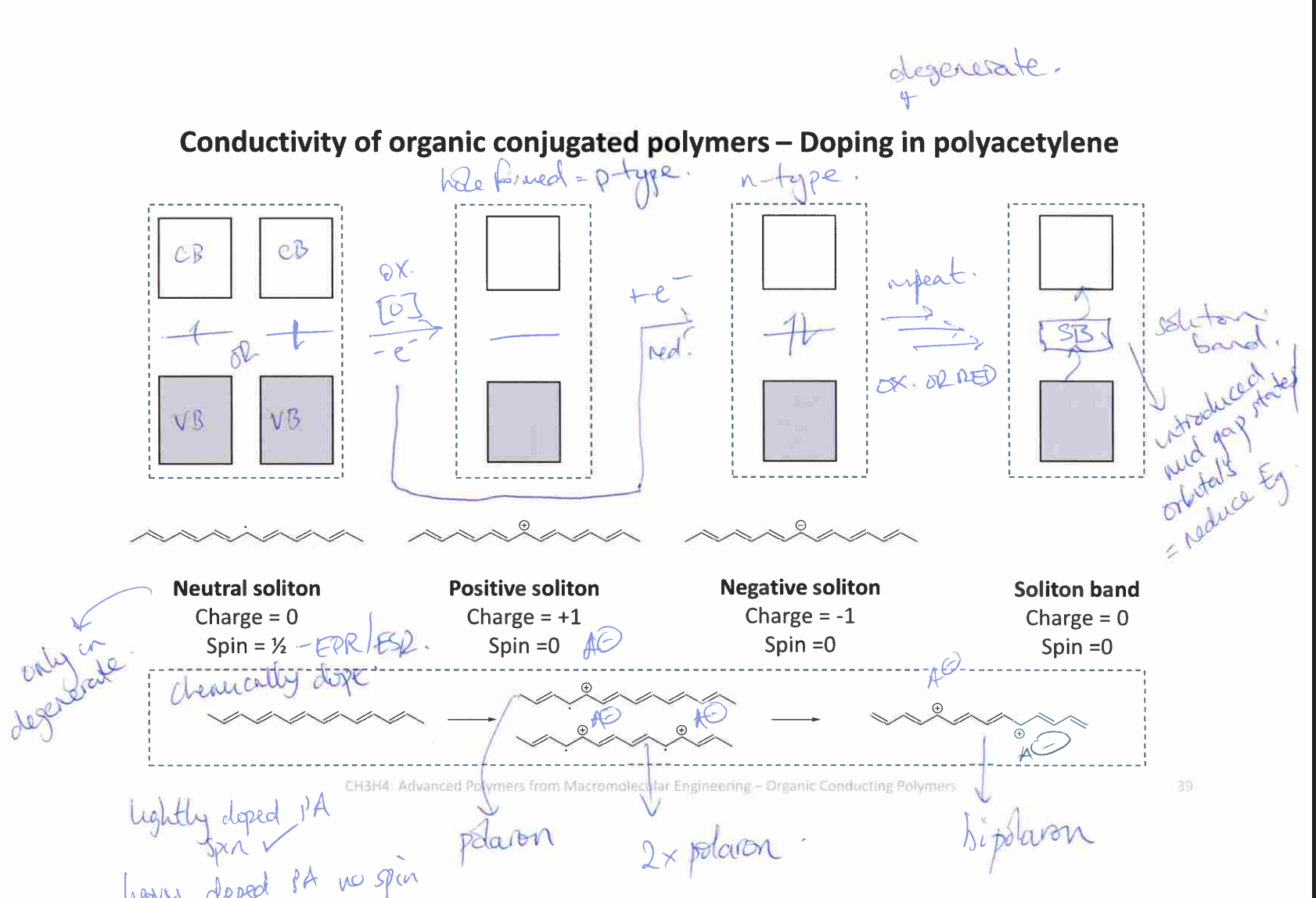
What happens as the level of doping increases?
At low doping, isolated charge carriers form (shown at the bottom of the slide).
As more charges are introduced:
Polarons form.
More doping gives two polarons.
These can combine into a bipolaron.
At high doping, many defect states overlap to form a soliton band inside the band gap.
The result is:
more available energy levels,
easier electron movement,
much higher electrical conductivity.
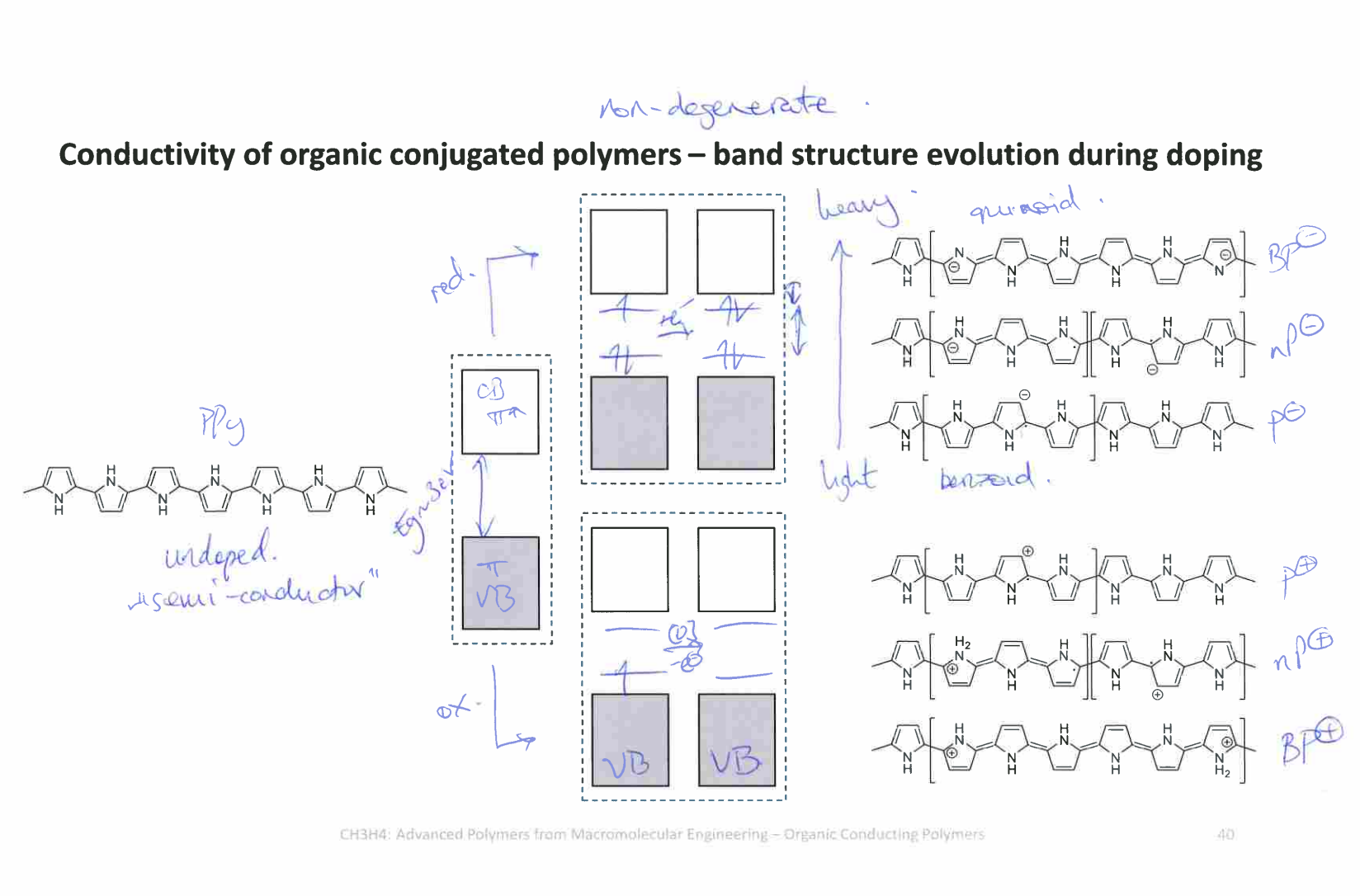
How does doping change the band structure of a non-degenerate polymer?
An undoped polymer has:
Conduction Band (CB)

      Band gap (Eg)

Valence Band (VB)
When the polymer is doped, new energy levels appear inside the band gap.
Reduction (n-type): electrons are added, creating occupied mid-gap states.
Oxidation (p-type): electrons are removed, creating empty mid-gap states.
These new states mean electrons no longer have to jump the full band gap.
Result:
smaller effective band gap
easier electron movement
higher conductivity.
What are polarons and bipolarons, and how do they form?
When a non-degenerate polymer is doped:
Light doping
One charge is introduced.
↓
A polaron forms.
carries one charge
has one unpaired electron (spin = ½
More charges are introduced.
↓
Two polarons combine.
↓
A bipolaron forms.
carries two charges
no unpaired electron (spin = 0)
Easy memory:
Polaron = one charge
Bipolaron = two charges
How do the polymer structures on the right relate to polarons and bipolarons?
The structures show how the polymer backbone changes as doping increases.
Moving from bottom to top:
Benzoid polymer (undoped, least conductive)
Positive/negative polaron (lightly doped)
Positive/negative bipolaron (heavily doped)
The backbone becomes more quinoid-like, allowing greater π-electron delocalisation.
This structural change is why doping improves conductivity:
More quinoid character → more delocalisation → smaller band gap → higher conductivity.
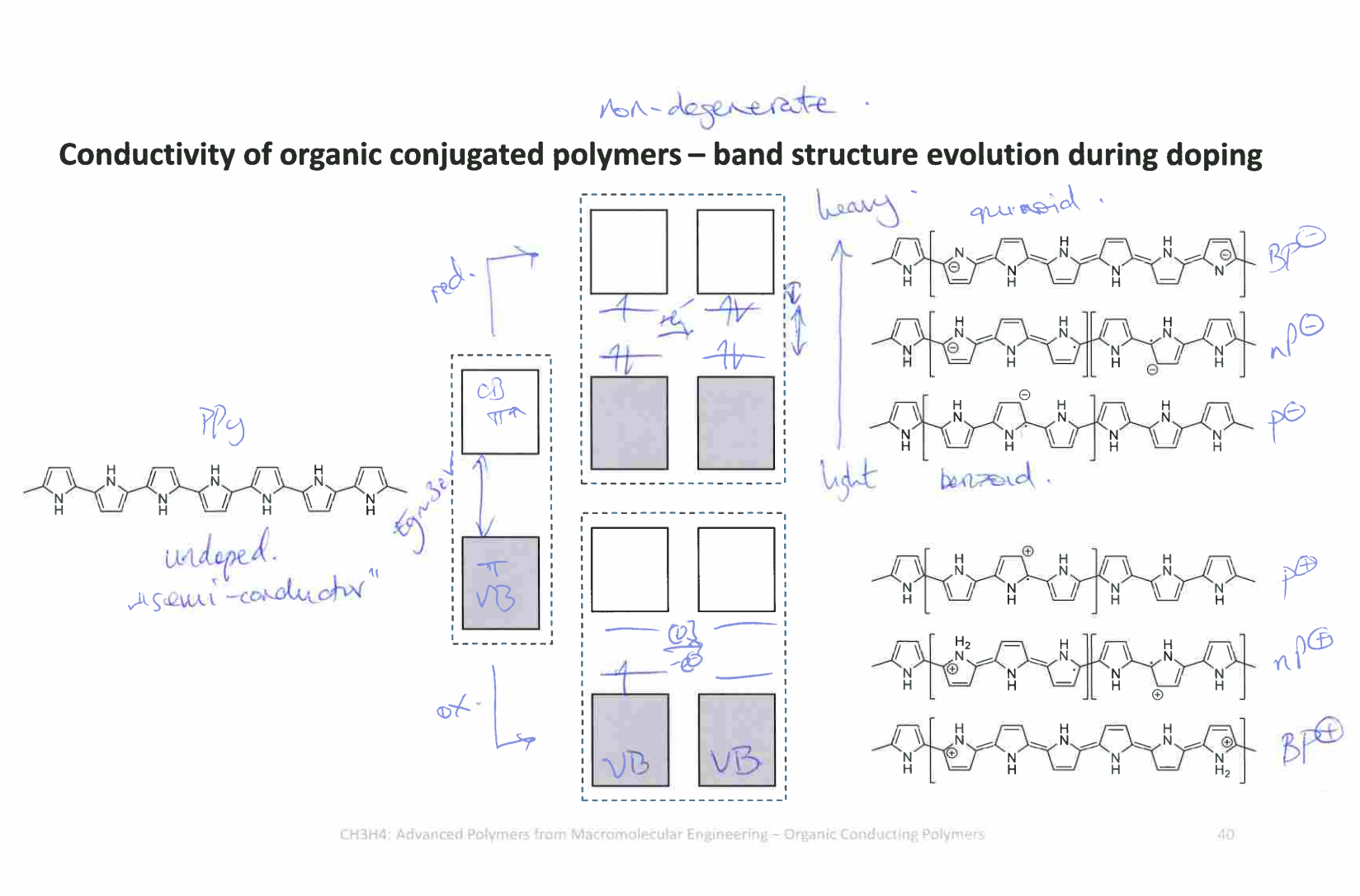
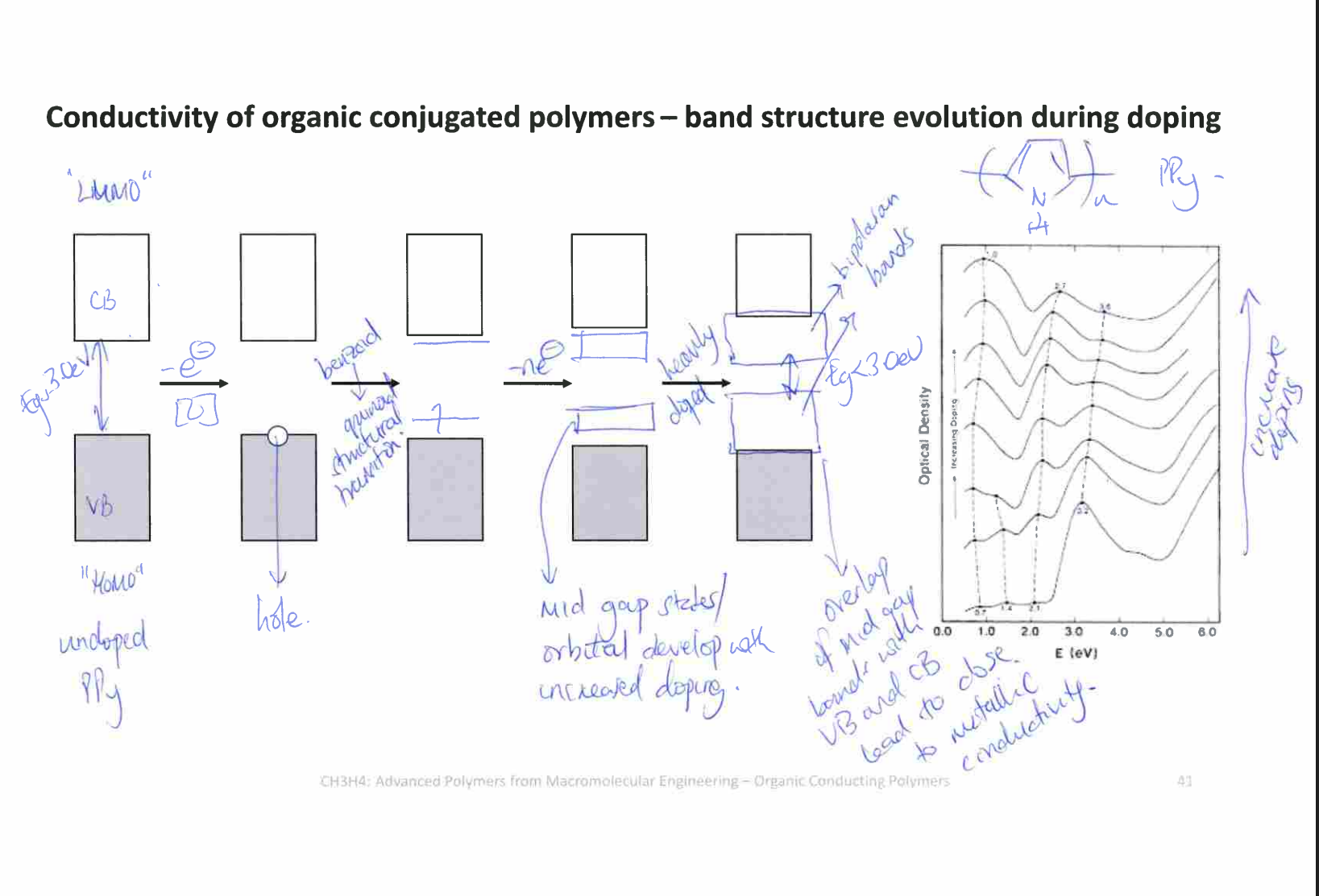
Explain how the band structure of a non-degenerate conducting polymer changes as doping increases, and why this increases conductivity.
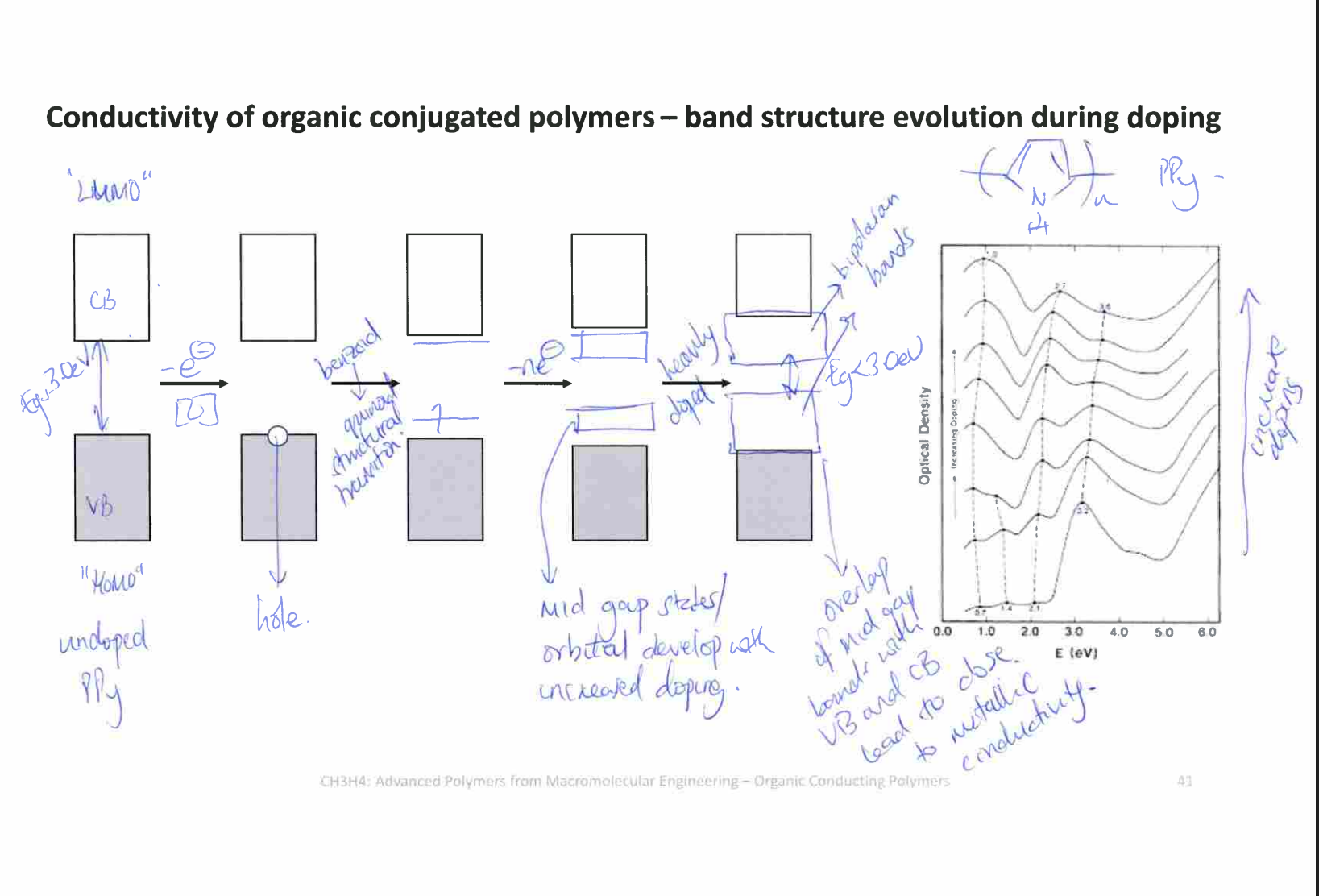
This slide shows the step-by-step evolution of the band structure as a conducting polymer (e.g. polypyrrole) is increasingly p-type doped (oxidised).
1. Undoped polymer
Initially the polymer has:
Conduction Band (CB)

      Large band gap (Eg)

Valence Band (VB)
The band gap is relatively large, so electrons need lots of energy to move from the VB to the CB.
➡ The polymer behaves as a semiconductor/poor conductor.
2. Light doping (oxidation)
Oxidation removes an electron:
Polymer → Polymer⁺ + e⁻Removing an electron leaves behind a hole (positive charge).
This doesn't just create a hole—it also creates a new electronic state (polaron level) inside the band gap.
Now electrons can move:
VB → Polaron state
or
Polaron state → CB
instead of jumping the full band gap.
➡ Effective band gap decreases.
3. Increased doping
As more electrons are removed:
more polarons form,
they begin to overlap,
eventually bipolarons form,
these defect states broaden into bipolaron bands (mid-gap bands).
4. Heavy doping
At very high doping:
the bipolaron band becomes so wide that it begins to overlap with the valence and conduction bands.
The original band gap almost disappears.
Electrons can move extremely easily through these overlapping bands.
➡ Conductivity approaches metallic conductivity.
What does the graph on the right show?
The optical spectra experimentally confirm this process.
As doping increases:
new absorption peaks appear,
they move to lower energies,
showing that new mid-gap states are forming.
These new transitions prove that the polymer is developing polaron and bipolaron bands inside the original band gap.