Lecture 9: Plants as biofuel factories
 Call Kai
 Learn
Learn Practice Test
 Spaced Repetition
 Match
Match Flashcards
 Knowt Play
1/42

There's no tags or description
Looks like no tags are added yet.
Name | Mastery | Learn | Test | Matching | Spaced | Call with Kai | Chat |
|---|
No analytics yet
Send a link to your students to track their progress
43 Terms
what is the goal for photosynthesis research?
- To understand the natural photosynthetic energy conversion
- To modify plants using genetics to make them produce energy more efficiently: BIOFUELS
- To mimic the process in artificial reactors using biology based material chemistry: aquire fuel (H2) from the sun and
talk about the most powerful energy source
Major energy source= the sunlight
- Very powerful energy source
- If we were able to harvest the sun energy for just 1 min we could use it for the humans global total energy use for an entire year- however the challenge is that the sunlight is a very “diluted” source of energi distributed over the entire globe which make it difficult to harvest a significant amount of it
what are the two main strategies of converting sunlight to energy
there are two approaches to converting the sunlight into useful energy sources for humans:
1. Natural photosynthesis (fossil fuels) and
2. Artificial photosynthesis (biofuels)
give eg on renewable and non renewable power
- Fossil fuel and nuclear power are non renewable- when used you can not restore them
- Other sources are renewable including wind, solar power, hydroelectric power, wave power, geothermal power, and biofuels
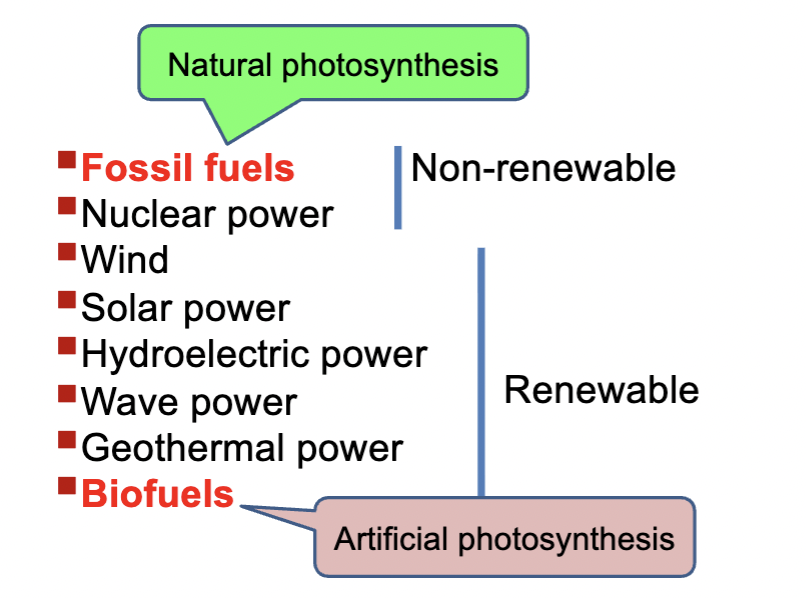
what power sources are photosynthesis based?
fossil fuels= natural photosynthesis
bio fuels= artificial photosynthesis
talk a bit about biofuels vs fossile
Biofuels are carbon neutral and a sort of artificial photosynthesis since the carbon already is part of the active circulation- in contrast to fossil fuels which is a sort of natural photosynthesis (over long time) however this is stored underground- and when used and combusted it creates a carbon surplus addition in the athmosphere/circulation and hence contribute to an increase of CO2 concentrations in the athmosphere
what is the global energy trend
A positive trend of the use of renewable energy- however the overall energy need and consumption is projected to increase by a lot in the near future.
what are fossile fuels. How is electricity made?
Fossil fuels= energy from fossilized organic materials:
- coal, oil and gas
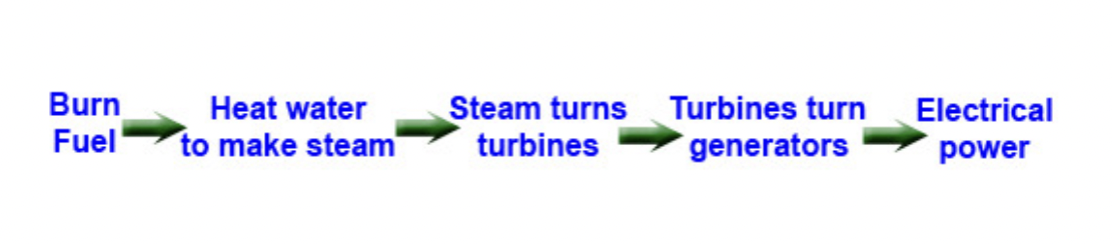
- Electricity is made by: fossile fuels being burned- the energy from the combustion is used to heat water- creates steam which cause turbines to turn, which drive generators and give electrical power
explain nuclear power- how is electricity made?
Nuclear power= energy from splitting uranium atoms.
- Nuclear fission: neutrons smash into the nucleus of the uranium atoms, which split roughly in half and release energy in the form of heat.
- Nuclear fission lead to the heating of water- create steam that turn turbines, which drive generators to generate electrical power

explain solar power- how is electricity made? what are the two main kinds
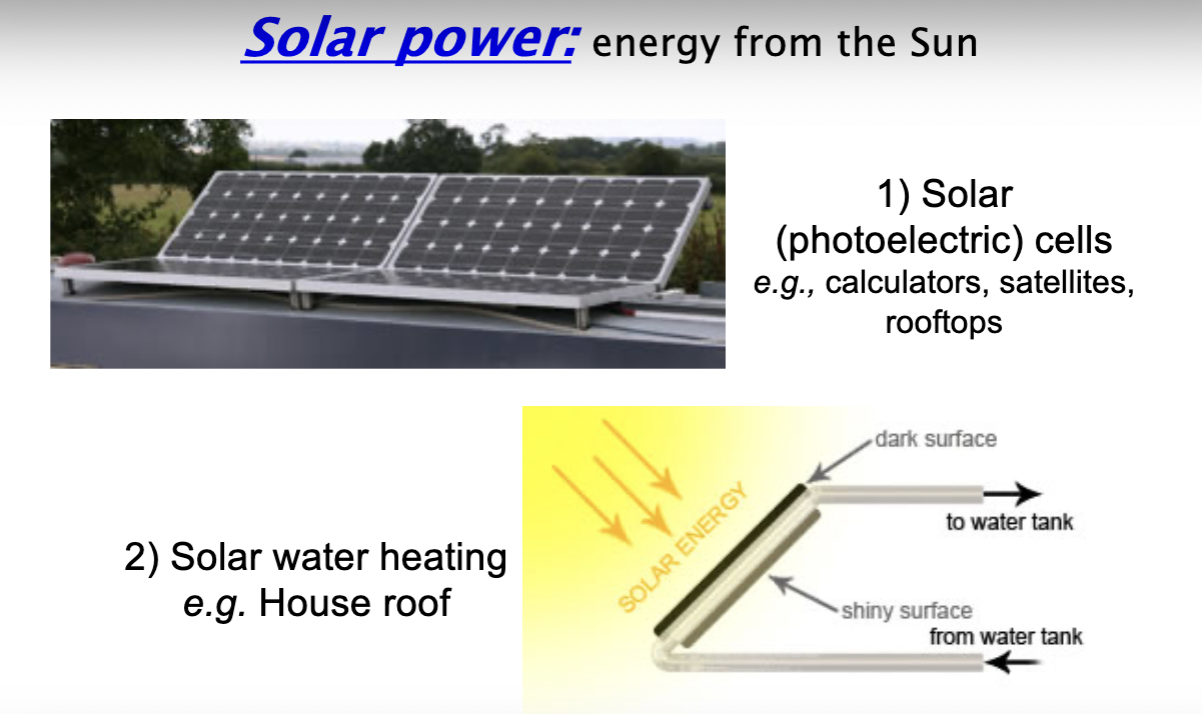
Solar power= energy from the sun
Two main kinds:
1. Solar (photoelectric) cells: convert sunlight directly into electricity through the photoelectric effect- used to drive calculators, satellites etc
2. Solar water heating: installed on eg house rooftops: uses a dark absorbing surface to capture heat from sunlight and transfer it to water circulating through a panel — a simpler and cheaper technology than the solar cells, commonly used for domestic hot water
explain wind power
Wind power= wind drive rotation of propellor which turn generators and give electricity
- Wind farms
explain hydroelectric power
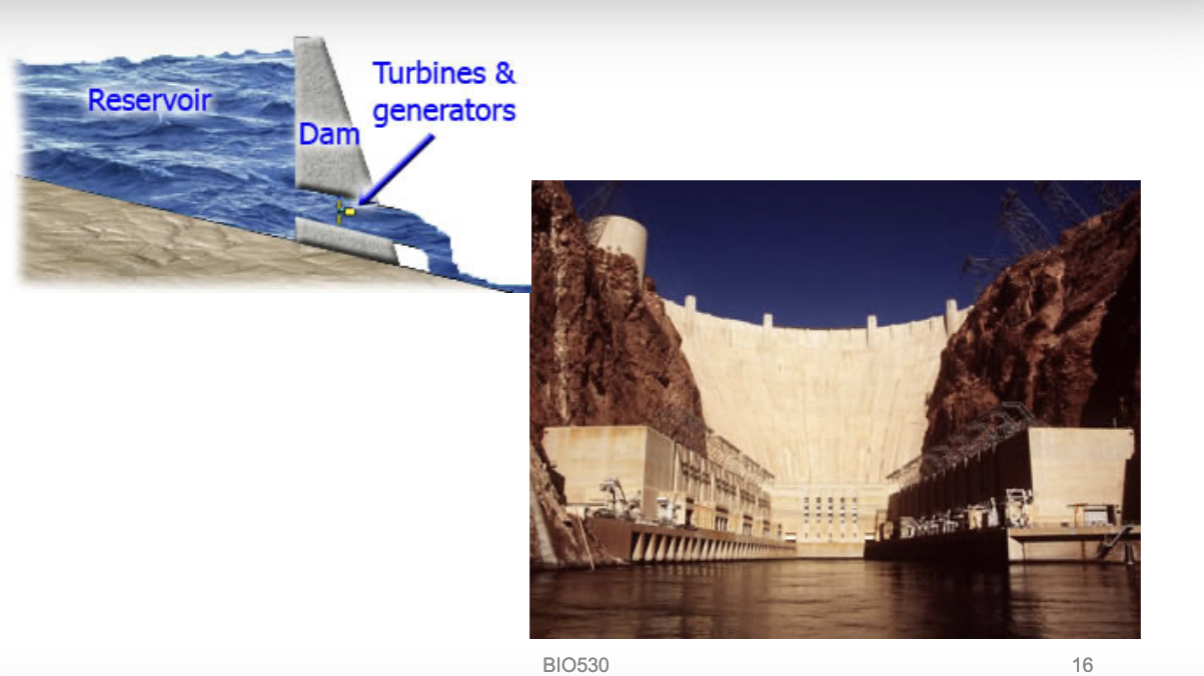
Hydroelectric power= energy from falling waters
- Constructed as a reservoir and dam- the water in the reservoir is channeled through the dam and directed through a narrow passage equipped with turbines and generators- when the water is driven through the passage, energy is generated through the driving/turning of the turbines and generators—> electricity
explain biofuels what are the three main types
Biofuels= Energy from organic material- potentially carbon-neutral.
- Three main categories:
1. Biomass: cumbustion of organic materia such as wood, crop waste etc generate heat/electricity.
2. Biogas: methane produced by microbial decomposition of organic waste- can be burned for energy.
3. Plant derived biofuels: three types a) bio-ethanol which is produced from microbial fermentation of sugar/starch derived from plant biomass eg corn/sugarcane. b) Bio-diesel: produced from plant oils/fats. c) Bio-H2: hydrogen gas produced biologically.
how can biomass be used for power
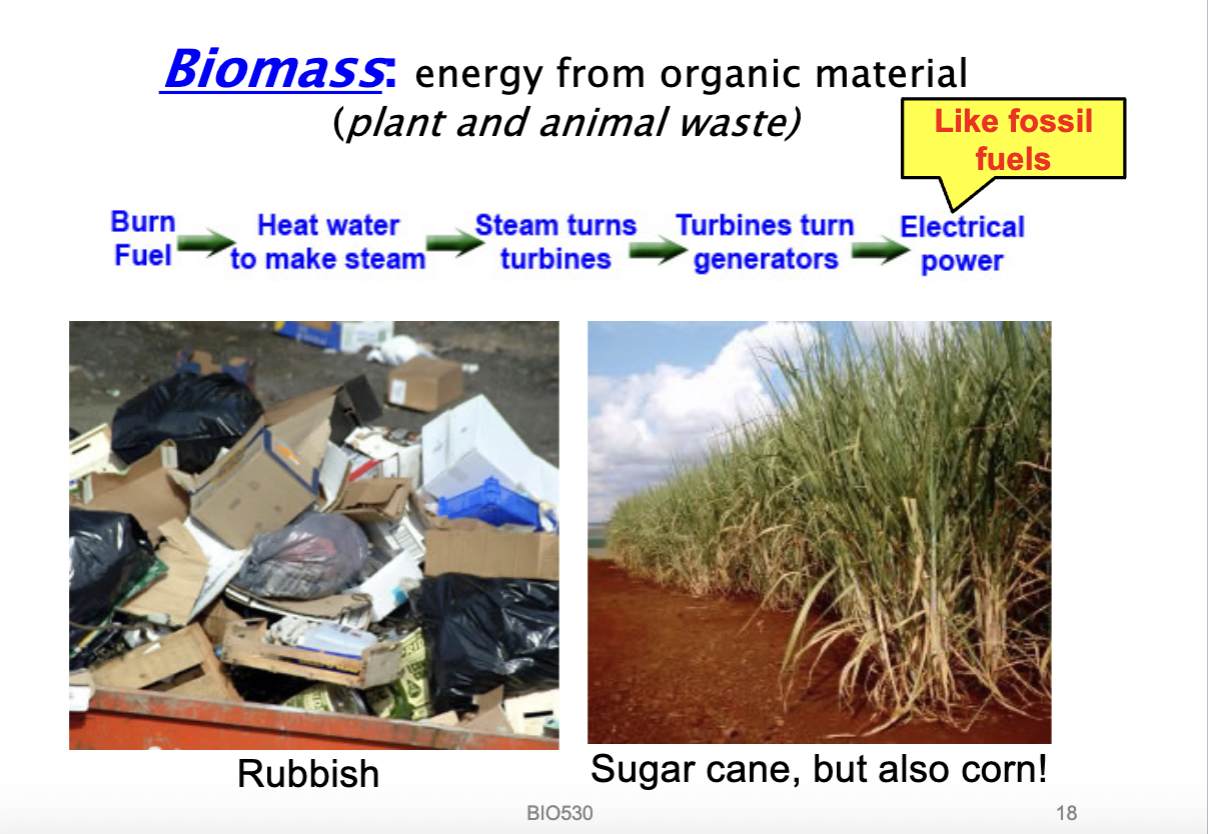
Biomass: energy from organic material (plant and animal waste)
- Burn fuel (such as rubbish and agricultural residues eg corn/sugarcane)- the heat from combustion heats up water- create steam- steam turn turbines which in turn drives generator and give electrical power (like fossil fuels)
explain what biogas is, how does it work- what are the two main types and how are they made
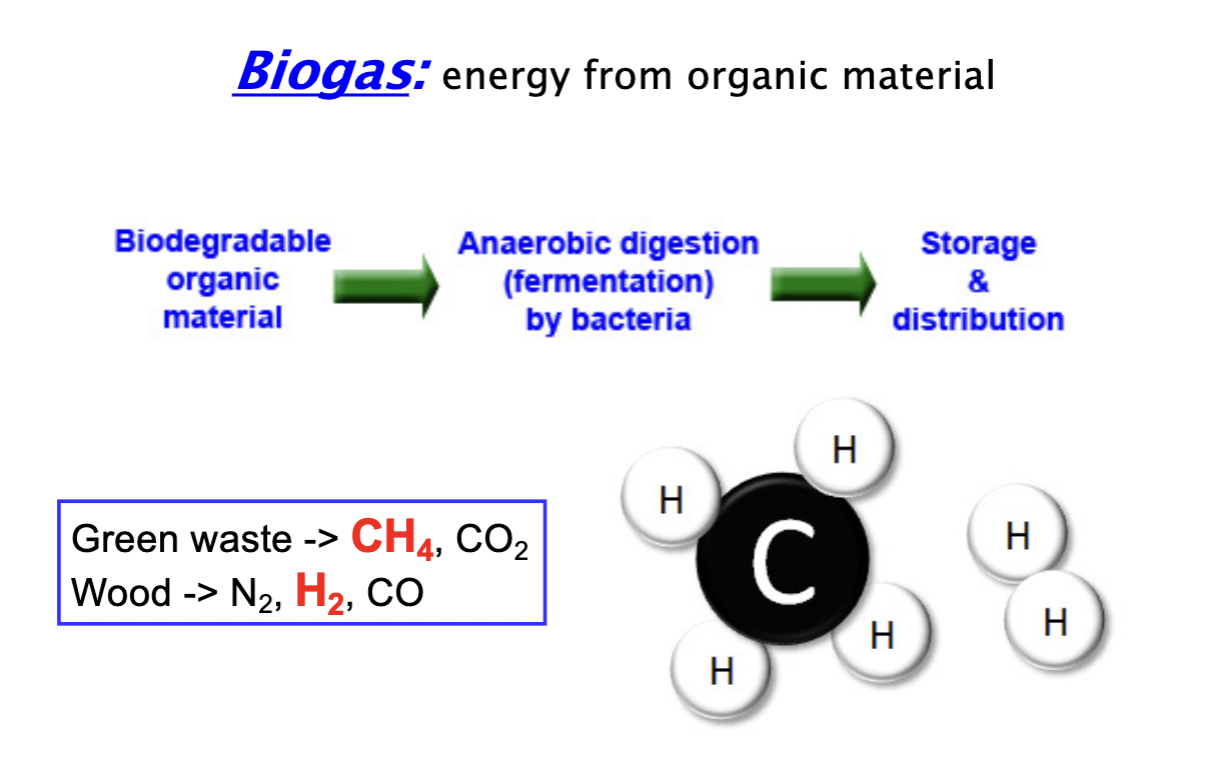
Biogas= energy from organic material:
- Anaerobic bacteria ferment organic material (such as green waste)
- Biodegradable organic material such as green waste (wood, leaves, organic scraps eg from garden) is fermented by anaerobic bacteria which is stored and distributed (the gas needs to be stored and distributed until the power is used for electrical power by burning the energy rich gas and using it for physical energy)
- The bacteria digest the organic material (in the absence of oxygen) which release gases as a byproduct- these gases are then collected, stored and distributed as fuel.--> the type of gas, depend on the organic materia used in the fermentation
- Green waste: food scraps, garden waste etc will primarily produce methane gas (CH4) (as well as CO2 as “by product)
- Wood: will mainly result in hydrogen gas (H2) (as well as N2 and CO as by product)
explain natural photosynthesis
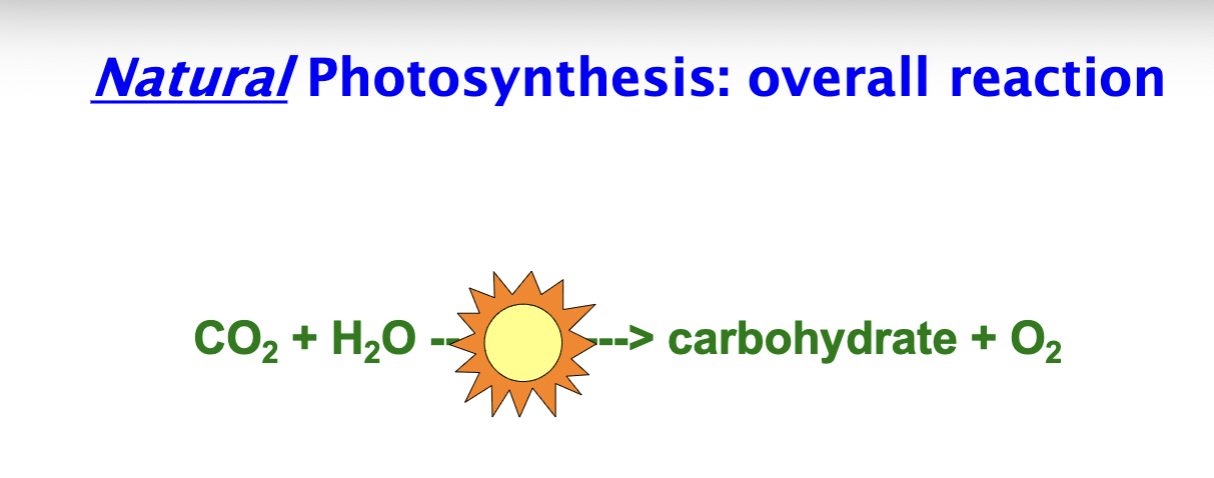
CO2+H2O+ sunlight —> sugar + O2
- Cyanobacteria have made this reaction since 2 billions years ago
- Today we can describe the photosynthetic energy conversion on a molecular level very detailed
explain artificial photosynthesis, what are the two main types
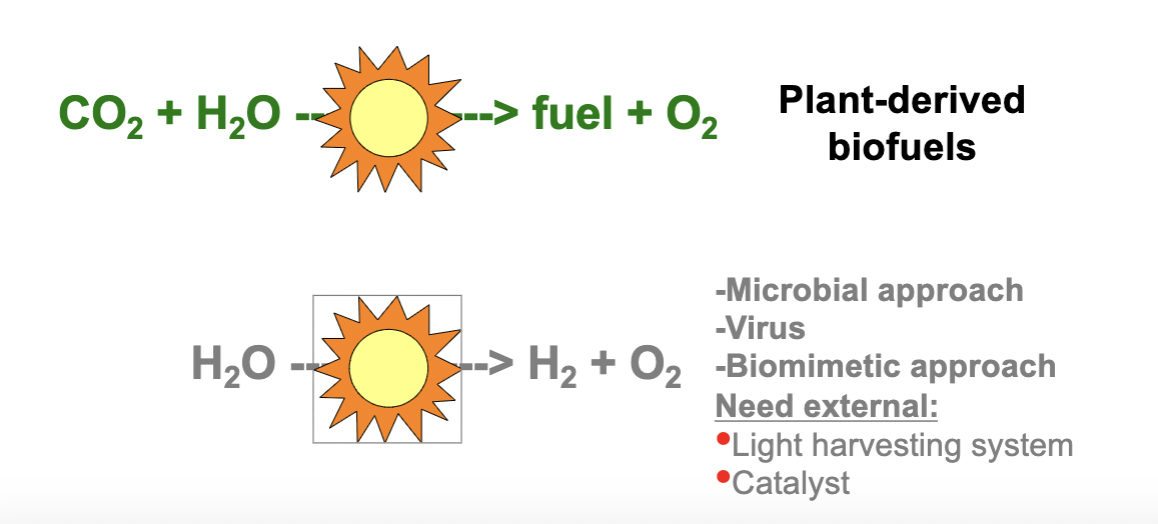
Artificial photosynthesis: The aim is to modify or mimic/replicate the natural process of photosynthesis. Two Main Pathways:
1. Replicating natural photosynthesis: converting CO2 and water and using sunlight to create "fuel" (like hydrocarbons or alcohols) and O2. This mimics what plants do but aims for higher efficiency.
2. Water Splitting (H2 production): A simpler but powerful reaction where sunlight is used to split water into Hydrogen gas (H2) and Oxygen (O2). Hydrogen is the "fuel" here, which is incredibly clean-burning.
- Split water with the help of sun energy to hydrogen and oxygen (H2O+ sun—> H2 + O2): you can either use photosynthetic microbes/engineered viruses OR the biomimetic approach. Either way- external light harvesting system and catalyst need to be externally added.
what is biomimetics
Using synthetic chemistry that "mimics" the biological enzymes- supermolecules
explain the first, second and third generation of biofuels, and why they have been developed
- First generation biofuels: sugar canes maize etc to make ethanol. —> Derived from food crops. Issue- High land use and "food vs. fuel" ethical concerns
- 2nd generation: Derived from non-food oils or specialized crops (Palm oil, Soybean, Algae) to make biodiesel,
- 3rd generation: Uses engineered cyanobacteria to aqcuire a range of alcohols as fuels
- Why the change of biofuels (between the 1, 2, and 3 generation): first gen is ethanol (they used crops in order to create biofuel- however those biofuel crops have to compete with food production- cause starvation/famine etc by directing potential food sources toward other purposes), 2nd gen biofuels made biodiesel (crops rich in oil used to make something similar to diesel- biodiesel- however still competition with food production- except for algae- the use of algae solve the competition problem here). The 3rd generation use cyanobacteria which does not compete with food production —> both the first and second generation biofuels require massive amounts of arable land- competing with food industry
epxlain the 1st gen biofuel
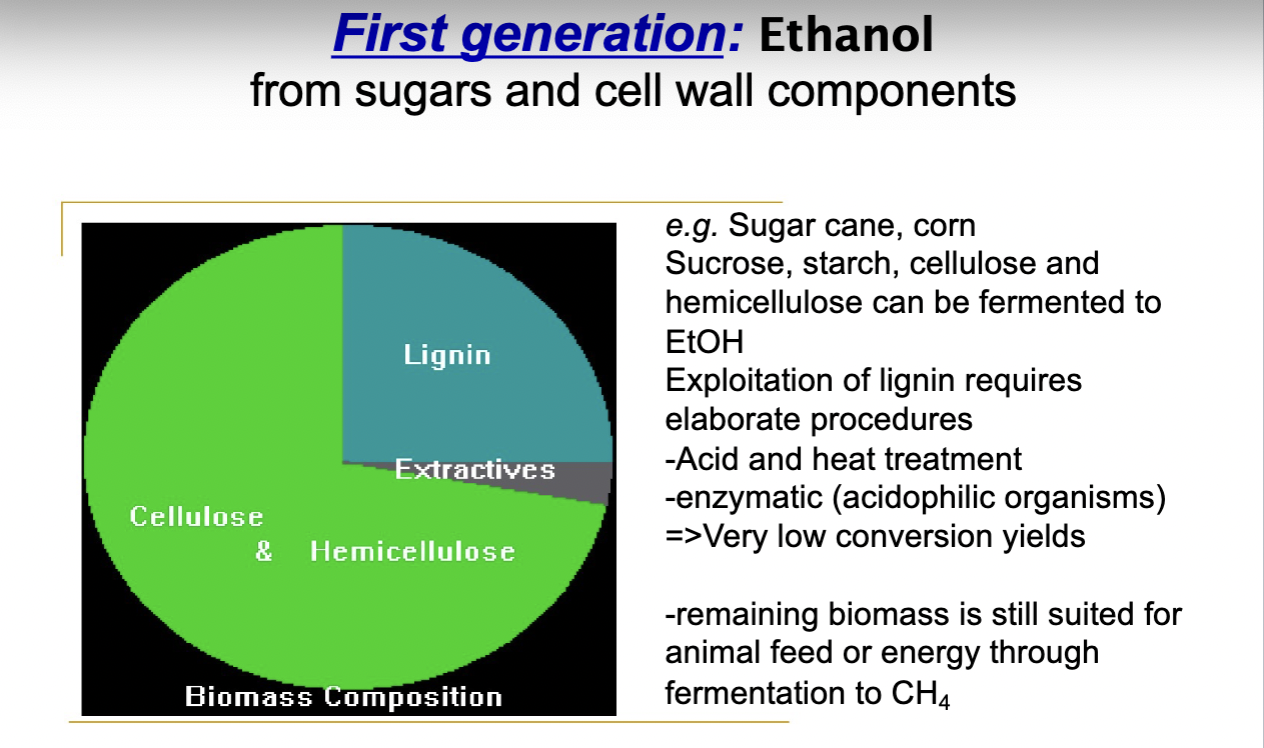
1st gen biofuel= ethanol:
- Made from sugars and cell wall components: Sucrose, starch, cellulose and hemicellulose can be fermented to EtOH (ethanol) used for fuel
- Disadvantages: Lignin is a very rigid molecule resistant to breakdown- To get to the fermentable sugars in the cellulose, you have to "unlock" the lignin using harsh acid/heat treatments. The breakdown is enzymatic and has very low conversion yields.
- very hard to use- very rigid molecule- hard to break down into soluble sugars- the biomass is used as animal feed
- Remaining biomass (after biofuel extraction) is still suited for animal feed or energy through fermentation to CH4
explain the second generation biofuel
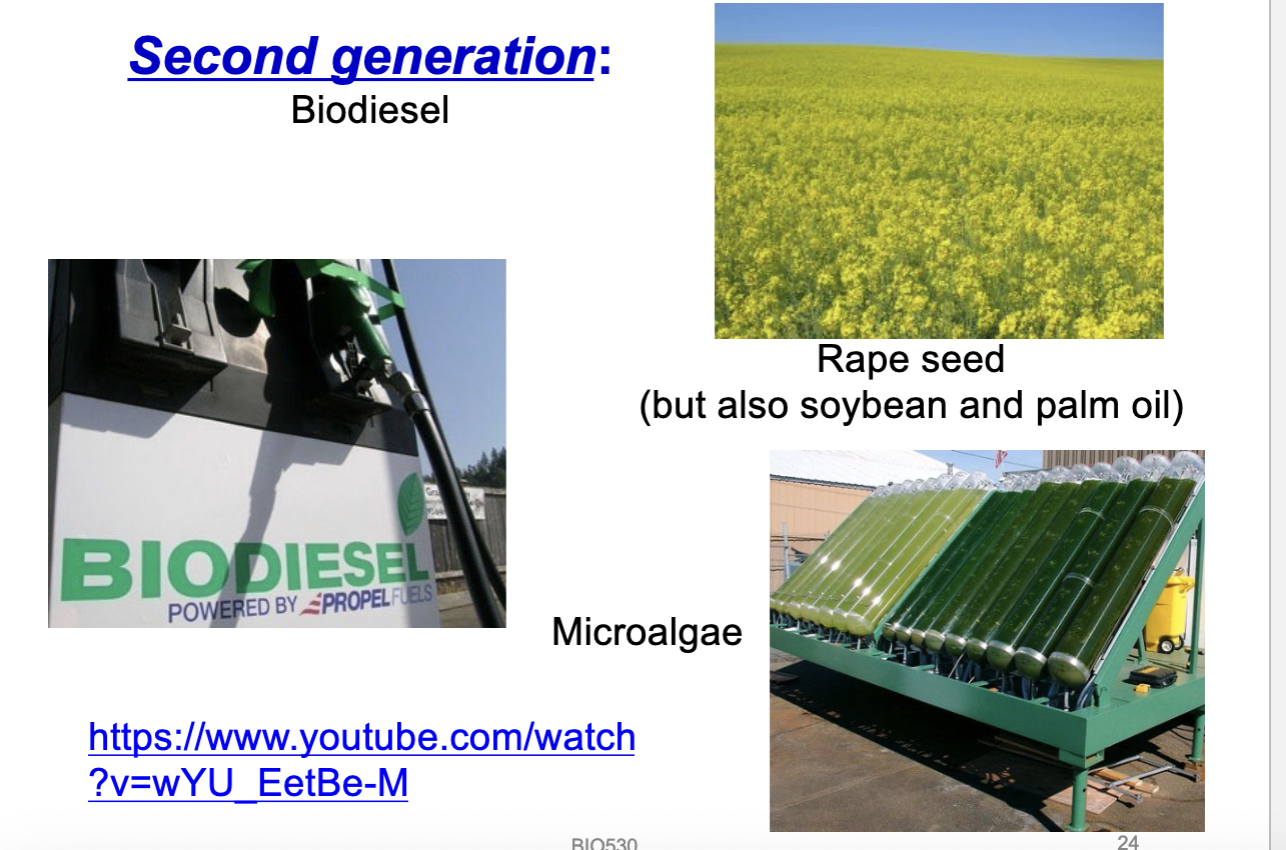
2nd gen biofuels= Biodiesel
- Still used today
- Could be derived from oil rich biomass such as palm oil, rapeseed, soybean and algae- because of the competition with food production with the use of most land plants —> lead to the widespread use of microalgae
explain the advantages with using algae for biofuels, what gen is it
2nd gen- biodiesel
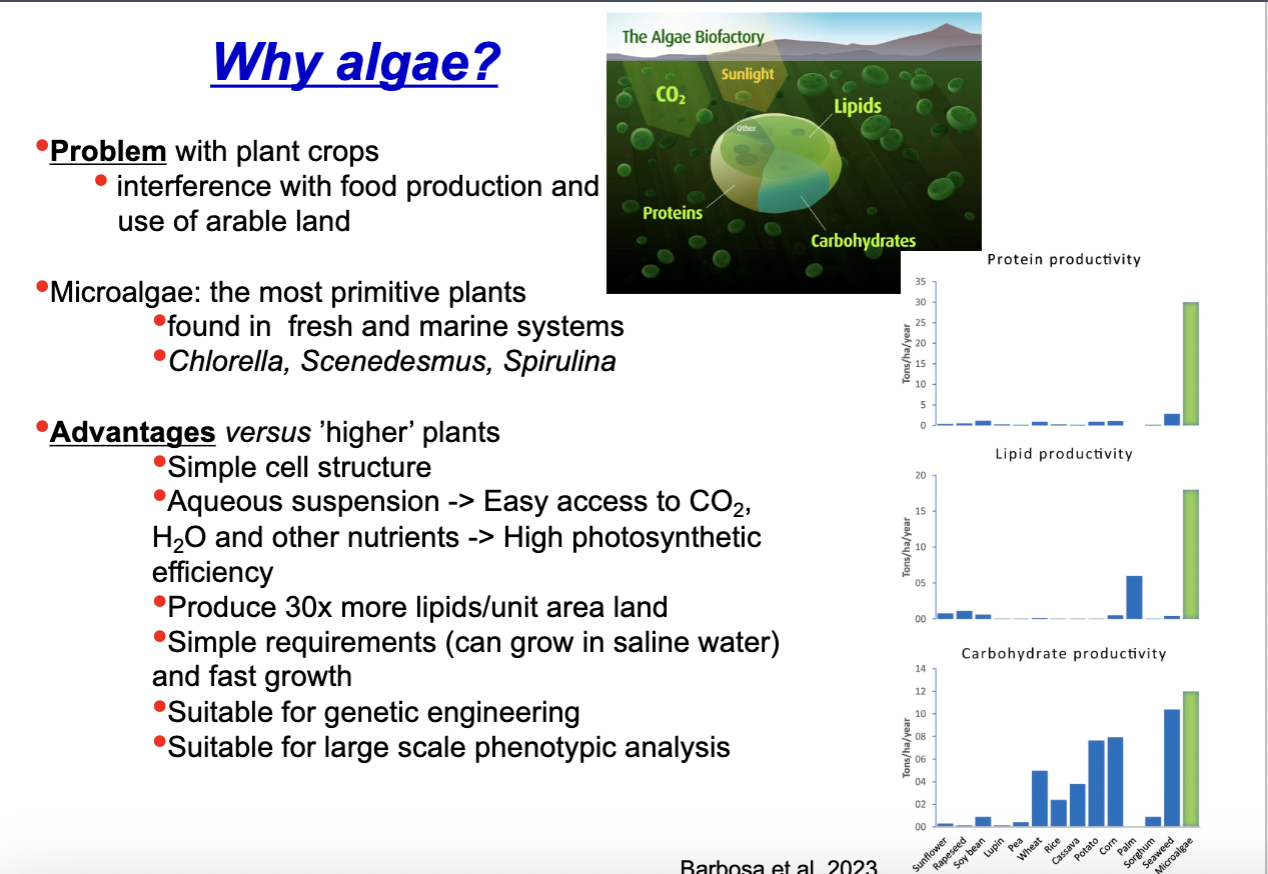
- no interference with food competition, no need for agricultural land, rich in oil, don’t need land- use water, unicellular- if you suspend them in a medium they will immediately disperse and take up the nutrients- high productivity, able to produce a lot of lipids in comparison to plants because they are small, can grow fast etc. Simple requirements, you can use sea water or even waste water. You can also easily genetically modify the organisms.
Algae is exponentially better at lipid (oil) production compared to crops like Soy or Rapeseed. (Lipids are the direct precursor to Biodiesel)
explain how the circular vision for biofuels (2nd gen) could look like
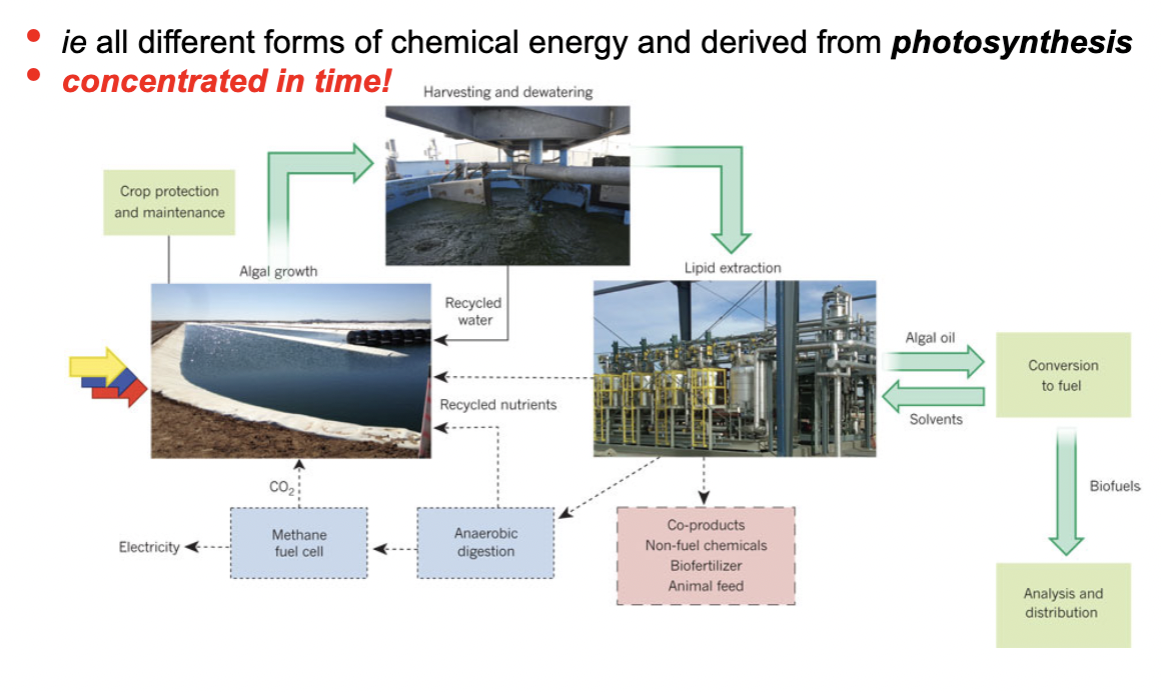
microalgae could be used for a circular energy process where all its components are used in a circulatory system
- algea ponds (open area where algea have acces to sunlight, CO2 and nutrients)- once algea are growing—> biomass that is harvested- water is removed- biomass will be used to extract the lipids (main component) – get algea oil that is processed and give bio oil/biodiesel- the byporducts from the algea can be used for animal feed, fertilisers, and other chemicals- the left overs can be subject to anaerobic digestion and generate methane which in turn can be used to generate electricity or be put back into the water to fuel further algea growth.
list the advantages with algaa versus ’higher’ plants in biodiesel (2nd gen biofuel):
- Simple cell structure
- Aqueous suspension -> Easy access to CO2, H2O and other nutrients -> High photosynthetic efficiency
- Produce 30x more lipids/unit area land
- Simple requirements (can grow in saline water) and fast growth
- Suitable for genetic engineering
- Suitable for large scale phenotypic analysis
explain the 3rd generation biofuel
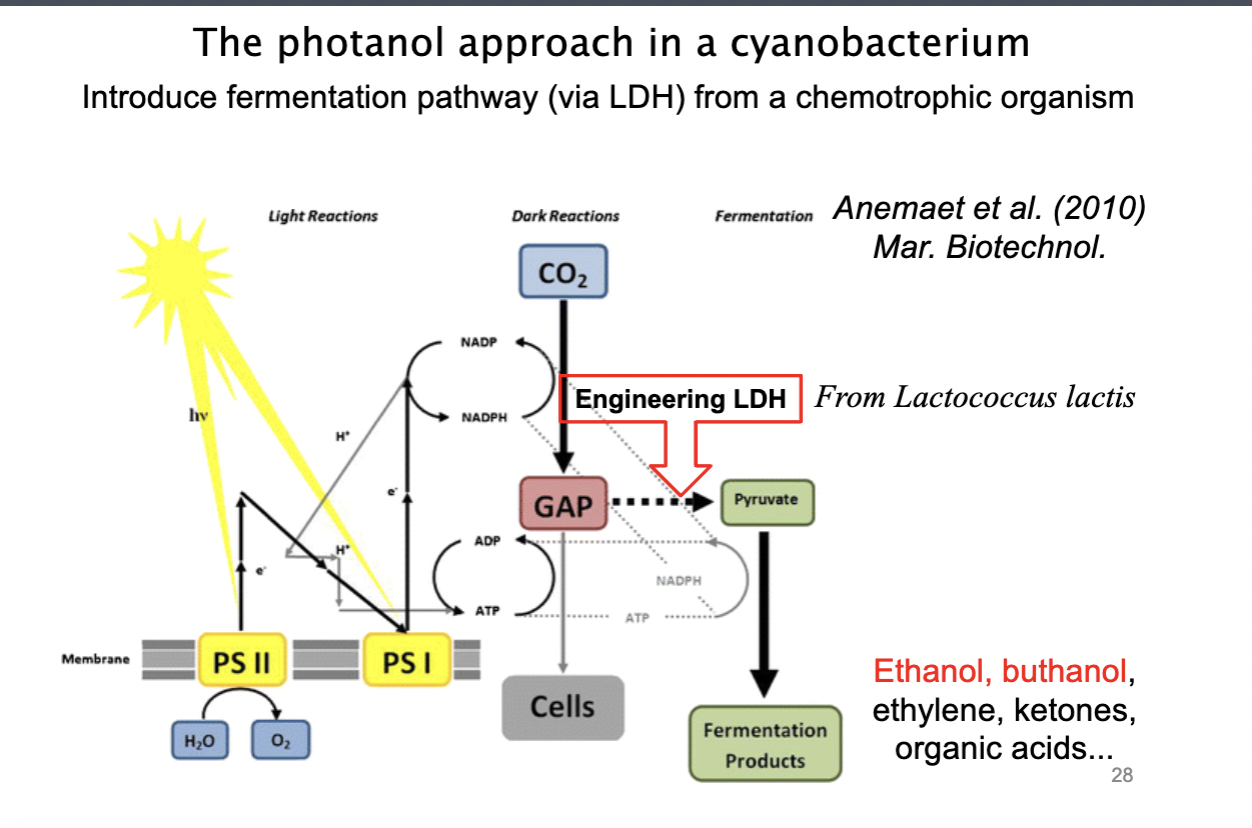
The photanol approach in a cyanobacterium: introduce fermentation pathway (via LDH) from chemotrophic organism
- Cyanobacteria are naturally photosynthetic — they use sunlight to fix CO₂ into GAP (glyceraldehyde-3-phosphate), a sugar intermediate, using the standard light and dark reactions of photosynthesis. Normally this GAP would just go towards building cell biomass- however if LDH gene is engineered into the cyanobacteria (the LDH gene is taken from eg Lactococcus lactis — a fermentative bacterium) the LDH enzyme diverts the GAP towards pyruvate, which then enters a fermentation pathway producing useful biofuels and chemicals like ethanol, butanol, ethylene, ketones and organic acids
- Photosynthetic cyanobacteria can when engineered with an additional gene from a chemotrophic bacteria in order to be able to convert photosynthetic products (GAP) directly into fuel (alcohols)- no need for harvesting and extracting.
- "photanol" — photosynthesis + ethanol
- Using cyanobacteria and engineering genes from chemotroph to generate the desired fuels through the combination of photosynthesis and fermentation
in short name two advantages and one disadvantage of H2 as fuel
H2: considered to be a clean fuel because it is natural- part of water. Useful as a compact energy source in fuel cells and batteries.
- Issues: because it is a gas that has to be transported under pressure to keep compact—> lead to extra weight of vehicles, and potential explosion risk. Ideally computers and cars could be driven by H2. —> Many companies are working hard to develop technologies that can efficiently exploit the potential of hydrogen energy
how is H2 made naturally, by who? what are the three ways to make it as fuel?
- All oxygenic photosynthetic organisms use water as substrate- when water is used you get oxygen and hydrogen (protons)
- Plants can not make hydrogen gas- they will use the protons for other purposes however there are some algae and cyanobacteria that have certain enzymes which allow them to produce H2
- Three ways: 1. Microbial approach: using algea/cyanobacteria, 2. Virus use or 3. The biomimetic approach
describe the microbial approach to make H2 as fuel:
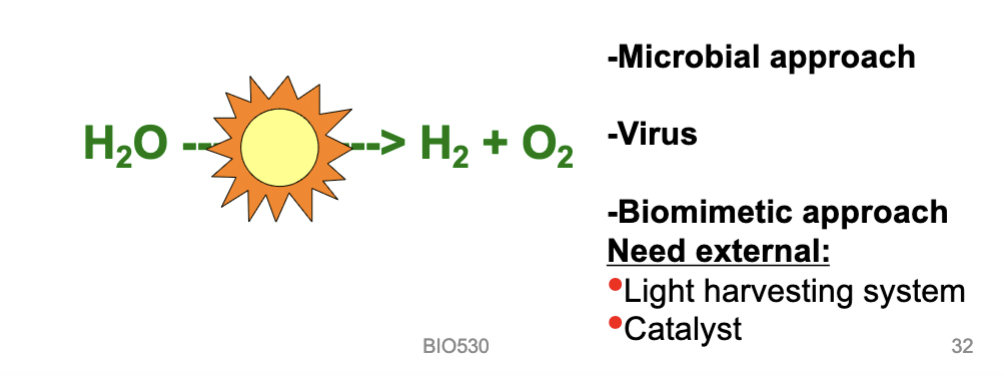
Microbial approach to make H2: cyano bacteria/ algea do photosynthesis.
- Using microbes that naturally have an enzyme (hydrogenase) which can convert protons to H2.
- Hydrogen (H2) accumulate on the surface of cultures- easily collected
- Green algae: Have Fe2 hydrogenase (which can synthesise H2) however this enzyme is very sensitive to oxygen and is inactivated by it. Therefore the oxygen in the photosynthesis need to be separated from the enzyme.--> ongoing research how to do this in order to benefit the H2 production while simultaneously allowing photosynthesis to occur
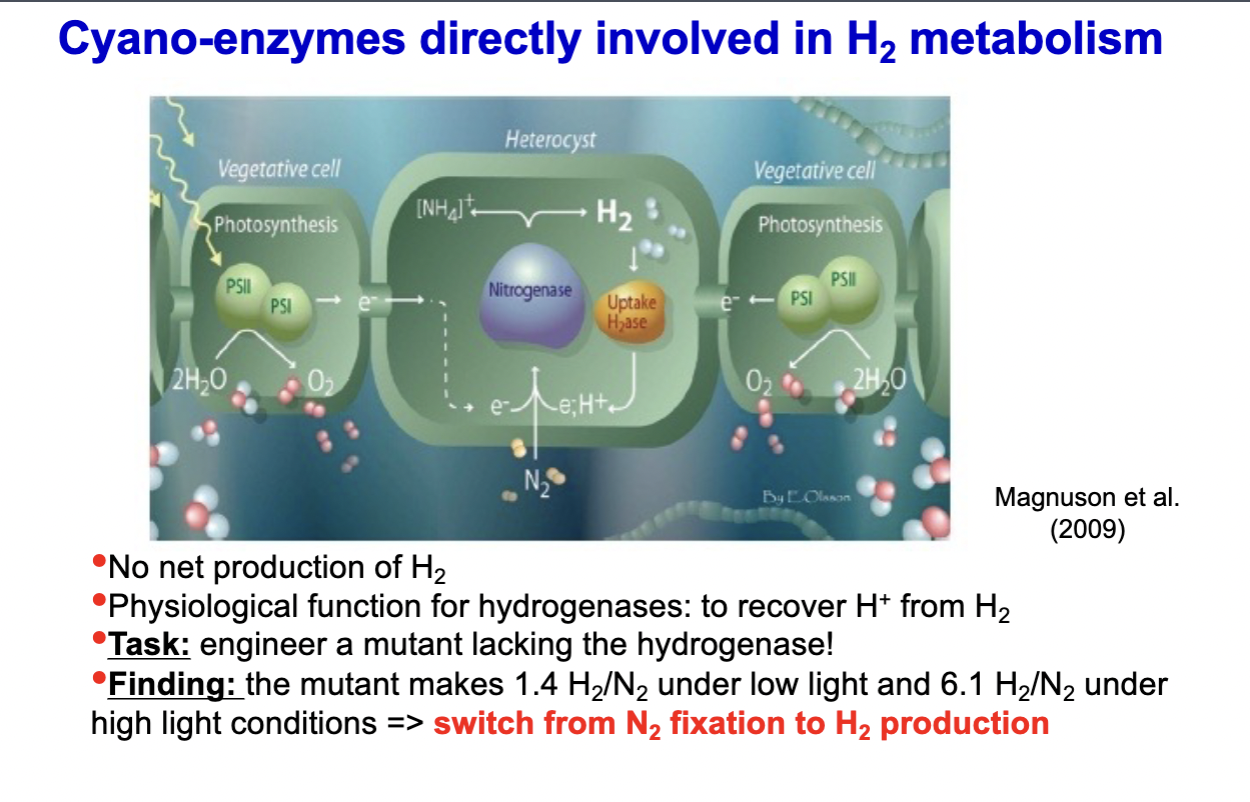
- Cyanobacteria (nitrogen fixing bacteria): in addition to photosynthesis they can fixate nitrogen (with nitrogenases and NiFe hydrogenases located in heterocyst structures). Alternating types of cells- vegetative photosynthetic cells alternating with heterocyst cells: fixates nitrogen wiith the enzyme nitrogenase, the byproduct H2 is then converted into protons by the enzyme hydrogenase and can be used in the nitrogen fixation again—> no net production of Hydrogen gas since it is converted of H2 into protons by the hydrogenase- however genetic engineering can mutate the bacteria so that it lacks hydrogenase which will inhibit the H2 to be consumed and used in nitrogen fixation and instead lead to the net production of H2 production
explain viral production of H2
viruses can be genetaícally engineered to create H2 and O2 from H2O.
- Eg using the virus M13: common and harmless bacterial virus.
- Need solar panel to capture sunlight, catalyst and pigments (in the form of artificial nanostructures)—> on the way to biomimetics- not completely “organic” nor artificial
explain the biomimetic approach to H2 production as fuel
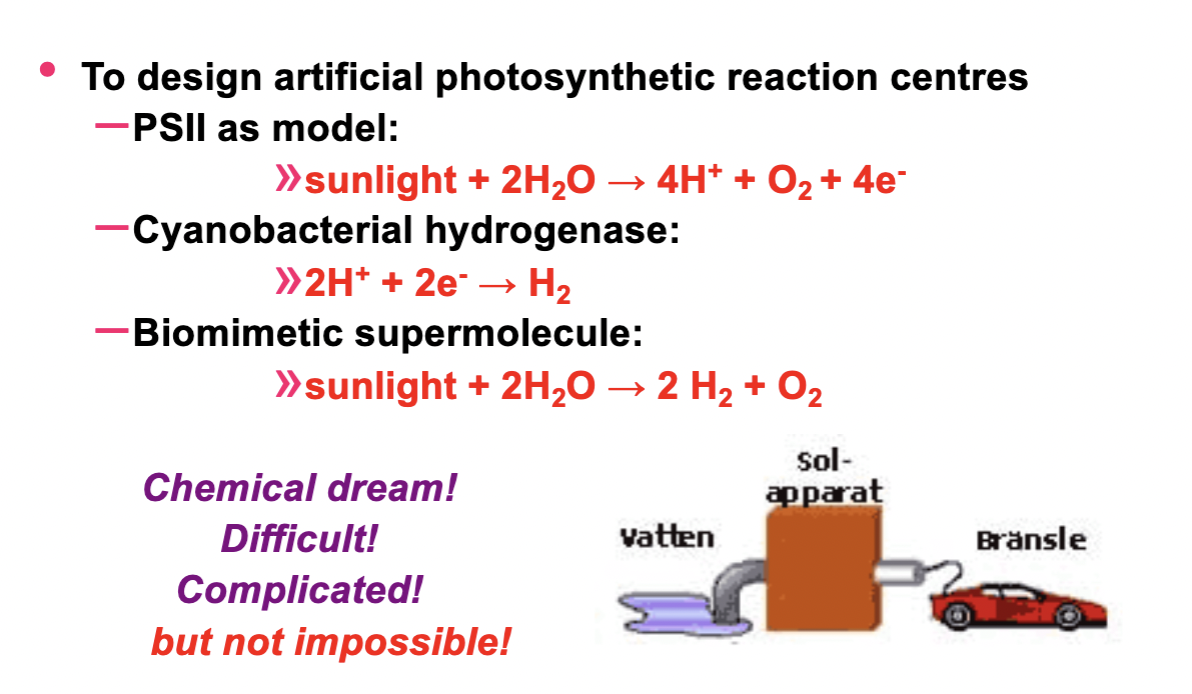
The goal is to design artificial photosynthetic reaction centres- allowing for supermolecules which can utilize the two reactions:
1) PS2 from photosynthesis- using the energy from sunlight and using it to split water molecules into protons, oxygen (and electrons),
2) hydrogenase from the cyanobacteria (reversible enzymes involved in the nitrogen fixating heterocyst processes) can be used to then convert the protons and electrons into H2 (hydrogen gas).
—> The final reaction being: sunlight + 2H2O → 2 H2 + O2
- Learn from natural system to construct artificial system.
- Biomimetic supermolecule should be constructed to perform both the PS2 (in photosynthesis) reaction as well as the cyanobacterial hydrogenase reaction.
what do chlorophyll do
Chlorophyll pigments absorb sunlight- pass the energy between them- the energy is then channeled and concentrated into the pigment reaction centre where one electron from the pigment leaves (due to high energy input) and is accepted by the primary acceptor molecule. —> Energy transfer is channeled within each chlorophyll system and used in charge separation (=the conversion of light energy to chemical energy)
Chlorophylls are bound to proteins.
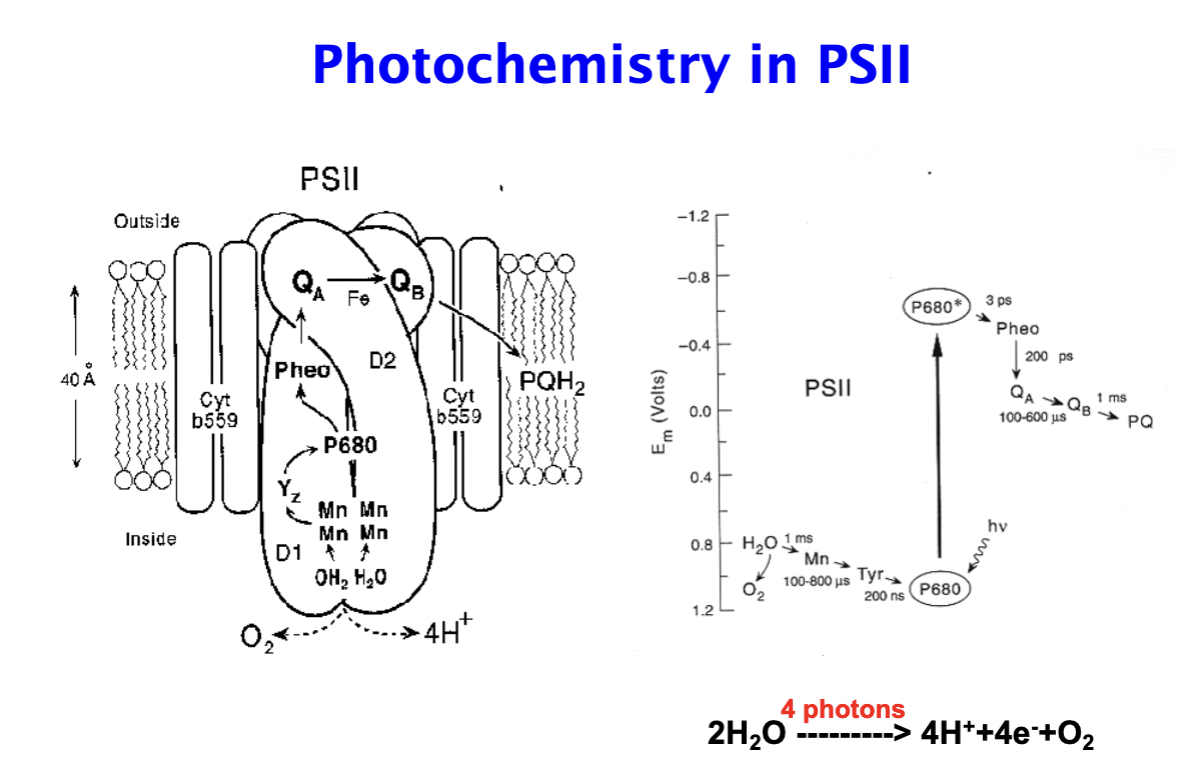
summarise the electron transport chain in PS2
- Light capture: Photons hit the LHC (Light Harvesting Complex) molecules surrounding the reaction centre in the chlorophyll pigment- Energy is passed between the LHC molecules until it reaches P680 (the reaction centre chlorophyll). —> Charge separation: P680 absorbs the energy and ejects an electron, becoming P680⁺ (positively charged). The electron is transferred to Pheophytin (Pheo) — the first electron acceptor. —> Electron transfer down the chain: The electron moves from Pheophytin → QA → QB (quinone electron carriers), eventually leaving PSII as PQH₂ (plastoquinol) to continue down the wider electron transport chain. —> Water splitting (Kok/S-state cycle): The reaction center P680+ needs to be “reset” by taking electrons from water via a tyrosine residue which in turn pulls electrons from an Mn₄Ca²⁺ cluster. Electrons are cycled one at a time (one Mn atom for each electron)— one photon at a time—> 4 electrons are accumulated and 2 water molecules are split in the process, releasing 4H⁺ + 4e⁻ + O₂.
—> The net result: Sunlight energy is converted into separated charges — electrons flow forward down the transport chain to eventually drive ATP synthesis and NADPH production
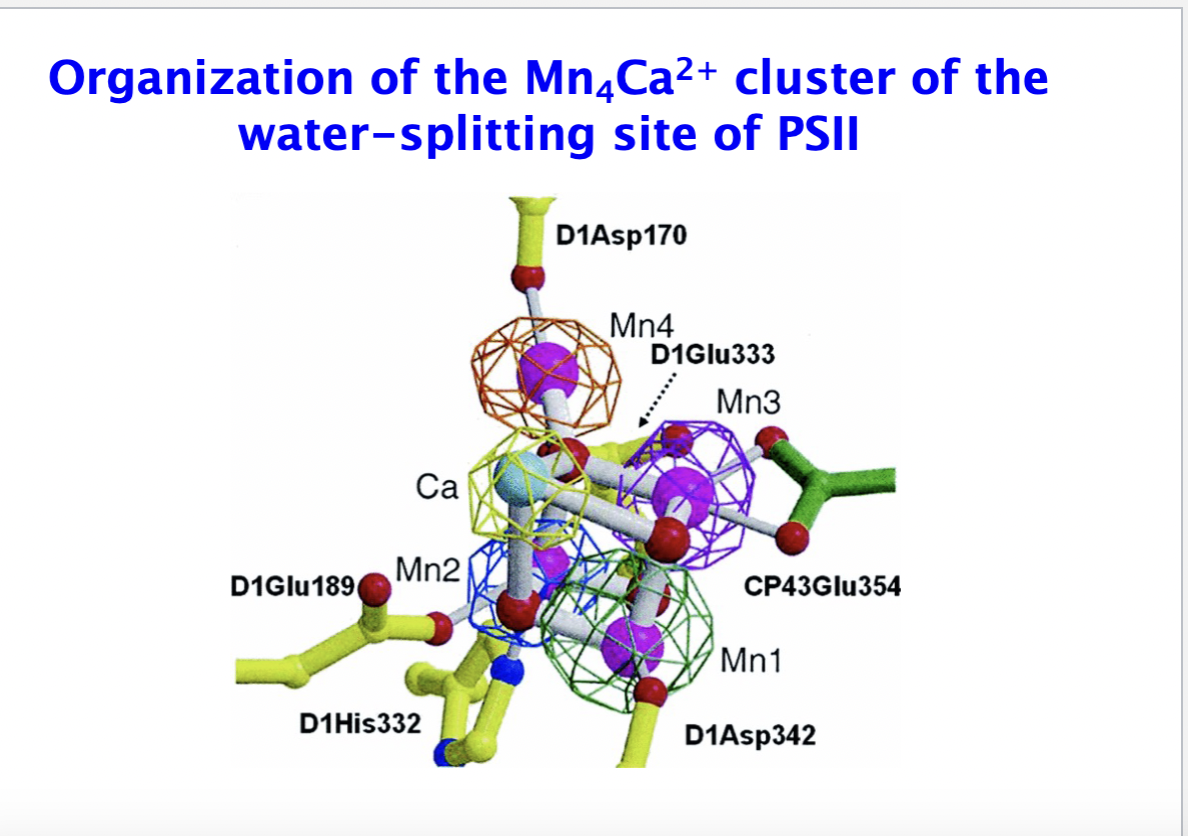
what is the water splitting site, what does it contain?
Manganese and calcium cluster is present in water splitting site of the photosystem2. 4 Manganese are present in order to extract 4 electrons from the water.
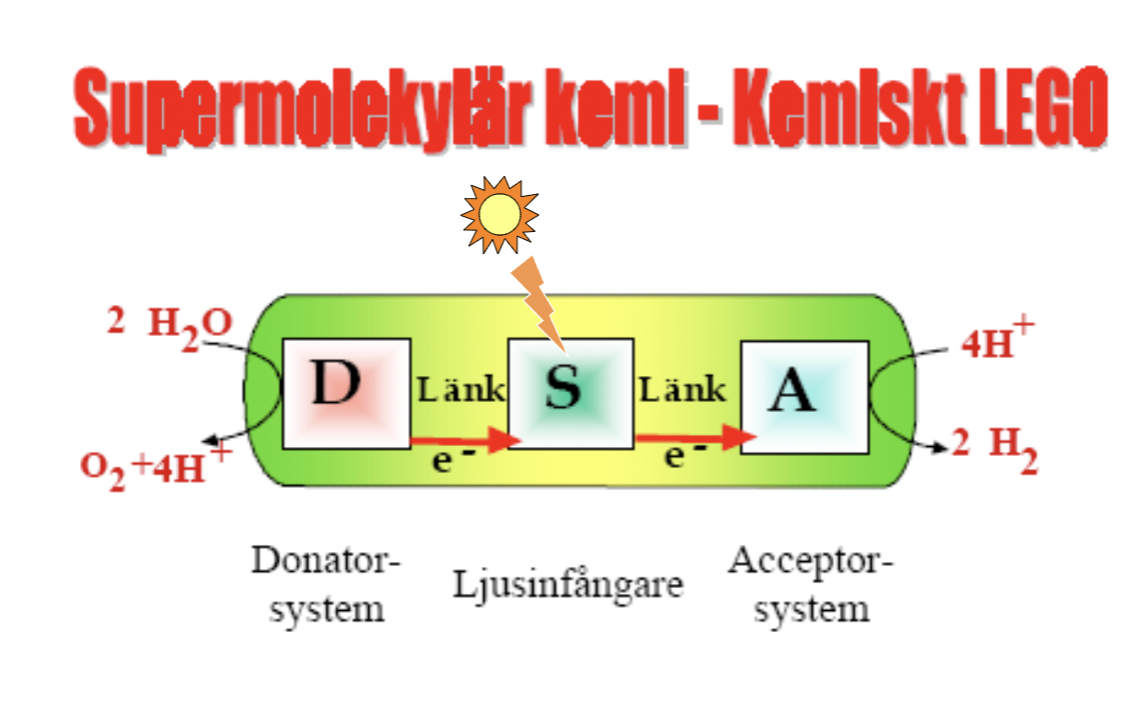
what is the principle of constructing a supermolecule (biomimetics)
chemical lego
what does the supermolecule in biomimetics contain
- D — Donor system: The artificial equivalent of the Mn₄Ca²⁺ cluster and water splitting site. It takes in 2 water molecules, oxidizes them, releasing O₂ and 4H⁺ while sending electrons forward through the molecule. A donator should be able to donate electron to substrate molecule
- S — Light harvester: This is the artificial equivalent of P680 and the LHC. It absorbs sunlight and uses that energy to drive the electron transfer in both directions — pulling electrons from D and pushing them towards A. —> The pigment: S (substrate)- pigment should be able to absorb light- it should be able to donate electrons to the acceptor molecule
- A — Acceptor system This is the artificial equivalent of hydrogenase. It receives the electrons and combines them with H⁺ to produce 2H₂ gas.
—> Donator- pigment- acceptor
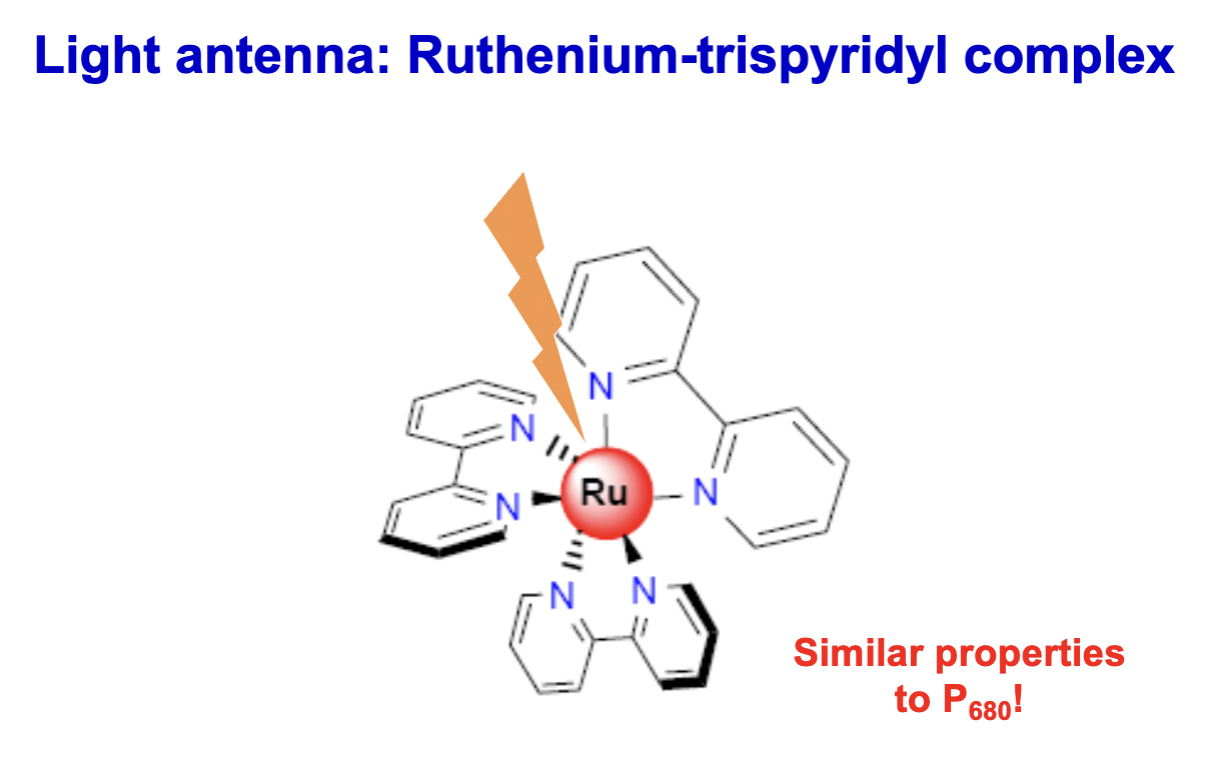
describe what the Pigment have been composed of in recent trials, in the supermolecule for artificial photosynthesis- how did they come up with that?
S: Pigment/The light antenna: looked at chlorophyll structure and tried to engineer something similar. In the middle of the natural P680 molecule there is Magnesium—> designed a complex with Ru in the middle instead- with surrounding ring structures- when light hits the molecule it had similar properties to the reaction center in chlorophyll (P680):
- Ruthenium complex: When light hits it, Ru gets excited and ejects an electron — just like P680. This is the S (sensitizer/light harvester) component of the supermolecule.
describe what the Donor system have been composed of in recent trials, in the supermolecule for artificial photosynthesis- how did they come up with that?
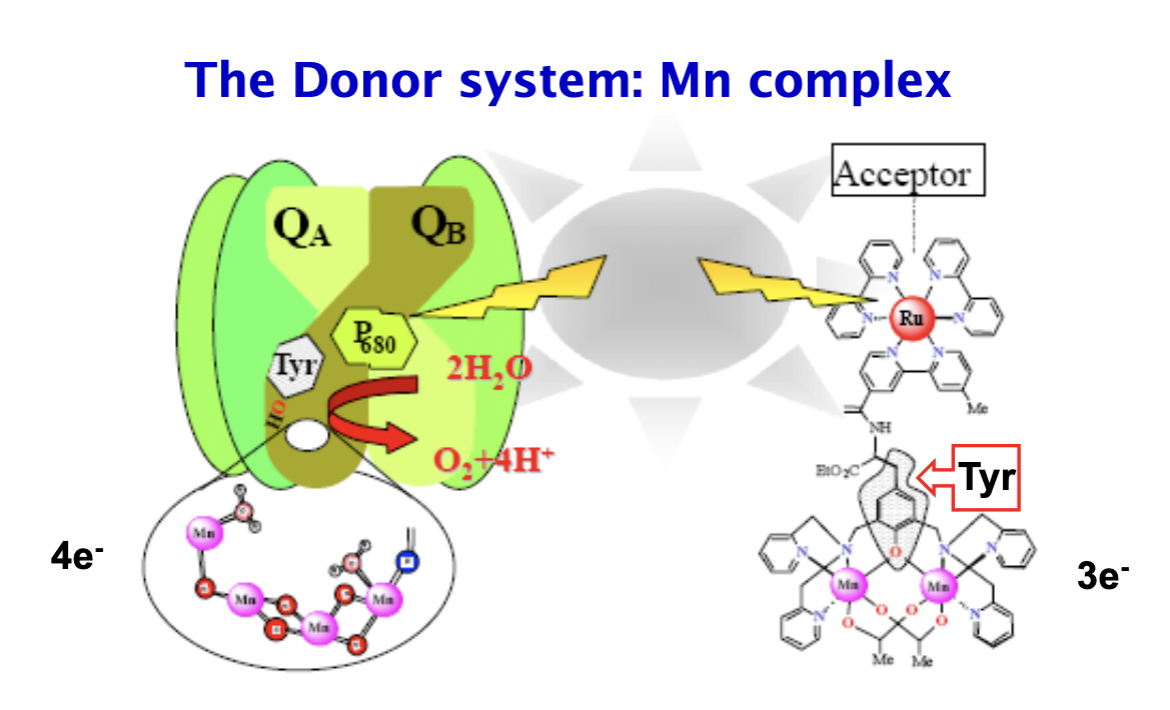
D: The donor system: extract electrons from water and give it to the pigment molecule. Manganese system
- Mn complex: Mimics the Mn₄Ca²⁺ cluster of PSII
- The Mn complex is linked to the pigment molecule through a Tyrosine bridge (like in plants)
- The Mn complex oxidizes water, extracting electrons and passing them via Tyr to Ru (in the S molecule).
- The artificial system currently achieves 3 electron transfers compared to the natural 4 — still a work in progress.
what is vectorial electron transport- why does it need to be repllicated in artificial photosynthesis- how?
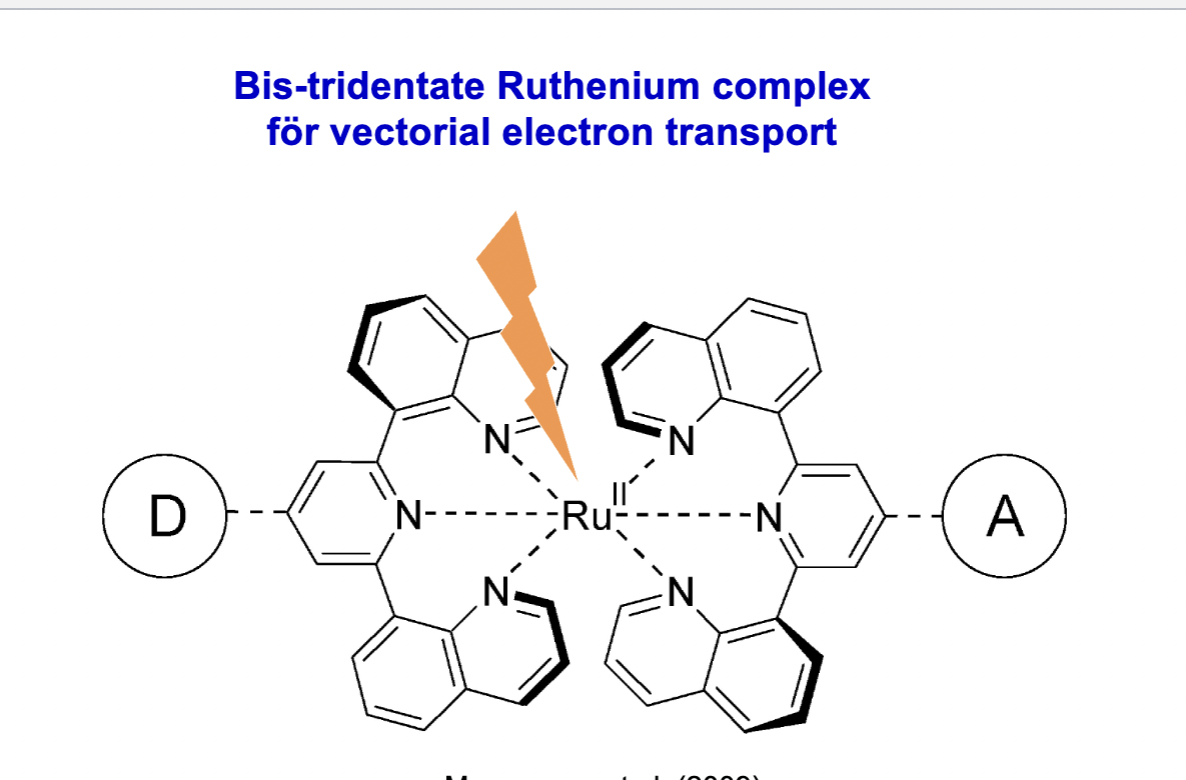
Vectorial electron transport- need to be aligned so the electrons can travel between the components easily and in only one direction: mimicing the natural one directional one way electron transport of the membrane spanning arrangement of PS2.
- Bis-tridentate Ru complex
- The electrons need to flow in one direction only (D → S → A), not randomly.
- The bis-tridentate Ru complex is designed so that the donor (D) attaches on one side and the acceptor (A) on the other, creating a directional electron highway.
describe what the acceptor system have been composed of in recent trials, in the supermolecule for artificial photosynthesis
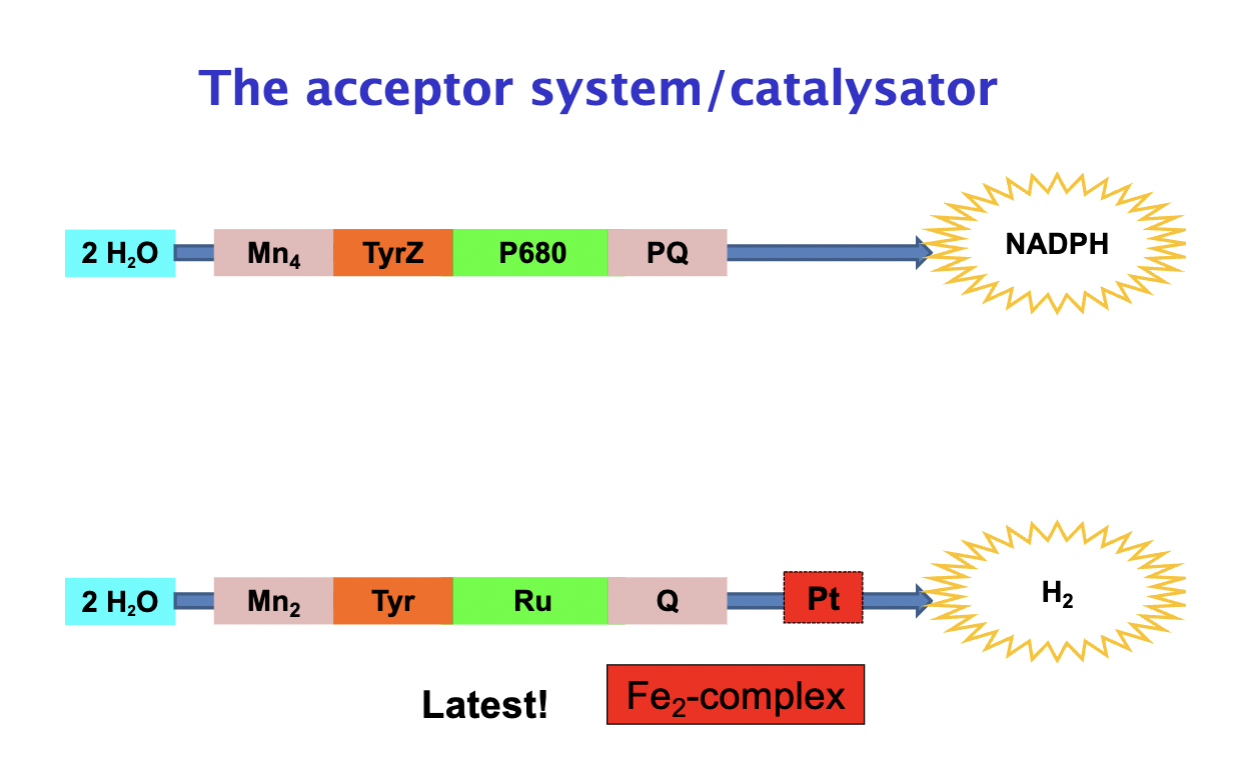
Acceptor system: naturally the NADPH is the final electron acceptor, in the artificial one we have Hydrogen (to result in H2).
—> Instead of NADPH as the final electron acceptor, the artificial system uses either platinum (Pt) or more recently an iron (Fe₂) complex (mimicking the Fe-hydrogenase active site) to combine H⁺ and electrons into H₂ gas.
describe how the final Ru-Fe₂ supermolecule looked like in the attempt of creating artificial photosynthesis
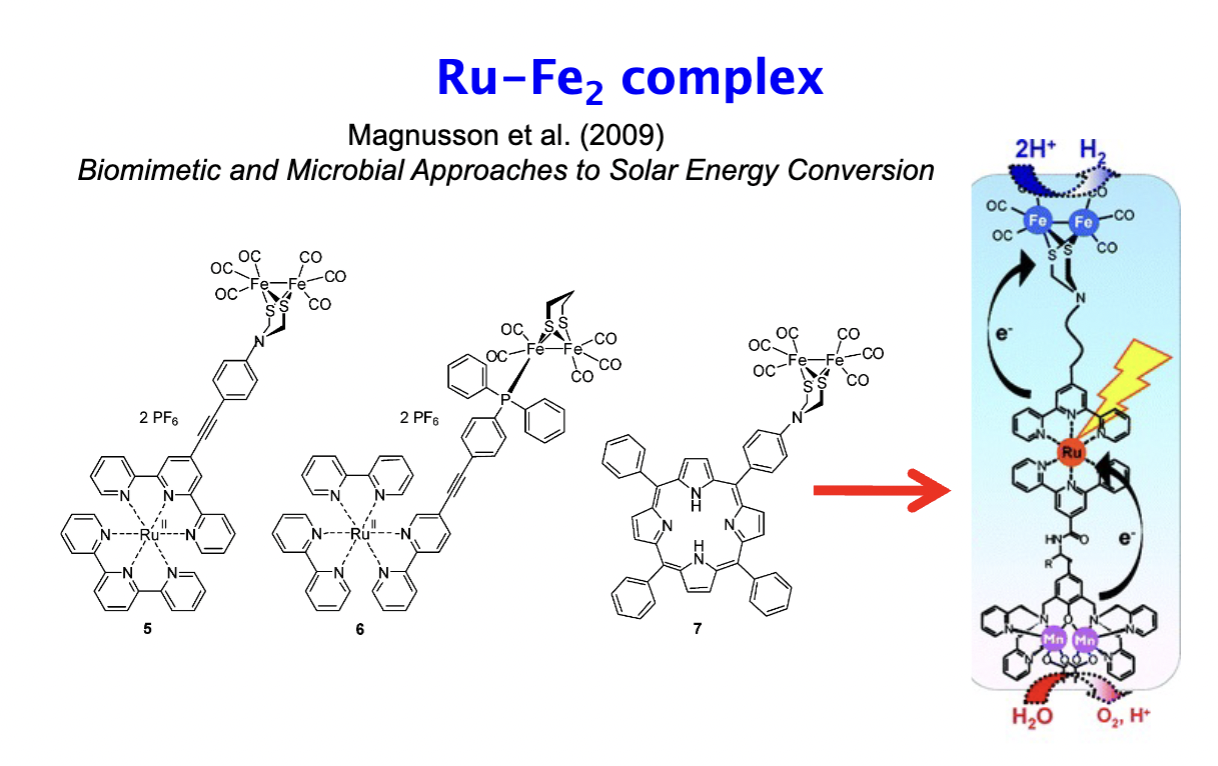
Ru light absorber with an Fe₂ complex acceptor combined: Mn complex that splits water, releases O₂ and H+, Ru that absorbs light and drives directional electron flow and lastly the Fe₂ complex which receives electrons and combines them with H⁺ to produce H₂.
talk about solar fuels- give one interesting example of how this could work in theory
use water and sun to produce H2. We do not want to use expensive materials- cheaper metals to make it more affordable.
- Use water as raw material and sun as energy source to produce molecular H2.
- Strategy: make catalysts from Earth abundant elements like Co, Mn, Fe, Ni
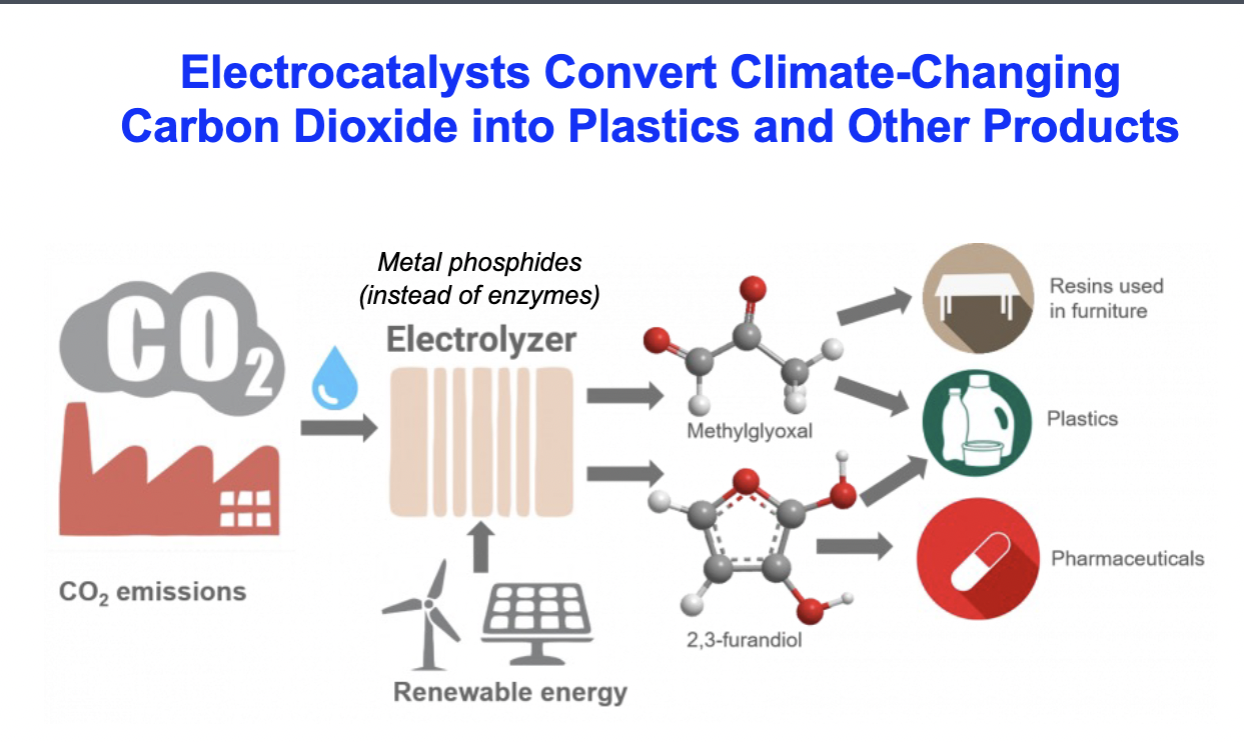
- Latest: Metal phosphides as Electrocatalysts for water splitting and H2 production
how can metal phosphides be used? what are advantages
Metal phosphides- made to take care of CO2 in the atmosphere
can be used as electrocatalysts to capture CO2 and produce other compounds that can be used as substrates for different fields
—> get rid of CO2 and make something useful instead
talk about the potential of biomimetics/artificial photosynthesis
Biomimetics would be very good as a renewable source of fuel (H2)- do not need any growable land- no need to compete with food supply production. And is very energy efficient! —> also apart from the hydroelectric, solar photovoltaic, geothermal, and wind, which produce electricity directly, with no fuel intermediate, H2 is a sort of fuel and can hence have a wider application
May become a very important source of fuel for transportation—> Unlike BIOMASS-derived energy, it does not require arable land, and so it need not compete with the food supply.