chemoreception & touch
 Call Kai
 Learn
Learn Practice Test
 Spaced Repetition
 Match
Match Flashcards
 Knowt Play
1/40

Earn XP
Description and Tags
https://f1000research.com/articles/5-880, https://pubmed.ncbi.nlm.nih.gov/30654923/#&gid=article-figures&pid=fig-3-uid-2, https://www.researchgate.net/publication/51273162_Development_of_the_Brain_Depends_on_the_Visual_Environment
Name | Mastery | Learn | Test | Matching | Spaced | Call with Kai | Chat |
|---|
No analytics yet
Send a link to your students to track their progress
41 Terms
whats homeothermic vs poikilothermic vs heterothermic
homeo- can function over narrow range of body temperatures
poikilothermic- can function over wide rage body temp
heterotherm- vary between self-regulation and allowing environment regulate internal temperature (endotherm & ectotherm obvious)
why does heat sometime lead to death
-denature proteins
-thermal inactivation of enzymes > rate of formation
-oxygen limitation
-effects on mb structure (fluidity)(cold reduces permeability cuz more tightly packed lipids)(hot is more fluid because more kinetic energy so lipids separate more, increase in permeability)
-diff processes in metabolic networks have diff temperature dependence
how can you use Q10 to measure thermosensitivity
Q10 = (R2/R1)^10/(T2 - T1)
if Q10 < 4 not thermosensitive, if >7 then considered thermosensitive
how is an increase in temperature produced when have fever
increase metabolic rate- higher set temperature checked voa hypothalamus - increased body temp also preferred in poikilothermic animals
whats the difference between heat & temperature
heat- measure in calories, 1cal= energy required to heat 1g water by 1C
temperature- measured in degrees C or K
how do measure heat balance
Htot = Hc + Hr + He + Hs
Htot = rate of metabolic heat production
Hc = rate of conductive and convective heat exchange
Hr = rate of net radiation exchange
He = rate of evaporative heat loss
Hs = rate of heat storage in body
what pathway does temperature sensory info enter the brain
from dermatome (TRP - transient receptor potential, TRPV channels open & ions in) (via c fibre/ A sigma fibres) -> DRG -> spinothalamic tract -> thalamus -> somatosensory cortex to preoptic area (central thermoregulatory center)
(this info integrated w brain temp info from warm sensitive GABAergic preoptic neurons)
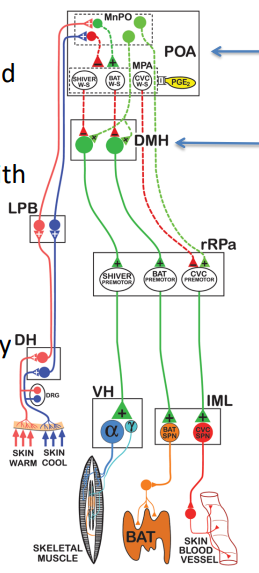
what path does the pre-optic area regulate temperature
-cutaneous vaso-constriction
-brown adipose tissue
-shivering
(through dorsomedial hypothalamus (DMH) then to sympathetic premotor neurons in rostral raphe pallidus (rRPa) then intermedial nucleus (IML) & ventral horn (VH) )
(LPB= lateral parabrachial nucleus, DH=dorsal horn, CVC= cutaneous vasoconstriction, BAT= brown adipose tissue)
what 4 subclasses of DRG neurons do TRP channels create
-TRPV1 -hot nociceptor
-TRPV1+TRPA1- putative hot-cold polymodal nociceptors
-TRPM8- cold sensors
-TRPV2- v high threshold hot nociceptors
(TRPV4 -in preoptic area, participates in regulation of body temperature)
how to activate TRPA1/ where is she?
pungent compounds, in nociceptive DRGs & trigeminals neurons
are TRPM8 & TRPA1 the only cold sensitive neurons?
30-50% unresponsive to TRPA1 or TRPM8 but are sensitive to cold - possible its K+ & Na+ channels
several K 2P channels are highly temp sensitive (TREK-1, TREK-2 & TRAAK), (these mediate voltage-independent background leak K+ currents and participate in setting the resting mb potential)
how does chemoreception work in tsetse flies
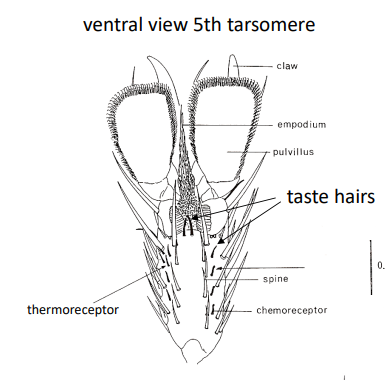
temp rate of change detected via peripheral sensory neurons (on chemoreceptor hairs on legs), body temp monitored via internal sensors & gives context to peripheral info (use Ir21a, Ir25a & Ir93a in cooling cells)
how did knowledge on the molecular mechanisms of touch evolve (2001)
2001- thought invertebrate models good because some c.elegans touch-receptor transduction apparatus used also by some vertebrate mechanoreceptors (still don’t know how to recognise mechanoreceptors)
how did knowledge on the molecular mechanisms of touch evolve (2009)
2009- mammal mechanoreceptors respond to touch, sound, acceleration, muscle & tendon stretch & blood pressure changes (nature of their transduction molecules unknown)
how did knowledge on the molecular mechanisms of touch evolve (2021)
2021- David Julius and Ardem Patapoutian- molecular mechanisms and transduction- answered molecular identity & nature of receptors sensing temperature & touch & how convert stimuli to APs in somatosensory fibres
how did Patapoutain find more out about the molecular mechanisms in touch?
-found candidate Neuro2A via patch clamp & brief and rapid indentation of the plasma mb
-then recorded to detect any possible current induced by the mechanical force
-global expression analysis of Neuro2A (using DNA microarrays, RNA-Seq)- found 72 candidate genes poss encode proteins
-silenced each gene one-by-one via RNA interference
-transfected cells -test if mechanical force results in current
-FAM38A KO eliminated mechanically activated current & corresponding protein= PIEZO I
after candidate genes were identified, what did patapoutain do to find out more about molecular mechanisms in touch?
-silenced each gene one-by-one via RNA interference
-transfected cells -test if mechanical force results in current
-FAM38A KO eliminated mechanically activated current & corresponding protein= PIEZO I
after FAM38A and PIEZO I were identified, what did patapoutain do to find out more about molecular mechanisms in touch?
-second mechanosensitive channel -PIEZO2 found via seq homology
-PIEZO2 (not 1) found to b expressed in DRG sensory neurons (via probe)
-PIEZO2 KO abolished mechanosensitivity in these sensory neurons
how did research in humans further support the role of PIEZO2 in mechanoreception
Humans with loss-of-function mutations in PIEZO2 also display profound deficits in touch sensation, including texture discrimination, hair deflection as well as tactile and vibration sensitivity.
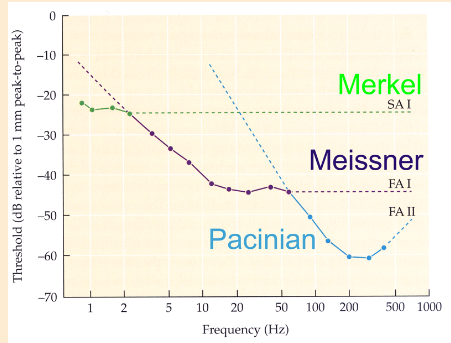
what does touch detection depend on (4 channel model)
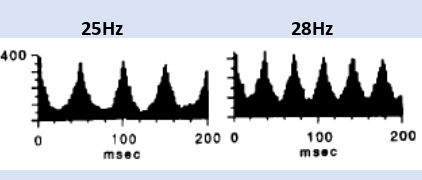
vibrotactile frequency- touch detection varies w vibrotactile stimulus frequency & probe area
why is touch important
motor control, social contact, agency, force sensing, directional movement sensing, object manipulation, only bi-directional input channel
what do merkel discs detect?
constant sources of stimulation over a small area (e.g. carrying a pebble)

what do meissner corpuscles detect?
-respond to active touch (during object exploration)
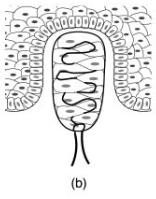
what do ruffini endings detect?
constant stimulation on a larger area (and skin stretch)
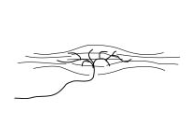
what do Pacinian corpuscles detect?
extremely sensitive over large receptive field (e.g. bloe gently on palm of your hand)

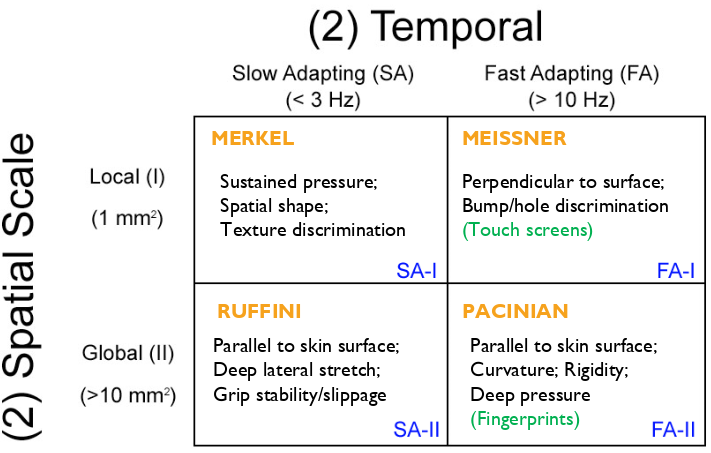
describe the 4 channel model
each channel has specific properties of how it detects different types of touch on the spatial & temporal scale (fast acting vs slow acting, large receptive area vs small receptive area)
in the dorsal column pathway for fine touch, where are the first afferent neurons?
-gracile fasciculus (fibres entering below midthoracic lvl)
-cuneate fasciculus (upper thoracic & cervical lvls)

in the dorsal column pathway for fine touch, where are the second afferent neurons?
-nuclei in Gracile & Cuneate nuclei
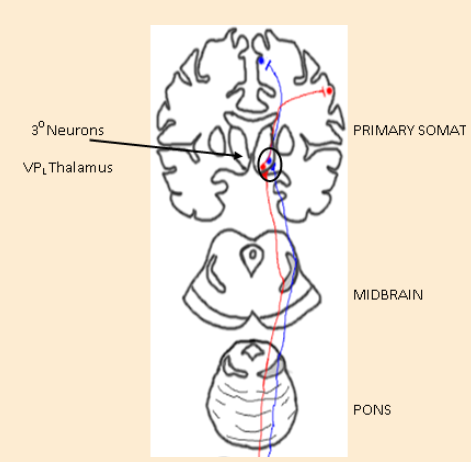
-majority of medial lemniscal fibres terminate in the ventral posterior lateral (VPL) nucleus of the thalamus

in the dorsal column pathway for fine touch, where are the tertiary afferent neurons?
-thalamocortical projections to primary somatosensory cortex (SI- Brodmann’s areas q, 2 3a & 3b)
what is Bell-Megendie’s Law
that in the dorsal spinal cord there are sensory afferents, in the ventral horn there are motor efferents
how and why is the rat somatosensory cortex mapped differently to humans?
-rats explore w whiskers so somatosensory cortex has ‘representations’ of the whiskers in the barrel cortex
-at every lvl (brainstem, thalamus, barrel cortex) the spatial relationship between each of the whiskers is conserved
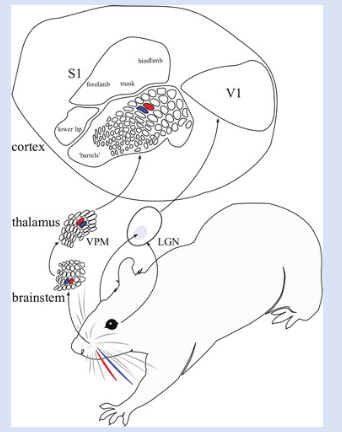
what do you mean when you talk about a ‘map’ in the brain?
a map= a representation of land or smthn, it should have a similar structure to what it represents even if its not an exact replicate
how are blind mole rats an example of how structure and size/ specialisation of brain areas links to their function
-they have skin covering their eyes & visual system mainly used for circadian functions so their V1 area is relatively small
-their primary sense is touch & the S1 takes up a much larger proportion of its brain (also demonstrates interspecies differences)

how did Blackmore and cooper demonstrate environmental exposure during critical periods can drive cortical map development?
-exposed kittens to either only vertical or horizontal lines in their environments (a cylinder)
-their neurons in the visual cortex showed adaption in their orientation (optimal orientations for each cell was only within a range close to either a vertical or horizontal line)
how did the idea around map plasticity (in the primate somatosensory system) evolve from 1978- 1988? (1978)
1978- static -Merzenich et al. showed 2 topographic representations of body surface in adult monkeys & fine detail of maps in areas are mirrored representations of one another (in areas 3b & 1- cytoarchitectonic areas)
how did the idea around map plasticity (in the primate somatosensory system) evolve from 1978- 1988? (1984)
1984- plasticity after peripheral trauma- Merzenich et al. showed alterations of input can change map structure in ADULT animals -even after amputation (of a finger), ‘silent’ zone not created, instead rfs of amputated zone in S1 now driven by adjacent fingers
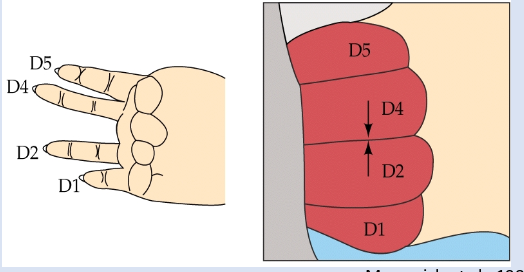
how did the idea around map plasticity (in the primate somatosensory system) evolve from 1978- 1988? (1988)
-1988- Clark et al found- plasticity after use-dependent change- induced syndactyly (surgically joining 2 digits in adult monkey)- increased temporally-coincident input to the 2 digits- correlates w emergence of dual digit rfs at border of 2 digit representations
what did Elbert et al (1995) find about intra-species cortical mapping differences? (violin players)
cortical representation of the digits of the left hand of string players was larger than that in controls
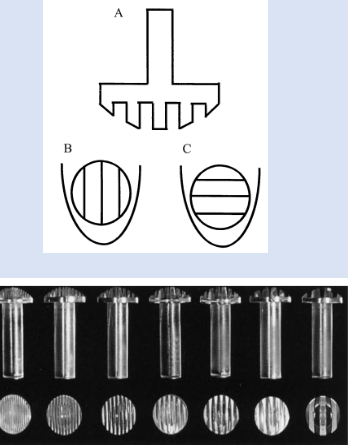
whats an example of how you can measure differences between peoples ability in a given sensory modality? (sensory sensitiveness?) (Van Boven et al 1994)
-focus on spatial sensivity (even though there are 4 LTMS)
-JVP Domes – used to assess tactile spatial resolution
-Analogous to grating discrimination in vision
-Domes placed either ‘along’ or ‘across’ glabrous fingertip
-Less prone to bias than 2 point discrimination
how is GABA thought to influence touch? (controvesial)
usually in cortical interneurons, can maybe ‘‘shape’ size & selectivity of receptive fields
how do neurons in the S1 respond to vibrotactile stimuli (firing-wise)
fire in phase w each cycle of the vibration (GABAergic inhibition shaped these response properties, supported by evidence- Regionally specific human GABA concentration correlates with tactile discrimination thresholds )