Lecture 11 - Algae and Water Plants
 Call Kai
 Learn
Learn Practice Test
 Spaced Repetition
 Match
Match Flashcards
 Knowt Play
1/26

Earn XP
Description and Tags
Be able to draw the different diagrams for this lecture!
Name | Mastery | Learn | Test | Matching | Spaced | Call with Kai | Chat |
|---|
No analytics yet
Send a link to your students to track their progress
27 Terms
Chlorophyta
green algae
mostly freshwater, some marine
cells contain same type of plastids and photosynthetic pigments as land plants
photosynthetic pigments: chlorophyll a & b, carotenoids
Rhodophyta
red algae
most are multicellular marine macroalgae
photosynthetic pigments: chlorophyll a & b, carotenoids, phycobilins (phycoerythrin)
usually complex life cycles (3 generations)
can live in deep ocean because of its color
Heterokontophyta
“golden algae” gets pigment from:
chlorophyll a and c
carotenoids
xanthophyll
AKA stramenopiles
tertiary plasmids
examples: diatoms and coccolithophores
Phaeophyta
brown algae
mostly marine, rarely freshwater
multi-cellular
pigments: chlorophyll a & c, carotenoids (canthophyll, fucoxanthin)
Accessory pigment
chlorophyll b, c, d
carotenoids
carotene: orange color
canthophyll: yellow color
fucoxanthin: brown color
phycobilins
phycoerythrin: red color
phycocyanin: blue color
Primary pigment
chlorophyll a
bacteriophyll (cyanobacteria)
Carotene
orange color
Chlorophyll a and b
a: main pigment, blue-green color
b: accessory. absorbs light and passes it to chlorophyll a, yellow-green color
Xanthophyll
yellow color
Phycoerythrin
red color
Phycocyanin
blue color

Thallus
entire body of seaweed structure

Blades
leaf-life structure; high surface area for photosynthesis
helps capture as much light as possible

Floats
gas-filled (CO) bulbs that help keep blades closer to the surface (aka to the light source)
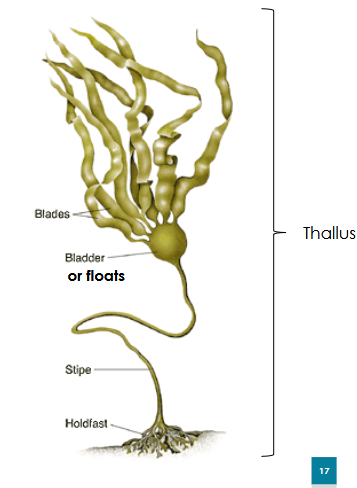
Stipe
stem-like structure; provides support
NOT an actual stem

Holdfast
attaches the thallus to the seabed
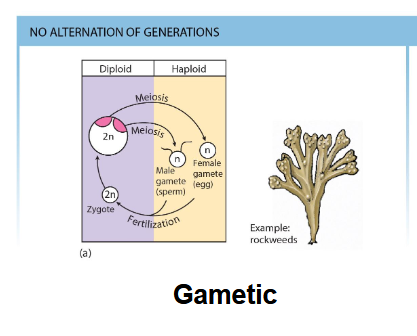
Gametic life cycle
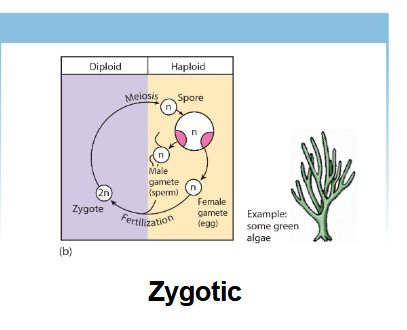
Zygotic life cycle
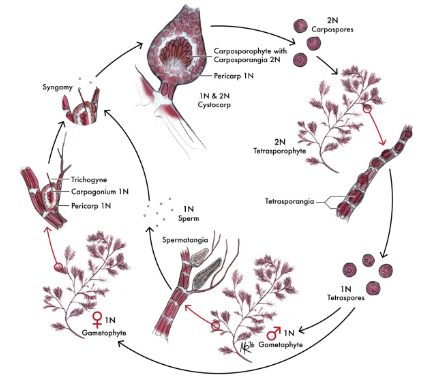
Alternation of 3 generations
Takes place in red algae
Gametophyte (haploid)
males release sperm from spermatangia; female eggs are in the carpogonium
Carposporophyte (diploid)
fertilizations and development directly on female gametophyte
produces 2N carpospores
these carpospores will be released, find a place to settle, and grow into a tetrasporophyte
Tetrasporophyte (diploid)
carpospores grow into 2N adult
meiosis produces tetraspores from the tetrasporangia
develop into male or female gametophytes
Alternation of 2 generations
type of sporic lifecycle, with a sporophyte and gametophyte (will go back and forth between the two)
Laminaria life cycle - alternation of 2 generations
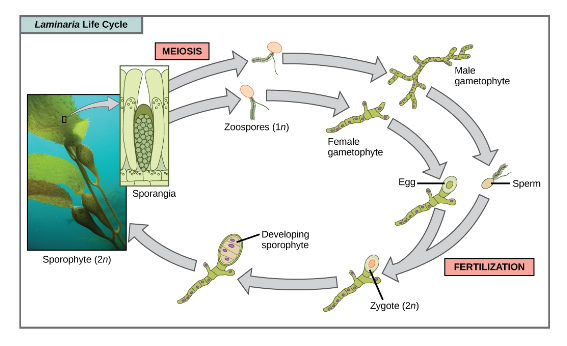
Gametophyte
Haploid
males release sperm from spermatangia: female eggs are in the carpogonium
Sporophyte
Diploid
produces haploid spores via meiosis
spore-producing phase in the life cycle of plants and certain algae
Carposporophyte
Diploid
fertilization and development directly on female gametophyte
produces 2N carpospores
Tetrasporophyte
Diploid
carpospores grow into 2N adult
meiosis produces tetraspores from the tetrasporangia
develop into male or female gametophytes
Seagrass
only “true” marine plant
have roots, leaves, flowers, seeds
live fully submerged in marine or brackish water
form large meadows
Importance of seaweed from environmental and economic perspectives
food
coast protection
pharmaceuticals
fabrics
energy source
fertilizers
tourism
Importance of seagrass habitats
they act as nurseries for sea life. can reproduce rapidly via asexual and sexual production. they are capable of making and taking carbon from the atmosphere. argued to be more efficient than the amazon rainforest.