Lewis 12th edition Chapter 62: Stroke
 Studied by 0 people
 Call with Kai
 Learn
Learn Practice Test
 Spaced Repetition
 Match
Match Flashcards
 Knowt Play
1/27

There's no tags or description
Looks like no tags are added yet.
Name | Mastery | Learn | Test | Matching | Spaced | Call with Kai |
|---|
No study sessions yet.
28 Terms
Which topic would the nurse anticipate teaching a patient who had a brief episode of tinnitus, diplopia, and dysarthria with no residual effects?
a. Cerebral aneurysm clipping
b. Heparin intravenous infusion
c. Oral low-dose aspirin therapy
d. Tissue plasminogen activator (tPA)
c. Oral low-dose aspirin therapy
A patient is being admitted with a possible stroke. Which information from the nursing assessment indicates that the patient is more likely to be having a hemorrhagic stroke than a thromboembolic stroke?
a. The patient has intermittent bouts of atrial fibrillation.
b. The patient has had brief episodes of right-sided hemiplegia.
c. The patient has a history of treatment for infective endocarditis.
d. The patient reports that the symptoms began with a severe headache.
d. The patient reports that the symptoms began with a severe headache.
A patient being admitted with a stroke has right-sided facial drooping and right-sided arm and leg paralysis. Which other finding would the nurse expect?
a. Impulsive behavior
b. Right-sided neglect
c. Hyperactive left-sided tendon reflexes
d. Difficulty comprehending instructions
d. Difficulty comprehending instructions
The health record indicates that a patient has an occluded left posterior cerebral artery. Which finding would the nurse anticipate?
a. Dysphasia
b. Confusion
c. Visual deficits
d. Poor judgment
c. Visual deficits
Which information about clopidogrel (Plavix) will the nurse provide to the patient who has cerebral atherosclerosis?
a. Monitor and record the blood pressure daily.
b. Call the health care provider if stools are tarry.
c. Clopidogrel will dissolve clots in the cerebral arteries.
d. Clopidogrel will reduce cerebral artery plaque formation.
b. Call the health care provider if stools are tarry.
A patient with carotid atherosclerosis asks the nurse to describe a carotid endarterectomy. Which response by the nurse is accurate?
a. "The diseased portion of the artery is replaced with a synthetic graft."
b. "The obstructing plaque is surgically removed from inside an artery in the neck."
c. "A wire is threaded through an artery in the leg to the clots in the carotid artery,
and clots are removed."
d. "A catheter with a deflated balloon is positioned at the narrow area, and the
balloon flattens the plaque."
b. "The obstructing plaque is surgically removed from inside an artery in the neck."
A patient admitted with possible stroke has been aphasic for 3 hours and has a current blood pressure (BP) of 174/94 mm Hg. Which order by the health care provider would the nurse question?
a. Keep head of bed elevated at least 30 degrees.
b. Infuse normal saline intravenously at 75 mL/hr.
c. Start a labetalol drip to keep BP less than 140/90 mm Hg.
d. Begin tissue plasminogen activator (tPA) intravenously per protocol
c. Start a labetalol drip to keep BP less than 140/90 mm Hg.
A patient arrives in the emergency department with hemiparesis and dysarthria that started 2 hours previously. Health records show a history of several transient ischemic attacks (TIAs). Which interprofessional intervention at would the nurse anticipate for this patient?
a. Surgical endarterectomy
b. Transluminal angioplasty
c. Intravenous heparin drip administration
d. Tissue plasminogen activator (tPa) infusion
d. Tissue plasminogen activator (tPa) infusion
A female patient who had a stroke 24 hours ago has expressive aphasia. Which intervention would the nurse use to help the patient communicate?
a. Ask questions that the patient can answer with "yes" or "no."
b. Develop a list of words that the patient can read and practice reciting.
c. Have the patient practice her facial and tongue exercises with a mirror.
d. Prevent embarrassing the patient by answering for her if she does not respond.
a. Ask questions that the patient can answer with "yes" or "no."
Which concern would the nurse anticipate for a patient who had a right hemisphere stroke?
a. Right-sided hemiplegia
b. Speech-language deficits
c. Denial of deficits and impulsiveness
d. Depression and distress about disability
c. Denial of deficits and impulsiveness
Which intervention would the nurse include in the plan of care for a patient with new right-sided homonymous hemianopsia after a stroke?
a. Apply an eye patch to the right eye.
b. Approach the patient from the right side.
c. Place needed objects on the patient's left side.
d. Teach the patient that the left visual deficit will resolve.
c. Place needed objects on the patient's left side.
A left-handed patient with left-sided hemiplegia has difficulty feeding himself. Which intervention would the nurse include in the plan of care?
a. Provide a wide variety of food choices.
b. Provide oral care before and after meals.
c. Assist the patient to eat with the right hand.
d. Teach the patient the "chin-tuck" technique.
c. Assist the patient to eat with the right hand.
A patient has a ruptured cerebral aneurysm and subarachnoid hemorrhage. Which intervention will the nurse include in the plan of care?
a. Apply intermittent pneumatic compression stockings.
b. Assist to dangle on edge of bed and assess for dizziness.
c. Encourage patient to cough and deep breathe every 4 hours.
d. Insert an oropharyngeal airway to prevent airway obstruction.
a. Apply intermittent pneumatic compression stockings.
A patient will attempt oral feedings for the first time after having a stroke. After assessing the gag reflex, which action would the nurse take?
a. Order a varied pureed diet.
b. Assess the patient's appetite.
c. Assist the patient into a chair.
d. Offer the patient a sip of juice.
c. Assist the patient into a chair.
A 70-yr-old female patient with left-sided hemiparesis arrives by ambulance to the emergency department. Which action would the nurse take first?
a. Take the patient's blood pressure.
b. Check the respiratory rate and effort.
c. Assess the Glasgow Coma Scale score.
d. Send the patient for a computed tomography (CT) scan.
b. Check the respiratory rate and effort.
Several weeks after a stroke, a patient has impaired awareness of bladder fullness, resulting in urinary incontinence. Which intervention would the nurse plan to begin an effective bladder training program?
a. Limit fluid intake to 1200 mL daily to reduce urine volume.
b. Assist the patient onto the bedside commode every 2 hours.
c. Use an external catheter to protect the skin and prevent embarrassment.
d. Perform intermittent catheterization after each voiding to check for residual urine.
b. Assist the patient onto the bedside commode every 2 hours.
A patient who has a history of a transient ischemic attack (TIA) has an order for aspirin 160 mg daily. The patient says, "I don't need the aspirin today. I don't have a fever." Which action would the nurse take?
a. Document that the patient refused the aspirin.
b. Tell the patient that the aspirin is used to prevent a fever.
c. Explain that the aspirin is ordered to decrease stroke risk.
d. Call the health care provider to clarify the medication order.
c. Explain that the aspirin is ordered to decrease stroke risk.
A patient in the clinic reports a recent episode of dysphasia and left-sided weakness at home that resolved after 2 hours. Which medication topic would the nurse anticipate teaching the patient?
a. tPA
b. Aspirin
c. Warfarin
d. Nimodipine
b. Aspirin
A patient with a left-brain stroke suddenly bursts into tears when family members visit. How would the nurse respond?
a. Use a calm voice to ask the patient to stop the crying behavior.
b. Explain to the family that depression is normal following a stroke.
c. Have the family members leave the patient alone for a few minutes.
d. Teach the family that emotional outbursts are common after strokes
d. Teach the family that emotional outbursts are common after strokes
Which stroke risk factor for a 48-yr-old male patient in the clinic is most important for the nurse to address?
a. The patient is 25 pounds above the ideal weight.
b. The patient drinks a glass of red wine with dinner daily.
c. The patient's usual blood pressure (BP) is 170/94 mm Hg.
d. The patient works at a desk and relaxes by watching television.
c. The patient's usual blood pressure (BP) is 170/94 mm Hg.
A patient in the emergency department with sudden-onset right-sided weakness is diagnosed with an intracerebral hemorrhage. Which information about the patient is most important to communicate to the health care provider?
a. The patient's speech is difficult to understand.
b. The patient's blood pressure (BP) is 144/90 mm Hg.
c. The patient takes a diuretic because of a history of hypertension.
d. The patient has atrial fibrillation and takes warfarin (Coumadin).
d. The patient has atrial fibrillation and takes warfarin (Coumadin).
A patient with left-sided weakness that began 60 minutes earlier is admitted to the emergency department. Which prescribed diagnostic test would be done first?
a. Complete blood count (CBC)
d. Noncontrast computed tomography (CT) scan
c. Computed tomography (CT) scan
d. 12-Lead electrocardiogram (ECG)
d. Noncontrast computed tomography (CT) scan
A patient with a stroke has progressively increasing weakness and decreasing level of consciousness. Which patient problem would the nurse determine has the highest priority for the patient?
a. Sensory deficit
b. Risk for aspiration
c. Musculoskeletal problem
d. Risk for impaired skin integrity
b. Risk for aspiration
Which information about the patient who had a subarachnoid hemorrhage is most important to communicate to the health care provider?
a. The patient reports having a stiff neck.
b. The patient's blood pressure (BP) is 90/50 mm Hg.
c. The patient reports a severe and unrelenting headache.
d. The cerebrospinal fluid (CSF) report shows red blood cells (RBCs).
b. The patient's blood pressure (BP) is 90/50 mm Hg.
The nurse is caring for a patient who has been experiencing stroke symptoms for 60 minutes. Which action can the nurse delegate to a licensed practical/vocational nurse (LPN/VN)?
a. Assess the patient's gag and cough reflexes.
b. Determine when the stroke symptoms began.
c. Administer the prescribed short-acting insulin.
d. Infuse the prescribed IV metoprolol (Lopressor).
c. Administer the prescribed short-acting insulin.
After receiving change-of-shift report on the following four patients, which patient would the nurse see first?
a. A 60-yr-old patient with right-sided weakness who has an infusion of tPA prescribed
b. A 50-yr-old patient who has atrial fibrillation and a new order for warfarin (Coumadin)
c. A 30-yr-old patient with a subarachnoid hemorrhage 2 days ago who has nimodipine scheduled
d. A 40-yr-old patient who had a transient ischemic attack yesterday and has a dose of aspirin due
a. A 60-yr-old patient with right-sided weakness who has an infusion of tPA prescribed
The nurse is caring for a patient who has just returned after having left carotid artery angioplasty and stenting. Which assessment information is of most concern to the nurse?
a. The pulse rate is 102 beats/min.
b. The patient has difficulty speaking.
c. The blood pressure is 144/86 mm Hg.
d. There are fine crackles at the lung bases.
b. The patient has difficulty speaking.
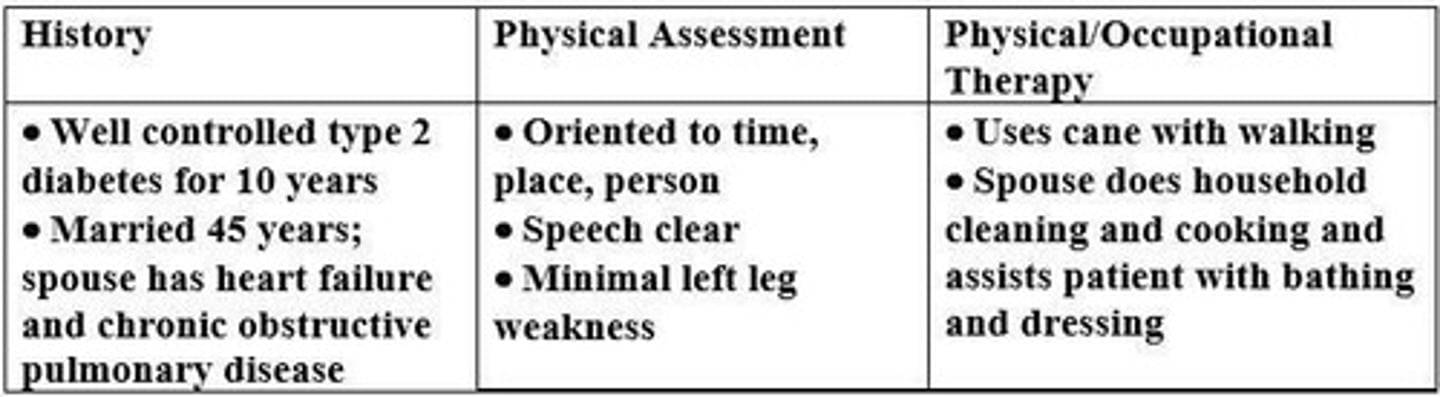
The home health nurse is caring for an 81-yr-old patient who had a stroke 2 months ago. Based on patient information shown in the accompanying figure, which action would the nurse take?
a. Teach about preventing hypoglycemia.
b. Begin processes to obtain a wheelchair.
c. Provide support to the spouse caregiver.
d. Remind the patient to take prescribed medications.
c. Provide support to the spouse caregiver.