NASM Ch 7 Intro Human Mvmt Science
 Call Kai
 Learn
Learn Practice Test
 Spaced Repetition
 Match
Match Flashcards
 Knowt Play
1/43

There's no tags or description
Looks like no tags are added yet.
Name | Mastery | Learn | Test | Matching | Spaced | Call with Kai | Chat |
|---|
No analytics yet
Send a link to your students to track their progress
44 Terms
human movement system
The collective components and structures that work together to move the body: muscular, skeletal, and nervous systems.
interdependent links
Although separate in structure and function, the HMS relies on a collaborative effort to form
less optimal performance
if kinetic chain in injured
kinetic chain
A concept that describes the human body as a chain of interdependent links that work together to perform movement.
regional interdependence model
The concept describing the integrated functioning of multiple body systems or regions of the body.
Articular (Joint) System
What body system may prevent a full range of motion during a front shoulder raise because the joints are stiff, even if the muscles and nerves work normally?
nervous system
If the signal from the brain cannot reach the deltoid, causing the arm to be unable to lift despite healthy joints and muscles, which body system is the problem?
muscular system
During a front shoulder raise, which body system is responsible for producing the movement after receiving signals from the nervous system?
full ROM
a client with normal functioning muscular and nervous systems should be able to complete a front shoulder raise through the shoulder joint’s:
biomechanics
The science concerned with the internal and external forces acting on the human body and the effects produced by these forces.
kinesiology
Study of movement as it relates to anatomy and physiology.
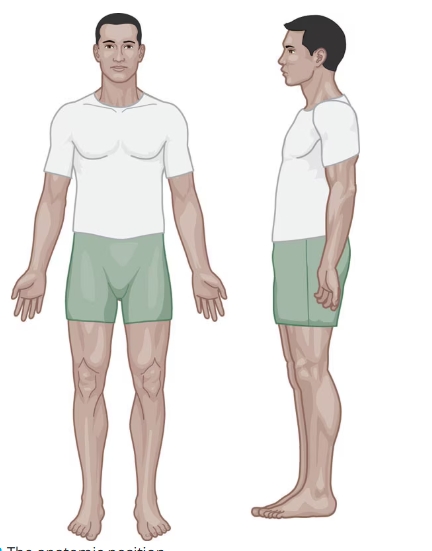
anatomic position
The position with the body erects, the arms at the sides, and the palms forward. It is the position of reference for anatomic nomenclature.
biomechanics
uses scientific principles of physics to study how the body creates movement at the joints, especially in the context of exercise and sport
kinesiology
investigates movement further
anatomical
what position is this?
Anatomic locations
describe the relative positioning of segments of the body
medial
Relatively closer to the midline of the body
lateral
Relatively farther away from the midline or
toward the outside of the body
contralateral
Positioned on the opposite side of the body
ipsolateral
Positioned on the same side of the body
anterior
Positioned on or toward the front of the body
posterior
Positioned on or toward the back of the body
proximal
positioned nearest to the center of the body or other identified reference point
distal
Positioned farthest from the center of the body or other identified reference point
inferior
Positioned below an identified reference point
superior
Positioned above an identified reference point
medial
The adductors (inner thigh muscles) attach to the _ side of the femur (thigh bone).
laterally
The ears are positioned _ on the head.
contralateral
The right foot is _ to the left hand.
ipsilateral
The right foot is _ to the right hand.
anterior
The quadriceps are located on the _ aspect of the thigh.
posterior
The hamstring complex is located on the _ aspect of the thigh.
proximal
The wrist is more _ to the elbow than the fingers.
distal
The ankle is more _ to the hip than the
knee.
inferior
The soleus (calf muscle) is _ to the
hamstring complex.
superior
The pelvis is _ to the tibia (shin bone).
anterior
red
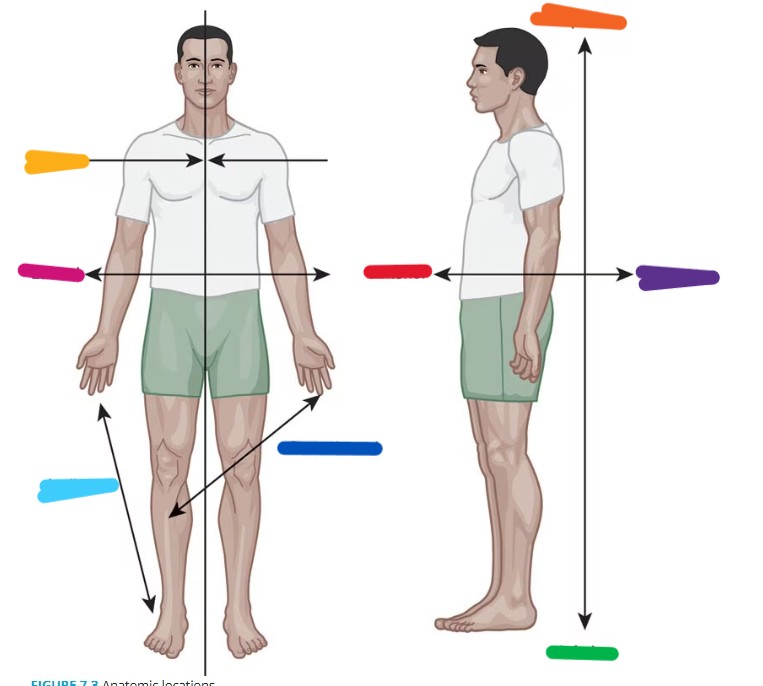
posterior
purple
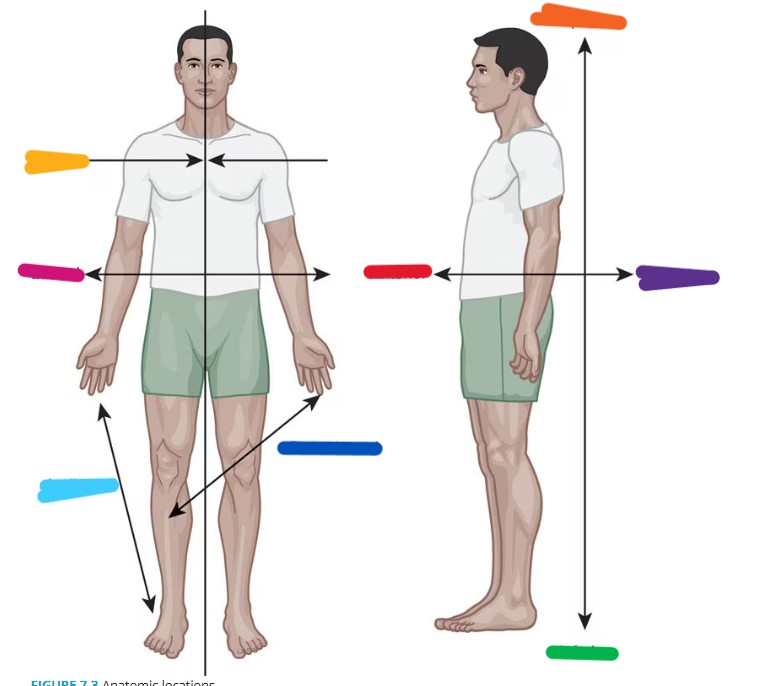
superior
orange
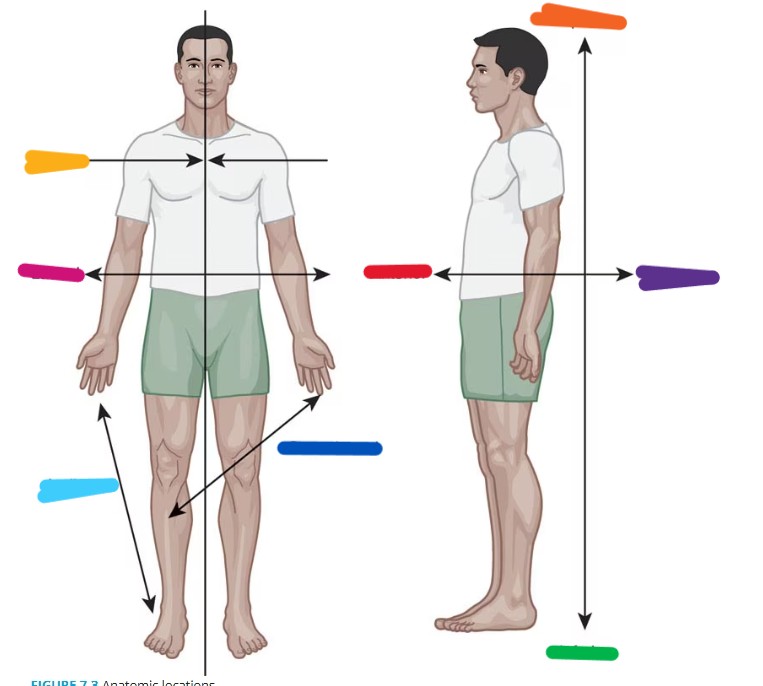
inferior
green
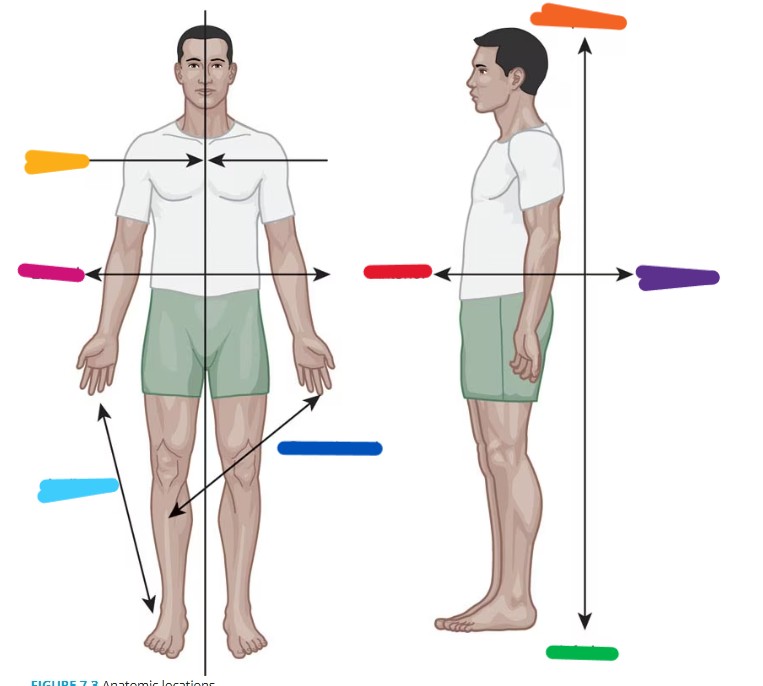
contralateral
dark blue
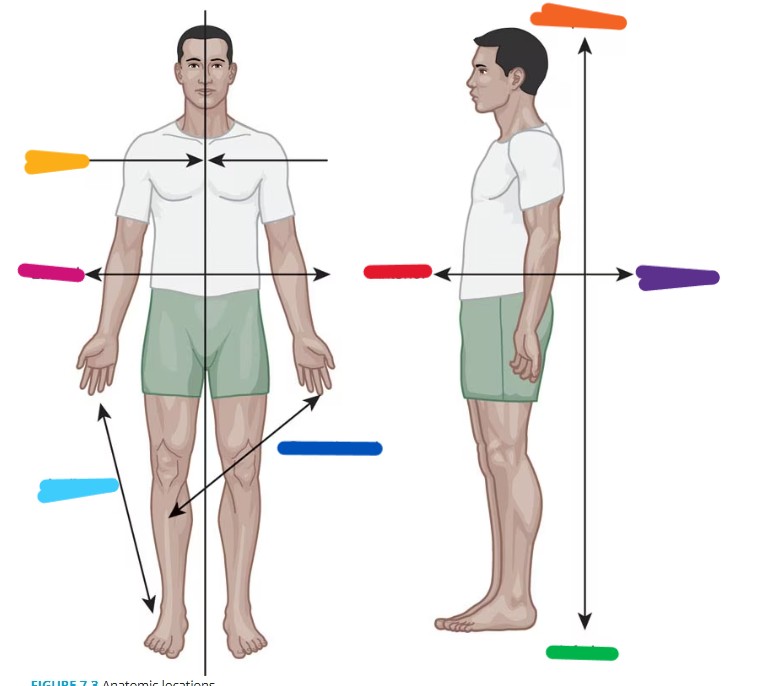
ipsilateral
light blue
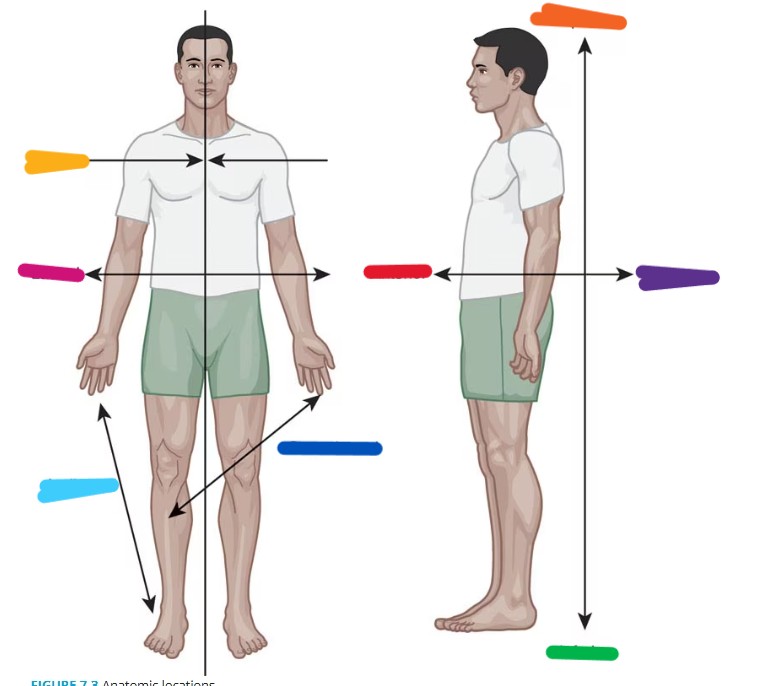
lateral
pink
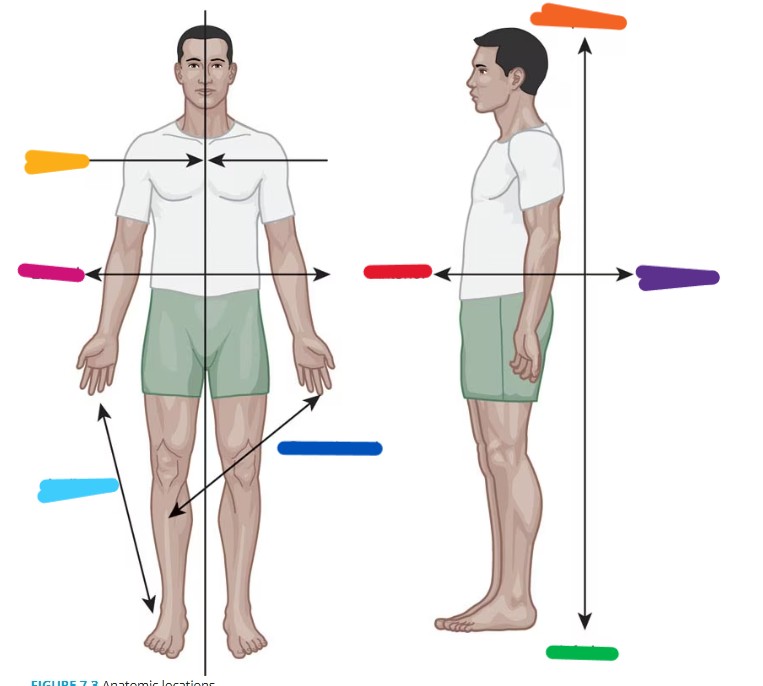
medial
yellow