cognition textbook defintions exam 1
 Call Kai
 Learn
Learn Practice Test
 Spaced Repetition
 Match
Match Flashcards
 Knowt Play
1/32

Earn XP
Description and Tags
chapters 1-4
Name | Mastery | Learn | Test | Matching | Spaced | Call with Kai | Chat |
|---|
No analytics yet
Send a link to your students to track their progress
33 Terms
mind
System that creates mental representations of the world and controls mental functions such as
perception, attention, memory, emotions, language, deciding, thinking, and reasoning.
cognition
the mental processes, such as perception, attention, and memory
cognitive psychology
The branch of psychology concerned with the scientific study of the mental processes involved in perception, attention, memory, language, problem-solving, reasoning, and decision making.
In short, cognitive psychology is concerned with the scientific study of the mind and mental processes.
coined in 1967
Franciscus Donders, 1868
studied how long it took people to make a decision, processing speed
reaction time
The time it takes to react to a stimulus.
This is usually determined by measuring the time between presentation of a stimulus and the response to the stimulus.
Examples of responses are pushing a button, saying a word, moving the eyes, and the appearance of a particular brain wave
difference between simple and choice time = how long it takes to react
simple reaction time
Reacting to the presence or absence of a single stimulus
choice reaction
Time to respond to one of two or more stimuli.
took one-tenth of a second longer
For example, in the Donders experiment, asking his participants to push the left button when they saw the left light go on and the right button when they saw the right light go on
Wilhem Wundt
founded the first laboratory of scientific psychology
structuralism
analytic introspection
structuralism
An approach to psychology that explained perception as the adding up of small elementary units called sensations.
bottom-up sensation, the receptors in body create our world view
analytic introspection
A procedure used by early psychologists in which trained participants described their experiences and thought processes in response to stimuli.
shown a picture of a rose, describe the qualities and “building blocks” of the rose
“red” “soft” “delicate” NEVER naming the actual object
participants had to be conditioned into responding in this way, biased experiment
Hermann Ebbinghaus
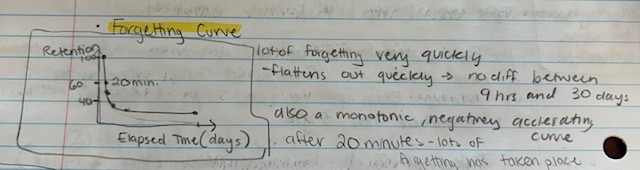
first to scientifically study memory, he studied his own mind using quantitative method for measuring memory.
repeated lists of 13 nonsense syllables such as DAX, QEH, LUH, and ZIF
recorded how long it took to learn the first time, delay, then RELEARNED IT
Savings
Learning Curve, Forgetting curve
savings
Measure used by Ebbinghaus to determine the magnitude of memory left from initial learning.
Higher savings indicate greater memory. - dont need to know formula
savings curve, forgetting curve
decline rapidly over the first two days, after that the forgetting leveled out
memory has already been solidified
William James
First psychology textbook; some of his observations are still valid today
father of functionalism ?
John Watson
rejected Wundt’s introspection → behaviorism
Little Albert experiment
used classical conditioning to argue that behavior can be analyzed without any reference to the mind.
pairing one stimulus with another affected behavior.
behaviorism
observable behavior provides the only valid data for psychology. A consequence of this idea is that consciousness and unobservable mental processes are not considered worthy of study by psychologists
did not allow any consideration of the mind’s role in creating behavior.
classical conditioning
A procedure in which pairing a neutral stimulus with a stimulus that elicits a response causes the neutral stimulus to elicit that response.
Ivan Pavlov
the father of classical conditioning
pairing of food (which made the dog salivate) with a bell (the initially neutral stimulus) caused the dog to salivate to the sound of the bell
BF Skinner
operant conditioning
argued that children learn language through operant conditioning
operant conditioning
A learning process by which behaviors are made more likely to recur by the inclusion of reinforcers or less likely to recur by the inclusions of punishments.
Operant conditioning can be used to shape behavior toward a more desired outcome.
Edward Tolman
didn’t agree with behaviorism
rat in the maze rewarded when turning right, but when map was flipped instead of turning right the rat learned and turned left. results didn’t perfectly match with behaviorism
rat created a cognitive map (Mental conception of a spatial layout)
Noam Chomsky
children say many sentences that have never been rewarded by parents (“I hate you, Mommy,”
language development driven by an inborn biological program that holds across cultures
cognitive revolution
A shift in psychology, beginning in the 1950s, from the behaviorist approach to an approach in which the main thrust was to explain behavior in terms of the mind.
One of the outcomes of the cognitive revolution was the introduction of the information-processing approach to studying the mind
paradigm
A system of ideas, which guide thinking in a particular field.
paradigm shift is when the thinking shifts from one paradigm to another
information processing approach
developed after the invention of the computer
the approach to psychology, developed beginning in the 1950s, in which the mind is described as processing information through a sequence of stages.
developed after neissers book?? - double check that
cocktail party effect
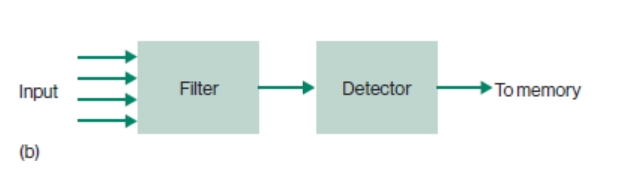
Colin Cherry - audio messages, people were aware of the noise but were not gathering meaning and understanding those noises
The ability to focus on one stimulus while filtering out other stimuli, especially at a party where there are a lot of simultaneous conversations.
Donald Broadbent
designed the first diagram to describe the flow of information in the mind based off the cocktail party effect results
artificial intelligence
The ability of a computer to perform tasks usually associated with human intelligence.
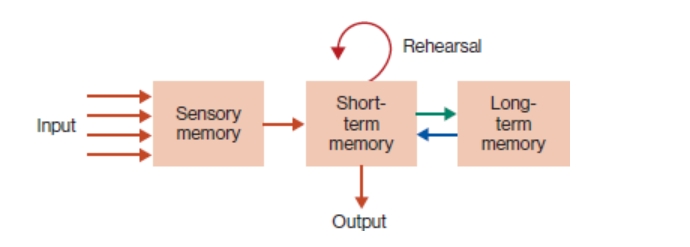
first models of memory
Richard Atkinson and Richard Shiffrin’s
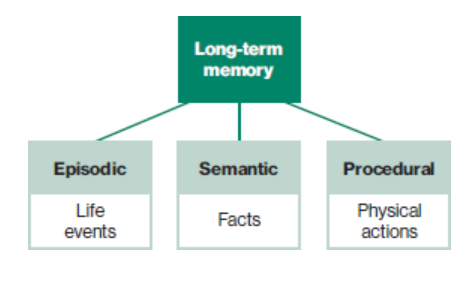
Endel Tuvling representation
Episodic memory is memory for events (like what you did last weekend).
Semantic memory is memory for facts (such as the capitals of the states)
Procedural memory is memory for physical actions, muscle memory
neuropsychology
the study of the behavior of people whose brains had been damaged by traumatic injury, had been providing insights into the functioning of different parts of the brain since the 1800s.
Electrophysiology
measuring electrical responses of the nervous system, made it possible to observe and measure the activity of specific neurons.
brain imaging
technique such as functional magnetic resonance imaging (fMRI) that results in images of the brain that represent brain activity. In cognitive psychology, activity is measured in response to specific cognitive tasks.
PET
fMRI