3.3.2 Alkanes
 Call Kai
 Learn
Learn Practice Test
 Spaced Repetition
 Match
Match Flashcards
 Knowt Play
1/37

There's no tags or description
Looks like no tags are added yet.
Name | Mastery | Learn | Test | Matching | Spaced | Call with Kai | Chat |
|---|
No analytics yet
Send a link to your students to track their progress
38 Terms
What is an alkane?
Saturated hydrocarbons containing C-H bonds only
What is the general formula of an alkane?
CnH2n+2
Are the bonds in alkanes polar or non-polar & why?
Non-polar: carbon & hydrogen have similar electronegativities
Which intermolecular forces do alkanes have & why?
Only Van der Waals forces of attraction, as the C-H bonds are non-polar
Are alkanes soluble in water & why/why not?
Insoluble, as hydrogen bonds in water are stronger than alkanes’ Van der Waals forces of attraction
How reactive are alkanes?
Very unreactive
Which reactions will alkanes undergo?
Combustion & free radical substitution
What is crude oil, how is it formed & is it renewable?
Crude oil is a mixture of hydrocarbons formed from animal & plant remains that were buried under sediment & converted by heat & pressure over millions of years
It is a non-renewable resource & takes very long to form & cannot be replaced once used
What are the names of the fractions from low to high boiling point?
Liquified petroleum gases (fuel)
Petrol (cars)
Kerosene (jet/plane fuel)
Diesel (lorries)
Heavy fuel oil (ships/power stations)
Bitumen (roads/roofing)
how to remember → Lazy Penguins Keep Drinking Hot Beer
How does fractional distillation work?
Crude oil is heated to around 350°C & most of it vaporises
The vaporised crude oil enters the bottom of the fractionating column (hot at the bottom & cooler at the top, creating a temperature gradient)
As the vapours rise, they cool & hydrocarbons condense when they reach a level where the temperature is below their boiling point
Long-chain hydrocarbons have high boiling points, so they condense low down in the column (or may not even vaporise). Short-chain hydrocarbons have low boiling points, so they rise higher before condensing
The shortest-chain hydrocarbons do not condense in the column & are drawn off at the top as gases

What is cracking & why is it needed?
Involves breaking C-C bonds in alkanes
Long chain alkanes are not in demand, so they are cracked into shorter chain alkanes (can be used as a fuel) & alkenes (more reactive & are a starting point for many products)
What are the conditions for thermal cracking?
High temperature (1000°C)
High pressure (70 atmospheres)
What is the intermediate for thermal cracking?
Free radicals
What is the main product of thermal cracking?
Alkenes
What are the conditions for catalytic cracking?
Moderate temperature (500°C)
Moderate pressure
Zeolite catalyst
What are the main products of catalytic cracking?
Aromatic hydrocarbons & motor fuels
What is a fuel?
Something which releases heat energy when combusted (e.g. alkanes)
What is complete combustion & what products are formed in the case of alkanes?
Combustion with plenty of oxygen
Products: carbon dioxide & water
What is incomplete combustion & what products are formed in the case of alkanes?
Combustion in a limited supply of oxygen
Products: carbon monoxide (poisonous), carbon (soot particulates → global dimming) & water
Which type of hydrocarbons are most likely to undergo incomplete combustion?
Longer chain hydrocarbons
Why is carbon monoxide harmful?
It is toxic & poisonous, as molecules bind to haemoglobin in red blood cells, limiting the amount of oxygen that can be transported around the body
How are nitrogen oxides produced?
The high pressure & temperature in a car engine cause the nitrogen & oxygen atoms from the air to react together

Why are unburnt hydrocarbons harmful?
They react with nitrogen oxides in the presence of sunlight to form ground-level ozone (smog)
This irritates people’s eyes, aggravates respiratory problems & causes lung damage
What are the main three pollutants from vehicle exhausts & how can these be removed?
Catalytic converters on cars:
nitrogen oxides
unburnt hydrocarbons
carbon monoxide

How is sulphur dioxide produced?
Some fossil fuels contain sulphur & when burned, the sulphur reacts to form sulphur dioxide
If sulphur dioxide gets into the atmosphere, it dissolves in the moisture, forming sulphuric acid (acid rain)
Why is sulphur & nitrogen dioxide harmful if it gets into the atmosphere?
They are converted into sulphuric & nitric acid, which causes acid rain
Acid rain destroys trees & vegetation, as well as corroding buildings & statues & killing fish in lakes

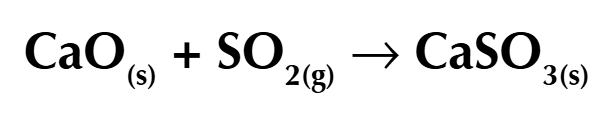
How can sulfur dioxide be removed from power station flue gases before it gets into the atmosphere?
Powdered calcium carbonate (limestone) or calcium oxide is mixed with water to make an alkaline slurry
When the flue gases mix with the alkaline slurry, the acidic sulfur dioxide gas reacts with the calcium compounds to form a harmless salt (calcium sulfite), which can be removed
acid-base reaction (neutralisation)
What is the environmental impact of burning fossil fuels?
Produces greenhouse gases (e.g. CO2), which leads to global warming
Greenhouse gases absorb infrared radiation & emit some back towards the Earth, keeping it warm (greenhouse effect)
Define carbon neutral activities
Activities that produce no net / overall carbon dioxide emissions
How are halogenoalkanes formed?
Halogens react with alkanes in a free radical substitution reaction
What are the three stages of a FRS?
Initiation: breaking halogen bond to form free radicals
Propagation: chain part of the reaction where products are formed but free radical remains
Termination: free radicals removed, stable products formed
What is the condition needed for free radical substitution?
Presence of UV light
What is the ozone layer’s function?
Protects the Earth from harmful exposure to too many UV rays
How do chlorofluorocarbons (CFCs) break the ozone layer down?
Free radical substitution: chlorine free radicals form & break down the ozone layer
Overall equation: 2O3 → 3O2
What are the two equations to show how a chlorine free radical acts as a catalyst in the decomposition of ozone?
Cl·(g) + O3(g) → O2(g) + ClO·(g)
ClO·(g) + O3(g) → 2O2(g) + Cl·(g)
What have CFCs been replaced with & why?
HCFCs (hydrochlorofluorocarbons) & HFCs (hydrofluorocarbons)
They don’t contain a C-Cl bond, so chlorine free radicals can’t be formed to break down the ozone layer

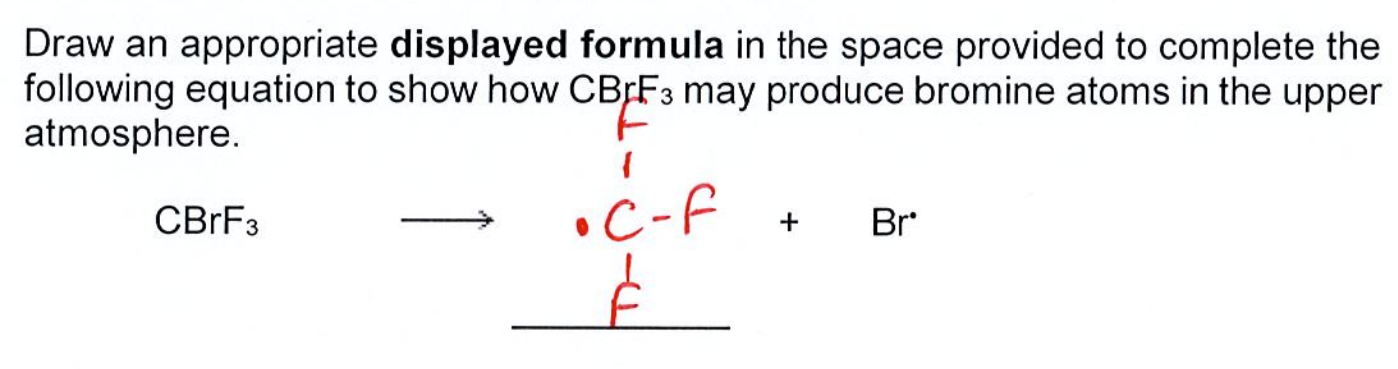
Draw an appropriate displayed formula to complete the following equation to show how CBrF3 may produce bromine atoms in the upper atmosphere
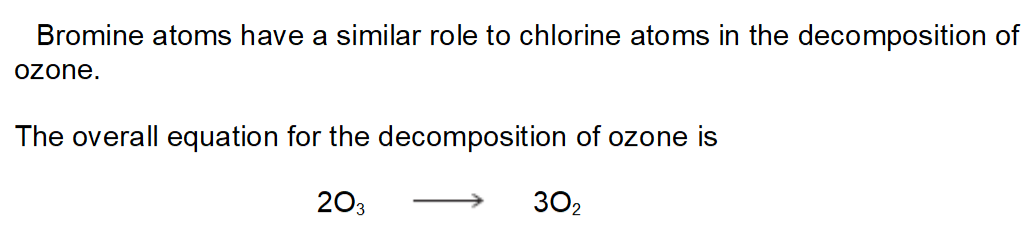
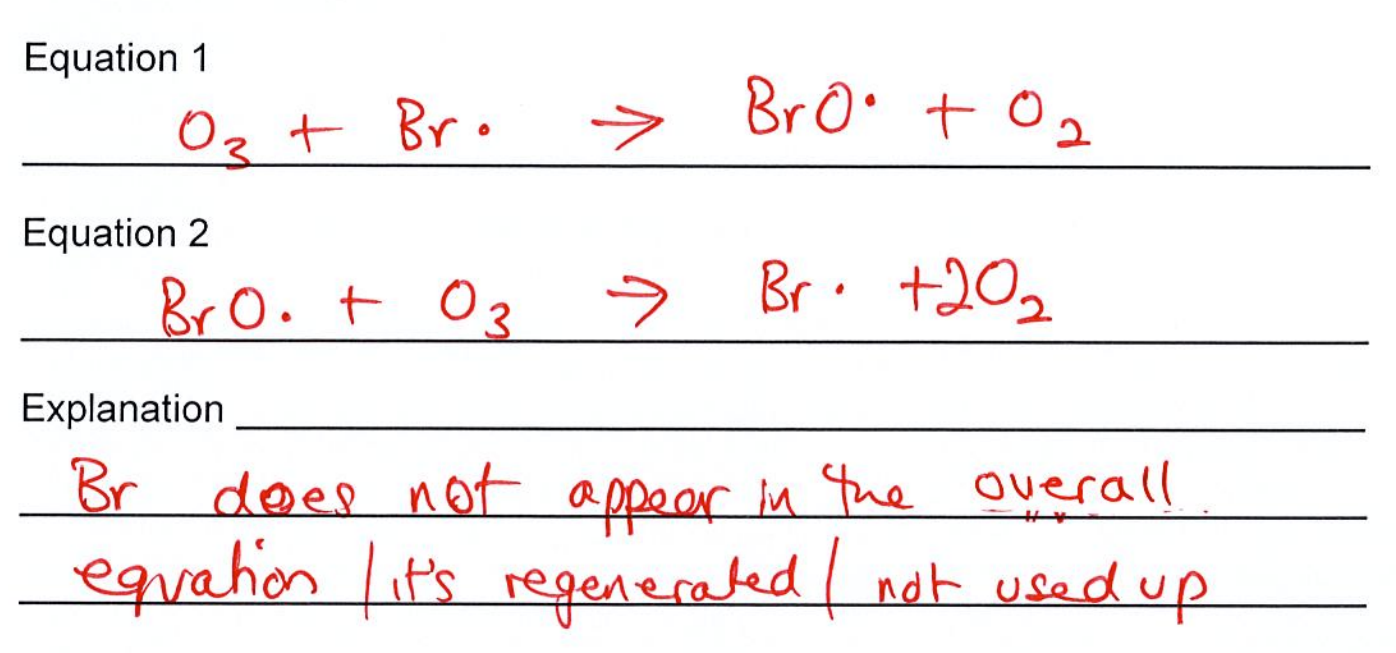
Write two equations to show how bromine atoms (Br·) act as a catalyst in the decomposition of ozone
Explain how these two decomposition equations show that bromine atoms behave as a catalyst