Exam 1 | Art History
 Call Kai
 Learn
Learn Practice Test
 Spaced Repetition
 Match
Match Flashcards
 Knowt Play
1/27

Earn XP
Description and Tags
:D glhf
Name | Mastery | Learn | Test | Matching | Spaced | Call with Kai | Chat |
|---|
No analytics yet
Send a link to your students to track their progress
28 Terms

Temple of Anu
Also known as the White Temple, made in circa 3300 BCE.
In the Mesopotamia Era.
Temple was dedicated to the sky god, (theory) temple could've been elevated to represent that closeness to heaven.
Proof of the start of a market/redistributive economy. Keeps track of goods. Temple controlled assets.
Start of the development of language.
Early tablets are used for administration, first recording of language. Used clay over stone. First writing system, NOT language.

Uruk Vase
Made in Alabaster around circa 3200 BCE
In the Mesopotamia Era.
Relief sculpture, NOT a sculpture of the round.
Lower band = Livestock and agriculture. Shows lively values. Stylized, abstract.
Central band = Men carrying goods/produce. Stylized, abstract.
Upper band = Shows a goddess. Uses hierarchy of scale to show importance (aka the queen). There are symbolisms for Ennana. The theme is surplus.

Votive figures from the Temple of Abu
Made in Eshnunna (Tell Asmar, Iraq)
Made around 2750-2600 BCE.
In the Mesopotamia Era.
Usually made for people in power. Scuplture in the round.
Decently abstract figures with some naturalistic properties and have a distinct approach when it comes to carving eyes.
These large eyes are indicative of how they stared up at the gods.
They were left in the Temple of Abu as offerings to communicate with the gods, for example when someone is sick.
They were founded in the ground.
This Mesopotamian society has a surplus, and so they didn’t care to use materials like limestone, alabaster, black limestone, and lapis lazuli as a code of offerings to the gods because they don’t acknowledge the expenses of these goods.
Shows the wealth/privilege of this family by being able to use such valuable materials.
Potentially purchased from a craftsman.
Theocracy
A state/society ruled by priests in the name of God or a god.
Narrative
Art that tells a story, either as one captured moment in an ongoing story or as a sequence of events unfolding over time.
City-State
An independent city that encompasses the totality of its sovereign territory.
Naturalistic
Derived from or closely imitating real life or nature.
Abstract
Depicted or treated in a mannered and non-realistic style.
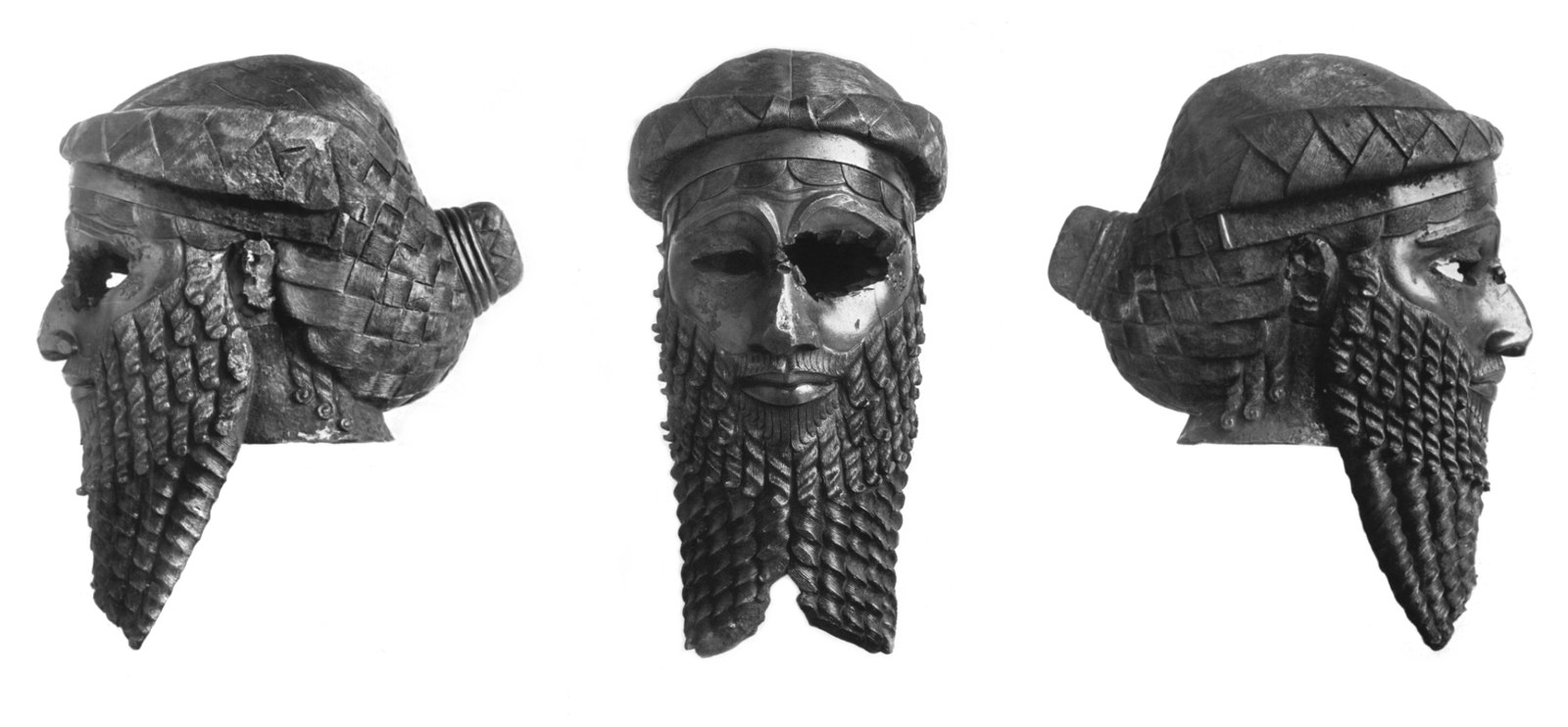
Head of an Akkadian Ruler
Founded in Temple of Ishtar, Nineveh.
Made in circa 2250-2220 BCE.
In the Akkadian Period.
A portrait of a king. The potential beginning of royal statues and self-insertion into culture because of the absolute monarchy.
Either Sargon or his son.
Start of Iconography (of kingship). Very expensive material, showcasing power perhaps.
Mix of naturalism and abstraction.
Earliest example of lost-wax casting, showing efficiency in metal working and makes fine detail.
Eyes and ears have been gouged out on purpose, "damnation of memory".

Stele of Naram-Sin
Made in circa 2254-2218 BCE
In the Akkadian Period.
Uses hierarchy of scale.
Shows potential worship to Saram-Sin, a potential victory celebration after war with the Lullabis.
First example of a historical narrative.
A stele is a monument that's set in public for various different reasons, mostly with legal documents.
Twisted perspective – showing different perspectives within one piece/figure.
Naram is stepping over his foes (The Lullabis).
2 gods depicted, one with the sun and another with the horned helmet "double crown".
"Discourse creates that which it utters." (Propaganda)

Djoser’s Funerary Complex
Made in 2667-2648 BCE.
In the Old Kingdom Era.
Concept of kingship is evolving
Djoser was the first king of the 3rd dynasty.
Can control numerous amounts of labor.
Buildings are huge, around 60-ish feet tall and 500+ feet wide.
The Ka statue of Djoser is outside, peeping through eye holes at people as a way to show power, that people can’t look at it but it can look at us.
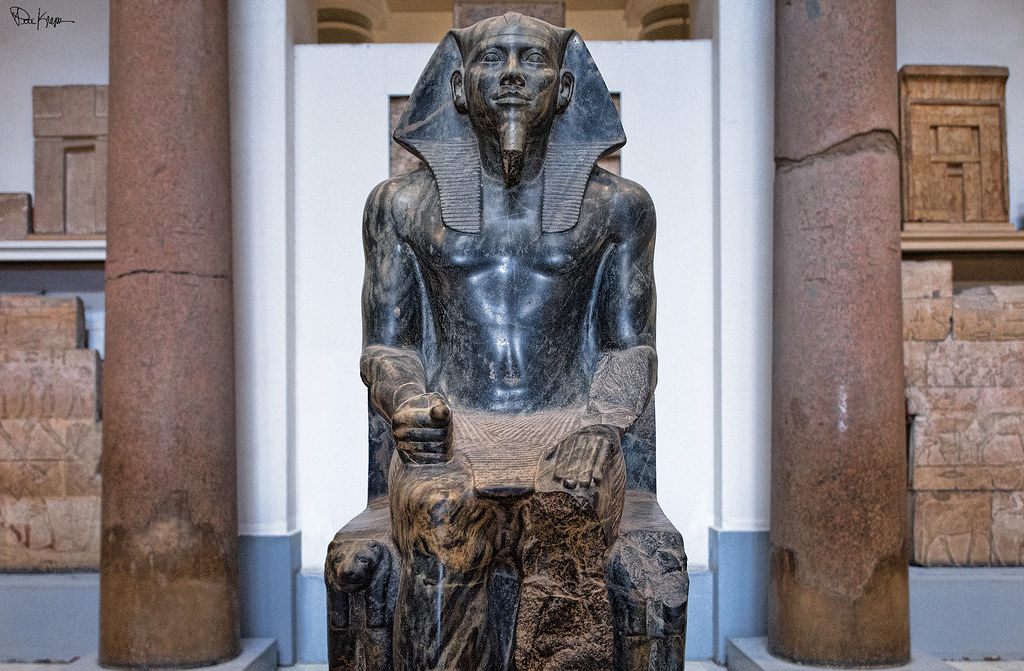
Khafre as the Enthroned King
Made in 2558-2532 BCE.
In the Old Kingdom Era.
Must’ve been extremely expensive to make due to the material (anorthosite gneiss) and how difficult it is to shape, not to mention the material is 400 miles away from Egypt.
Has a bird, Horus, to protect the king and even shows a protective gesture.
Not necessarily true to life due to the figure being around 5’6 while sitting down.
He has a shendyt kilt, reserved only for pharaohs.
False beard.
Missing object from hand.
Intertwined lotuses are carved into the sides of the seats to represent upper and lower Egypt uniting.
Shows perfection and an idealized version of Khafre out of respect for the pharaoh, also not to mention their culture surrounding death and immortality through the afterlife.

Senusret III
Twelfth Dynasty, made in 1870-1831 BCE.
In the New Kingdom Era.
Uses idealism and realism; this sculpture was more accurate to what the subject actually looked like.
Built up to scale.
The king was seen as a wise, protective leader that was also a Shepherd.
Was taken very seriously as a leader at the time (Legitimation), and seen as the “offspring of a god”.
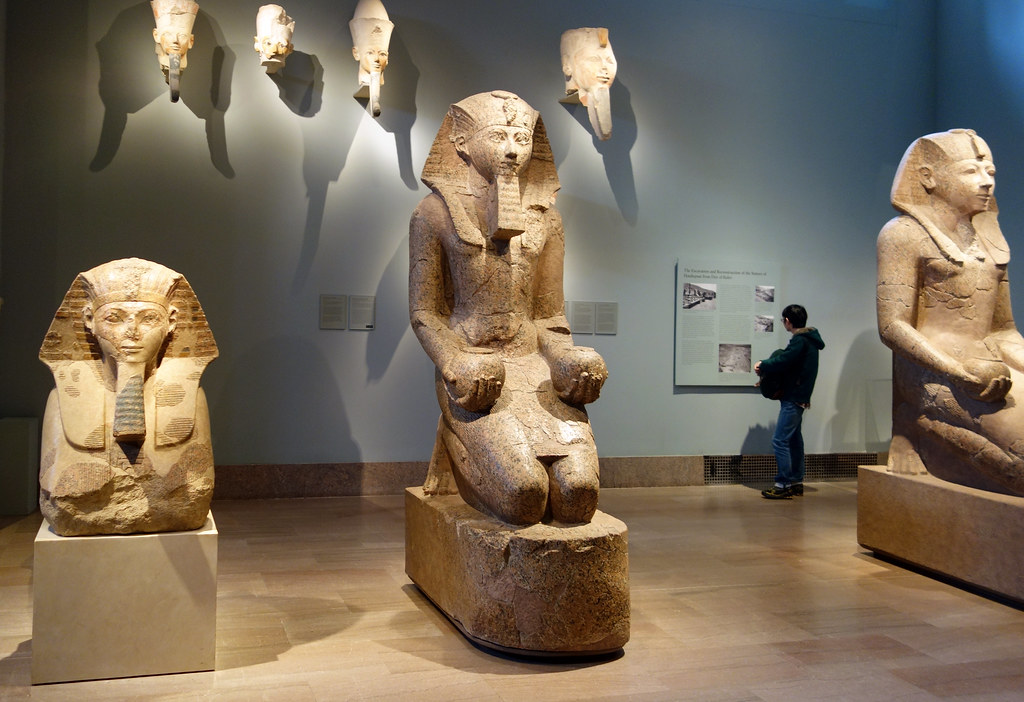
Large Kneeling Statue of Hatshepsut
Made in 1479-1459 BCE.
In the New Kingdom Era.
Hatshepsut, a female pharaoh, ruled Egypt for over two decades, using art to convey royal authority.
She built a mortuary temple, featuring kneeling statues and sphinx representations.
Hatshepsut adopted traditional male symbols of kingship, like the head cloth and beard, while inscriptions identified her as female.
After her death, her images were systematically destroyed, but scholars now view her more sympathetically.
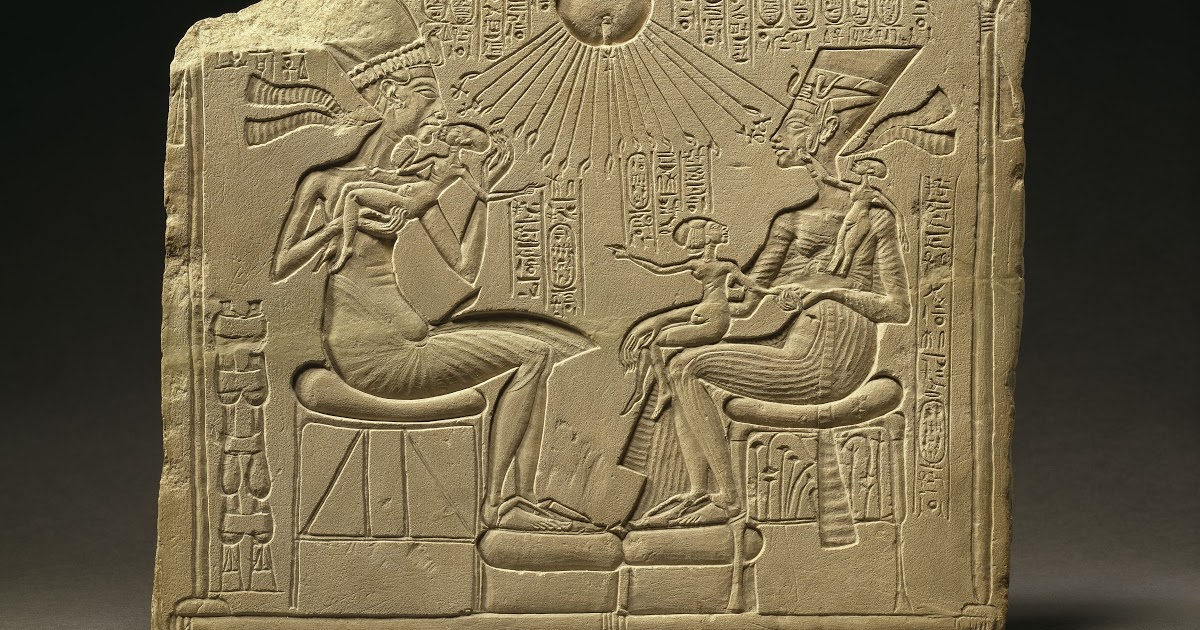
Akhenaten and Nefertiti with Three Daughters
Made in 1350~ BCE.
In the New Kingdom Era.
The tips of the sun’s rays are shown as hands extending symbols of life.
The features of both the king and the queen have been drawn in an abstract style.
Traditionally rulers were depicted as being both youthful and handsome, in order to document the power of the kingly state.
A no less extreme break with tradition is the representation of the daughters with heads which are elongated at the back as a manifestation of the life-giving power of the sun god.
Relief Sculpture
Sculpture in which the images have been carved or modeled on a surface so as to stand out from the background.
Composite Perspective
Also known as twisted perspective. A pose that combines two or more viewpoints in a single representation, a convention common in ancient Near Eastern and Egyptian art.
Sculpture in the Round
A type of sculpture in which the figures are presented in complete three-dimensional form and are not attached to a flat background.
Iconography
The study of the significance and interpretation of the subject matter of art, studies the identification, description and interpretation of the content of images.

Megaloceros Gallery Cave Paintings
Founded in Chauvet Cave, France and was made in circa 30,000 BCE.
From the Paleolithic Period.
Very dynamic for the time period considering that most cave paintings were made in a profile style.
Could be used to communicate animals in the area.
It is one of the oldest cave paintings we have ever discovered, for example “The Hall of Bulls” was made around 17,000 BCE.

Ancient Painting in a Well
Founded in Lascaux, France and was made in circa 15,000-13,000 BCE.
From the Paleolithic Period.
A potential narrative piece about a hunter and some form of mammal, a bull or buffalo perhaps.
Shows the intestines of the mammal, depicting the fact he probably killed it or is in the process of killing it.
Used animal fat to paint.
Could be a potential warning to other people that there’s a dangerous mammal on the prowl.

Lion-Human Figure
Founded/made in Hohlenstein-Stadel, Germany and was made in circa 40,000-35,000 BCE.
From the Paleolithic Period.
A potentially valuable object considering it has signs of wear and tear over the years.
First signs of mythological human and animal hybrid beings.
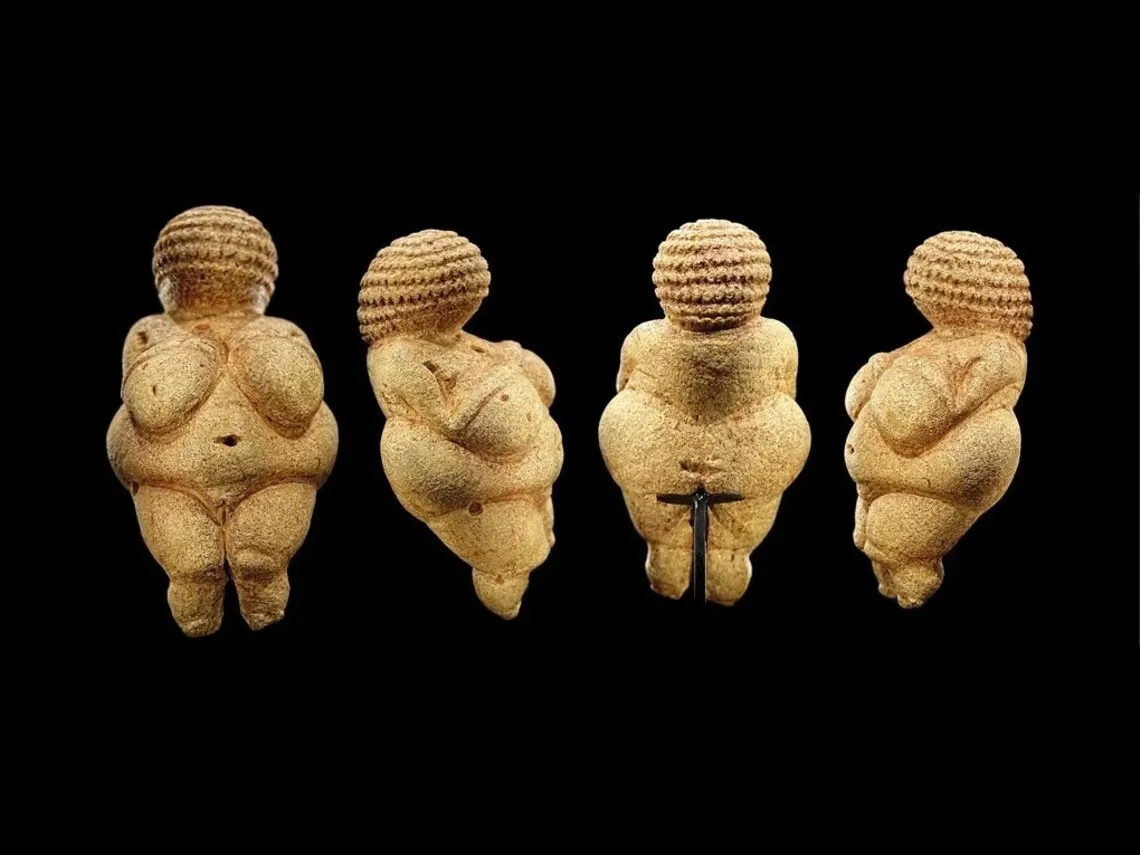
Woman of Willendorf
Founded/made in Austria and was made in circa 24,000-22,000 BCE.
From the Paleolithic Period.
A very theorized figure with no distinct answer as to why she was made.
Potentially a self portrait due to the fact she’s faceless and mirrors weren’t a thing back then.
Depicts vulnerability and fertility due to her naked figure.
Originally painted with red ochre which is a very valuable material.
Idealism
The unrealistic belief in or pursuit of perfection.
Paleolithic Era
An ancient cultural stage of human technological development, characterized by the creation and use of rudimentary chipped stone tools. These included simple pebble tools (rock shaped by the pounding of another stone to produce tools with a serrated crest that served as a chopping blade), hand adzes (tools shaped from a block of stone to create a rounded butt and a single-bevel straight or curved cutting edge), stone scrapers, cleavers, and points. Such tools were also made of bone and wood. The Paleolithic Period was also characterized by the manufacture of small sculptures (e.g., carved stone statuettes of women, clay figurines of animals, and other bone and ivory carvings) and paintings, incised designs, and reliefs on cave walls.
Mesopotamian Era
A historical region of West Asia situated within the Tigris–Euphrates river system, in the northern part of the Fertile Crescent. It corresponds roughly to the territory of modern Iraq. Just beyond it lies southwestern Iran, where the region transitions into the Persian plateau, marking the shift from the Arab world to Iran.
Mesopotamia is the site of the earliest developments of the Neolithic Revolution from around 10,000 BC. It has been identified as having "inspired some of the most important developments in human history, including the invention of the wheel, the planting of the first cereal crops, the development of cursive script, mathematics, astronomy, and agriculture." It is recognised as the cradle of some of the world's earliest civilizations.
(Egypt) Old Kingdom Era
(circa 2613-2181 BCE)
Also known as the "Age of the Pyramids" or "Age of the Pyramid Builders" as it includes the great 4th Dynasty when King Sneferu perfected the art of pyramid building and the pyramids of Giza were constructed under the kings Khufu, Khafre, and Menkaure.
The historical records of this period, the 4th-6th Dynasties of Egypt, are scarce, and historians regard the history of the era as literally "written in stone" and largely architectural in that it is through the monuments and their inscriptions that scholars have been able to construct a history. The pyramids themselves relay scant information on their builders, but the mortuary temples built nearby and the stelae that accompanied them provide kings' names and other important information.
(Egypt) New Kingdom Era
Spanning from approximately 1570 to 1069 BCE, marks a significant era characterized by political reunification and military expansion. This period began when Ahmose I, following the defeat of the Hyksos—a group of foreign rulers who had occupied Egypt for nearly a century—reestablished Thebes as the capital and solidified Egyptian dynastic rule. The expulsion of the Hyksos not only unified Upper and Lower Egypt but also initiated a phase of increased military campaigns that extended Egyptian influence into the Near East.
Ahmose I’s military strategies, including notable battles at Avaris and subsequent campaigns in Palestine, contributed to the economic revitalization of Egypt. This period witnessed a renaissance in arts, architecture, and trade, alongside a growing emphasis on the religious supremacy of the god Amen. The innovations introduced by the Hyksos, such as the chariot and composite bow, equipped the Egyptians with enhanced military capabilities, further facilitating their expansions. The New Kingdom ultimately transformed Egypt into a dominant regional power, laying the foundations for the influential Eighteenth through Twentieth Dynasties.