Soil Science
 Call Kai
 Learn
Learn Practice Test
 Spaced Repetition
 Match
Match Flashcards
 Knowt Play
1/219

There's no tags or description
Looks like no tags are added yet.
Name | Mastery | Learn | Test | Matching | Spaced | Call with Kai | Chat |
|---|
No analytics yet
Send a link to your students to track their progress
220 Terms
What is the study of rocks?
Petrology
In hydrometer method, what chemical is used for dispersing the soil?
Calgon, Sodium hexametaphosphate
Aggregates of different kinds of minerals
Rocks
From Latin word ‘Ignis’ meaning Fire • Forms from solidification of hot molten material such as magma and lava • Most abundant rock in the Earth’s crust – 95%
Igneous rocks
From trapped magma, slow cooling, coarse textured
Intrusive Igneous or Plutonic
Natural relatively permanent soil aggregates
Peds
artificial formation of osil mass due to disturbances such as tillage
Clods
From lava upon rapid cooling, fast cooling, fine texture.
Extrusive igneous or volcanic
Coarse texture > intrusive igneous
Phaneritic
Fine textured > Extrusive igneous
Aphanitic
Larger crystals (phenocryst) surrounded by matrix of smaller crystall (groundmass)
Porphyritic
Forms from the compaction and cementation of sediments of pre-existing rocks such as igneous and metamorphic rock subjected to weathering
Sedimentary rocks
May also form from parts of living organisms
Bituminous coal (from plant)
collective term for step 1 to step 3 → weathering, transport, and deposition
Sedimentation
it refers to group of soil particles that bin to each other strongly than adjacent particles
Soil aggregates
collective term for step 1 to step 3 → weathering, transport, and deposition
Lithification
change in structure or composition due to heat and pressure • Form from pre-existing rocks such as igneous and sedimentary rocks subjected to heat and pressure
Metamorphic rocks
change in structure or composition due to heat and pressure
Metamorphism
Naturally occurring inorganic substance that has definite internal arrangement and definite chemical composition and physical properties
Minerals
Study of minerals concerned with structure and properties
Mineralogy
Form from crystallization of igneous rocks, source of sand and silt fractions
Primary minerals
Black mica also called?
Biotite
White mica also called?
Muscovite
Examples of extrusive igenous
Basalt, rhyolite, andesite
Example of intrusive igneous
granite, gabbro, diorite, pegmatite
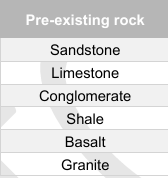
What metamorphic rocks equivalent is the result?
Quartzite, marble, meta-conglomerate, slaet, schist, gneiss
Abundant elements in the earth’s crust
Oxygen 46.6%, Silicon 27.72%, Aluminum 8.13%, Iron 5%, Calcium 3.63%, Sodium 2.83%, Potassium 2.59%, Magnesium - 2.09%, Other elemetns 1.41%
Groups of soil particles that bind to each other strongly than adjacent particles.
Soil aggregate
Ability of soil to resist disruptive forces such as wind and water erosion
Aggregate stability
Common in A horizon, formation is influenced by humus, rapid water permeabilit
Granular
Major process of sedimentary rock formation
Mechanical and chemical weathering, transport of weather product, water, gravity, wind or ice, deposition of sediment and compaction and cementation.
Angular or subangular forms in the B horizon, from illuviation of clay which fills the pores, forming a block-like appearance.
Blocky
Forms in B horizon after block structure, moderate water permeability
Prismatic
Form from weathering of pre-existing mineral
Secondary Minerals
E.g of primary minerals
Olivine, pyroxene, amphibole, plagioclase, mica
e.g of secondary minerals
Pyrite, halite, kaolinite, hematite
also known as fool’s gold
Pyrite
Forms in B horizon, common in semiarid and arid regions, presence of salt cap, slow water permeability.
Columnar
Aka salt or NaCl
halite
aka Clay mineral
Kaolinite
aka oxidized iron
hematite
observable cracks caused by pressure release during uplift and erosion
exfoliation
water enters cracks and expands rock upon freezing
Freeze-thaw
cracking of rocks due to repeated expansion (high temperature) and contraction (low temperature)
Thermal expansion
collision of rocks resulting to smooth surface
abrasion
Combination of oxygen to minerals
Loss of electrons
Oxidation of magnetite to hematite
Oxidation
Forms as a result of compaction,
common in A horizon under intensive management,
very slow water permeability.
Platy
Removal of oxygen to minerals
Gain of electrons
Reduction
attack of water to minerals which causes
Change in mineral composition
Change in mineral structure
Decomposition
Hydrolysis of Kaolinite → Silt clay
Hydrolysis
Water is absorbed in the mineral structure
Does not destroy chemical structure
Hydration
Rocks or mineral with carbonic acid
Carbonation
entry of plant roots in small cracks which causes further cracks as it grows
Root wedging
Burrowing and excavation of animal, eg piddocks
Animal activity
natural body comprised of solids (minerals and organic matter), liquid, and gases that occurs on the land surface, occupies space, and is characterized by one or both of the followings: horizons or layers, that are distinguishable from the initial material as a result of additions, losses, transfers, and transformations of energy and matter or the ability to support rooted plants in a natural environment
Definition of soil, soil survey 1999
Father of Soil Science
Vasily Dokuchaev
5 Factors of Soil Formation, CLORPT
Hans Jenny
5 factors of soil formation.
Climate, Organism, Relief, Parent Materials, Time
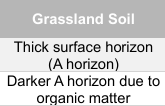
What formation in forest soil based on the table?
Thin surface horizon (a horizon), formation of thin O horizon
Grains are not connected, lacks structure, examples are dune sand and river deposites
Single grained
Mass of soil particles with no pattern, lack structure, very slow water permeability
Massive
Test the stability of soil aggregates in water
Slake test
Fast development of soil due to high leaching and relatively less erosion as compared to backslope
Summit, shoulder
Slow development of soil due to less leaching and faster runoff causing soil erosion
Backslope
Slow development of soil due to accumulation of sediments from upslope
• Prone to flooding
Footslope and toeslope
Residual – from the bedrock
Parent material
transportation and deposition of sediments by flowing water
Alluvium
Deliberately destroying soil structure by plowing and harrowing the soil in a flooded or saturated state. Formation of impervious layer
Puddling
transportation and deposition of sediments by flowing water
What are considered cementing agents in the soil?
Lime, sesquioxides, clays
soil formation by desposition of wind transported sediments.
aeolian
bulk density increase with
increasing soil depth
bulk density is heavily related to?
Compaction
Soil accumulation transported downslope by gravity.
Colluvium
Ratio of mass of soil solids to the volume of soil.
Bulk density.
deposition of soil material from melting ice
Glacial drift
Includes processes and conditions by which initial materials are differentiated into soil profiles with many horizons
Horizonation
Includes processes and conditions by which horizonation is inhibited or decelerated or by which horizons are mixed or disturbed
Haploidization, erosion and pedoturbation
Simonson’s model
Soil = f(a,r,t1,t2)
general term for any material added to soil body
Enrichment
darkening of light colored mineral by admixture of organic matter
Melanization
aeolian, hydrologic, and man-made additions of mineral particles to the surface of a soil solum
Cumulization
accumulation on the mineral soil surface of organic litter and associated humus to a depth of less than 30cm
Littering
Standard of particle density (mineral soils)
2.65 g/cm3
removal of material from the surface layer of a soil
Erosion
general term for washing out or eluviating soluble materials from the solum
Leaching
breakdown of mineral and organic materials
Decomposition
formation of new particles of mineral and organic species
Synthesis
release of minerals components (inorganic) of organic matter through decomposition
Mineralization
transformation of raw organic materials into humus
Humification
chemical, biological, and physical changes in organic soil after air penetrates previously waterlogged soil
Ripening
increase in volume of voids by activity of plants, animals, and humans and by freeze-thaw or other physical processes and by removal of material by leaching
Loosening
decrease in volume of voids by collapse and compaction and by filling of some voids with fine earth, carbonates, silica, and other materials
Hardening
accumulation of soluble salts such as sulfates and chlorides of calcium, magnesium, sodium, and potassium in salty (salic) horizons
Salinization
accumulation of sodium ions on the exchange sites in a soil
Alkalization/ Solonization
leaching of sodium ions and salts from nitric horizons
dealkalization/ solodization
chemical migration of aluminum and iron and/or organic matter, resulting in concentration of silica in the layer eluviated
Podzolization / Silication
chemical migration of silica out of the soil solum and thus the concentration sesquioxides in the solum
Laterization / Desilication
release of iron from primary minerals and the dispersion of particles of iron oxide in increasing amounts; their progressive oxidation or hydration, giving the soil mass brownish, reddish brown, and red colors, respectively
Braunification, Rubification, Ferrugination
reduction of iron under anaerobic “waterlogged” soil conditions, with the production of bluish to greenish gray matrix colors, with or without yellowish brown, brown, and black mottles, and ferric and manganiferous concretions
Gleization
washing in suspension of fine clay down cracks and other voids in a soil body
Lessivage