Week 3 - Canada and WWII
 Call Kai
 Learn
Learn Practice Test
 Spaced Repetition
 Match
Match Flashcards
 Knowt Play
1/40

There's no tags or description
Looks like no tags are added yet.
Name | Mastery | Learn | Test | Matching | Spaced | Call with Kai | Chat |
|---|
No analytics yet
Send a link to your students to track their progress
41 Terms
950,000 men; 50,000 women
How many Canadian men and women served in uniform in World War II?
______ men and _____ women
internal conflict; limited liability
Early concerns of the war?
Prime Minister Mackenzie King knew he could not keep Canada out of the conflict if Britain declared war—he had been affected by WWI and how it almost tore apart French and English Canada brought on by class and region. He wanted to contain _______ _______ and maintain unity to avoid mistakes from WWI with respect to recruitment, conscription, and managing social and economic policy.
King wanted Canada to fight a war of _____ _______where contribution of materiel would dominate. He wanted to prevent need for conscription (promised to Quebec) and have minimal casualties. He wanted to avoid sending many people in expeditions.
Eager enlisting
_________ - Many young Canadian men enlisted as they wanted to escape effects of the Great Depression, escape a mad marriage, poor job or boredom. Some wanted to support Britain which was seen as Canada’s mother country
British Commonwealth Air Training Plan (BCATP)
_________ - was a plan for aviation (had speed, range, reliability and destructive payload) and Canada was the ideal location as it had vast open spaces, access to America’s large air industry, relative safety from enemy attack and closer proximity to Australia for ferrying planes to England. The BCATP once negotiated allowed Canada to graduate 1,500 aircrew/month compared to the 125/month before.
Blackout drills
________ -were practiced across Canada as the war became serious and frightening due to how quickly Nazi Germany was conquering Europe. They were especially worried when France was conquered followed by attacks in England—the Battle of Britain (Luftwaffe/German aircraft) in preparation for Operation Sea Lion, the planned invasion of England by Nazi Germany.
National Resources Mobilization Act (NRMA)
____________ - took a census of all available labour of both genders, 16yrs and up, and establish conscription for home defence for single men 19-45yrs—at first for one month but then to four months in Feb 1941. Then in April, the length of service was extended indeterminately possibly for the entire war.
funded
_____________ - Canada ______ its war efforts via centralizing financial control, taking exclusive jurisdiction over income, corporate and inheritance taxes from the provinces as well as implementing recommendations from the Royal Commission on Dominion-Provincial Relations in exchange for assuming up to 40% of municipal-provincial debt
Additionally, the government established a national unemployment insurance fund which accumulated a large surplus as wartime jobless rates plummeted. The 1942 Dominion-Provincial Taxation Agreement Act also was enacted where provinces rented their tax fields to Ottawa for the war’s duration.
Command economy
_________ - a system where government controls production, distribution and pricing
Canada and the command economy
Command economy
_________ - to avoid problems in WWI, seen in the creation of the Wartime Prices and Trade Board (WPTB). High inflation was causing economic and social strain during WWI, and the WPTB imposed a freeze on wages and prices. The gov. centralized the Department of Munitions and Supply as well.
This economy streamlined industrial production, regulated profits, secured Canada’s raw materials and also created government corporations to create military equipment on a large scale.
Early Canadian conduct in Britain
_____________ - was where Canadian soldiers settled to protect them from a Nazi invasion. Canada established a Civil Affairs Branch to organize assistance like to help harvest crops, but many felt bored and restless not being in action. They grew impatient with British military instructors who reportedly treated them as incompetent—this plus Britain’s damp, cold climate and poor accommodations made it so many Canadian troops were arrested for being drunk and disorderly conduct.
Canada’s Airforce on the other hand were tasked with escorting British bombers—though Canadian aircraft was inferior and lost more than it gained. The Royal Canadian Navy (RNC) was preferred by Prime Minister King, were with Corvettes which were modest in size, less sophisticated, cheap but suitable for anti-submarine patrol. The RNC patrolled Canadian, British, Indian, African, Caribbean and Mediterranean coastlines.
3 female military services
_______ - The Canadian gov. created:
The Canadian Woman’s Army Corps (CWAC)
The Canadian Women’s Auxiliary Air Service/Women’s Division of the RCAF
Women’s Royal Canadian Naval Service
Roles of female military services
3 female military services
_______ - to release men for active service due to expanding commitments abroad, while women held the homefront.
Hong Kong
_________ - The Canadian Army’s earliest engagement here was disastrous—the British told Canadians the Japanese were poor soldiers and would not attack them to risk conflict with the British Empire.
King did not want to send troops, but eventually had to in the C category which were troops not ready for action and needed more training.
The Japanese attacked and Canadians were ill-prepared—the Commander of C Force was killed early into the engagement.
290 Canadians were killed and 500 wounded, while survivors spent the rest of the war in Japanese slave-labour POW camps where beatings, torture and mock executions were common and malnutrition left prisoners susceptible to disease.
Japanese-Canadian “evacuation”/internment
_____________ - was where local Japanese Canadians were rumoured to help Japan during Hong Kong and Pearl Harbour. Unwilling to alienate the BC wing of the Liberals and Canadians, Japanese-Canadians in BC were forced to relocate, and those who refused faced internment and forced labour.
Federal authorities sold and confiscated Japanese property. Many were forced to live in quickly constructed government complexes that were small, used oil lamps and wood heat and had no private bathrooms. Many ended up as labourers.
Alaska Highway; Dawson Creek; Fairbanks
____________ - was built with the purpose to quickly transport troops and supplies in the case of a Japanese invasion from the north. It stretched over 2,500km from ________, BC to _______, Alaska.
Rations
___________ - Gasoline, sugar, tea, coffee, butter and meat were rationed as imported products were more difficult to obtain and accommodate rising demand from troops and civilians overseas.
Wartime Information Board
__________- was created by the Canadian gov. for managing information, consulting with advertising agencies and surveys to gauge support to government war policies and to identify the best ways to mobilize people. AKA manage public messaging and build domestic support, creating a strategic approach to wartime propaganda
It controlled the narrative of war to boost and maintain public morale
Ex: The Dieppe Raid was a huge defeat for Canada but was spined praising the troops as heroes and not framing it out to be a complete loss.
Major military events (1942-1943)
_______ - include…
The Dieppe Raid (August 1942)
Canada’s Mid-Ocean Escort Force, Battle of the Atlantic & Battle of the St. Lawrence (1942-1943)
Bomber Command & No. 6 Group
Invasion of Sicily/Operation Husky
The Italian Campaign (Fall-Winter 1943)
1) Dieppe Raid
Major military events
___________ - in August 1942, designed to test German coastal defenses and gather intelligence. Driven by Admiral Lord Louis Mountbatten, the raid went ahead despite serious concerns.
German’s were much more prepared-- Canadians lost the element of surprise, suffered from inadequate naval/air support, and landed in daylight on exposed pebble beaches under heavy barrage from surrounding cliffs. It was Canada’s single costliest day of World War II.
Battle of the Atlantic + Battle of the St. Lawrence River
Major military events
___________ - In February 1942, Canadian vessels assumed leadership roles in the Mid-Ocean Escort Force. Later that year, German U-boats got to the St. Lawrence River, sinking multiple merchant vessels and the civilian ferry SS Caribou (killing 137 people), forcing the Canadian government to close the St. Lawrence to ocean traffic.
By mid-1943, via breaking Germany’s Enigma Code (communication), heavy losses forced U-boats to withdraw. In April 1943, the Northwest Atlantic Command was created under Canadian Rear Admiral Leonard W. Murray—the only theatre of operations commanded by a Canadian in WWII.

Bomber Command + No. 6 Group
Major military events
___________ - Canada supplied 15 squadrons and 25% of personnel to RAF Bomber Command. Pushing back against British resistance, Canadian air force brass successfully established No. 6 (Canadian) Group, which became operational as the only non-British group in Bomber Command.
Invasion of Sicily + Operation Husky
Major military events (The Italian Campaign)
___________ - Roughly 23,000 Canadian troops joined a 140,000-strong Allied force invading Sicily. Over the month-long campaign, there were nearly 50,000 casualties across both sides, including 562 Canadians killed and nearly 1,800 wounded.

The Italian Campaign
Major military events
___________ - fall/winter 1943 — On September 3, 1943, Canadian troops crossed the Strait of Messina into mainland Italy. As German troops rapidly occupied the country and dug in, Canadians encountered heavy resistance at Campobasso (October), the Sangro River (November), the Moro River ("river of blood", December 6), and intense urban combat in Ortona (late December).
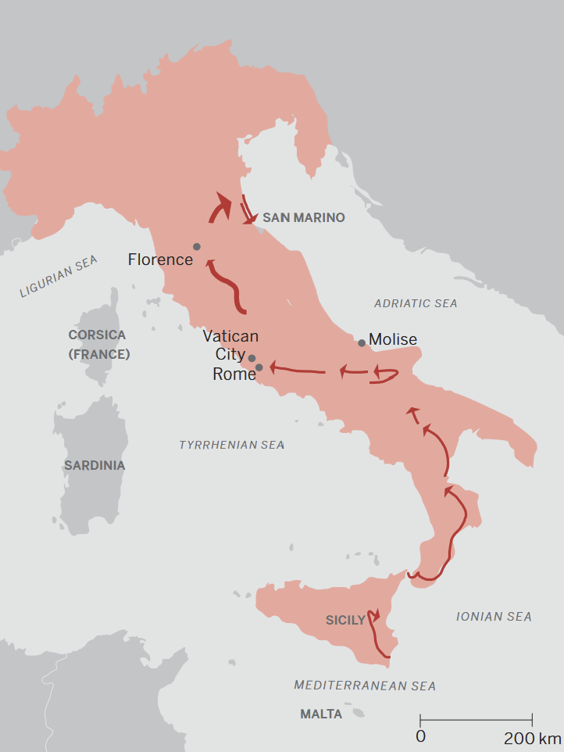
Nature of Warfare for Canadian Troops
______________ - In Sicily, troops navigated steep, narrow mountain goat paths booby-trapped by enemy forces amid desert terrain and intense summer heat.
Disease was a constant threat, with roughly 1,200 Canadians contracting malaria.
In Italy, troops advanced through relentless cold, sleet, and mud. Airborne crews in Bomber Command faced high mortality rates, suffering 9,919 deaths (more than half of all RCAF fatalities).
Ground troops at Ortona engaged in room-by-room urban fighting, using explosives to blast through adjoining walls of row houses ("mouse-holing") to bypass streets, while dealing with booby-trapped buildings set by seasoned German paratroopers.
Medical care improved considerably compared to WWI, lowering the death rate of wounded soldiers who reached medical care to 66 per 1,000 (down from 114 per 1,000 in WWI) due to blood typing and antibiotics. The military also set up dedicated rest centres for troops experiencing "battle exhaustion" and auxiliary leave centres (such as in Campobasso in October 1943) offering canteens, shows, games, and lodging.
War impact on Newfoundland
___________ - St. John’s became a key hub for organizing Atlantic shipping convoys. Up to 20,000 American troops arrived to garrison posts at St. John’s, Torbay, Argentia, Gander, and Stephenville to prevent potential German occupation of the region. Out of a population of 300,000, approximately 13,000 Newfoundlanders gained employment linked to the massive American military construction and presence.
About 6,000 Canadians were stationed here, participating in operations like Ferry Command, which flew roughly 11,000 military aircraft from Gander and Goose Bay to Britain.
Concerned that _________ might fall under American control—and given that Bell Island supplied one-third of the ore for Cape Breton steel mills—Ottawa appointed a High Commissioner in St. John's (1941) and invested $16 million in harbour infrastructure.
Warfare hit home directly in September 1942 when the Nova Scotia–Newfoundland ferry SS Caribou was torpedoed and sunk by a German U-boat, resulting in 137 deaths.
Battle of St. Lawrence River
Canadian women (1942-1944)
______ - obtained employment in areas connected to the war effort that used to be exclusive to men—women w jobs grew from 22.7% to 33.1% and more working women were married and having kids
Income tax breaks were implemented and federal-provincial childcare was implemented.
Propaganda conveyed that women took jobs out of patriotism and victory would return to domestic life— but women saw this as a way of future change and equality.
Women spoke of their jobs extended beyond traditional roles and growing ambitions, as well as earning their own paycheque.
Women were paid less still, and many jobs were lower-graded and reflected gender stereotypes— But to get more workers, women’s pay was increased and raises were provided on equal basis as men.
Labour movement milestones
________ - Workers clocked in record hours and produced to their limit—unemployment disappeared, and the pre-tax salary rose immensely. Strikes were officially discouraged, but there were still grievances. Union demands were ignored, and mandatory wage controls had not risen adequately. Organized labour strength increased as workers shortages helped unionization and people were less fearful about losing jobs if they supported a union. Organized labour got stronger and strikes increased, but King managed to negotiate saying improvements in collective bargaining rights were justified.
Action occurred at the provincial level, with unions having immense power. The Cooperative Commonwealth Federation (CCF) led both major parties, and Canada’s first CCF gov in SK under Tommy Douglas. The CCF forced conservatives and liberals to adopt pro-labour policies. Provincial legislation was implemented which protected unions and workers. The momentum forced King to adopt family allowances, which were Canada’s first universal social program
Major events in Europe (1944-1945)
____________ - In Italy 1944, Canadian Corps broke through the German Gustav Line blocking the road to Rome. Canadians then broke the more formidable Hitler line.
Canadian Corps joined Allies in northwest Europe which involved 237,000 Canadians, with ~44,000 casualties and ~11,000 killed. On D-Day, Canadian troops were on Juno Beach—the Commanders of Germany’s 12th SS believed the inexperienced Canadians were easy to destroy. There were many casualties but Canadians pushed through and the Allies captured Caen. They closed the Argentan-Falaise pocket in the Battle of the Falasie Gap—Germans were trapped and their resistance in Normandy was ended. Canada had steep casualties.
Canada had control of the left flank of the Allied Advance and to capture the French channel ports—Antwerp was the last one most suitable, and while Britain captured it, Canada was to clear the Germans of the waterways and islands that formed the Scheldt estuary. Canadians transversed rivers, canals, water-filled ditches, flooded fields and badly exposed roadways, prevailing with greater proficiency with still many casualties.
In 1945, the First Canadian Army composed of I and II Corps, moved to take Nijmegen in the Netherlands and south to neutralize the Nazis between the Maas and Rhine rivers. Canada was successful in liberating the Netherlands.
Canadian women post-WWII
__________ - Canadian women were pressured to give up their jobs and have babies after WWII in a return to normalcy. Mothers were made to feel guilty for not spending more time at home, and single women feared becoming spinsters. The federal government ended support for daycare and wartime income tax breaks for working wives, no protection was extended to women, and many women hired to produce aircraft in Thunder Bay were dismissed
By 1944, plans were underway to eliminate the three women corps.
Japanese-Canadians post-WWII
________ - were treated with racist attitudes and were denied freedom of movement, but could not return to their homes in BC and scatter. They could also chose to be sent to Japan even though many were born in Canada and had no ties to Japan—AKA deported.
Some wanted to be repatriated, only to want to change their mind as Japan was devastated. Some returned, but many applied to come back with only ~170 being successful.
Veterans
__________ - King viewed veterans as a huge voting bloc and realized they did not hold him in high regard, with many denouncing him for not serving in WWI and resisting conscription. To avoid mistakes of veterans in WWI, the federal gov. planned early for repatriation, and introduced the Post-Discharge Re-establishment Order—those honourably discharged would receive tax-exempt payments for time served both in the Western Hemisphere and overseas.
The 1942 Reinstatement in Civil Employment Act made it so healthy veterans could resume their pre-military jobs or those comparable with their former employer at a rate equivalent had they not enlisted. Grants and loans were given to entrepreneurs, do commercial fishing, or under the Veterans Land Act, farm full-time or a small hobby farm.
The Vocational Training Coordination Act provided a living allowance to veterans to the time they spent in the military along with free university education. These veteran benefits dwarfed other social welfare costs.
Federal Liberals
_____________ - they avoided conscription to calm Quebec, used Conservative dislike to win a majority, negotiated social-democratic policies with the CCF, centralized economic control, and used the Wartime Indo board to shape public opinion and kept veterans happy.
Conscription issue
How did federal liberals stay in power throughout WWII?
__________ - It was King’s goal to not make the same mistakes as in WWI with regional divisions. Early in the war, King focused on equipment production, naval expansion and air training like the British Commonwealth Air Training Plan over ground forces to keep casualties low and avoid overseas conscription.
When conscription was more pressured by English Canada, King passed Bill 80 “conscription if necessary but not necessarily conscription” to keep promises to Quebec who did not want conscription. This delayed conscription until late 1944, which prevented Quebec from pulling away politically.
Liberals vs Conservatives
How did federal liberals stay in power throughout WWII?
__________ - In the 1940s snap election, the conservative leader called for a coalition due to wanting to push for mandatory overseas conscription. However, King’s Liberals used this to his advantage, calling for a snap election and avoiding the coalition—voters rejected the coalition and resulted in Liberals winning a majority—conservatives were still widely disliked from the Depression, and Quebec wasn’t a fan of mandatory conscription.
Then the next federal election was in 1945 just a bit after Germany’s surrender which deflated conscription worries. Throughout the war, King was careful to compromise with he various other political parties to maintain support, whether that be through the CCF, the conservatives or Quebec.
Negotiating w/ Social Democrats
How did federal liberals stay in power throughout WWII?
__________ - During WWII as left-wing policies from the social-democratic CCF, such as Unemployment Insurance in 1940, and benefits. When union memberships and strikes got more popular, King chose to work with them rather than suppress them such as with the National War Labour Board which helped expand collective bargaining rights.
Centralized economic control
How did federal liberals stay in power throughout WWII?
__________ - by enacted the War Measures Act and 1942 Dominion-Provincial Taxation Agreement which gave Ottawa financial control to fund the war via having provinces “rent” corporate and income tax fields to Ottawa. War production and new established Crown Corporations created a booming war industry that ensured widespread employment.
Shaping public opinion + Veterans
How did federal liberals stay in power throughout WWII?
__________ - Federal liberals hired advertising agencies like the Wartime Information Board to keep track of public opinion, shape public sentiment and war news to keep public morale high.
Veterans also become a massive voting bloc that was critical of King’s leadership, so programs like the Veterans Land Act, job reinstatement guarantees, university allowances created significant benefits and support to veterans.
In fact, veteran benefits accounted for more than all federal social welfare spending.
Social welfare
____________ - was a concern because of worries of the Great Depression and worries over post-war collapse—with production so high during the war people were worried for their unemployment after the war. Over the previous generation, social welfare demands had increased well beyond the capacity of municipal and provincial governments. Its answer was to provide the federal government with control over income, corporate, and inheritance taxes in exchange for Ottawa creating a national unemployment insurance scheme, a national adjustment grant to ensure all parts of the country met minimum standards in areas like education and health, and to assume up to 40% of the combined municipal–provincial debt.
There was also a working-class strain as worker’s faced federal wage controls and long working hours, upset that pay had not adjusted with inflation or living standards since the Depression. Rapid industrialization caused union membership to spike and worker anxiety cumulated in strikes the government had to establish worker rights and labour protections.
Family dynamics changed as well, as women entered the work industry and joint funding for childcare, but this created debate between women advocating for permanent equality and government propaganda insisting women return to home. Public concern also grew over unsupervised children with fathers in the military and mothers in the workforce, which fueled social welfare policies to support them.
When veterans returned, many Canadians were anxious over how returning personnel would integrate back into society, and the government saw that failing to provide for veterans could lead to poverty or social unrest (seen in the VE-Day riots). To attempt to prevent this, legislation like the Veterans Land act, job guarantees, training, university, was given to returning veterans.
The rise of the CCF (Co-operative Commonwealth Federation) forced Progressive Conservatives and King’s Liberals to prioritize social welfare. Opposition parties endorsed welfare platforms like low-cost public housing, nation public health insurance, expanded pensions. The Liberal gov. then introduced Unemployment Insurance and campaigned in 1945 promising government intervention to ensure high post-war employment and a “New Social Order” forcing mainstream parties to adopt social reform platforms.
Quebec and the Federal Liberals
____________ - was something King tried hard to preserve to avoid division as seen in WWI. King pledged to Quebec that he would not implement conscription overseas, as this was something Quebec disliked. To avoid casualties and needing conscription, King focused on limited liability by prioritizing military precaution, air training and naval expansion rather than ground troops. Furthermore, the conservatives coalition government/pressure for conscription was rejected by the Liberals, to which King used to call a snap election resulting in a Liberal majority. Quebecers were not a fan of the conservatives pro-conscription stance in WWI.
As military demands increased as the war went on, there was a deep Anglo-French split where 72% of Quebecers voted no and 80% of the rest of Canada voted yes for conscription. King passed Bill 80 to remove geographical limits on conscription service but only 4 out of 49 Quebec Liberal MPs voted in favour. To prevent Quebec from breaking away politically King followed his conscription of necessary formula to delay overseas conscription as long as possible.
Domestically, Quebec’s Liberal Premier was defeated in provincial elections by the Union Nationale—Quebec voters turned against their Liberal Premier (Adelard Godbout) was kicked as seen as too subservient to King’s Liberals. When Defence Minister Ralston wanted to enforce overseas conscription in 1944, King sacked him out of Cabinet to maintain Quebec’s trust.
Halifax VE-Day Riot
___________ - (May 7-8) was indication of future turmoil where more than 1,000 naval personnel led looting 500 stores and produced $5,000,000 in damages, 3 civilian deaths and 211 arrests.
What originally started as celebration turned destructive. The feds were concerned as is was a big, violent breakdown of military discipline and civil order involving military personnel. It caused a lot of arrests, property damage, and embarrassment.
“Good War”
_________ - I wouldn’t call WWII a “Good War” for Canada as it seems a little tone deaf due to the treatment of Japanese-Canadians and the many casualties in mistakes like Dieppe and in Hong Kong—yes Canada gained global respect and the military grew more skillful in their miltary and global standing, but I would call it a “Transformative war”—which helped crush Nazism and Fascism but also caused great harm to its own people. War is never a good, but something that can cause immense change, even positive change in the long run.