Ig physics - fomrula
 Call Kai
 Learn
Learn Practice Test
 Spaced Repetition
 Match
Match Flashcards
 Knowt Play
1/50

There's no tags or description
Looks like no tags are added yet.
Name | Mastery | Learn | Test | Matching | Spaced | Call with Kai | Chat |
|---|
No analytics yet
Send a link to your students to track their progress
51 Terms
Density Formula
ρ= m/v
Symbol | Means | Unit |
|---|---|---|
ρ (rho) | Density | g/cm³ or kg/m³ |
m | Mass | g or kg |
V | Volume | cm³ or m³ |
Spring Force
F = k×x
Symbol | Means | Unit |
|---|---|---|
F | Force (load) applied | newtons, N |
k | Spring constant | N/m or N/cm |
x | Extension = new length − original length | m or cm |
Moments
M= F×d
Symbol | Means | Unit |
|---|---|---|
M | Moment (turning effect) | newton-metres, Nm |
F | Force applied | N |
d | Perpendicular distance from the pivot to the line of action of the force | m |
Object at equilibrium:
Object at Equilibrium :
sum of clockwise moments = sum of anticlockwise moments
no turning effect
e.g.: seesaw in balance
Centre of Gravity:
Centre of gravity: The single point where the whole weight of the object acts.
Pressure Formula:
P=F/A
Symbol | Means | Unit |
|---|---|---|
p | Pressure | pascals, Pa (N/m²) |
F | Force pushing perpendicular to the surface | N |
A | Area force acts over | m² |
Pressure in Liquids
P= ρ×g×h
Symbol | Means | Unit |
|---|---|---|
ρ | Density of the liquid | kg/m³ |
g | Gravitational field strength | N/kg (=9.8) |
h | Depth below the surface | m |
- Pressure increases as depth increases
Speed Formula
V= d/t
Symbol | Means | Unit |
|---|---|---|
v | Speed | m/s |
d | Distance travelled | m |
t | Time taken | s |
Velocty Formula
Velocity = Displacement/ Time
Displacement = distance but with direction
Acceleration Formula
∆Velocity/t
Symbol | Means | Unit |
|---|---|---|
a | Acceleration | m/s² |
v | velocity | m/s |
t | Time taken for the change | s |
Force Formula
F = m×a
Symbol | Means | Unit |
|---|---|---|
F | Resultant force | N |
m | Mass | kg |
a | Acceleration (same direction as F) | m/s² |
Weight Formula
W = m×g
Symbol | Means | Unit |
|---|---|---|
W | Weight | N |
m | Mass | kg |
g | Gravitational field strength (= force per unit mass, equivalent to acceleration of free fall) | N/kg |
Mass ≠ weight! Mass is constant everywhere (kg, scalar-ish quantity of matter). Weight is a force (N) that changes with g (e.g. weight on the Moon is smaller because g is smaller, but mass is unchanged)
Momentum Formula
mom = m×velocity
Symbol | Means | Unit |
|---|---|---|
mom | Momentum | kg m/s |
m | Mass | kg |
velocity | Velocity | m/s |
Impulse Formula
Impulse = ∆momentum
∆= change in
Impulse Formula- force and time
Impulse = F/ ∆t
Symbol | Means | Unit |
|---|---|---|
F | Force applied | N |
Δt | Time for which the force acts | s |
Total meom,entum before = toalmmoemt um after
Take one direction as positive and the opposite as negative.
Conservation of energy: energy cannot be created or destroyed, only transferred from one store to another — total energy before = total energy after
Kinetic Energy
KE = ½ m×v²
Symbol | Means | Unit |
|---|---|---|
KE | Kinetic energy | J |
m | Mass | kg |
v | Speed | m/s |
Gravitational Energy
GPE = m×g×h
Symbol | Means | Unit |
|---|---|---|
GPE | Gravitational potential energy | J |
m | Mass | kg |
g | Grav. field strength | N/kg |
h | Height risen/fallen | m |
Elastic Strain Energy
EPE = ½ k×x²
Symbol | Means | Unit |
|---|---|---|
EPE | Elastic potential energy | J |
k | Spring constant | N/m |
x | Extension/compression | m |
Work done
W = F×d
Symbol | Means | Unit |
|---|---|---|
W | Work done (= energy transferred) | J |
F | Force applied | N |
d | Distance moved in the direction of the force | m |
Power Formula
P = W / t or E / t
Symbol | Means | Unit |
|---|---|---|
P | Power | W (watts) |
W or E | Work done or energy transferred | J |
t | Time taken | s |
Word done = energy transfereed
Efficenency formula
Efficiency = (useful energy/power output ÷ total energy/power input) × 100%
Symbol | Means | Unit |
|---|---|---|
Useful output | Energy/power in the form you wanted | J or W |
Total input | All energy/power supplied | J or W |
💡 "Charge flowing per second", "rate of flow of charge" → current. Like charges repel, unlike charges attract. Charging by friction = transfer of electrons only (negative charge moves, never positive). Conventional current flows + to −; electron flow is − to + (opposite direction!).
Charge & current
I = Q / t
Symbol | Means | Unit |
|---|---|---|
I | Current | amperes, A |
Q | Charge passing a point | coulombs, C |
t | Time | s |
EMF
EMF = W / Q
Symbol | Means | Unit |
|---|---|---|
EMF | Electromotive force — work done by the source driving a unit charge around the whole circuit | V |
W | Work done / energy transferred | J |
Q | Charge | C |
V = W / Q
Voltage: Ohms law
V = I R
Symbol | Means | Unit |
|---|---|---|
V | Potential difference across component | V |
I | Current through component | A |
R | Resistance | ohms, Ω |
📐 Resistance ∝ length (longer wire = more resistance) and resistance ∝ 1/(cross-sectional area) (thinner wire = more resistance). p.d. across a conductor increases as its resistance increases, for constant current.
🔗 SERIES circuits — full rule set
Current is the SAME at every point: I = I₁ = I₂ = I₃
P.d. is shared: Vtotal = V₁ + V₂ + V₃
EMF adds for cells in series: total EMF = EMF₁ + EMF₂ + …
Resistance adds:
Rtotal= R₁ + R₂ + R₃ + …
🔗 PARALLEL circuits — full rule set
P.d. is the SAME across every branch = same as the p.d. across the whole arrangement.
Current is shared: current from source = sum of branch currents. Itotal = I₁ + I₂ + I₃ (Kirchhoff's junction rule — current into a junction = current out).
Current from the source is larger than the current in any single branch.
Combined resistance of resistors in parallel is less than the smallest individual resistor.
Advantage of parallel lighting circuits: each lamp gets full source p.d. and works independently — if one fails, the others stay on.
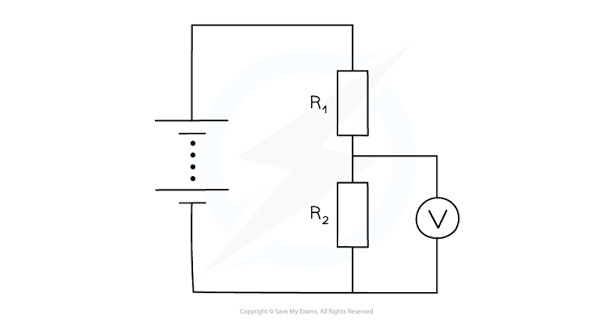
Potential Divider Formula
Vout = Vin × R₂ / (R₁ + R₂)
Symbol | Means | Unit |
|---|---|---|
Vout | Output p.d. taken across R₂ | V |
Vin | Supply p.d. | V |
R₁, R₂ | The two resistors (or thermistor/LDR + resistor) in series | Ω |
Electrical Power
P = I V
Symbol | Means | Unit |
|---|---|---|
P | Electrical power | W |
I | Current | A |
V | Potential difference | V |
Electrical Power
P = I² R
Symbol | Means | Unit |
|---|---|---|
P | Electrical power | P |
I | Current | A |
R | Resistance | Ohms |
Electricla energy transfered
E = I V t or P t
Symbol | Means | Unit |
|---|---|---|
E | Electrical energy transferred | J |
t | Time | s |
Cost = power (kW) × time (h) × price per kWh — kilowatt-hour (kWh) = the energy used by a 1 kW appliance running for 1 hour.
Transformer - number of turns
Vp / Vs = Np / Ns
Symbol | Means | Unit |
|---|---|---|
Vp, Vs | Primary / secondary voltage | V |
Np, Ns | Number of turns on primary / secondary coil | — |
Transferomer Power (for 100% efficiency — power in = power out)
Vp Ip = Vs Is
Magnetism basic
Like poles repel, unlike poles attract. Field direction at a point = direction of force on a N pole placed there.
Field lines point from N to S outside the magnet, closer lines = stronger field.
Soft iron → temporary magnet (induced magnetism, loses it quickly). Steel → permanent magnet (keeps magnetism).
✋ Hand rules — the most examined part of this topic
Fleming's LEFT-hand rule — for the MOTOR EFFECT (force on a current-carrying wire in a field)
ThuMb → Motion / force
First finger → Field
seCond finger → Current
Use when a force is being produced — motors, force on a wire/beam of charged particles.
Fleming's RIGHT-hand rule — for the GENERATOR EFFECT (electromagnetic induction)
ThuMb → Motion of the wire (the thing you're doing)
First finger → Field
seCond finger → induced Current
Use when motion is producing a current — generators, induction.
💡 Memory trick: "Left = motor, Right = generator" — alphabetical (L before R, motor before generator... or just remember "FBI": First finger=Field, secBond finger=Current, thuMb=Motion, in that order for both hands).
Boyles Law
p V = constant (Boyle's Law — fixed mass of gas, constant temperature)
Symbol | Means | Unit |
|---|---|---|
p | Pressure | Pa |
V | Volume | m³ |
Often used as: p₁V₁ = p₂V₂ (Start pressure times start volume equals end pressure times end volume)
Celsius Conversion to Kelvin
T (K) = θ (°C) + 273
Symbol | Means | Unit |
|---|---|---|
T | Temperature | kelvin, K |
θ | Temperature | °C |
Specific Heat Capacity
Q = m c Δθ
Symbol | Means | Unit |
|---|---|---|
Q | Thermal energy transferred (heat) | J |
m | Mass | kg |
c | Specific heat capacity (energy needed to raise 1 kg by 1°C) | J/(kg°C) |
Δθ | Temperature change | °C |
Wave Speed
v = f λ
Symbol | Means | Unit |
|---|---|---|
v | Wave speed | m/s |
f | Frequency | Hz |
λ (lambda) | Wavelength | m |
f = 1 / T
Symbol | Means | Unit |
|---|---|---|
f | Frequency | Hz |
T | Period (time for one complete wave) | s |
n = sin i / sin r
Symbol | Means | Unit |
|---|---|---|
n | Refractive index | no unit |
i | Angle of incidence (in the less dense medium, e.g. air) | degrees |
r | Angle of refraction (in the denser medium) | degrees |
Critical Angle
n = 1 / sin C
Symbol | Means | Unit |
|---|---|---|
C | Critical angle | degrees |