Clostridioides difficle Infection (CDI)
 Call Kai
 Learn
Learn Practice Test
 Spaced Repetition
 Match
Match Flashcards
 Knowt Play
1/13

There's no tags or description
Looks like no tags are added yet.
Name | Mastery | Learn | Test | Matching | Spaced | Call with Kai | Chat |
|---|
No analytics yet
Send a link to your students to track their progress
14 Terms
Objectives
Identify clinical signs and symptoms associated with Clostridioides difficile infection (CDI).
Differentiate between non-severe, severe, and fulminant CDI.
Design a pharmacotherapy plan (drug, dose, route, frequency and duration) for the management of non-severe, severe and fulminant CDI, including both initial and recurrent infections.
List infection control-related strategies aimed at preventing the spread of C. difficile in the healthcare setting
What is the clinical presentation of a patient with mild-moderate C. difficile infection?
Diarrhea
± abdominal cramping
Mild abdominal tenderness on physical exam
No systemic symptoms
No pseudomembranes present
Mild leukocytosis (< 15,000 cells)
What is the clinical presentation of a patient with moderate-severe C. difficile infection
Profuse diarrhea
Abdominal cramping
Significant abdominal pain and distension
+ Systemic symptoms
Pseudomembranous colitis present
Profound leukocytosis (> 15,000 cells)
When would you order tests for C. Diff?
If there’s > 3 new onset unexplained liquid/loose stools within the last 24 hours
No other explanation of diarrhea (laxatives, lactulose, tube feeds, oral contrast)

Compare and contrast
Non-severe CDI
Severe CDI
Fulminant CDI

Initial Treatment of CDI in adults
Non-severe or Severe
Preferred: FIdoaxomicin 200mg PO BID 10 days
Alt: Vancomycin 125mg QID PO 10 days
Alt for non-severe: Metronidazole 500mg PO TID 10-14 days
Fulminant
Vancomycin 500mg QID PO or nasogastric tube. If ileus, consider adding rectal instillation of Vancomycin. Add IV metronidazole 500mg TID if ileus present
Fidaxomicin
MOA
Dosing
Advantages
Disadvantages
Mechanism of action: Binds to bacterial DNA-dependent RNA polymerase; inhibits bacterial RNA synthesis
Dosing: 200 mg PO twice daily

What infection control measures should be used to prevent the spread of CDI to other patients?
Contact precautions
Move patient to private room
Gown and gloves required upon entry into the patient room
Use dedicated patient equipment
Handwashing with soap and water after patient contact
Continue precautions at least 24 hours after diarrhea has resolved
Should loperamide be used in our patient for the management of diarrhea? Why or why not?
Loperamide slows intestinal motility, allowing C.diff toxins to remain in the colon longer and increases risk of severe complications
What medications are avoided in CDI?
Antiperistaltics
Loperamide (Imodium)
Diphenoxylate/atropine (Lomotil)
Opioid agonists (morphine, fentanyl, etc.)
Non-CDI targeted antibiotics
Removal of inciting antibiotic whenever possible
Limit re-exposure to antibiotics to prevent recurrent infections
T/F A repeat C. difficile toxin test should be performed once patients are stable as a “test of cure.”
False → limited clinical value
Many patients remain positive after successful treatment
can lead to unnecessary treatment if colonization detected rather than active infection
Treatment of Recurrent CDI in Adults
Preferred
Fidaxomicin 200mg BID 10 days
OR Fidaxomicin 200mg BID for 5 days, then once every other day for 20 days
ALT
Vancomycin PO in a taper and pulsed regimen
Vancomycin 125mg QID PO for 10 days → IF metronidazole was used for 1st episode
What is Fecal Microbiota Transplantation (FMT)?
Transplantation of stool from healthy individuals
Re-establish microbiota balance
Use appropriate antibiotics for at least 3 CDI episodes before offering
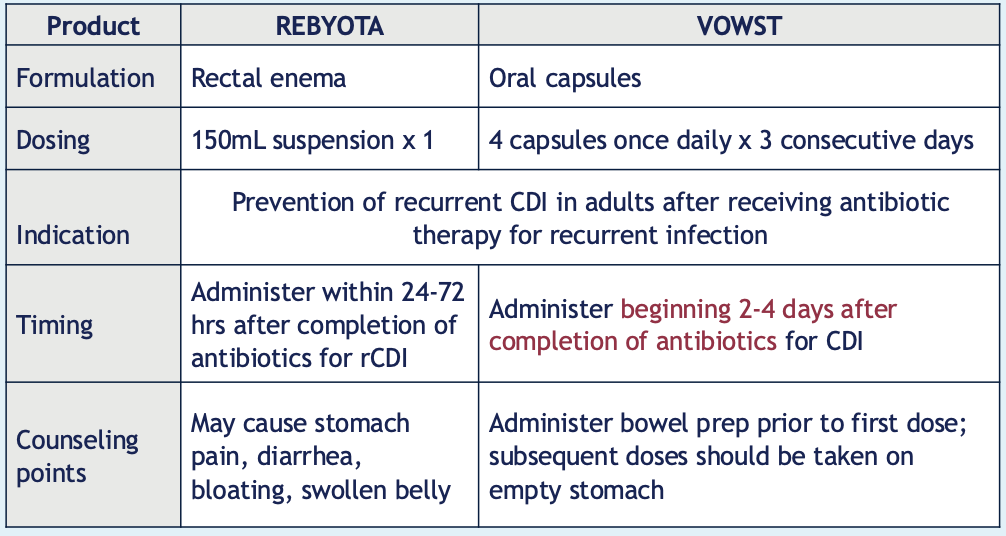
Compare REBYOTA and VOWST
Formulation
Dosing
Indication
Timing
Counseling points