ASM Drug Interaction Kinetics (L2)
 Call Kai
 Learn
Learn Practice Test
 Spaced Repetition
 Match
Match Flashcards
 Knowt Play
1/91

There's no tags or description
Looks like no tags are added yet.
Name | Mastery | Learn | Test | Matching | Spaced | Call with Kai | Chat |
|---|
No analytics yet
Send a link to your students to track their progress
92 Terms
_________ slows the rate of absorption, but has no effect on bioavailability and may be beneficial for ASMs with rapid t1/2
food (able to decreases SEs without having to decrease dose)
____________ (medication class) reduce PHT bioavailability by 20-30% and should therefore be separated by 2 hours
antacids
antacids reduce ___________ (ASM) bioavailability by 20-30% and should therefore be separated by 2 hours
PHT (Phenytoin)
enteral feedings via NG tube reduce __________ (ASM) bioavailability and should therefore be delayed 1-2 hours before and after ___________ dose
PHT (Phenytoin)
__________ reduce PHT bioavailability and should therefore be delayed 1-2 hours before and after PHT dose
enteral feedings (via NG tube)
interactions involving hepatic metabolism observed with all ASMs, except those eliminated renally like ___________
LEV (Levetiracetam)
onset of hepatic enzyme inhibition: initial effect within ________
24 hours (immediate)
onset of hepatic enzyme induction: meaningful effect within ________
1-3 weeks (longer)
clinical consequences of hepatic enzyme inhibition
_________ CL intrinsic (metabolism)
decreased (less drug getting metabolized and peed out= t1/2 will increase= drug will work longer)
clinical consequences of hepatic enzyme induction
_________ CL intrinsic (metabolism)
increased (more drug getting metabolized and peed out= t1/2 will decrease= drug will not work as long)
clinical consequences of hepatic enzyme inhibition
__________ elimination half-time (t1/2)
increased (less drug getting metabolized and peed out= t1/2 will increase= drug will work longer)
clinical consequences of hepatic enzyme induction
__________ elimination half-time (t1/2)
decreased (more drug getting metabolized and peed out= t1/2 will decrease= drug will not work as long)
clinical consequences of hepatic enzyme inhibition
_________ Css-total and Css-free, and therefore a _________ pharmacological effect (unless its a prodrug)
increased
clinical consequences of hepatic enzyme induction
_________ Css-total and Css-free, and therefore a _________ pharmacological effect (unless its a prodrug)
decreased
clinical consequences of hepatic enzyme inhibition
increased Css-total and Css-free
if it is a prodrug this means a __________ pharmacological effect
decreased (less drug being metabolized into its active metabolite form)
clinical consequences of hepatic enzyme induction
decreased Css-total and Css-free
if it is a prodrug this means a __________ pharmacological effect
increased (more metabolism= more working/active drug is made)
CBZ is 85% metabolized by CYP____ and CYP1A2/2C (minor)
3A4
__________ is 85% metabolized by CYP3A4 and CYP1A2/2C (minor)
CBZ (Carbamazepine)
PHT major metabolism pathway is CYP____ and CYP2C19 (minor)
2C9
________ major metabolism pathway is CYP2C9 and CYP2C19 (minor)
PHT (Phenytoin)
VPA 30-50% metabolized via ____________, 30-40% by beta-oxidation, 10-20% by CYP2C9/2C9
glucuronidation
_____ 30-50% metabolized via glucuronidation, 30-40% by beta-oxidation, 10-20% by CYP2C9/2C9
VPA (Valproic Acid)
Erythromycin is eliminated by hepatic metabolism via CYP3A4 and it inhibits CYP3A4 and 1A2
consequences of co-administration with CBZ= _________ [CBZ]
increased (inhibited CYP3A4= decreased hepatic metabolism of CBZ= less CBZ peed out)
Erythromycin is eliminated by hepatic metabolism via CYP3A4 and it inhibits CYP3A4 and 1A2
consequences of co-administration with PHT= _________ [PHT]
no change (since CYP3A4 does not effect PHT)
Erythromycin is eliminated by hepatic metabolism via CYP3A4 and it inhibits CYP3A4 and 1A2
consequences of co-administration with VPA= _________ [VPA]
no change (since CYP3A4 does not effect VPA)
Omeprazole is eliminated by hepatic metabolism via CYP2C19 and CYP3A4 and it inhibits CYP2C19 and 3A4
consequences of co-administration with CBZ= _________ [CBZ]
increased (inhibited CYP3A4= decreased hepatic metabolism of CBZ= less CBZ peed out)
Lansoprazole is eliminated by hepatic metabolism via CYP2C19 and it inhibits CYP1A2 (weak)
consequences of co-administration with CBZ= _________ [CBZ]
no change
the 4 ASMs that increase metabolism and therefore decrease effect of OCPs are
CBZ, PHT, OXC, TPM
Css-________ is the total steady-state plasma drug concentration
total (not the same as pharmacological effect)
Css-_______ is the unbound steady-state plasma drug concentration
free (same as pharmacologic effect)
fu is the fraction unbound, fraction of drug in plasma not bound to plasma proteins (ratio of Css-____:Css-_____ drug concentration)
free:total

this is the equation for Css-________ (which includes fu in the denominator)
total (therefore fu does not affect the pharmacological effect)

this is the equation for Css-_______ (which does not include fu in the denominator)
free (this is the same as the pharmacological effect)
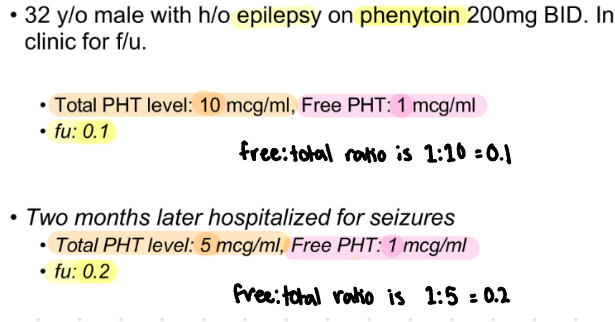
should we decrease this patients dose
NO
(the Css-free did not change and therefore the pharmacological effect did not change)
(only the fu changed, meaning the Css-total changed, which has no effect on pharmacologic effect)
pharmacologic effect is directly related to changes in Css-_______, which (looking at the equation) is NOT affected by ______
free, fu
an interaction causing a change in bioavailability (F) or hepatic metabolism (CLintrinsic)
the change in Css-total is _________ (same or different) as Css-free (pharmacologic effect)
same (i.e. monitoring Css-total does provide an accurate reflection of change in pharmacological effect)
an interaction which alters protein binding (fu)
the Css-_________ is unchanged
free (therefore the pharmacological effect is unchanged)
an interaction which alters protein binding (fu)
the Css-free is __________ (changed or unchanged)
unchanged
an interaction which alters protein binding (fu)
the Css-total is __________ (changed or unchanged)
changed (Css-total changes proportional to change in fu)
an interaction which alters protein binding (fu)
the Css-_______ changes proportional to changes in fu
total
an interaction which alters protein binding (fu)
the change in Css-total is _________ (same or different) as Css-free (pharmacologic effect)
different (monitoring Css-total does NOT provide an accurate reflection of changes in pharmacologic effect)
if F (absorption) is decreased
change in Css-total: _____
change in Css-free: _____
change in pharmacologic effect: ________
clinical action required: __________ the dose
decreased, decreased, decreased, increase
(Css-total and Css-free change the same= Css-total does accurately reflect pharmacologic effect)
if F (absorption) is increased
change in Css-total: _____
change in Css-free: _____
change in pharmacologic effect: ________
clinical action required: __________ the dose
increased, increased, increased, decrease
(Css-total and Css-free change the same= Css-total does accurately reflect pharmacologic effect)
if CL intrinsic (hepatic metabolism) is inhibited (less being metabolized= less being peed out)
change in Css-total: _____
change in Css-free: _____
change in pharmacologic effect: ________
clinical action required: __________ the dose
increased, increased, increased, decrease
(Css-total and Css-free change the same= Css-total does accurately reflect pharmacologic effect)
if CL intrinsic (hepatic metabolism) is induced (more being metabolized= more being peed out)
change in Css-total: _____
change in Css-free: _____
change in pharmacologic effect: ________
clinical action required: __________ the dose
decreased, decreased, decreased, increase
(Css-total and Css-free change the same= Css-total does accurately reflect pharmacologic effect)
if displacement occurs/ there is a decrease in plasma proteins (increased fu)
change in Css-total: _____
change in Css-free: _____
change in pharmacologic effect: ________
clinical action required: __________ the dose
decrease, unchanged, unchanged, do NOT change
(since Css-free is not effected by changes in fu, then pharmacologic effect does not change)
displacement of ASMs from their binding site causes a ___________ in pharmacologic effect
no change (since fu does not effect Css-free= does not effect pharmacologic effect) (fu only effects Css-total)
displacement of ASMs from their binding site causes a ___________ in Css-free
no change (fu only effects Css-total)
displacement of ASMs from their binding site causes a ___________ in Css-total
decrease (due to an increased fu)
displacement of ASMs from their binding site causes a ___________ in fu
increase (less bound to their site= more unbound) (increased fu= decreased Css-total)
ASMs that are highly protein bound (>90%) are ______ and _______
PHT, VPA (Phenytoin and Valproic Acid)
ASMs that are highly protein bound (>90%) are PHT and VPA
drugs such as ___________ (class) can displace PHT and VPA
salicylates (ASA, Aspirin)
ASMs that are highly protein bound (>90%) are PHT and VPA
_____ (ASM) can displace PHT
VPA
ASMs that are highly protein bound (>90%) are PHT and VPA
VPA can displace ______ (ASM)
PHT
ASMs that are highly protein bound (>90%) are PHT and VPA
PHT and VPA can displace __________
warfarin
hypoalbuminemia can happen d/t malnutrition, renal failure, or pregnancy
we should adjust the observed Css-total _________ (ASM) for patients with low albumin or renal disease
PHT (Phenytoin)
CBZ effects onto other drugs: it is an inducer of ____________ and CYP______
glucuronidation, 3A4
________ effects onto other drugs: it is an inducer of glucuronidation and CYP3A4
CBZ
effects of other drugs on CBZ: drugs like __________ inhibit CYP3A4
clarithromycin, erythromycin
effects of other drugs on CBZ: ______ (ASM) inhibits epoxide hydrolase
VPA (prevents breakdown of active CBZ-10,11-epoxide into the inactive CBZ-10,11-diol= more active CBZ-10,11-epoxide is around= increase [active CBZ])
effects of other drugs on CBZ: drugs like Clarithromycin and Erythromycin inhibit ________
CYP3A4
effects of other drugs on CBZ: VPA inhibits _______ ________
epoxide hydrolase (prevents breakdown of active CBZ-10,11-epoxide into the inactive CBZ-10,11-diol= more active CBZ-10,11-epoxide is around= increase [active CBZ])
effects of other drugs on CBZ: ________ (ASM) induces CYP3A4
PHT (Phenytoin)
effects of other drugs on CBZ: drugs like Clarithromycin and Erythromycin ______ CYP3A4
inhibit
effects of other drugs on _____: drugs like Clarithromycin and Erythromycin inhibit CYP3A4
CBZ
effects of other drugs on CBZ: VPA _________ epoxide hydrolase
inhibits (prevents breakdown of active CBZ-10,11-epoxide into the inactive CBZ-10,11-diol= more active CBZ-10,11-epoxide is around= increase [active CBZ])
effects of other drugs on ______: VPA inhibits epoxide hydrolase and prevents breakdown of the active _____-10,11-epoxide into the inactive form
CBZ
effects of other drugs on CBZ: PHT _______ CYP3A4
induces
effects of other drugs on CBZ: PHT induces ________
CYP3A4
effects of other drugs on _______: PHT induces CYP3A4
CBZ
effects of other drugs on CBZ: VPA induces epoxide hydrolase, which _________ breakdown of active CBZ-10,11-epoxide into the inactive CBZ-10,11-diol
prevents (decreases)
PHT displays ________ kinetics
non-linear
PHT effect on other drugs: it is an inducer of __________ and CYP_____
glucuronidation, 3A4
PHT effect on other drugs: it is an _______ of glucuronidation and CYP3A4
inducer
______ effect on other drugs: it is an inducer of glucuronidation and CYP3A4
PHT
PHT time-dependent effect on other drugs (ex: _________): initial competitive inhibition, then enzyme induction next 1-3 weeks
warfarin
PHT time-dependent effect on other drugs (ex: Warfarin): initial __________, then enzyme _________ next 1-3 weeks
inhibition, induction
PHT alters Warfarin kinetics by:
initial competitive inhibition (CYP_____)
induction of _________ __________
2C9, hepatic metabolism
PHT alters Warfarin kinetics by:
initial competitive inhibition via CYP2C9 (less metabolism= less being peed out), then induction of hepatic metabolism (more metabolism= more being peed out)
after adding PHT, Warfarin initially __________ the efficacy and then __________ its efficacy
increase, decrease
PHT alters Warfarin kinetics by:
initial competitive inhibition via CYP2C9 (less metabolism= less being peed out), then induction of hepatic metabolism (more metabolism= more being peed out)
after adding PHT, Warfarin initially requires a ___________ in dose and then a __________ in dose
decrease, increase
VPA effect on other drugs: inhibits CYP_______, ___________, and ________ _________
2C9, glucuronidation, and epoxide hydrolase
VPA effect on other drugs: _______ CYP2C9, glucuronidation, and epoxide hydrolase
inhibits
_______ effect on other drugs: inhibits CYP2C9, glucuronidation, and epoxide hydrolase
VPA
effects of other drugs onto VPA: induction from _______, ________ (ASMs via multiple pathways), and _________ (ASM via weak glucuronidation only)
CBZ, PHT, LMT
effects of other drugs onto ____: induction from CBZ, PHT (via multiple pathways), and LTG (via weak glucuronidation only)
VPA
effects of other drugs onto VPA: ________ from CBZ, PHT (via multiple pathways), and LTG (via weak glucuronidation only)
induction
effect of LTG on other drugs: induction of __________ (weak)
glucuronidation
effect of LTG on other drugs: ________ of glucuronidation (weak)
induction
effect of other drugs onto LTG: inhibition from _______ (ASM) via glucuronidation
VPA
effect of other drugs onto LTG: ______ from VPA via glucuronidation
inhibition
effect of other drugs onto LTG: induction from _______ and ________
CBZ and PHT
patient is 33 y/o female with refractory epilepsy
currently on CBZ XR 400mg BID and VPA ER 750mg BID
during the clinic visit she says she is very sedated and reports double vision and problems with balance (ataxia)
what could be causing her symptoms?
VPA inhibiting epoxide hydrolase= increasing [active CBZ] (d/t prevention of active CBZ-10,11-epoxide breakdown into the inactive CBZ-10,11-diol)