Anatomy and Physiology
 View linked note
 Call Kai
 Learn
Learn Practice Test
 Spaced Repetition
 Match
Match Flashcards
 Knowt Play
1/87

There's no tags or description
Looks like no tags are added yet.
Name | Mastery | Learn | Test | Matching | Spaced | Call with Kai | Chat |
|---|
No analytics yet
Send a link to your students to track their progress
88 Terms
Anatomy
The branch of science that deals with the structure of body parts, their forms, and organization.
Physiology
The branch of science that is concerned with the functions of body parts, what they do, and how they do it.
Levels of organization
The hierarchical organization of the body, from atoms and molecules to organ systems and the human organism.
atoms> molecule> macromolecule> organelle> cell> tissue> organ> organ system> organism
Atoms
Microscopic particles that are the building blocks of matter.
Molecules
Atoms joined together to form larger units.
Macromolecules
Molecules joined together to form even larger molecules.
Organelles
Small structures located inside a cell that are made up of macromolecules.
Cell
The basic unit of structure and function in living organisms.
Tissue
Cells that are organized into layers and perform a specific function.
Organs
A group of interacting tissues working together for a common goal.
Organ System
A group of organs that function closely together.
Organism
A group of organ systems working together to form a living being.
Movement
The self-initiated change in position or internal body parts.
Responsiveness
The ability to sense changes inside and outside of the body.
Growth
The increase in body size.
Reproduction
The process of making a new individual.
Respiration
The process of obtaining oxygen, using oxygen, and removing carbon dioxide.
Digestion
The process of breaking down food substances and using them for energy.
Absorption
The passage of digestive products into body fluids.
Circulation
The movement of substances from place to place within the body.
Assimilation
The process of chemically changing absorbed substances.
Excretion
The removal of wastes from the body.
Metabolism
The sum total of chemical reactions in the body that break down substances and build them up.
requirement of organism- Water
A requirement for metabolism, transportation of substances, and regulation of body temperature.
requirement of organism- Food
Provides the body with chemical energy and materials to build new matter.
requirement of organism- Oxygen
Used to release energy from food.
requirement of organism- Heat
The product of metabolic reactions, which affects the speed of metabolism.
requirement of organism- Pressure
Air pressure for breathing and blood pressure for circulation.
Homeostasis
The tendency to maintain a stable internal environment with narrow limits.
Shivering
Muscular contractions that produce heat in cold environments.
Sweating
The release of heat through the evaporation of sweat.
Body Cavities
Spaces where organs are found, such as the cranial, vertebral, thoracic, and abdominopelvic cavities.
cranial
brain and skull
vertebral
spinal cord
thoracic
between neck and diaphram
abdominopelvic
between diaphram and pelvis
abdominal
between diaphram and upper pelvic
pelvic
enclosed by hip bones
orbital
eyes
nasal
nose
oral
mouth
Organ Systems
Eleven different systems in the body that perform specific functions, such as body covering, support and movement, integration and coordination, transport, absorption and excretion, and reproduction.
body covering
integument (skin)
support and movement
skeletal and muscular
intergration and coordination
nervous and endocrine
transport
circulatory and lymphatic
absorption and excretion
digestion, respiratory, urinary
reproductive
reproductive
Anatomical position
The standard position of the body for anatomical reference, with the body standing erect, facing forward, and upper limbs at the sides with palms facing forward.
The difference in the cellular shape makes the functions
differ
A cell consists of three main parts
Nucleus, cytoplasm, and cell membrane

Cell Membrane
The thin, selectively permeable outer layer of a cell regulates the movement of substances in and out of the cell and helps cells adhere to other cells.
Characteristics:
The cell membrane is thin selectively permeable (choosy)
The surface is adapted to increase surface area (villi)
Structure: Consists of a double layer of phospholipids, with fatty acid tails turned inward, “sandwiched” in the middle
Heads are polar (like water)
Tails are nonpolar (dislikes water)
The double layer is also known as a “Fat Sandwich” or “Fluid Mosiac” model

Nucleus
The double-layered organelle in a cell that contains genetic material and controls cell activities.
Selectively permeable
Cytoplasm
The clear liquid that suspends the organelles within a cell.
Endoplasmic Reticulum (ER)
A network of thin membranes that act as a transport system inside the cell.
With Ribosomes, it is called Rough ER, and makes proteins
Without Ribosomes, it is called Smooth ER, and makes good fats
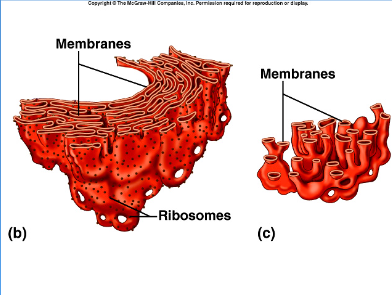
Ribosomes
Organelles are found with the ER and throughout the cytoplasm that make proteins. They contain RNA
Golgi Apparatus
Flattened sacs that package and deliver proteins within the cell.
Vesicles aid the Golgi by acting as a “Delivery service”, carrying chemicals throughout the cell
Mitochondria
Organelles that are the powerhouses of the cell and produce energy.
Very active cells contain many mitochondria

Lysosomes
Organelles act as the "garbage disposals" of the cell, getting rid of waste materials.
Microfilaments and Microtubules are..
Thin structures that serve as the skeleton of the cell.
Centrosome
Made up of two hollow cylinders called centrioles, which separate chromosomes during cellular division.
Cilia and Flagella
Extensions from the cell that aid in movement
Cilia
short hair-like projections
propel substances on cell surfaces
found lining the respiratory tract
flagella
flagella is long tail-like projections
found on and provides motility to sperm
The Cell Membrane is
selectively permeable
Mechanisms of movement across the membrane may be:
Passive, requiring no energy from the cell (diffusion, facilitated diffusion, osmosis)
Active mechanisms, requiring cellular energy (active transport)
Nucleus
Is a double-layered organelle with pores and is also “selectively permeable”
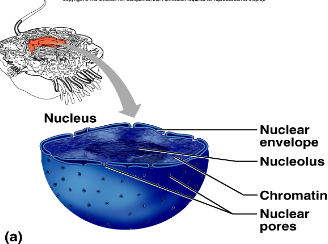
Nucleolus
A structure within the nucleus that is composed of RNA and protein and is the site of ribosome production.
Chromatin
Loosely coiled fibers of DNA within the nucleus.
Passive mechanicisms - Diffusion
The random movement of molecules from an area of high concentration to an area of low concentration.
Passive mechanicisms - Facilitated Diffusion
The movement of large molecules across the cell membrane with the help
Mechanisms of movement across the membrane may be:
passive, active, diffusion, facilitated diffusion, osmosis
passive
requiring no energy from the cell (diffusion, facilitated diffusion, osmosis)
Osmosis
– the diffusion of water
Water moves from an area of greater water concentration to an area of lower water concentration
Water moves from a low solute area to a high solute area
hypertonic
Outside cell has higher solute concentration (water leaves the cell-osmosis and shrinks the cell)
hypotonic
Higher solute inside the cell (water enters the cell via osmosis and the cell expands / bursts.)
isotonic
concentrations of solute outside and inside the cell are equal
active transport
Cell uses ATP to move molecules from areas of low concentration to areas of high concentration
Crossing the cell membrane
Examples – sugars, amino acids, Na, K, Ca, and H ions as well as nutrients in the intestines
The Cell Cycle
The series of changes a cell undergoes from the time it is formed until it reproduces
The cell cycle consists of interphase, mitosis, cytokinesis, and differentiation
The cell cycle is highly regulated – most cells do NOT divide continually
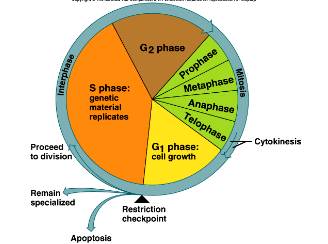
interphase
A period of growth in which the cell makes new products
The DNA of a cell is replicated in preparation for cell division
mitosis
One type of cell division, meiosis, four cells (sperm or egg) are produced, each of which contains half of the parents cell’s genetic information
Mitosis is a division of the nucleus that results in each daughter cell receiving and exact copy of the parent cells genetic information
prophase
the first stage of mitosis
DNA condenses into chromosomes
Nuclear membrane disappears
metaphase
Chromosomes align in the middle of the cell
anaphase
Chromosomes are pulled apart to opposite sides of the cell and form halves called sister chromatids
telephase
the final stage of mitosis
Begins when chromosomes have completed their migration
Nuclear membrane reappears
Chromosomes begin to unwind back into chromatin
cytokinesis
begins when the cytoplasm divides and a ring pinches the two cells apart
cell differentiation
New cells from mitosis develop into different types of cells with specialized functions
stem cell
can divide to form two new stem cells
can divide to form a stem cell and a progenitor cell
totipotent – can give rise to any cell type
pluripotent – can give rise to a restricted number of cell types
progenitor cell
committed cell
can divide to become any of a restricted number of cells
pluripotent