Week 7 Lecture 1 Adolescent Risk Taking
 Call Kai
 Learn
Learn Practice Test
 Spaced Repetition
 Match
Match Flashcards
 Knowt Play
1/11

There's no tags or description
Looks like no tags are added yet.
Name | Mastery | Learn | Test | Matching | Spaced | Call with Kai | Chat |
|---|
No analytics yet
Send a link to your students to track their progress
12 Terms
- Describe the difference between experience-based and description-based risky decisions.
When do teenagers take risks?
In real-world scenarios → Between the ages of 15 to 25, people are more likely to die, therefore, their risk-taking is higher. This difference is higher for males than females, tends to be a phenomena that has prevailed throughout the ages.
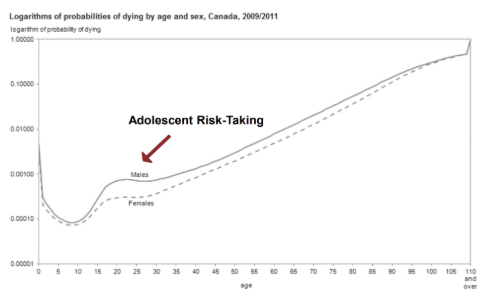
In a lab based scenario → risk-taking in the real-world has not been reflected in the lab-based studies.
What is the difference between risk taking in the lab and risk taking in the real world?
Risk taking in the laboratory often involves fully described outcomes and probabilities but Risk taking in the real world involves experience-based situations Maybe this explains why there is a difference in the risk-taking in the real-world vs. lab-based designs.
What is a risky decision from description and experience?
In lab-based tasks → if you were to explore fully described outcomes – individuals are asked to choose between
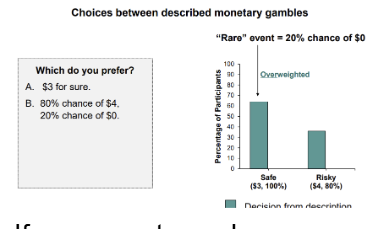
If you were to explore more experienced based risk-taking – you use a sampling paradigm. Individuals are asked to choose between Option A and B, and over time are given the experience to choose A or B.
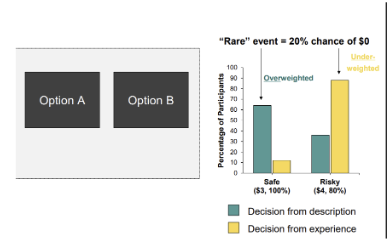
People in the experience condition will underweight the risky decision.
- Give examples of adolescent risk taking and understand under which conditions teenagers take more risks than children and adults.
Describe the study of Adolescent Choices under Risk and Uncertainty?
Had 3 x IV - Choice under Risk, Choice under Ambiguity (and Levels of Ambiguity) and Choices under Uncertainty.
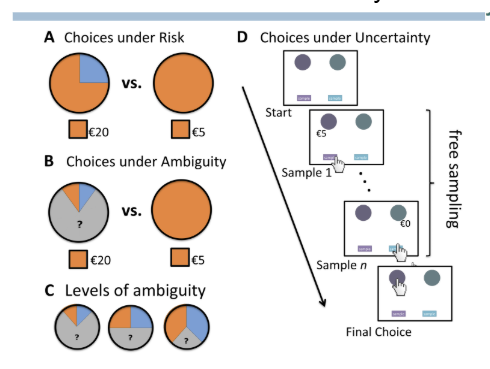
Used a wheel of fortune paradigms – wheel spins, depending on colour, individuals win or lose things. Individuals can sample the wheels for as long as they like. Found that between the ages of 13-18, individuals are ambiguity neutral - they don’t display aversive reactions to choices under risk. Found also that there is a U-shaped curve between 10-16 years teenagers are happy with less information. – that is, teenagers can take more risks despite not having that much information. (Explains real-world behaviours).
Because adolescents are more tolerant to ambiguity, and to uncertainty during decision-making, they are more likely to take more risks compared to adults, as they are more tolerant to uncertainty.
- Summarize different accounts explaining why teenagers take more risks.
Why do teenagers take risks?
Increased access to risky activities Developmental imbalance between maturation of brain responsible to cognitive control, and brain regions devoted to reward Peer Influence and Peer observation Adaption to the developmental period.
Describe increased access to risky activities as an explanation for risk-taking
Evidence from traffic-related deaths and alcohol-related hospitalisation finds there is a correlation between when the legal age is reached and when these incidents tend to increase. This supports the account that access to risky activity is an essential factor in risk-taking behaviour.
Describe developmental imbalances in brain maturation as an explanation for risk-taking?
Comparing response in the ‘hot’ version (wherein affective systems are activated) and cold version (wherein affective systems are not) of the Columbia card task finds that adolescents affective systems can override the deliberation system in states of heightened emotional arousal. In the task, individuals are told to flip cards which may be lost or gain cards
in the hot version they are told to flip sequentially, in the cold version they are told to report in advance the exact number of cards they have to turn over.
Describe peer influence and peer observation as an explanation for risk-taking?
Adolescents suffer more car accidents when driving with passengers in the car, mere observation increases risky decision-making in lab studies and real-world health and crime statistics show that crime tends to be committed in groups of peers. This indicates that increased sociality may lead to more risk-taking.
Describe risk-taking as an adaptation and affordances of developmental periods?
Uses life history theory - which argues that organisms develop behavioural strategies in responses to the harshness (rates of morality and morbidity) and unpredictability (variability in the range of possible outcomes). The theory supposes that that increased Harshness and unpredictability = more risk-taking now, compared to if Harshness and unpredictability was low. (e.g. of late and early puberty) However, this explanation does not fully explain all of risk-taking of adolescent cohort, but as an individual As a cohort , the ecological rationality approach states that this developmental period occurs as it allows for certain benefits at this period (ontogenetic adaptation), and deferred adaptation to future developmental niches.
What is deferred adaption?
Behaviors and mechanisms that have delayed benefits and adapt an organism to a future developmental niche (e.g., the adult developmental niche)
What is an Ontogenetic adaptation?
Behaviors and mechanisms that adapt an organism to its current (as opposed to its future or past) developmental niche