Hemoglobin, an Allosteric Protein
 Call Kai
 Learn
Learn Practice Test
 Spaced Repetition
 Match
Match Flashcards
 Knowt Play
1/95

There's no tags or description
Looks like no tags are added yet.
Name | Mastery | Learn | Test | Matching | Spaced | Call with Kai | Chat |
|---|
No analytics yet
Send a link to your students to track their progress
96 Terms
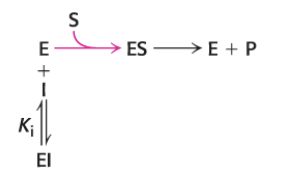
which inhibitor
competitive
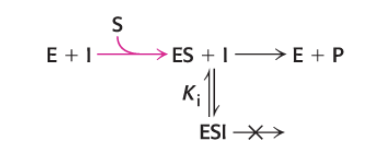
which inhibitor
uncompetitive
which inhibitor
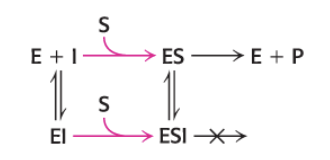
noncompetitive
which inhibitor
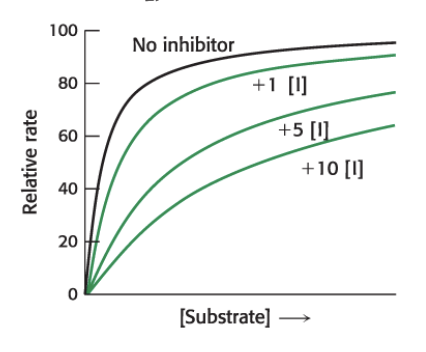
competitive
which inhibitor

uncompetitive
which inhibitor
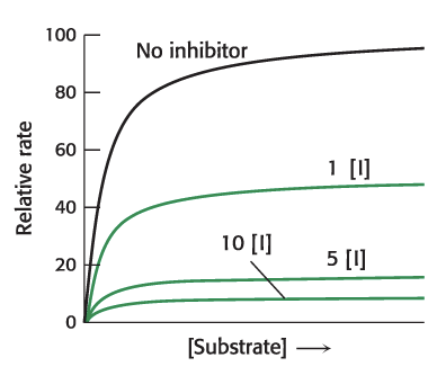
noncompetitive
which inhibitor

competitive
which inhibitor

uncompetitive
which inhibitor

noncompetitive
As aerobic organisms, all our cells require what to burn fuel (carbohydrates, fats, etc.) to generate energy to do work (just like a gasoline engine in a car)
oxygen
O2 is what soluble in aqueous solutions
poorly
erythrocytes (red blood cells) are specialized for transporting what
oxygen
hemoglobin
the oxygen-binding protein in red blood cell
hemoglobin
RBCs use what to bind oxygen in the lungs, and release it at
tissues that need it
is hemoglobin an enzyme
no
tetramer
hemoglobin is a what consisting of two α subunits (141 residues)
and two β subunits (146 residues) (two different proteins and genes)
both of hemoglobin’s subunits have a bound heme prosthetic group containing an Fe2+ what atom
iron
protoporphyrin
heme consists of a complex organic ring structure, what, with a bound Fe2+ atom
the hemoglobin tetramer is a pair of αβ dimers (which structure)
quaternary
In what, which corresponds to the T state of this allosteric protein, the αβ dimers are linked by an extensive interface
deoxyhemoglobin
allosteric protein
binding of a ligand or molecule to one site affects the binding properties of another site on the same protein
modulator/regulator
ligand that binds to an allosteric protein to induce a conformational change
modulator is a normal ligand
homotropic
modulator is not the normal ligand
heterotropic
ligand
In a multisubunit protein, a conformational change in one subunit
affects the conformation of other subunits to alter their what binding
more stable when O2 is absent
T state
higher affinity for O2 (O2 bound)
R state
deoxyhemoglobin
T state
oxyhemoglobin
R state
When one hemoglobin subunit binds oxygen, the other three subunits
shift to the which state, which allows oxygen to bind more easily
– an allosteric conformational change
R
cooperativity
Hemoglobin is an allosteric protein that displays what in oxygen binding and release
globin
hemoglobin is a member of the what protein family
globins
protein family found in animals, plants and some bacteria
globins
– highly conserved what structure: eight α-helices connected by bends
tertiary
O2
globins = protein family found in animals, plants and some bacteria
– most function in what transport or storage
muscle
Myoglobin (153 residues) is an oxygen binding protein in cardiac and skeletal what cells
heme
Like hemoglobin, myoglobin has a bound what prosthetic group, which binds oxygen. The iron in the myoglobin heme gives cooked meat its red color
monomeric
Unlike hemoglobin, myoglobin is a what protein
Hemoglobin subunits and Myoglobin are Structurally what
Similar
The binding of oxygen by hemoglobin is what
cooperative
The binding of oxygen by myoglobin is what
uncooperative
pressure
Oxygen binding is related to the partial what of oxygen (pO2)
oxygen
Partial pressure is the fraction of the mixture of gases that is due to one gas - in
this case, what. At sea level, 1 atmosphere of pressure = 760 torr. Air is 21%
oxygen, so the partial pressure of oxygen is 159 torr (kind of like gas concentration)
In where, where hemoglobin binds oxygen, the partial pressure of oxygen is
~100 tor
lungs
In where, where hemoglobin needs to deliver oxygen, the partial pressure of oxygen is ~ 20 torr – there is much less oxygen near the cells that require it for their metabolic need
tissues
curves
Hemoglobin and myoglobin have oxygen-binding what with different shapes
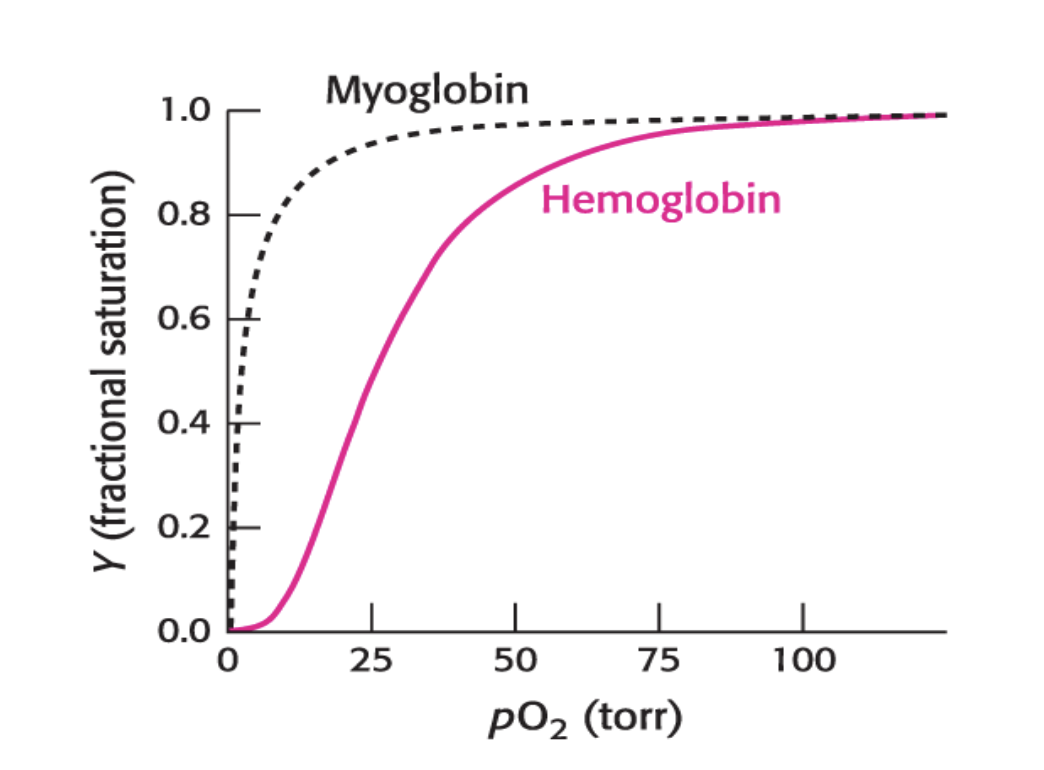
Michaelis-Menten
Myoglobin binding to oxygen follows a ‘what’ curve
allostery
Hemoglobin’s binding curve does not follow a ‘Michaelis-Menten, it indicates what at work
Although hemoglobin doesn’t bind oxygen as ‘well’ as myoglobin, it can release oxygen much what at the sites where it is needed
better
?% O2 released by hemoglobin versus ?% of O2 released by myoglobin
66, 7
The iron lies in the middle of the protoporphyrin bound to how many nitrogens
four
coordination
Besides the four nitrogen, Iron can form two additional bonds, called the fifth and sixth what sites
Which coordination site binds oxygen
sixth
iron
When the what binds oxygen, it moves slightly
protoporphyrin
Upon oxygen binding, the iron moves into the plane of the what ring
histidine
Upon oxygen binding, the iron moves into the plane of the protoporphyrin ring
This also moves what by 0.04 nm
This tiny change results in what binding of oxygen by the other subunits!
cooperative
The movement of the iron moves the histidine, the histidine is part of an what
helix, and the other end of that what helix is near the interface where all the
subunits come together
alpha
conformational
O2 binding to heme in one hemoglobin subunit in the T state triggers a what change to the R state
O2 binding to heme in one hemoglobin subunit in the T state triggers a
conformational change to the R state
The structural change is or is not communicated to the other subunits
is
The two αβ dimers rotate how many ° relative to each other; the other subunits shift into the R state. Some side chain interactions that stabilize the T state break are broken, and new ones that stabilize the R state form
15
The heme in the other what subunits is now more accessible to oxygen
b
oxygen is a what allosteric regulator
homotropic
Functional magnetic resonance can be used to monitor activity in specific regions of the brain by measuring the increase in what
oxyhemoglobin
2,3-bisphosphoglyceric acid (2,3-BPG or BPG)
a small molecule in red blood cells that plays an important role in how hemoglobin binds and delivers oxygen
BPG is a what allosteric modulation
heterotropic
BPG binds in which state to a site distant from the oxygen-binding site
T
BPG when bound, the affinity of hemoglobin for oxygen is greatly what
reduced
the molecule has two phosphate groups and the phosphates are bonded to each other
diphosphate
the molecule has two phosphate groups, not directly connected
bisphosphate
Ionic interactions with BPG stabilize which state
T
Ionic interactions with BPG stabilize the T state
- this makes it harder for what to bind oxygen
deoxyhemoglobin
Ionic interactions with BPG stabilize the T state
- this makes it easier for what with bound oxygen to release it
hemoglobin
The presence of 2,3- BPG allows hemoglobin to convert to the T state and release oxygen when the partial pressure of oxygen does what in tissues
falls
myoglobin
Hemoglobin in the absence of 2,3-BPG behaves like what!
lowered oxygenation of peripheral tissues because hemoglobin binds oxygen less wel
hypoxia

black line
oxygen-binding curve of hemoglobin with no BPG

blue line
oxygen-binding curve of hemoglobin at sea level
over time at high altitudes, BPG levels in the blood what
increases
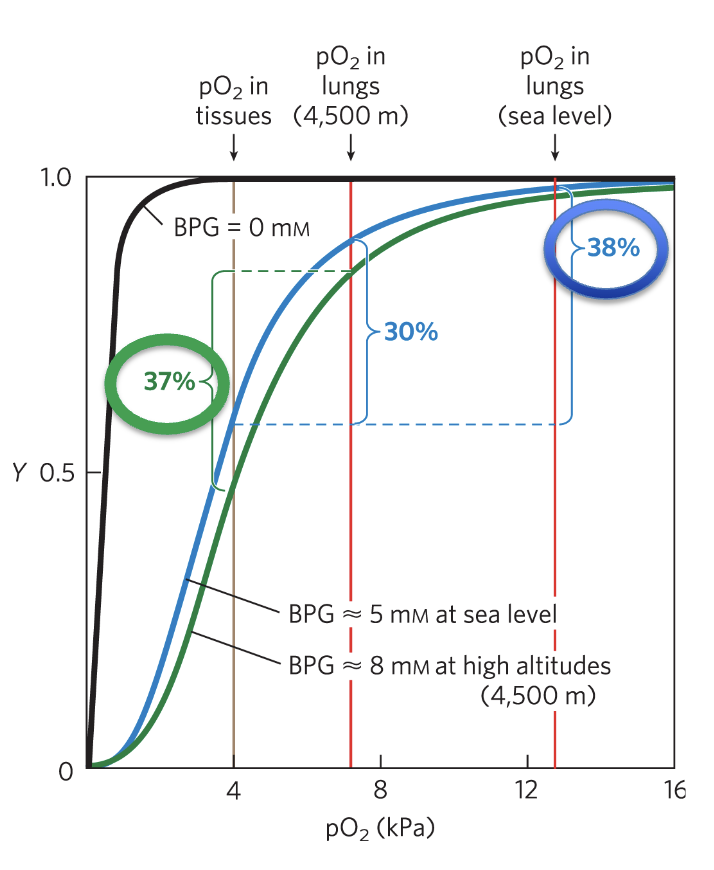
oxygen-binding curve of hemoglobin with the increased amount of BPG in the blood
green line
Carbon dioxide
What produced by actively respiring cells is taken up by red blood cells
bicarbonate
Carbonic anhydrase in RBCs converts CO2 and water to what and H+
lungs
The bicarbonate is carried to the what in the blood plasma. This is the major way that CO2 is transported to the what to be exhaled
hemoglobin
Carbon dioxide and H+, produced by actively respiring tissues, helps enhance the release of oxygen by what in those tissues
Bohr
The stimulation of oxygen release by carbon dioxide and H+ is called the what effect and has two components
The H+ from actively respiring cells change the local pH from 7.4 to what.
7.2
Lower pH allows the formation of new ionic interactions that stabilize which state
T
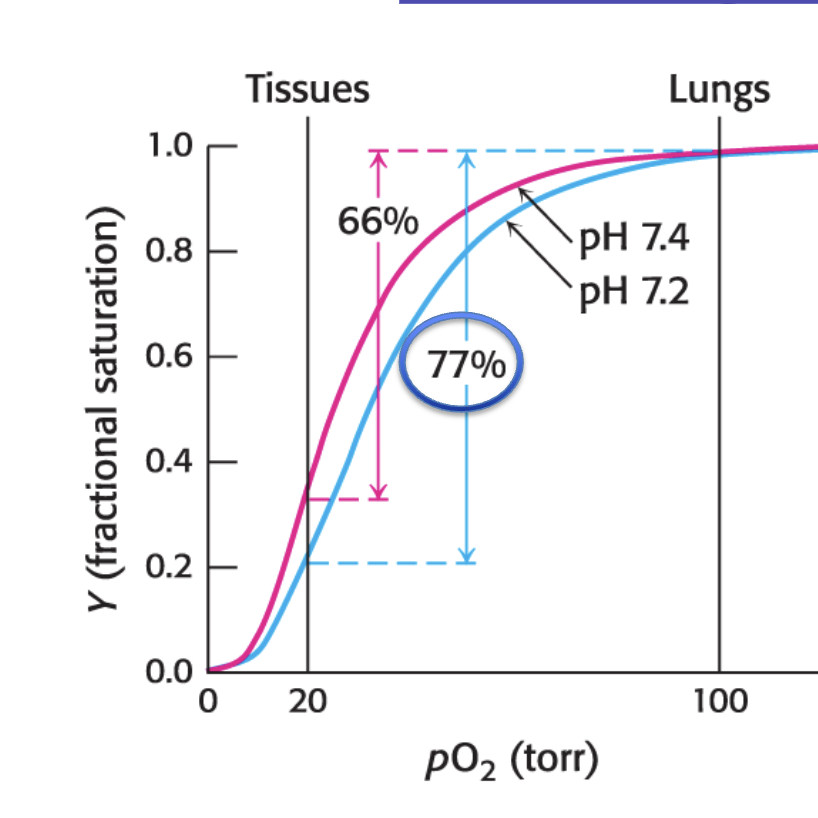
the change in pH (from 7.4 to 7.2) due to H+ from actively respiring cells shifts the binding curve of hemoglobin even more to the right
blue curve
Even more O2 is given up at tissues when they are
very active! (gets us to ?% released)
77
Carbon dioxide released by respiring cells reacts with the amino groups of
the hemoglobin chains to form what charged carbamate groups
negatively
T
These carbamate groups also stabilize which state
The stabilization of the T state caused by carbon dioxide from actively respiring cells shifts the binding curve of hemoglobin even more to the what

right
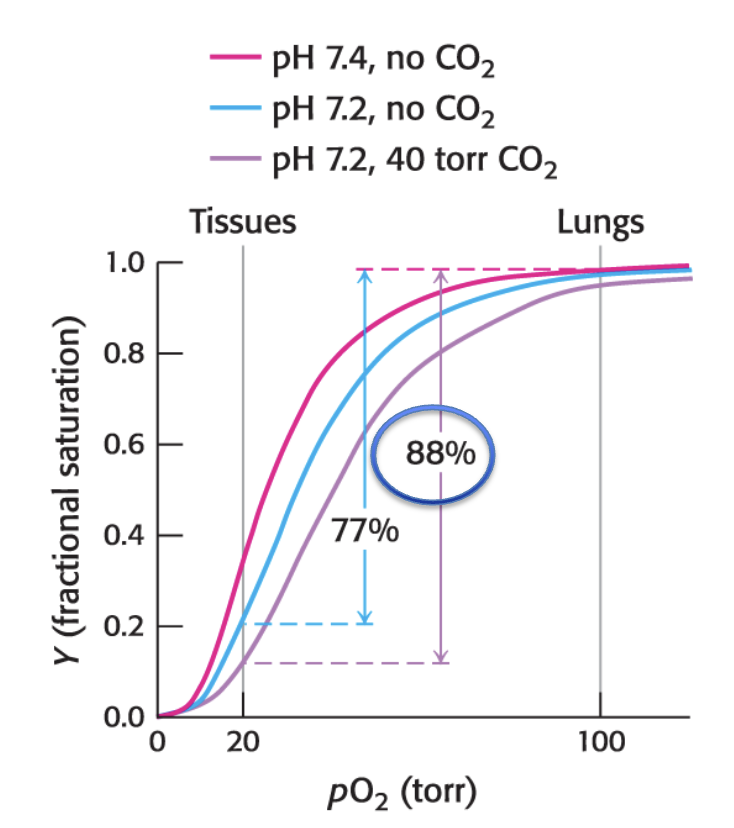
the full Bohr effect (CO2 and H+ effects) results in hemoglobin releasing almost 90% of its bound O2 at actively respiring tissues
purple curve
Carbon dioxide and H+ are which allosteric regulators of hemoglobin
heterotropic
carbon monoxide (CO) binds hemoglobin how many times better than O2
250
CO is a what inhibitor of hemoglobin
competitive