Lecture Quiz 1-4.1 BIOLOGY 006
 Call Kai
 Learn
Learn Practice Test
 Spaced Repetition
 Match
Match Flashcards
 Knowt Play
1/50

Earn XP
Description and Tags
Last Material on MT 1 is Cell structure and Function Lecture 5
Name | Mastery | Learn | Test | Matching | Spaced | Call with Kai |
|---|
No analytics yet
Send a link to your students to track their progress
51 Terms
What does it mean to say that something is alive?
Cellular Organization: All living things are composed of one or more cells, which are the basic units of life.
Metabolism: Living things take in and use energy to survive, grow, and repair themselves.
Homeostasis: They have the ability to maintain a stable internal environment (like regulating temperature) despite outside changes.
Reproduction & Heredity: Living things can produce offspring and pass on their genetic traits (like DNA) to the next generation.
Response to Stimuli: They can sense and react to environmental changes (such as plants bending toward the sun).
Growth & Development: They increase in size and change in form or complexity over their lifespan.
SPONCH Atoms that make up life
Sulfur, Phosphorus, Oxygen, Nitrogen, Carbon, Hydrogen,
Hydrogen most abundant then Oxygen
The Hierarchical Organization of Life
Atoms, Small molecules, Large molecules [Proteins, Lipids, Carbs, Nucleic Acids]
Cells, Tissues, Organs, Organ systems
Organisms Population, Community, Landscapes, Biosphere
Why are lipids different?
they are not true polymers and they are highly hydrophobic (water-insoluble)
Prokaryotes Vs Eukaryotic
Prokaryotes: Smaller and Simpler, Includes bacteria, No nucleus, Membrane
Eukaryotic: Much complex and larger,
At what level of organization do all the properties of life emerge?
Cells is more than the sum of its parts
Structure determines
3D Shape, and chem properties, Fxn
DNA Basis of Inheritance
ACTG nucleic bases
DNA TRANSCRIPED into mRNA that is TRANSLATED to chain of amino acids PROTEIN FOLDING into protein
Sexual reproduction involves the union of gametes
Seen in the Kingodms:
• Animalia
• Plantae
• Fungi
Classifying the Diversity of Life
Each species is given a two-part name: The genus, to which the species belongs, and a species name unique to that species
• E.g., Homo sapiens, the name of our species
Where does this diversity come from?
Evolution – populations change over time
Domains
Bacteria, Archaea, Eukarya
Eukarya evolved from Archaea: Includes Kingdom, Plantae, Fungi, Animalia, Protists
Science: way of knowing, based on inquiry.
two key features that distinguish it from other forms of inquiry.
– depends on observations and measurements that others can verify
– requires that ideas (hypotheses) are testable by experiments that others can repeat.
• Science seeks natural causes for natural phenomena.
– This limits the scope of science to the study of structures and processes that we can observe and measure directly or indirectly.
There are two main scientific approaches
Discovery science is mostly about describing nature. Verifiable observations and measurements are the data
Hypothesis-driven science is mostly about explaining nature. Uses a process of inquiry called the scientific method. A hypothesis is a tentative answer to a question or proposed explanation for a specific phenomenon that has been observed.
– It must be testable
– It must be falsifiable
Theory
– A proposed explanation (why) for a wide range of observations & experimental results (broad explanatory power)
– supported by a large body of evidence from different areas of inquiry
• A hypothesis needs to be tested whereas a theory has been tested and is supported by evidence
• A hypothesis is usually more specific than a theory
• e.g. Theory of Evolution, Germ Theory, Cell Theory, Theory of Relativity
Law
– A scientific law is a description of a natural relationship or principle, (often expressed in mathematical terms) with no known exceptions.
– Describes how things are, not an explanation of “why”
For example:
– Second Law of Thermodynamics
– Law of Gravity
– Newton’s Law of Motion (F=ma)
The Scientific Method + Example
• Observe: The remote doesn’t work.
• Define the problem. What’s wrong?
• Create a good working hypothesis.: The batteries are dead.
• Design an experiment to test your hypothesis.
• Predict the outcome of your experiment.: With new batteries, it will work.
• Test your hypothesis (run the experiment).: Replace Batteries
• Examine the results and draw conclusion. Evaluate and re-work hypothesis if necessary
HYPOTHESIS CAN ONLY BE SUPPORTED OR DISPROVEN
Independent Variable: IV
single factor that varies in an experiment
“Whether or not one takes a VD supplement”
MANIPULATED BY SCIENTIST
ONLY ONE IN AN EXPERIEMENT TO DETERMINE HOW IT AFFECTED DV
Standardized Variable SV
all other factors that remain constant
“age, gender, location, stress level, etc.”
Dependent Variables DV
Outcome being measured or recorded
“Occurrence of Colds”
Control
A test in which IV is set to zero or some default value: Leave out IV “no VD”, if cannot set to default
NEGATIVE CONTROL
Positive Control
appropriate for some experiments, a known positive result
Identification of Atom: + cation, - anion [atoms with charge]
Atomic Mass: Top of Label, # of protons tell what element is
Atomic Mass: Half protons and Half Neutrons
Electrons would be equal to protons
How to change the mass? # of Neutrons, changing protons would result in a diff element
Isotope: unstable, same element, different mass
Structural isomers have different covalent arrangements of their atoms
Orbitals
First Shell: 2 Electrons
Second Shell: 8 Electrons→ MUST EVEN OUT AND FILL UP FIRST SHELLS
Third Shell: 18 Electrons Maximum, Stable if has 8 electrons
OUTER SHELL IS VALENCE SHIELD
Chemical bond
an attractive force that links two atoms together in a molecule.
Ionic bond: An electrical attraction between ions bearing opposite charges.
• Form as the result of an atom giving up one or more electrons to another atom.
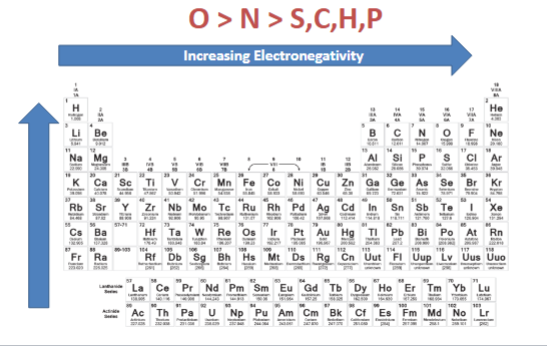
• Tends to happen between atoms with very large difference in electronegativities.
• Covalent bond: Polar and Non Polar
• Hydrogen bond Not really a bond! It’s a weak interaction.
Atoms “want” [WHEN ATOMS ARE MOST STABLE]
to have electrons in pairs,
- to have their outer (valence) shells filled,
- and to be (close to) electrically balanced.
• How can an atom accomplish this? Interactions with other atoms!
• Remember the octet rule? an atom will lose, gain, or share electrons in order to achieve a stable configuration of eight electrons in its outermost (valence) shell.
• How all this goes down is related to the electronegativity of the atoms involved.
Electronegativity
• The tendency of an atom to attract electrons when it occurs as part of a
compound
Nonpolar Covalent Bonds
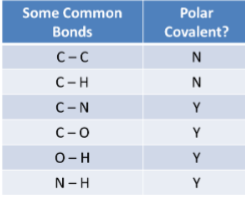
Form as a result of the relatively equal sharing of one or more pairs of electrons.
• Can be single, double or triple bonds. (How many electrons in each of these?)
• Happens when the elements in a bond have similar electronegativities.
• Very strong/stable at the conditions found in biological systems.
Polar Covalent bonds
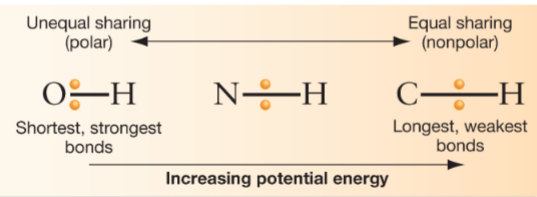
Covalent bond in which electrons are unequally shared.
• Happens when one element in the bond has a stronger electronegativity than the other (but not so strong to as to “steal” the electron away completely!)
• Results in unequal distribution of electrons, and thus, charge.
Chemical Energy
A molecule’s potential to form stronger bonds is type of potential energy called
chemical energy
The basic arrangement of covalent bonds and electron pairs around CARBON, OXYGEN, NITROGEN and many other atoms is a tetrahedron due to repulsive forces between electrons. This basic geometric arrangement is altered with double or triple bonds.
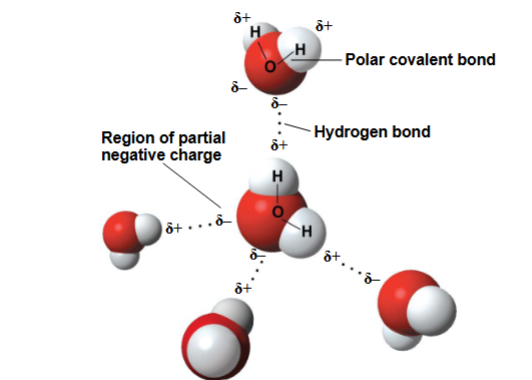
Water (H 2O) is planar and bent because of two unshared electron pairs
As a consequence, water is polar – it carries a partial positive charge on one side and a partial negative charge on the other.
Hydrogen Bond
A weak electrostatic attraction between partial positive (δ+) H and a partial negative (δ-) atom (typically O or N).
Properties of Water: Polar dissolves in water, hydrophobic clusters up in it
Solvent - liquid in which other molecules dissolve
• Primary environment in which biological systems exist.
• High specific heat – amount of energy required to raise the temperature of 1 gram of a substance by 1 o C.→ Important for moderating temperature.
• High heat of vaporization - The energy that must be supplied to convert a molecule from a liquid to a gas at its boiling point.
• Means that evaporation leads to cooling. Think sweating = cooling.
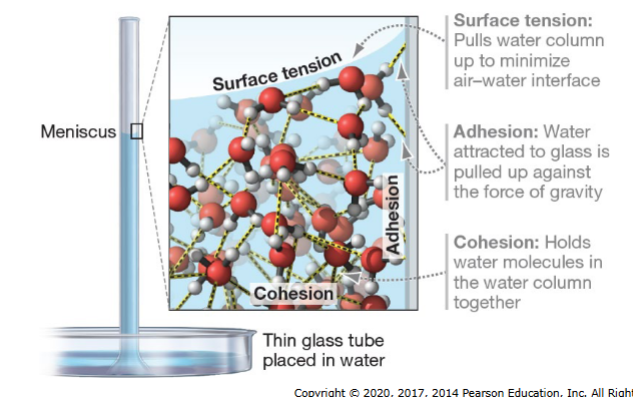
• Cohesion - The tendency of molecules (or any substances) to stick together.
• Adhesion - Binding of one substance or structure to another.→ Important for movement of water up the roots and into the leaves of tall plants.
• Surface tension - The attractive intermolecular forces at the surface of liquid._> Ice is less dense than liquid water – consequently, ice floats
The significance of polar covalent bonds
• Polar molecules tend to be hydrophilic. Polar molecules want to maximize their interactions with themselves
• Nonpolar molecules are called hydrophobic because they tend to aggregate with other nonpolar molecules. They are excluded from the hydrophilic substances
Figure 35.9 Water Can Rise via Capillary Action
Surface tension: pulls water column up to minimize air-water interface
Adhesion: water attracted to glass is pulled up against the force of gravity
Cohesion: Holds water molecules in the water column together
Dissociation of Water Molecules
By convention, the hydronium ion is represented as a hydrogen ion (H+):
In pure water there will be equal concentrations of these two ions making it a neutral solution, though water is rarely pure.
Acids and Bases
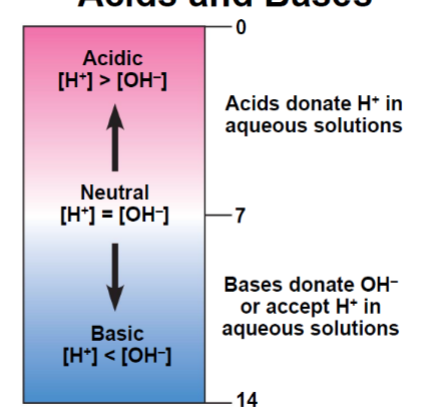
pH
• A measurement of how acidic or basic something is.
pH = -log [H + ]
pH 7 = 10 -7 H + M
• Each pH unit reflects a 10-fold difference in H + concentration (short hand notation: [H + ] )
• Lower pH = higher [H + ] (and vice versa)
pH 3 = 10-3 M = 0.001 M [H + ]
pH 9 = 10 -9 M = 0.000000001 M [H+ ]
Weak acids and bases common in biology (reversible)
carboxyl group (—COOH) = acid
—COOH → —COO– + H +
• amino group (—NH 2) = base
—NH 2 + H + → —(NH3)+
• Buffers allow solutions to resist pH change. E.g. bicarbonate buffering in the blood
Organic molecules contain C & H:
methane (CH 4 ), glucose (C 6 H 12 O6 ) are organic
• water (H 2 O), carbon dioxide (CO 2 ) are inorganic
• organic molecules are typically derived from living things, hence the term “organic
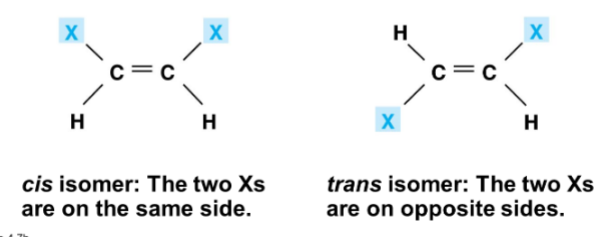
Cis-trans isomers have the same covalent bonds but differ in their spatial arrangements
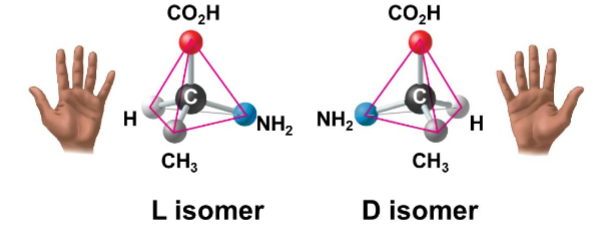
Enantiomers
isomers that are mirror images of each other
• Asymmetric carbons are connected to 4 different atoms or groups and have 2
possible arrangements (aka. Chirality)
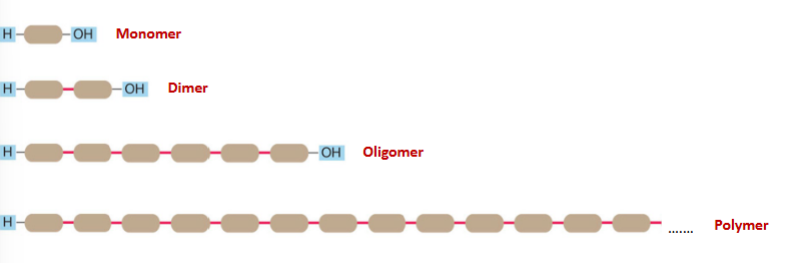
Polymers
A large molecule made up of similar or identical subunits called monomers
Monomer - A small molecule, two or more of which can be combined to form oligomers (consisting of a few monomers) or polymers (consisting of many monomers).
linked by dehydration or polmerization
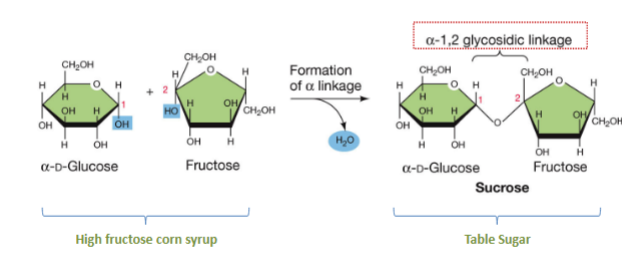
Glycosidic Linkage:
covalent bond that joins a carbohydrate (sugar) molecule to another group
Glycosidic bonds between monomers can vary by
1) which carbons they link (allowing branching!) and
2) orientation of the bond.
These create FUNCTIONAL DIFFERENCES.
Fructose is sweeter than Glucose. Why? Tastes sweet because of diff structure since binds to sweet receptors on tastesbuds
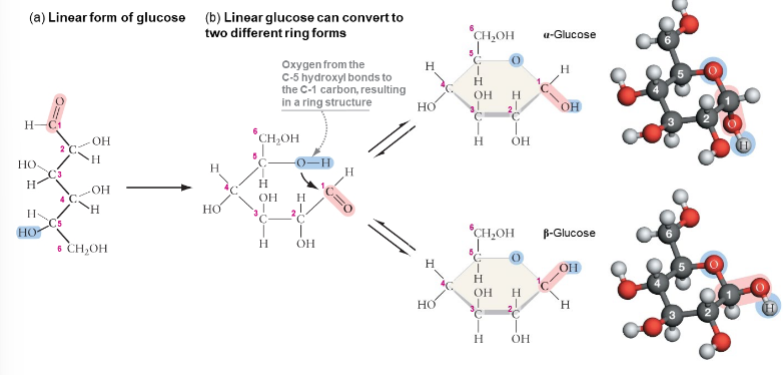
Carbohydrates – Monomers
a-Glucose: AIMS DOWN
b-Glucose: AIMS UP
RNA RIbose: Has OH on C2
DNA Deoxyribose: Has H on C2
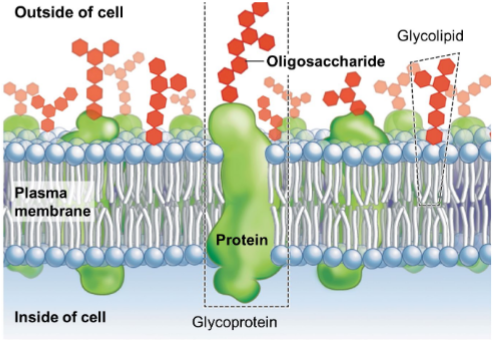
Oligosaccharides
Covalently linked to proteins (glycoproteins), lipids (glycolipids) on the outer surface of cells as a recognition signal (think varying flags) to identify specific cells
• E.g. ABO blood groups
Polysaccharides – Cellulose
Cellulose is an unbranched polymer of β-glucose. Each β-glucose monomer is upside down with respect to its neighbor, resulting in:
• A linear molecule
• Hydrogen bonding between adjacent, parallel strands of cellulose
This is why cellulose serves as a strong, structural support in the cell walls of plants and algae.
B-1,4 Linkages make rigid structure
Polysaccharides – Starch and Glycogen
Starch and glycogen are polymers of α-glucose.
Branching in glycogen provides more points for enzymes to break it down when glucose is needed.
α-1,4 linkage with α-1,6 linkage causing branching
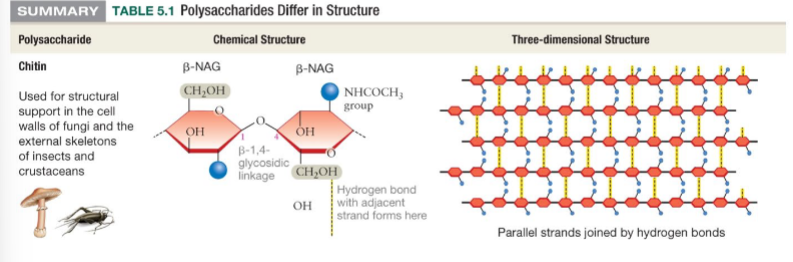
Polysaccharides – Chitin
Chitin is a polymer of N-acetyleglucosamine (NAG), a modified monosaccharide
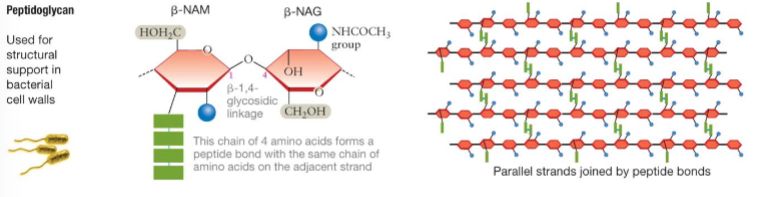
Polysaccharides – Peptidoglycan
Peptidoglycan is a polymer of N-acetyleglucosamine (NAG) and N-acetylmuramic acid (NAM) (modified monosaccharides).
Other Modified Carbohydrates
• Phosphorylated sugars (sugars with one or more phosphate groups attached)
– Metabolic intermediates
• Glucosamine
– Extracellular matrix in animals
– Cartilage
Starch and glycogen are easily hydrolyzed because they have α-glycosidic linkages
• Glycogen is hydrolyzed by the enzyme phosphorylase
• Many animal cells contain phosphorylase
• They can break down glycogen to provide glucose
• Starch is hydrolyzed by amylase enzymes:
• Amylases play a key role in carbohydrate digestion