WHB Final: French Revolution/Napoleon: Causes and Impact v26
 Call Kai
 Learn
Learn Practice Test
 Spaced Repetition
 Match
Match Flashcards
1/14

There's no tags or description
Looks like no tags are added yet.
Name | Mastery | Learn | Test | Matching | Spaced | Call with Kai | Chat |
|---|
No analytics yet
Send a link to your students to track their progress
15 Terms
In the late 1700s, which situation in France is considered a cause of the other three?
unfair policies of taxation
Which statement best describes the rigid social structure of the Three Estates in pre-revolutionary France?
The First Estate (Clergy) and Second Estate (Nobility) held nearly all political power and were largely exempt from taxes, while the Third Estate (everyone else) paid most of the taxes.
In 1789, the delegates to the Estates-General that broke away and declared themselves to be the National Assembly were from the
Third Estate.
Members of the Third Estate in the French National Assembly swore the Tennis Court Oath, which was a
vow to continue to meet unitl they had produced a new French Constitution
The document that is most closely identified with the French Revolution is the
Declaration of the Rights of Man
Which issue was a cause of the French Revolution?
demand of the Third Estate for more political power.
… We must ask ourselves three questions.
1. What is the Third Estate? Everything.
2. What has it been until now in the political
order? Nothing.
3. What does it want to be? Something. …
— Abbé Sieyès, 1789 (adapted)
Based on this passage, what did the Third Estate want?
more influence in the political system
What statement best summarizes how the convergence of national debt, poor harvests, and social inequality collectively triggered the outbreak of the French Revolution?
The economic burden of national debt and poor harvests fell disproportionately on the tax-paying Third Estate, whose pre-existing social grievances were compounded to create an environment ripe for mass political uprising.
Maxmilien Robespierre and the Jacobins are best known for
instituting the Reign of Terror
Robespierre believed that France could achieve a “republic of virtue” only through
the use of terror.
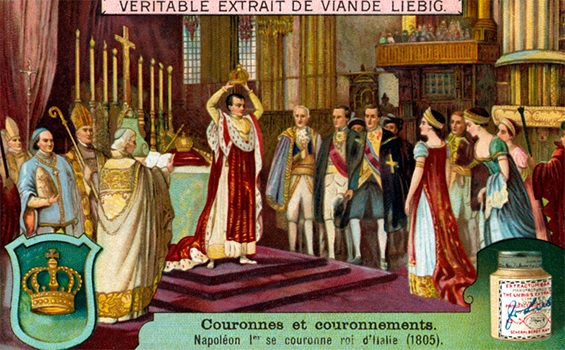
What is significant about the the event of Napoleon’s coronation as pictured here?
Napoleon is asserting he is the source of his own authority.
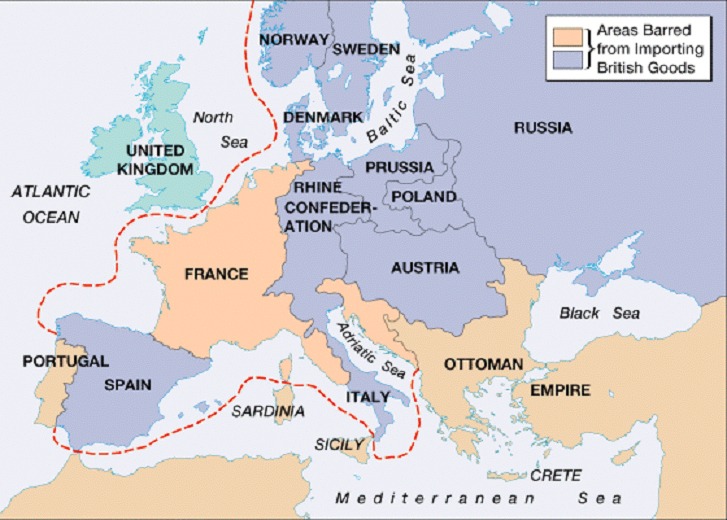
Analyzing the map of the "Continental System" , what was the primary goal of this policy, and why did it ultimately contribute to Napoleon's downfall?
It was an economic blockade designed to isolate and weaken Great Britain, but it failed because of smuggling and a strong British navy.
Napoleon's establishment of the Napoleonic Code (or Civil Code) in 1804 primarily served which social purpose in France?
It unified France's complex legal system, securing basic rights like equality before the law and protecting private property.
In analyzing the long-term impact of the Napoleonic Wars on the European political order, which statement provides the strongest synthesis of his overall effect?
His actions inadvertently spread Enlightenment and revolutionary ideas, fostering a rise in nationalism and demands for political reform across Europe.
What legacy did Napoleon leave throughout Europe?
Conquered countries kept many of the changes Napoleon introduced through the Napoleonic Code.