Biochem Midterm 4
 Call Kai
 Learn
Learn Practice Test
 Spaced Repetition
 Match
Match Flashcards
 Knowt Play
1/83

There's no tags or description
Looks like no tags are added yet.
Name | Mastery | Learn | Test | Matching | Spaced | Call with Kai | Chat |
|---|
No analytics yet
Send a link to your students to track their progress
84 Terms
Electrons with high transfer potential are captured by the pyruvate dehydrogenase complex in the form of:
A) ATP
B) acetyllipoamide
C) NADH
D) acetyl CoA
NADH
Which enzyme is a link between the citric acid cycle and oxidative phosphorylation?
A) isocitrate dehydrogenase
B) malate dehydrogenase
C) succinate dehydrogenase
D) succinate thiokinase
E) citrate synthase
succinate dehydrogenase
What product is formed after oxidative decarboxylation of pyruvate in the mitochondrial matrix?
A) acetyllipoamide
B) glucose
C) acetyl CoA
D) oxaloacetate
E) citrate
acetyl CoA
What enzyme can produce GTP from GDP by substrate-level phosphorylation in the Kreb’s cycle?
A) citrate synthase
B) α-ketoglutarate dehydrogenase complex
C) malate dehydrogenase
D) aconitase
E) succinyl CoA synthetase
succinyl CoA synthetase
In what sub-cellular region of the eukaryotic cell is oxidative phosphorylation carried out?
A) plasmatic membrane
B) outer mitochondrial membrane
C) inner mitochondrial membrane
D) mitochondrial matrix
E) cytoplasm
inner mitochondrial membrane
Consider your knowledge of oxidative phosphorylation. All of the following are potential names for the enzyme complex that carries the synthesis of ATP in eukaryotes, EXCEPT:
A) ATP synthase
B) F1F0 ATPase
C) mitochondrial ATPase
D) cytoplasmic ATPase
cytoplasmic ATPase
Cytochromes are:
A) lipid-soluble electron carriers
B) proteins that pump ATP and contain iron-sulfur clusters
C) electron-transferring proteins that contain heme as a prosthetic group
D) proteins that convert hydrogen peroxide into oxygen and water
E) transmembrane proteins that carry specific ions and charged metabolites across the inner mitochondrial membrane
electron-transferring proteins that contain heme as a prosthetic group
When glyceraldehyde 3-phosphate is converted to 1,3 biphosphoglycerate by the enzyme glyceraldehyde 3-phosphate dehydrogenase, which electron carrier is reduced?
A) NAD+
B) NADH
C) FAD
D) FADH
NAD+
Which enzyme in glycolysis requires ATP as a substrate?
A) phosphoglycerate kinase
B) aldolase
C) hexokinase
D) pyruvate kinase
hexokinase
Which complex in the electron transport chain converts to O2 to H2O?
A) Complex I, also known as NADH dehydrogenase
B) Complex IV, commonly known as cytochrome c oxidase
C) Complex II, also referred to as succinate dehydrogenase
D) Complex III, recognized as cytochrome bc1 complex
Complex IV, commonly known as cytochrome c oxidase
The chemiosmotic hypothesis, proposed by Peter Mitchell in 1961, revolutionized our understanding of how ATP is synthesized in cells during oxidative phosphorylation, challenged conventional wisdom by proposing:
A) ATP synthesis is independent of membrane potential
B) ATP synthesis is solely driven by the electron transport chain
C) ATP is synthesized through the coupling of proton flow and electrochemical potential across a membrane
D) ATP synthesis is a passive process regulated by cellular demand
ATP is synthesized through the coupling of proton flow and electrochemical potential across a membrane
Which of the following is a function of ubiquinone (coenzyme Q) in oxidative phosphorylation?
A) acts as a proton pump
B) forms part of Complex I
C) acts as the final electron acceptor
D) transfers electrons among Complexes I, II and III
E) directly transfers electrons to cytochrome c
transfers electrons among Complexes I, II and III
What is the primary function of cytochrome c in the electron transport chain during oxidative phosphorylation?
A) acts as a proton pump
B) accepts electrons from Complex II
C) donates electrons to Complex I
D) transfers electrons between Complexes III and IV
transfers electrons between Complexes III and IV
Which of the following molecules more directly contributes to the generation of the proton gradient across the inner mitochondrial membrane during oxidative phosphorylation?
A) oxygen
B) H2O
C) ATP
D) NADH
NADH
Coenzyme Q is involved in electron transport
A) directly to O2
B) as a lipid-soluble electron carrier
C) as a lipid-soluble proton pump
D) as a water-soluble electron carrier
E) as a water-soluble electron carrier
as a lipid-soluble electron carrier
During the electron transport chain, protons are pumped out of the matrix of the mitochondria at all major sites, except:
A) Complex IV
B) Complex III
C) Complex II
D) Complex I
Complex II
In the glycolytic pathway (glycolysis), the breakdown of one molecule of glucose to pyruvate (pyruvic acid) results in a net gain of _____ ATP.
A) 2
B) 6
C) 28
D) 3
E) 14
2
Which of the following statements is true regarding glycolysis?
A) Glycolysis produces ATP through oxidative phosphorylation
B) Glycolysis can occur without the presence of oxygen
C) Glycolysis occurs in the mitochondria
D) Glycolysis is only active in eukaryotic cells
E) Glycolysis is an aerobic process that requires oxygen
Glycolysis can occur without the presence of oxygen
What is the net production of ATP, pyruvate, and NADH when one molecule of glucose undergoes glycolysis?
A) 4 ATP, 2 NADH, and 4 pyruvate
B) 2 ATP, 1 NADH, and 1 pyruvate
C) 2 ATP, 2 NADH, and 2 pyruvate
D) 4 ATP, 1 NADH, and 2 pyruvate
2 ATP, 2 NADH, and 2 pyruvate
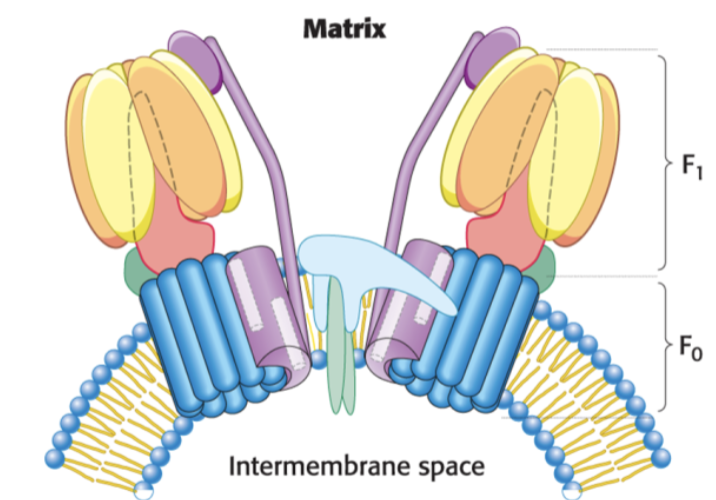
What is the relationship between the proton concentration and the relative acidity on either side of the mitochondrial membrane, and how does this relate to the function of the F0 and F1 portions of the ATP synthase?
A) The proton concentration is higher on the matrix side, creating a more acidic environment, and facilitating chemiosmosis and ATP synthesis by F1
B) The proton concentration is higher on the intermembrane space side, creating a less acidic environment, facilitating ATP synthesis by F1
C) The proton concentration is higher on the matrix side, creating a less acidic environment, facilitating ATP synthesis by F0.
D) The proton concentration is higher on the intermembrane side, creating a more acidic environment, and facilitating chemiosmosis and ATP synthesis by F1
E) The proton concentration is balanced on both sides, leading to an equally acidic environment, facilitating ATP synthesis by both F0 and F1
The proton concentration is higher on the intermembrane side, creating a more acidic environment, and facilitating chemiosmosis and ATP synthesis by F1
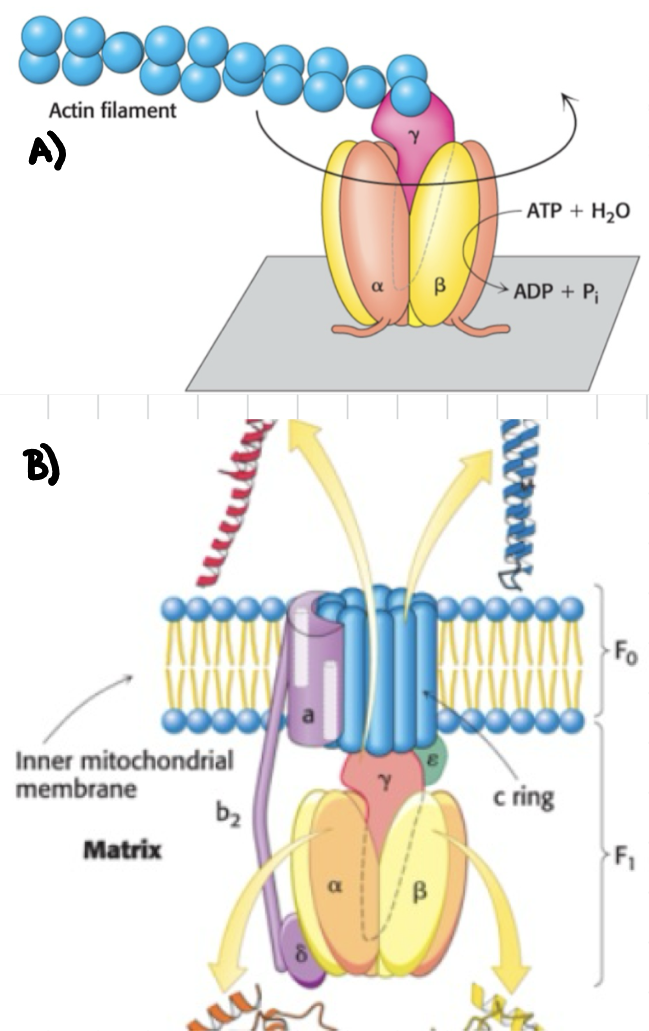
Please review the figures below. Which combination of subunits of the ATP synthase rotates?
A) Alpha and Beta subunits
B) Beta and Epsilon subunits
C) Gamma and Epsilon subunits
D) Alpha and Delta subunits
Gamma and Epsilon subunits
Which enzyme catalyzes the conversion of succinate to fumarate in the citric acid cycle and generates FADH2
A) ATPase
B) succinate dehydrogenase
C) malate dehydrogenase
D) isocitrate dehydrogenase
E) citrate synthase
succinate dehydrogenase
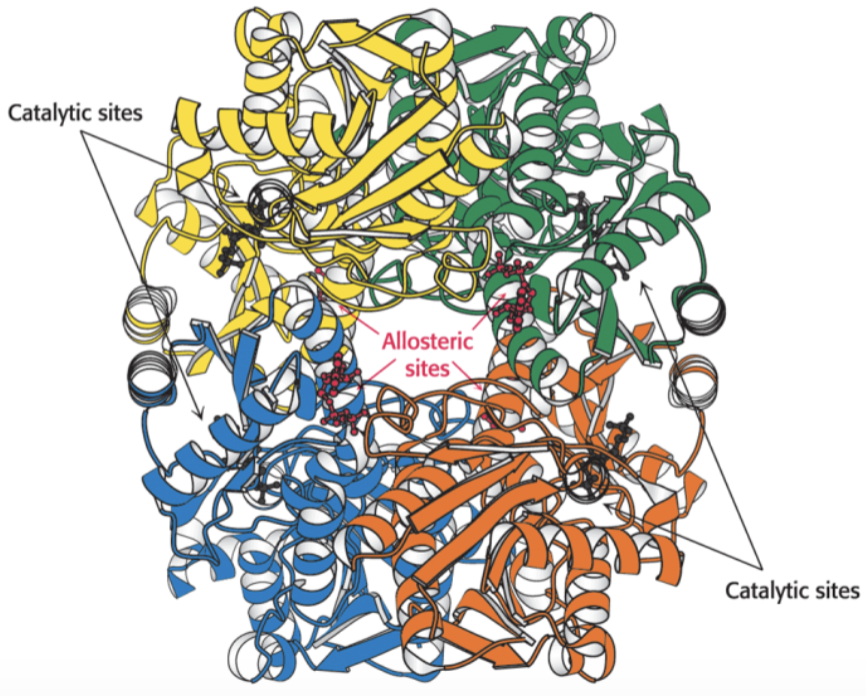
Which of the following accurately describes the role of ATP in the regulation of glycolysis via phosphofructokinase (PFK)?
A) ATP binds to an allosteric site on PFK to inhibit its activity
B) ATP competes with ADP to activate PFK
C) ATP enhances the catalytic activity of PFK
D) ATP acts as a positive regulator of PFK
ATP binds to an allosteric site on PFK to inhibit its activity
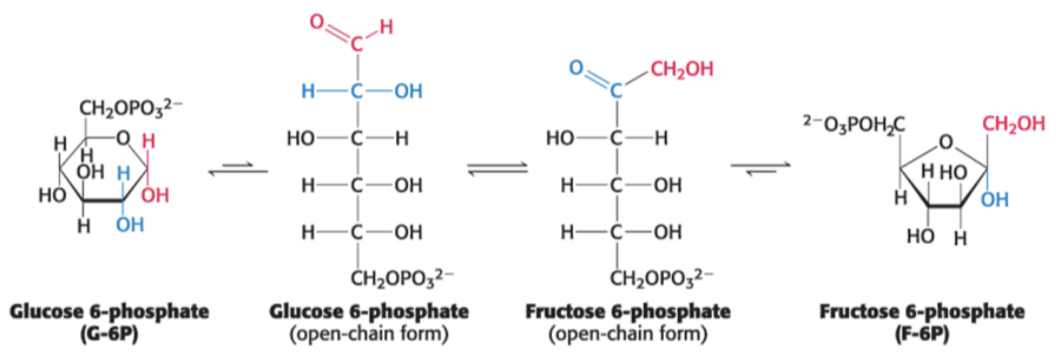
The enzyme that catalyzes this reaction in glycolysis is:
A) pyruvate kinase
B) enolase
C) glyceraldehyde 3-phosphate dehydrogenase
D) succinyl CoA synthetase
E) phosphoglucose isomerase
phosphoglucose isomerase
How many steps are there in the Krebs cycle and glycolysis, respectively?
A) Krebs cycle: 8 steps, Glycolysis: 10 steps
B) Krebs cycle: 6 steps, Glycolysis: 10 steps
C) Krebs cycle: 10 steps, Glycolysis: 8 steps
D) Krebs cycle: 10 steps, Glycolysis: 6 steps
E) Krebs cycle: 8 steps, Glycolysis: 8 steps
Krebs cycle: 8 steps, Glycolysis: 10 steps
Which stage of glycolysis involves the phosphorylation of fructose-6-phosphate to fructose-1,6-bisphosphate?
A) Stage 1 and 2
B) Stage 2
C) Stage 2 and 3
D) Stage 1
E) Stage 1 and 4
Stage 1
The mitochondrial inner membrane separates two main sides: the N-side (negatively charged) and the P-side (positively charged). Which of the following best describes the N-side?
A) It is the side facing the mitochondrial matrix
B) It contains enzymes involved in the glycolysis
C) It is positively charged due to the accumulation of protons
D) It is the side facing the mitochondrial intermembrane space
E) It is negatively charged due to the accumulation of protons
It is the side facing the mitochondrial matrix
What effect does the flow of protons cause in the conformation and release of ATP by ATP synthase?
A) Rotation of the ATP synthase rotor, inducing conformational changes that facilitate ATP release from the catalytic site
B) Activation of ATP hydrolysis within the ATP synthase complex, releasing ATP from the catalytic site
C) Inhibition of ATP synthesis by blocking the flow of electrons through the electron transport chain
D) Disruption of the proton gradient, leading to ATP hydrolysis instead of ATP synthesis
Rotation of the ATP synthase rotor, inducing conformational changes that facilitate ATP release from the catalytic site
Which of the following enzymes involved in the first step of glycolysis?
A) Hexokinase
B) Pyruvate kinase
C) Phosphofructokinase
D) Aldolase
Hexokinase
Which enzyme catalyzes the first step of the citric acid cycle, where acetyl-CoA combines with oxaloacetate to form citrate?
A) Citrate synthase
B) Succinyl-CoA synthetase
C) Aconitase
D) Isocitrate dehydrogenase
Citrate synthase
Which molecules from the citric acid cycle proceed into oxidative phosphorylation?
A) Acetyl CoA & Citrate
B) NADH & FADH2
C) Pyruvate & Oxaloacetate
D) ATP & GTP
NADH & FADH2
Which molecule is the final electron acceptor in the electron transport chain?
A) FAD
B) Ubiquinone (coenzyme Q)
C) NAD+
D) Oxygen (O2)
Oxygen (O2)
Which of the following complexes DON’T contribute to pumping protons into the mitochondrial intermembrane?
A) Succinate reductase (complex II)
B) Cytochrome c oxidoreductase (complex III)
C) Cytochrome c oxidase (complex IV)
D) NADH dehydrogenase (complex I)
succinate reductase (complex III)
Which of the following is false about oxidative phosphorylation?
A) The concentration gradient of the protons causes electrons to move from the matrix into the intermembrane
B) The shape of the cristae causes increased surface area allowing for many electron transport chains to take place
C) Q10 is membrane soluble and transports from complex I and complex III to complex III
Q10 is membrane soluble and transports from complex I and complex III to complex III
What is the starting molecule for the Krebs Cycle?
A) Pyruvate
B) Acetyl-CoA
C) Lactate
D) Glucose
Acetyl-CoA
What is the final product of the glycolysis pathway?
A) Phosphoglycerate kinase
B) Glucose-6-phosphate
C) None of the above
D) Pyruvate
Pyruvate
Which of the following is the net production of the Krebs Cycle after two pyruvates are consumed from the glycolysis?
A) 6 NADH, 2 FADH2, 2 GTP, and 4 CO2
B) 4 NADH, 2 FADH2, 2 GTP, and 4 CO2
C) 3 NADH, 1 FADH2, 1 GTP, and 3 CO2
D) 3 NADH, 1 FADH2, 1 GTP, and 3 CO2
E) 7 NADH, 2 FADH2, 3 GTP, and 4 CO2
4 NADH, 2 FADH2, 2 GTP, and 4 CO2
The number of ATP molecules produced by oxidative phosphorylation is imprecise due to variability in the structure and function of ATP synthase. Which of the following factors contributes to this imprecision?
Contextual Information
The number of ATP molecules produced by oxidative phosphorylation is imprecise due to variability in the number of subunits in the c-ring of the Fo region of ATP synthase. The c-ring can have between 8 and 15 subunits, with each subunit requiring 1 proton for rotation. A full 360-degree rotation of the c-ring produces 3 ATP molecules. Therefore, the proton-to-ATP ratio depends on the number of c-ring subunits.
For example:
• If the c-ring has 10 subunits, it requires 10 protons for one full rotation. Since 3 ATP molecules are produced per rotation, the proton-to-ATP ratio is 10 ÷ 3 = 3.33 protons per ATP
• If the c-ring has 12 subunits, it requires 12 protons for one full rotation. The proton-to-ATP ratio is 12 ÷ 3 = 4 protons per ATP
• If the c-ring has 8 subunits, it requires 8 protons for one full rotation. The proton-to-ATP ratio is 8 ÷ 3 = 2.67 protons per ATP
Additionally, for each NADH, approximately 10 protons are pumped across the inner mitochondrial membrane, while about 6 protons are pumped for each FADH2. The variability in the number of c-ring subunits and the protons pumped by NADH and FADH2, contribute to the imprecision in calculating ATP yield.
A) The relationship between the number of protons required for one full rotation of the c-ring and the number of ATP molecules synthesized during that rotation
B) All of the above
C) The number of protons pumped across the inner mitochondrial membrane by NADH and FADH2
D) The number of subunits in the c-ring of the Fo region of ATP synthase
All of the above
Which enzyme has the lowest affinity to a substrate(s) in the table below:
(ADD TABLE)
A) Lysozyme
B) Penicilinase
C) Carbonic anhydrase
D) Arginine-tRNA synthetase
Carbonic anhydrase
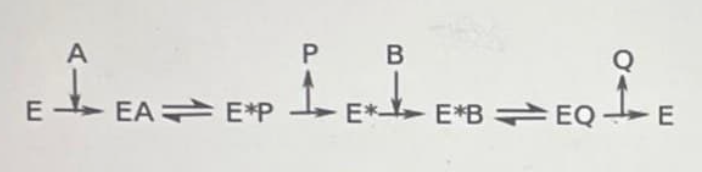
Identify the reaction mechanism of the enzyme in the reaction below:
A) Sequential mechanism
B) Random sequential mechanism
C) Ping-pong mechanism
D) Ordered sequential mechanism
Ping-pong mechanism
In enzyme kinetics, what does it mean if an enzyme has a high Km value?
A. The enzyme is working at maximum capacity.
B. The enzyme binds very tightly to its substrate.
C. The enzyme is extremely effective.
D. The enzyme does not bind strongly to its substrate.
The enzyme does not bind strongly to its substrate
Which of the following best describes the location where the initial breakdown of glucose to pyruvate takes place within a eukaryotic cell?
A. Mitochondrial matrix
B. Cytosol
C. Endoplasmic reticulum
D. Inner mitochondrial membrane
Cytosol
During the citric acid cycle, what is the main role of the reduced coenzymes NADH and FADH₂ produced in various steps of the cycle?
A. They directly generate ATP through substrate-level phosphorylation
B. They serve as carriers of high-energy electrons to the electron transport chain
C. They act as enzymes that catalyze oxidation reactions
D. They store energy by forming glucose molecules
They serve as carriers of high-energy electrons to the electron transport chain
During which specific steps of the citric acid cycle is carbon dioxide released as a byproduct of oxidative decarboxylation?
A. Conversion of succinate to fumarate
B. Isomerization of citrate to isocitrate
C. Oxidation of isocitrate and α-ketoglutarate
D. Regeneration of oxaloacetate from malate
Oxidation of isocitrate and α-ketoglutarate
In the citric acid cycle, which enzyme facilitates the structural rearrangement of citrate to form isocitrate, and what is the primary purpose of this transformation?
A. Aconitase; it converts citrate into a more reactive isomer to allow for subsequent oxidation
B. Citrate synthase; it breaks citrate down into oxaloacetate
C. Isocitrate dehydrogenase; it removes CO₂ from citrate directly
D. Succinate dehydrogenase; it oxidizes citrate into fumarate
Aconitase; it converts citrate into a more reactive isomer to allow for subsequent oxidation
If the enzyme responsible for phosphorylating nucleosides were inhibited during the citric acid cycle, which of the following immediate cellular consequences would be most likely?
A. GTP synthesis during the succinyl-CoA to succinate step
B. NADH oxidation by Complex I in the electron transport chain
C. Conversion of GTP into ATP via phosphate transfer
D. Entry of acetyl-CoA into the mitochondrial matrix
GTP synthesis during the succinyl-CoA to succinate step