COPAR
 Call Kai
 Learn
Learn Practice Test
 Spaced Repetition
 Match
Match Flashcards
 Knowt Play
1/68

There's no tags or description
Looks like no tags are added yet.
Name | Mastery | Learn | Test | Matching | Spaced | Call with Kai | Chat |
|---|
No analytics yet
Send a link to your students to track their progress
69 Terms
Community Organizing Participatory Action Research (COPAR)
___ is a process of building people's organizations by empowering communities to identify, analyze, and solve their own health and social problems through active participation.
COPAR
___ is a people-centered, participatory approach where the community becomes an active partner rather than a passive recipient of healthcare.
Game Changer:
___ = empowerment + participation + community action
Empower communities to solve their own problems
Develop community leadership
Encourage self-reliance
Promote participation in decision-making
Improve community health conditions
Establish sustainable health programs
COPAR aims to:
People Empowerment
Community Participation
Self-Reliance
Social Transformation
Partnership
Principles of COPAR
Facilitator
Educator
Organizer
Advocate
Researcher
Role of the Nurse in COPAR
facilitator
Game Changer:
In COPAR, the nurse's role is ___, not decision-maker.
Pre-Entry Phase
Game Changer:
The goal is to establish readiness for community entry.
Activities:
Select community
Gather background information
Coordinate with local leaders
Prepare resources
Identify possible partners
Entry Phase
Game Changer:
The nurse enters the community and begins building relationships.
Activities
Meet community leaders
Establish rapport
Introduce purpose
Identify initial contacts
Important concepts:
Respect culture
Build trust
Avoid imposing solutions
Integration
Game Changer:
___ builds trust and allows accurate assessment. The nurse becomes part of the community to understand its culture, needs, and concerns.
Activities:
Living/working with the community
Observing community life
Developing relationships
Identifying informal leaders
Community integration
Game Changer:
___ is essential before implementing programs.
Community Study / Diagnosis
Game Changer:
The community identifies and analyzes its problems.
Activities:
Data gathering
Community assessment
Problem identification
Priority setting
Tools:
Surveys
Interviews
Community mapping
Observation
Organization Building
Game Changer:
The goal is for the community to manage its own programs.
Formation and strengthening of community organizations.
Activities:
Identify potential leaders
Develop people's organizations
Train community members
Establish committees
Mobilization
Game Changer:
Community members take action to address identified problems.
Activities:
Implement health projects
Conduct campaigns
Use community resources
Examples:
Clean-up drives
Nutrition programs
Disease prevention activities
Evaluation
Game Changer:
Determining the effectiveness of community actions.
Evaluates:
Achievement of goals
Community participation
Sustainability of programs
1. Passive Participation
2. Consultative Participation
3. Active Participation
4. Self-Mobilization
Community Participation Levels
Passive Participation
Community only receives information. Example: Attending a lecture without involvement.
Consultative Participation
Community gives opinions but does not decide.
Active Participation
Community helps plan and implement activities.
Self-Mobilization
Community independently initiates and manages programs
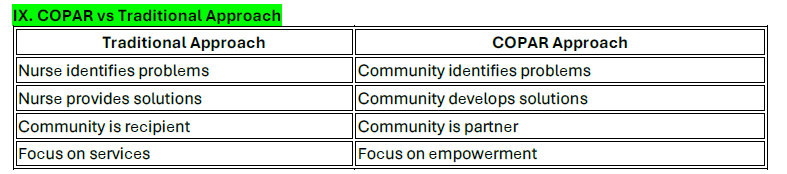
Traditional vs COPAR approach review
Recording
___ is the systematic documentation of health information, nursing care, and community health activities to provide a permanent written or electronic record.
Game Changer:
Documentation of care and health information
Accurate
Complete
Clear
Timely
Confidential
Game Changer:
Principles of Good Recording
Documented
Game Changer:
“If it is not ___, it is considered not done.”
Family Health Record
Individual Health Record
Community Health Records
Clinic Records
Home Visit Records
Nursing Notes
Game Changer:
Types of Records in Community Health Nursing
Reporting
Game Changer:
Communication of health information to appropriate persons/agencies.
Family Health Record
Contains:
Family profile
Health history
Health problems
Services provided
Purpose: Tracks health needs of the family.
Individual Health Record
Contains:
Personal information
Medical history
Immunizations
Treatments
Community Health Records
Contains:
Population census
Morbidity reports
Mortality reports
Disease surveillance data
Clinic Records
Contains:
Consultation records
Immunization records
Prenatal records
Treatment records
Home Visit Records
Contains:
Date and purpose of visit
Assessment findings
Nursing interventions
Follow-up plan
Nursing notes
Documents:
Care provided
Patient/community response
Health teaching
Target Client List (TCL)
A record used to monitor priority clients.
Family Treatment Record
Contains
Family Health problems
Interventions
Outcomes
Monthly Report Form (MRF)
Summarizes:
Health activities
Services provided
Disease cases
Individual Treatment Record (ITR)
Contains:
Patient visits
Treatments
Follow-up
Reporting
Game Changer:
is the organized communication of health information from one healthcare level to another. It ensures that health information reaches decision-makers for planning and action.
Routine Reports
Special Reports
Incident Reports
Types of reports
• Communicable diseases
• Outbreaks
• Unusual health events
Disease surveillance reporting content
Electronic Health Records (EHR)
Digital version of patient records.
Advantages:
• Easier access to information
• Improved continuity of care
• Reduced documentation errors
Health Information Systems (HIS)
Information technology used to:
• Collect health data
• Monitor programs
• Support decision-making
Telehealth / Telemedicine
Use of technology to provide healthcare services remotely.
Examples:
• Online consultations
• Remote monitoring
• Health education through digital platforms
Disease Surveillance Systems
Information technology used for:
• Tracking disease cases
• Monitoring outbreaks
• Reporting public health concerns
Data Management
Technology helps with:
• Data storage
• Analysis
• Program evaluation
Field Health Services Information System (FHSIS)
Game Changer:
It is the primary health information system used in Philippine public health.
Data Sources:
• Rural Health Units
• Barangay Health Stations
• Community health workers
Confidentiality
Game Changer:
___ must always be maintained in electronic and written records.
Internal Referral
Referral within the same healthcare facility.
Example:
Patient referred from
Nurse → Physician
Outpatient department → Laboratory
External Referral
Referral to another healthcare facility.
Example:
RHU → Provincial hospital
Vertical Referral
Referral between different levels of care.
Example:
Barangay Health Station → RHU → Hospita
Horizontal Referral
Referral between facilities of the same level.
Example:
One primary care clinic → another primary care clinic
“Use the appropriate level of care according to patient needs”
Game Changer:
Referral is NOT simply sending a patient away; it is a coordinated transfer of care.
• Primary care is the first level where most patients enter the health system.
• Referral follows the principle: "___"
Clinical Information
Chief complaint
Assessment findings
Vital signs
Diagnosis/problem
Treatment provided
Patient Information
Name
Age
Address
Contact information
In referral documentation, a referral form should include:
Feedback
Game Changer:
A nurse must stabilize emergency patients before referral.
___ from the receiving facility is essential for continuity of care.
Referral system supports:
Primary Health Care
Universal Health Care
Continuity of nursing care
Emergency Conditions
Conditions Beyond Facility Capability
High-Risk Patients
Referral Criteria (When to Refer)
1. Accessibility
2. Communication
3. Coordination
4. Continuity
5. Feedback Mechanism
Characteristics of a good and effective referral system
Health Education
___ is a process of helping individuals, families, and communities acquire knowledge, attitudes, and skills needed to promote, maintain, and restore health.
___ is a major function of community health nursing and a primary tool for prevention.
Game Changer:
It is a core function of community health nursing.
Individual
Family
Population Group
Community
Health Education Across Levels of Care
Individual teaching = specific and personalized
Family teaching = focuses on family as a unit
Group teaching = shared characteristics
Community education = population-wide interventions
Game Changer:
Health education for each individual, family, group, and community.
Demonstration + return demonstration
Game Changer:
The best method for skill learning is ___.
Evaluation is essential to determine learning effectiveness.
Research utilization
___ is the process of applying findings from scientific research into nursing practice to improve the quality, safety, and effectiveness of care. It bridges the gap between “what is known from research” and “what is done in practice.”
Research
___ utilization improves quality of care in community health nursing.
It is applied to:
Individuals
Families
Population groups
Communities
Quantitative Research
Type of research
Uses numbers and statistics
Measures outcomes
Examples:
Incidence of disease
Effectiveness of vaccine programs
Qualitative Research
Type of research
Explores experiences and perceptions
Examples:
• Patient satisfaction
• Cultural beliefs about illness
Epidemiologic Research
Type of research
Studies disease distribution and determinants
Examples:
• Outbreak investigations
• Risk factor studies
Evidence-Based Practice (EBP)
Game Changer:
Type of research
It is the gold standard in modern nursing.
Integration of:
• Best research evidence
• Clinical expertise
• Patient preferences
Lack of time
Lack of resources
Resistance to change
3 Barriers in evidenced based practice (EBP)
apply research findings
Game Changer:
In Evidenced-Based Practice (EBP), nurses must be able to interpret and ___.
Lack of Time
Lack of Resources
Lack of Research Skills
Resistance to Change
Organizational Barriers
5 Barriers to Research Utilization

Research Utilization vs Evidence-Based Practice (EBP) Review