LECTURE 8.2: Frozen Section in Histotechnology
 Call Kai
 Learn
Learn Practice Test
 Spaced Repetition
 Match
Match Flashcards
 Knowt Play
1/175

There's no tags or description
Looks like no tags are added yet.
Name | Mastery | Learn | Test | Matching | Spaced | Call with Kai | Chat |
|---|
No analytics yet
Send a link to your students to track their progress
176 Terms
FROZEN SECTION
Is a rapid diagnostic tool used during surgical procedures.
FROZEN SECTION
It helps the surgeon decide on the next course of action.
FROZEN SECTION
Recommended for examining lipids and nervous tissue elements.
FROZEN SECTION
Commonly used for muscle and nerve biopsies and surgically removed tumors.
Rapid processing time
Less equipment required
Minimal ventilation needs
ADVANTAGES OF FROZEN SECTION:
Lower morphological detail compared to paraffin sections
Potential ice crystal artifacts
Uneven freezing with liquid nitrogen
DISADVANTAGES OF FROZEN SECTION:
Rapid pathological diagnosis during surgery.
Diagnostic and research enzyme histochemistry.
Demonstration of lipids, carbohydrates, and soluble substances.
Immunofluorescent and immunohistochemical staining.
Specialized silver stains in neuropathology.
APPLICATIONS OF FROZEN SECTION:
Liquid Nitrogen
Isopentane cooled by liquid nitrogen
Carbon dioxide gas
Aerosol sprays
FREEZING METHODS:
LIQUID NITROGEN
Rapid but can cause cracking.
(FREEZING METHOD)
ISOPENTANE COOLED BY LIQUID NITROGEN
Ideal for muscle tissue.
(FREEZING METHOD)
CARBON DIOXIDE GAS
Used in freezing microtomes.
(FREEZING METHOD)
AEROSOL SPRAYS
Suitable for small tissue pieces.
(FREEZING METHOD)
Cold Knife Procedure
Cryostat Procedure
Tissue must be fresh and frozen quickly to avoid artifacts.
FROZEN SECTION TECHNIQUES:
COLD KNIFE PROCEDURE
Uses a freezing microtome.
(FROZEN SECTION TECHNIQUES)
CRYOSTAT PROCEDURE
Uses a cryostat (-10°C to -20°C).
(FROZEN SECTION TECHNIQUES)
-10°C to -20°C
Cryostat temperature:
(FROZEN SECTION TECHNIQUES)
COLD KNIFE PROCEDURE
Is used for cutting frozen tissue sections
COLD KNIFE PROCEDURE
Almost any microtome can be used, provided that freezing and maintaining low temperatures are ensured.
COLD KNIFE PROCEDURE
Carbon dioxide (CO₂) technique is commonly used for freezing.
Carbon dioxide (CO2)
This technique is commonly used for freezing in Cold Knife Procedure.
(COLD KNIFE PROCEDURE)
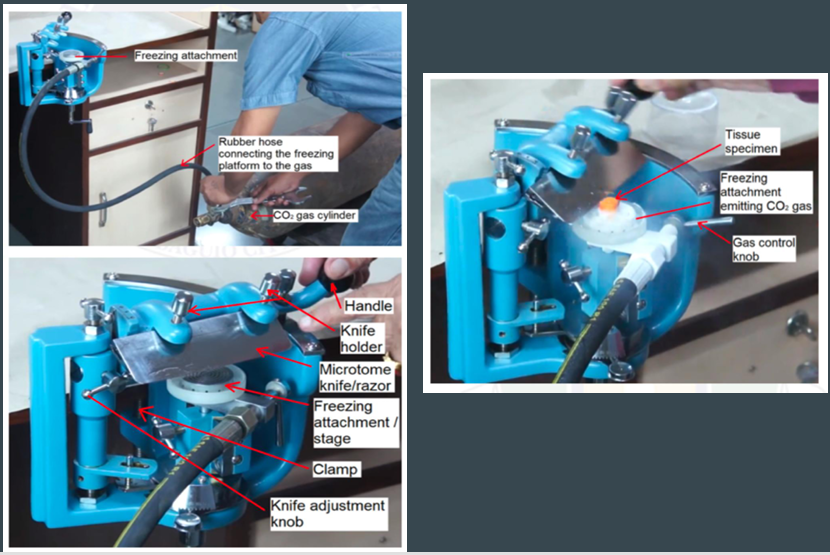
Freezing attachment
Rubber hose connecting the freezing platform to the gas
CO2 gas cylinder
TIssue specimen
Freezing attachment emitting CO2 gas
Gas control knob
Handle
Knife holder
Microtome knife/razor
Freezing attachment/stage
Clamp
Knife adjustment knob
PARTS OF COLD KNIFE PROCEDURE:
Preparation
Freezing the Tissue
Trimming and Dew Line
Section Cutting
Transfer and Staining
COLD KNIFE PROCEDURE STEPS:
PREPARATION
Soak filter paper in gum syrup and place it on the microtome stage.
Apply short bursts of CO₂ to freeze the filter paper onto the stage.
(COLD KNIFE PROCEDURE)
FREEZING THE TISSUE
Tissue block (3-5 mm thick) is oriented with intermittent CO₂ bursts.
Bursts last 1-2 seconds each, with 5-second intervals.
Freeze just enough to be firm for sectioning.
(COLD KNIFE PROCEDURE)
3-5 mm thick ; 5-seconds
Freezing the Tissue
Tissue block (________) is oriented with intermittent CO₂ bursts.
Bursts last 1-2 seconds each, with _____ intervals.
Freeze just enough to be firm for sectioning.
(COLD KNIFE PROCEDURE)
TRIMMING AND DEW LINE
Tissue is manually lifted to the knife and trimmed until flat.
Warm surface slightly to reveal the dew line—the ideal cutting point.
(COLD KNIFE PROCEDURE)
DEW LINE
The ideal cutting point
(COLD KNIFE PROCEDURE)
SECTION CUTTING
Sections are cut at 10 microns thickness.
Sections stick to the knife and are removed with a moistened brush or finger.
(COLD KNIFE PROCEDURE)
10 microns
Section Cutting
Sections are cut at ___ thickness.
Sections stick to the knife and are removed with a moistened brush or finger.
(COLD KNIFE PROCEDURE)
TRANSFER AND STAINING
Sections are placed in a dish of distilled water to separate.
They are then mounted and stained for microscopic examination.
(COLD KNIFE PROCEDURE)
Solution: Warm with finger to soften
Problem: Too hard frozen (tissue chips)
(COLD KNIFE PROCEDURE: Troubleshooting and Adjustments)
Solution: Apply more CO2 bursts to refreeze
Problem: Not frozen enough (thick/crumbling sections)
(COLD KNIFE PROCEDURE: Troubleshooting and Adjustments)
Solution: Ensure the knife is colder than the tissue
Problem: Knife too warm
(COLD KNIFE PROCEDURE: Troubleshooting and Adjustments)
-40° to -60°C
Optimal temperature range for knife
(COLD KNIFE PROCEDURE: Optimal Temperature Conditions)
-5° to -10°C
Optimal temperature range for tissue
(COLD KNIFE PROCEDURE: Optimal Temperature Conditions)
0° to -10°C
Optimal temperature range for environment
(COLD KNIFE PROCEDURE: Optimal Temperature Conditions)
cold room with controlled humidity
In cold knife procedure, best results are achieved in a?
(COLD KNIFE PROCEDURE: Optimal Temperature Conditions)
Thin sections (<6µm)
In cold knife procedure, ______ are difficult to obtain.
(COLD KNIFE PROCEDURE: Optimal Temperature Conditions)
FREEZING MICROTOME
Specialized apparatus for cutting frozen sections.
(COLD KNIFE PROCEDURE)
FREEZING MICROTOME
Similar to a regular microtome with added features:
CO₂ gas control and an automatic feed mechanism.
(COLD KNIFE PROCEDURE)
FREEZING MICROTOME
Incorporates:
Microtome knife control
CO₂ gas introduction system
Automatic feed mechanism (adjustable from 5-40 µm)
(COLD KNIFE PROCEDURE)
FREEZING MICROTOME
Features:
Clamped onto a desk or table.
CO₂ gas cylinder connected via a rubber hose.
Insulated rubber plate prevents heat conduction.
Adjustable knife holder for optimal cutting angle.
(COLD KNIFE PROCEDURE)
CRYOSTAT PROCEDURE
Uses a cryostat, a specialized apparatus for fresh tissue microtomy.
fresh tissue microtomy
In cryostat procedure, it uses a cryostat, a specialized apparatus for ______.
insulated microtome in an electrically driven refrigerated chamber
The cryostat houses an?
CRYOSTAT PROCEDURE
Maintains isothermic conditions at -18 to -20°C for precise sectioning.
isothermic ; -18 to -20°C
Cryostat procedure maintains ____ conditions at ___ for precise sectioning
-18 to -20°C.
Optimum working temperature for cryostat procedure:
(COLD KNIFE PROCEDURE: Temperature Control)
CRYOSTAT PROCEDURE
Fast freezing is critical to prevent artifacts.
(COLD KNIFE PROCEDURE: Temperature Control)
Fast freezing
In cryostat procedure, _____ is critical to prevent artifacts.
(COLD KNIFE PROCEDURE: Temperature Control)
CRYOSTAT PROCEDURE
Slow freezing causes distortion due to ice formation.
(COLD KNIFE PROCEDURE: Temperature Control)
SLOW FREEZING
In cryostat procedure, _____ causes distortion due to ice formation.
(COLD KNIFE PROCEDURE: Temperature Control)
Rotary microtome
Tissue shelf
Knife holder & blade
COMPONENTS OF THE CRYOSTAT:
ROTARY MICROTOME
Moves the tissue via a rotary wheel.
(COMPONENTS OF THE CRYOSTAT)
TISSUE SHELF
Keeps tissue at a lower temperature for freezing
(COMPONENTS OF THE CRYOSTAT)
KNIFE HOLDER & BLADE
Uses low- or high-profile disposable blades.
(COMPONENTS OF THE CRYOSTAT)
KNIFE HOLDER & BLADE
Alternative: Profile C steel blade.
(COMPONENTS OF THE CRYOSTAT)
Profile C steel blade
COMPONENTS OF THE CRYOSTAT
Knife holder & blade:
Uses low- or high-profile disposable blades.
Alternative: ______.
Blade angle: 5°-7°.
(COMPONENTS OF THE CRYOSTAT)
KNIFE HOLDER & BLADE
Blade angle: 5°-7°.
(COMPONENTS OF THE CRYOSTAT)
5°-7°
COMPONENTS OF THE CRYOSTAT
Knife holder & blade:
Uses low- or high-profile disposable blades.
Alternative: Profile C steel blade.
Blade angle: ____.
(COMPONENTS OF THE CRYOSTAT)
ANTIROLL PLATE & TISSUE HANDLING
Prevents curling of cut tissue.
(CRYOSTAT PROCEDURE)
ANTIROLL PLATE & TISSUE HANDLING
Made of glass within a metal frame.
(CRYOSTAT PROCEDURE)
ANTIROLL PLATE & TISSUE HANDLING
Positioned with a gap between the plate and the knife.
(CRYOSTAT PROCEDURE)
ANTIROLL PLATE & TISSUE HANDLING
Alternative: Cool sable hair brush can be used.
(CRYOSTAT PROCEDURE)
COOL SABLE HAIR BRUSH
CRYOSTAT PROCEDURE
Antiroll Plate & Tissue Handling:
Prevents curling of cut tissue.
Made of glass within a metal frame.
Positioned with a gap between the plate and the knife.
Alternative: ______ can be used.
(CRYOSTAT PROCEDURE: Antiroll Plate & Tissue Handling)
SPECIMEN HOLDER (CHUCK)
Available in different shapes and sizes.
(CRYOSTAT PROCEDURE: Specimen Holder & Embedding Medium)
CHUCK
Specimen holder in cryostat procedure which is available in different shapes and sizes
(CRYOSTAT PROCEDURE: Specimen Holder & Embedding Medium)
OPTIMUM CUTTING TEMPERATURE (OCT)
CRYOSTAT PROCEDURE
Specimen Holder & Embedding Medium:
Specimen holder (chuck): Available in different shapes and sizes.
Embedding medium: ____ compound.
Made of water-soluble glycols & resin.
Supports the tissue and ensures a firm but flexible sectioning process.
(CRYOSTAT PROCEDURE: Specimen Holder & Embedding Medium)
OPTIMUM CUTTING TEMPERATURE (OCT)
Embedding medium used in cryostat procedure which is made of water-soluble glycols & resin and supports the tissue and ensures a firm but flexible sectioning process.
(CRYOSTAT PROCEDURE: Specimen Holder & Embedding Medium)
OPTIMUM CUTTING TEMPERATURE (OCT)
Made of water-soluble glycols & resin.
(CRYOSTAT PROCEDURE: Specimen Holder & Embedding Medium)
OPTIMUM CUTTING TEMPERATURE (OCT)
Supports the tissue and ensures a firm but flexible sectioning process.
(CRYOSTAT PROCEDURE: Specimen Holder & Embedding Medium)
Tissue must remain frozen solid during sectioning.
Prevents compression & distortion during cutting.
Knife should be chilled to avoid melting the tissue.
IMPORTANCE OF MAINTAING THE FROZEN STATE IN CRYOSTAT PROCEDURE:
Overfreezing
What is the cause?
Issue: Tissue too cold
(CRYOSTAT PROCEDURE)
Becomes brittle, shatters upon cutting
What is the effect?
Issue: Tissue too cold
(CRYOSTAT PROCEDURE)
Underfreezing
What is the cause?
Issue: Tissue too warm
(CRYOSTAT PROCEDURE)
Tissue compresses & distorts
What is the effect?
Issue: Tissue too warm
(CRYOSTAT PROCEDURE)
Ice crystal formation
What is the cause?
Issue: Slow freezing
(CRYOSTAT PROCEDURE)
Freeze-thaw artifacts (holes in tissue)
What is the effect?
Issue: Slow freezing
(CRYOSTAT PROCEDURE)
Tissue too cold
What is the issue?
Cause: Overfreezing
Effect: Becomes brittle, shatters upon cutting
(CRYOSTAT PROCEDURE)
Tissue too warm
What is the issue?
Cause: Underfreezing
Effect: Tissue compresses & distorts
(CRYOSTAT PROCEDURE)
Slow freezing
What is the issue?
Cause: Ice crystal formation
Effect: Freeze-thaw artifacts (holes in tissue)
(CRYOSTAT PROCEDURE)
ICE CRYSTAL ARTIFACTS
Appear as holes in tissue.
(CRYOSTAT PROCEDURE: Freezing Artifacts & Their Impact)
CRYOSTAT PROCEDURE: Freezing Artifacts & Their Impact
Most problematic in skeletal muscle & delicate tissues.
skeletal muscle & delicate tissues
In cryostat procedure, freezing artifacts & their impact are the most problematic in what tissues?
(CRYOSTAT PROCEDURE: Freezing Artifacts & Their Impact)
COLD KNIFE PROCEDURE
Is used for rapid frozen tissue sectioning.
rapid frozen tissue
Cold Knife Procedure is used for?
COLD KNIFE PROCEDURE
Success depends on temperature control and proper technique.
temperature control
proper technique
Success in Cold Knife Procedure depends on:
COLD KNIFE PROCEDURE
A freezing microtome improves efficiency and accuracy.
FREEZING MICROTOME
In Cold Knife Procedure this improves efficiency and accuracy.
CRYOSTAT PROCEDURE
Allows controlled frozen sectioning at -18 to -20° C.
-18 to -20° C.
Cryostat Procedure allows controlled frozen section at what temperatures?
CRYOSTAT PROCEDURE
Fast freezing prevents ice crystal formation.
FAST FREEZING
In Cryostat Procedure what prevents ice crystal formation?
CRYOSTAT PROCEDURE
Antiroll plate & OCT compound improve sectioning quality
ANTIROLL PLATE & OCT COMPOUND
In Cryostat Procedure what improves sectioning quality?
CRYOSTAT PROCEDURE
Maintaining the right temperature is crucial
Maintaining the right temperature
What is crucial in Cryostat Procedure?
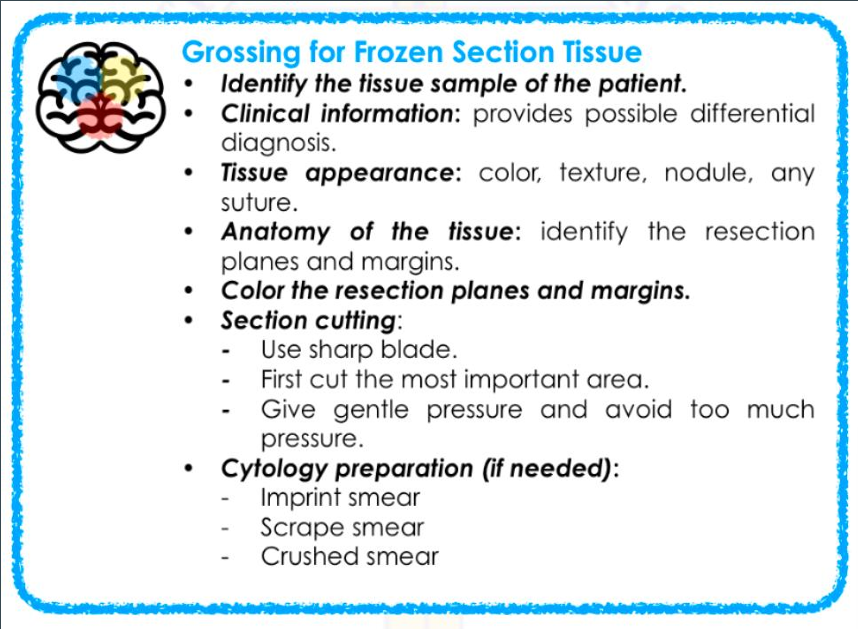
Identify the tissue sample of the patient.
Clinical information
Tissue appearance
Anatomy of the tissue
Color the resection planes and margins
Section cutting
Cytology preparation (if needed)
GROSSING FOR FROZEN SECTION TISSUE:
COLD KNIFE PROCEDURE (Freezing Microtome)
Uses a freezing microtome for sectioning.