gen chem mini exam 1
 Call Kai
 Learn
Learn Practice Test
 Spaced Repetition
 Match
Match Flashcards
 Knowt Play
1/211

There's no tags or description
Looks like no tags are added yet.
Name | Mastery | Learn | Test | Matching | Spaced | Call with Kai | Chat |
|---|
No analytics yet
Send a link to your students to track their progress
212 Terms
matter
anything that has mass and volume
atoms
can refer to atoms that have lost or gained electrons. can combine to form compounds
molecules
bound atoms, composes a substance determined by atoms
scientific law
statement that summarizes past observations and predicts future ones. describes how nature behaves
law of conservation of mass
in a chemical reaction, matter is neither created nor destroyed. lavoisier
theory
model for the way nature is and explains why and what. validated by experiments but never proven
substance
only made of 1 uniform element, chemically combined. can either be made up of molecules or atoms
3 types of matter
elements (substance), compounds (substance), mixtures (not a substance)
pure substance
only made of one component, its composition doesnt vary. can be individual atoms or groups of atoms joined togerher
elements
cant be broken down into simpler substances
compound
substance composed of two or more elements in fixed proportion, chemically bonded
mixture
2 or more components in proportions that can vary from one another (sweet tea). not chemically combined and can be separated by physical changes. retains many of the properties of the components
solution
aka homogeneous mixture. same composition throughout, uniformly mixed
aqueous solutions
solutions dissolved in water
decanting
pouring off a liquid
distillation
separating a homogeneous mixture (solution) of lliquids. mixture is heated to boil off more volatile liquids
physical changes
changes that alter only state or appearance but not composition. atoms or molecules dont change their identity
physical property
property that a substance displays without changing composition. ex smell of gas, odor, taste, color
chemical change
results in a completely different substance, changes that alter the composition of matter. ex rusting iron combines with oxygen
chemical property
displays only by changing its composition via change. ex corrosiveness, acidity, toxicity. involving chemical reactions, evidenced by temp or color changes. only chemical examinations can determine what type of change it is
energy
the capacity to do work. neither created nor destroyed
work
the action of a force through a distance
total energy
the sum of kinetic and potential energy
thermal energy
a type of kinetic energy because its associated with the motion of individual atoms.
potential energy
often unstable, associated with position or composition. use unstable changes like combustion to lower potential energy and make it more stable
mass v weight
mass is the measure of quantity of matter within an object. weight is the measure of gravitational pull on matter
temperature
measure of average kinetic energy. thermal energy goes from hot to cold objects.
kelvin
absolute zero- the coldest temp possible where molecular motion stops. C + 273.15
how to calculate farenheight from celcius
(c * 1.8) + 32
electric current
ampere, A
luminous intensity
candela, cd
exa
10^18
peta
10^15
tera
10^12
giga
10^9
mega
10^6
kilo
10³
deci
10^-1
centi
10^-2
milli
10^-3
micro
10^-6
nano
10^-9
pico
10^-12
femto
10^-15
atto
10^-18
derived unit
combination of any other units
density
an intensive property
intensive property
property that is independent of the amount of substance
extensive property
ex mass, one that depends on the amount of the substance
exact numbers
unlimited amount of sigfigs
from the accurate counting of discrete objects. ex 3 balls
from dfined quantities. ex number of cm in 1 m
from integral numbers that are part of an equation ex: radius=diameter/2
multi/divis sigfigs
result carries the same number of sigfigs as the factor with the fewest sigfigs
in add or sub sigfigs
same number of decimal places as the quantity with the fewest decimal places
accuracy
how close the measured value is to the actual value
precision
how close a series of measurements are to one another or how reproducible they are
random error
error that has the equal probability of being too high or too low, can average itself out
systematic error
error that tends to be repeatedly too high or too low. can be taken into account through calibration
how to go from L to kg
L to mL to cm³ to g to kg
phlogiston theory
explains combustion because combustible materials contain combustion. air attracts plogiston out of charcoal and stops when it is saturated. disproved by lavoisier, oxygen combines with a substance when it burns and the product weighs more because the mss includes the mass of the oxygen
molecular element
2 of the same thing bonded together
molecular compound
2 things covalently bonded
law of definite proportions
all samples of a given compound, regardless of source, have the same proportions of their constituent elements
how to solve law of definite proprotions
set up a proportion of a to b with the numbers they give you and use dimensional analysis to calculate the new number
atomic theory- dalton
each element is made of tiny, indestructible atoms
all atoms of a given element have the same mass and other proprties that distinguish them
atoms combine in simple, whole number ratios to form compounds
atoms of one element cant change into atoms of another. in a chem reaction, atoms only change the way theyre bound together with other atoms
law of multiple proportions- dalton
when two elements from 2 different compounds, the masses of element b that combine with 1 g of element a can be expressed as a ratio of small whole numbers.
cathode rays
discovered that cathode rays carry a negative electrical charge (electrons), which result in electrostatic forces
electric field
area around a charge particle where electrostatic forces exist
millikans oil drop experiment
deduced the charge of a single electron. calculated oil droplets falling in an electric field. helps us find the mass of an electron
how to calculate mass of an electron
charge of electron * mass/charge
mass of electorns
9.109 × 10e -28
plum pudding model- thomson
atom is a sphere of positive charge that has negative electrons in it, like a blueberry muffin. the mass of the atom is contained in the blueberries that are spread evenly throughout the massless dough
rutherfords gold foil experiment
shot particles through gold foil, should blast through. but, some bounced back, showing that the mass of the atom was focused in the nucleus. the rest is empty space with floating electrons in the cloud
nuclear theory
most of the atoms mass and all of its positive charge are contained in the nucleus
most of the volume is empty space, where electrons are
there are electrons and protons, so the atom is electrically neutral. mass is very small and dispersed over a large volume, mostly empty space. matter is much less uniform than we thought
chadwick
finished rutherfords model by discovering neutrons in the nucleus for the unaccounted mass
atomic mass unit
1/12 the mass of a carbon atom that contains 6 protons and 6 neutrons. mass of proton or neutron is approx 1 amu but electrons are much smaller
atomic number
number of protons in the nucleus of an atom. defines the element, the periodic table lists elements in order of increasing atomic number. also the number of electrons in a neutral atom
isotopes
atoms with the same number of protons but different number of neutrons, which just add extra mass. but, the size of an element for all isotopes is the same bc its so small
how are isotopes represented
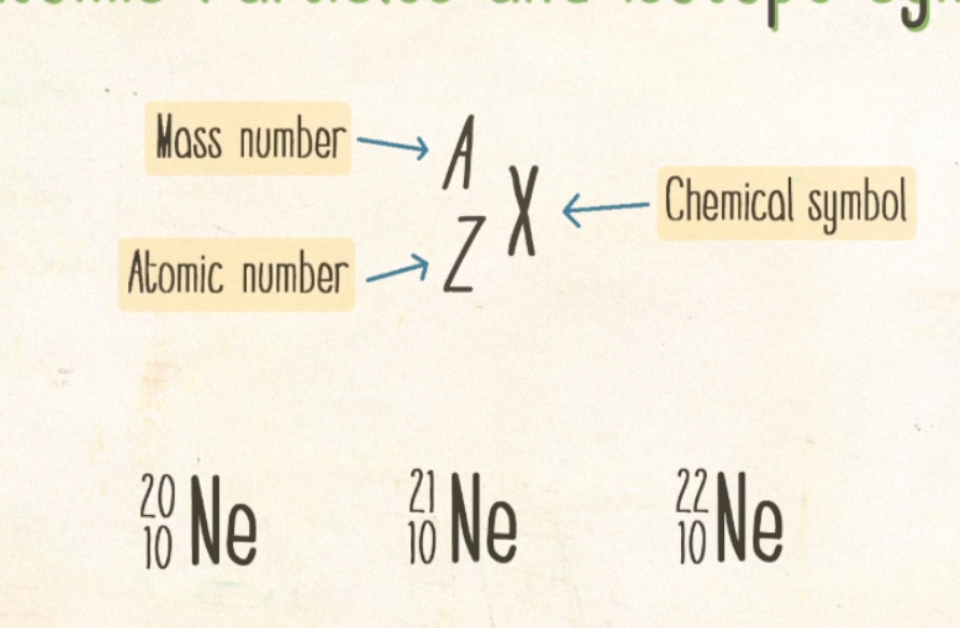
mass number
protons + neutrons
other way to represent isotopes
chemical symbol-mass. ex Ne-20
periodic law
when elements are arranged in order of increasing mass, certain sets of properties recur periodically and fall into columns
modern periodic table
listed in order of increasing atomic number, not mass
metals
good conductors, can be drawn into wires (ductility), shiny solids, lose electrons
nonmetals
varied properties- can be solids or gases (bromide is the only liquid). poor conductors of heat and electricity. gain electrons
metalloids
mixed properties. semiconductors because of their intermediate electrical conductivity. used in electirc chips aka semimetals
main group elements
properties are predictable based on position in periodic table. labeled with number and A. lose electrons
main group metals
lose electrons, forming a cation with the same number of electrons as the nearest noble gas
nonmetal main group elements
gains electrons, forming anion with same number electrons as nearest noble gas
transition metals
less predictable properties, number and B. contains inner transition elements
inner transition elements
lanthanides and acinides
columns
each column within the main group is a family or group of elements. usually have similar proper
noble gases
8A. unreactive
alkalai metals
1A except for hydrogen. reactive metals
alkaline earth metals
2A, fairly reactive but not ask much as alkalai
halogens
7A, reactive nonmetals
other main groups names
named for first element in the group ex oxygen family
atomic mass
average mass of the isotopes of the element, weighted according to the natural abundance of each isotope.
sum of (fraction of isotope)*(mass of isotope)
mass spectrometry
technique that separates particles according to mass. measures masses of atoms and the percent abundances of isotopes of elements. sample is injected and ionized
how to find total intensity from mass spectrometer results
divide each peak by totl intensity.
ex: 92.9/100+92.9
1 mol
6.022 × 10^(23)