Substitution & Elimination Q Banks
 Call Kai
 Learn
Learn Practice Test
 Spaced Repetition
 Match
Match Flashcards
 Knowt Play
1/17

There's no tags or description
Looks like no tags are added yet.
Name | Mastery | Learn | Test | Matching | Spaced | Call with Kai |
|---|
No analytics yet
Send a link to your students to track their progress
18 Terms
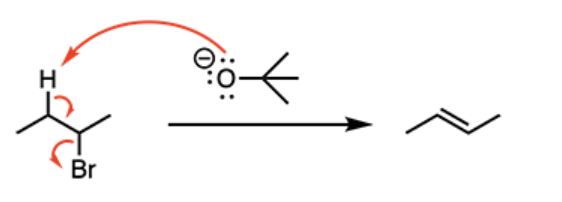
What is the major product of the following reaction?
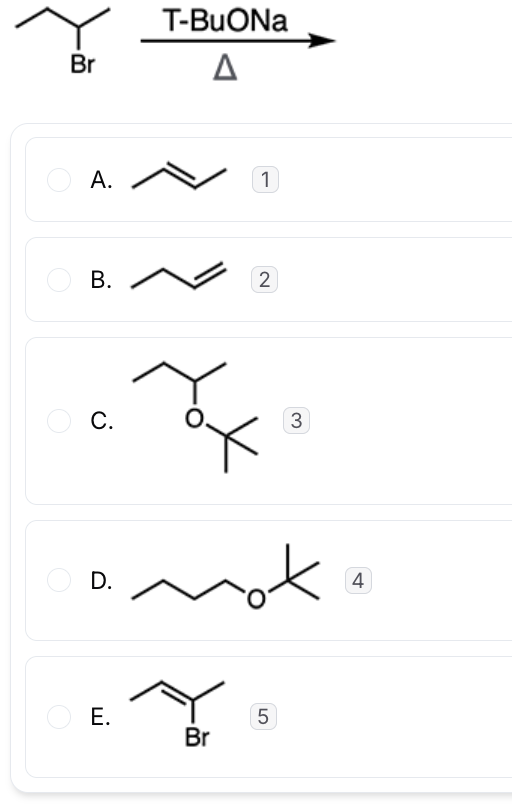
A
What is the major product of the following reaction?
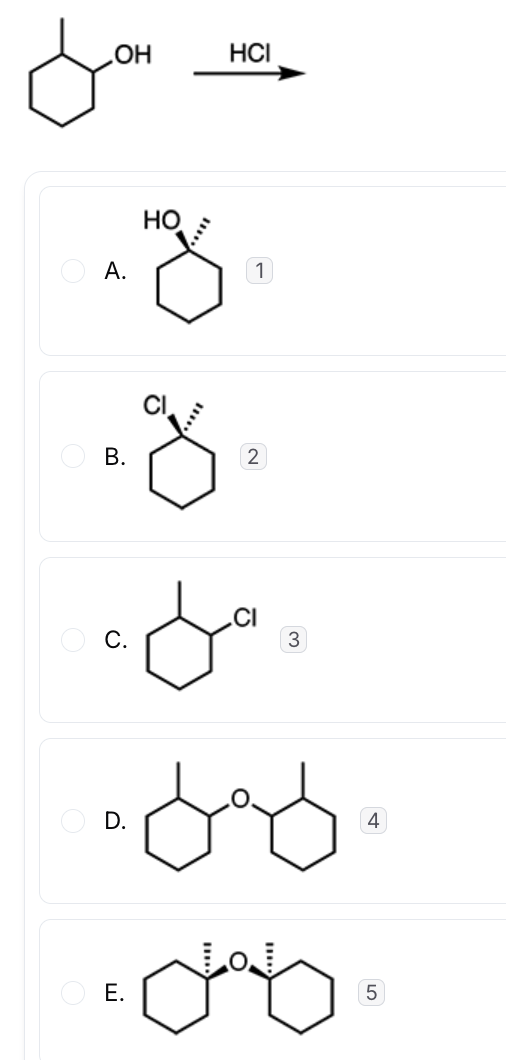
B
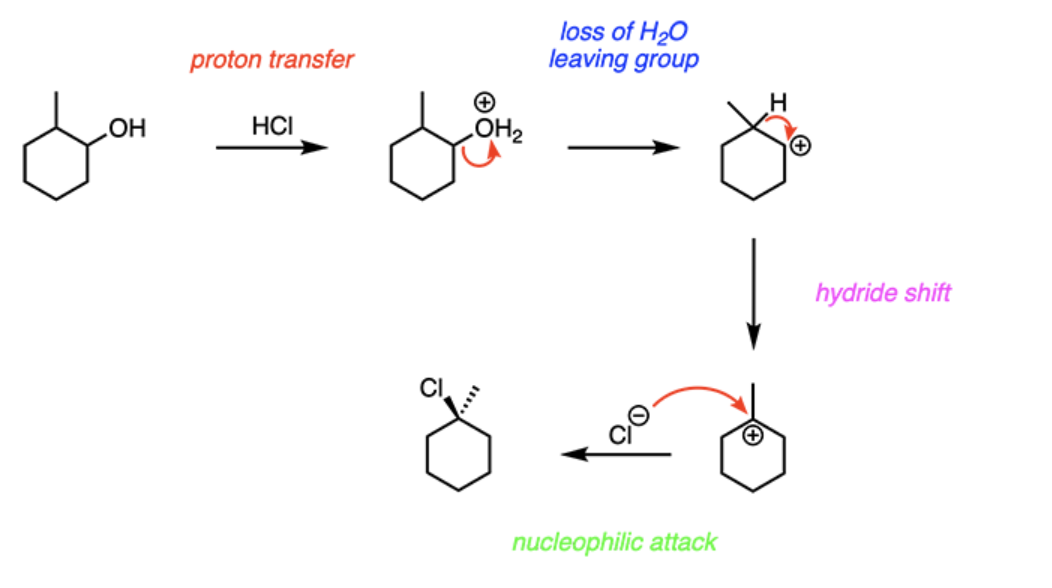
What is the major substitution product for the following reaction?
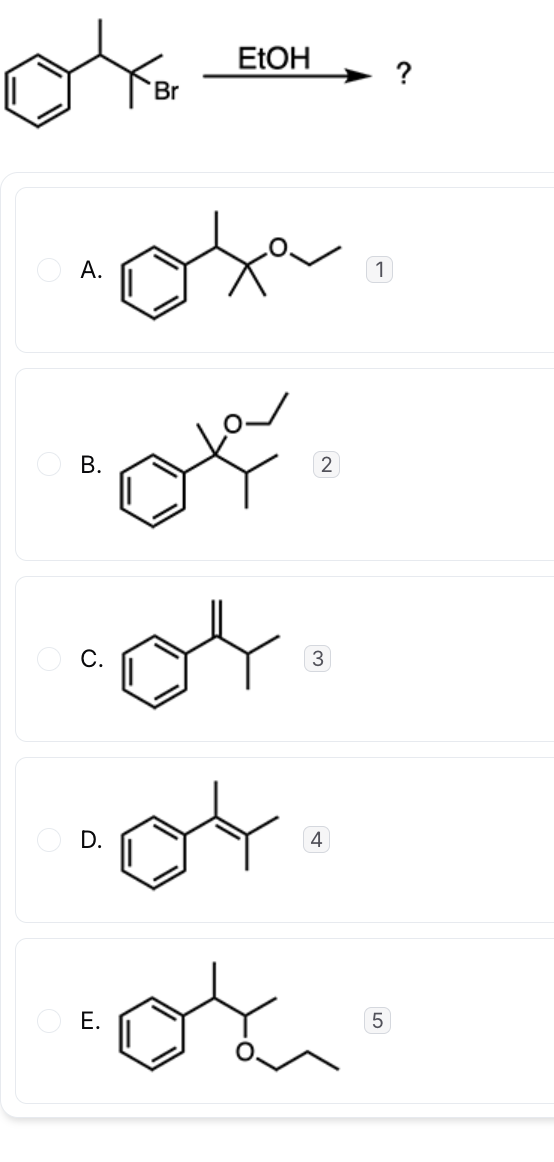
B
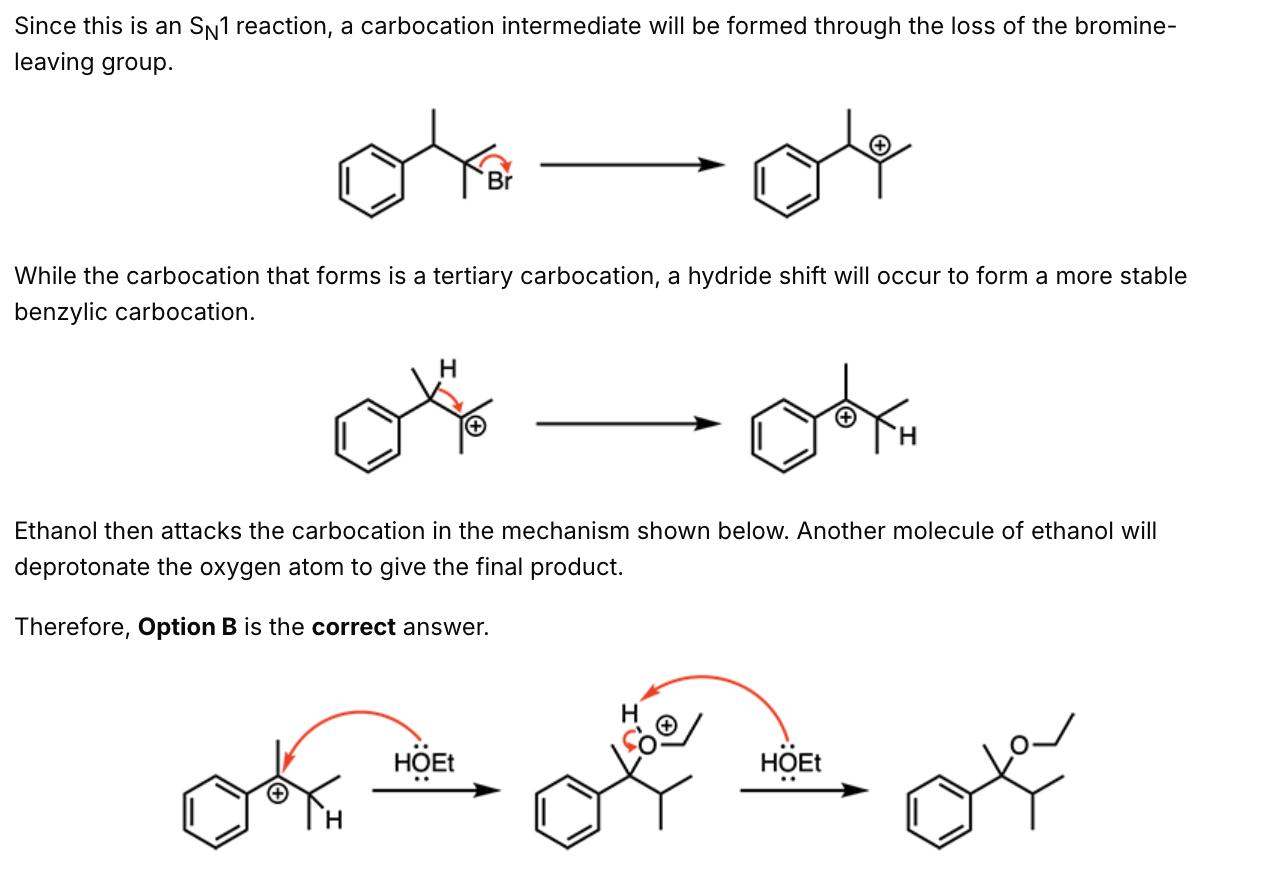
Which of the following compounds will undergo an SN1 mechanism the fastest?
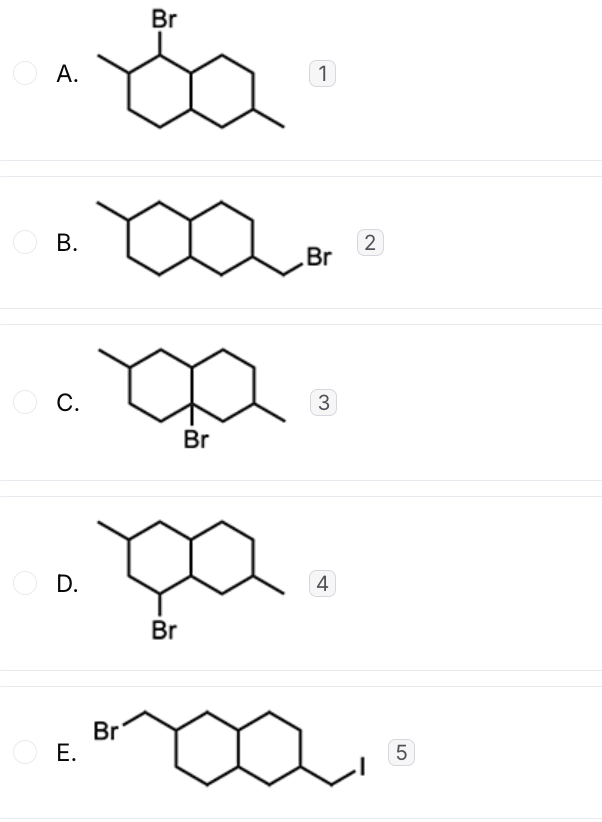
C
All of the compounds have a good leaving group, so the next step is to analyze the substitution of the alkyl halide carbon. Since the rate-determining step of an SN1 reaction is the leaving group breaking off and formation of a carbocation, the compound that will form the most stable carbocation will react the fastest. A tertiary alkyl halide will react faster than a secondary or primary alkyl halide because it results in a more substituted and therefore more stable carbocation. Answer choice C possesses a tertiary alkyl bromide, thereby forming a more stable tertiary carbocation.
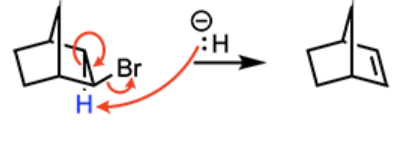
What is the major product of the following reaction?
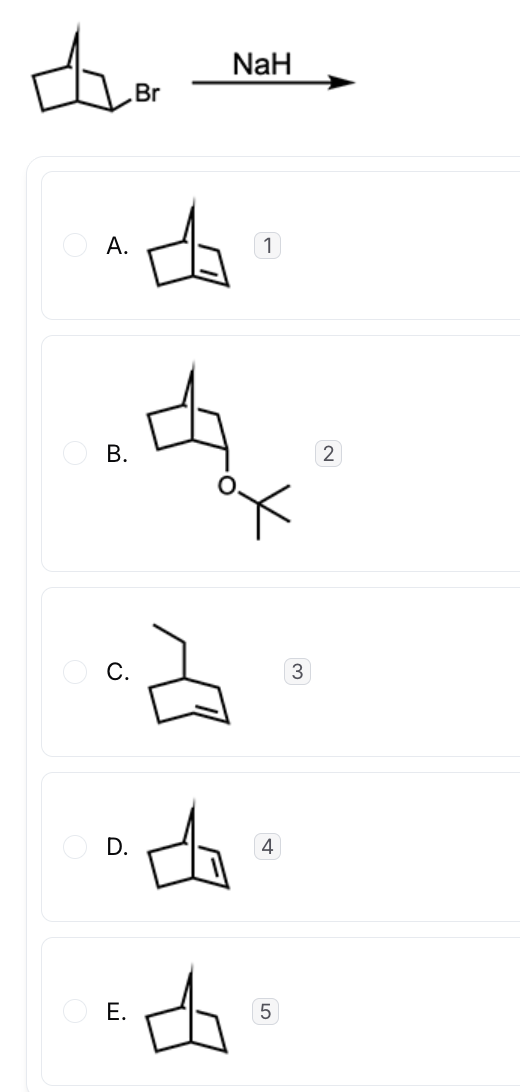
D
The following reaction occurs through what mechanism?
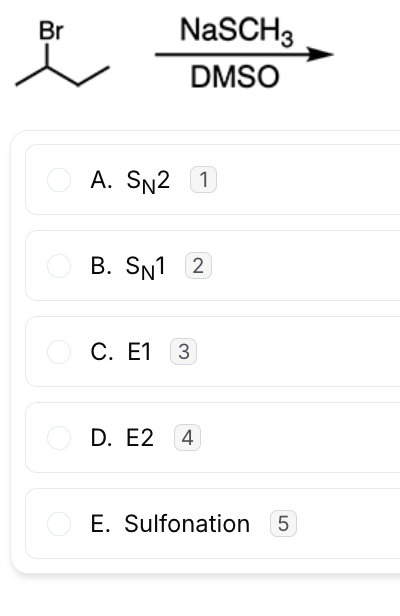
A: SN2
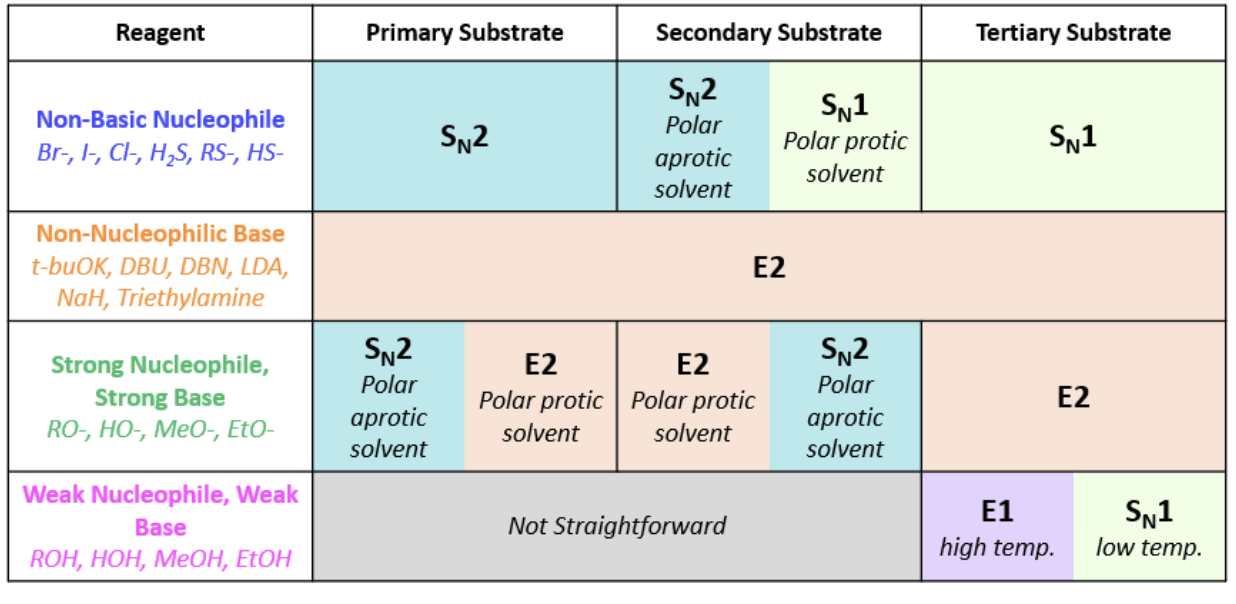
To solve questions like this one, first look at the alkyl halide. The substitution of the alkyl halide will narrow down the mechanism choices. In this case, the secondary alkyl halide reduces the options to the two bimolecular mechanisms in this chapter. Next, consider the basicity and nucleophilicity of the nucleophile. Sulfur nucleophiles are typically very nucleophilic and weakly basic, meaning SN2 will be favored.
The product of the following reaction is formed through what mechanism?
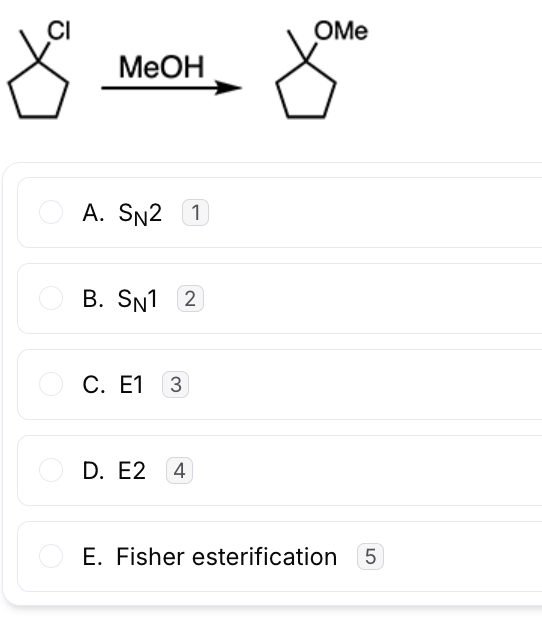
B: SN1
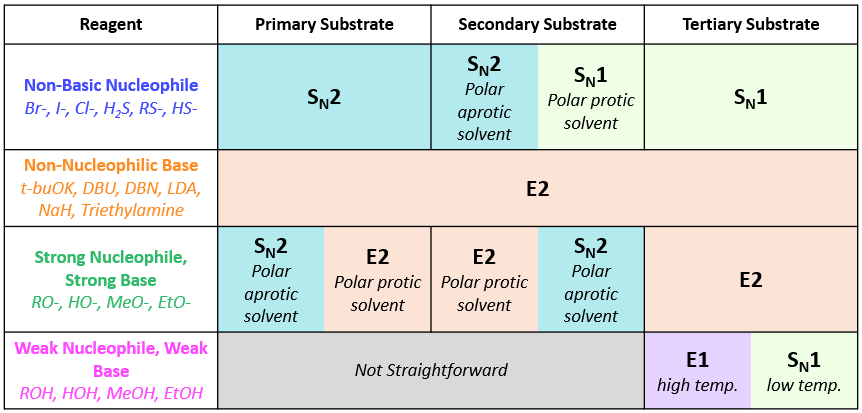
Which of the following reagents would favor the formation of the Zaitsev product in an E2 reaction?
A. t-BuOK
B. (CH3)2CHOK
C. CH3ONa
D.LDA
E. Diethyl ether
B. (CH3)2CHOK
elimination reactions can produce a Hofmann or Zaitsev product. The Hofmann product forms the least substituted alkene whereas the Zaitsev product forms the most substituted alkene. Since the Zaitsev product is the most substituted, it is also the most stable product of an elimination reaction. The more substituted a position is, the more hindered it is by steric interactions. Therefore, a base that is not sterically hindered is needed to obtain the Zaitsev product. The least sterically hindered base among the options given is sodium methoxide.
Which of the following correctly describes this reaction?
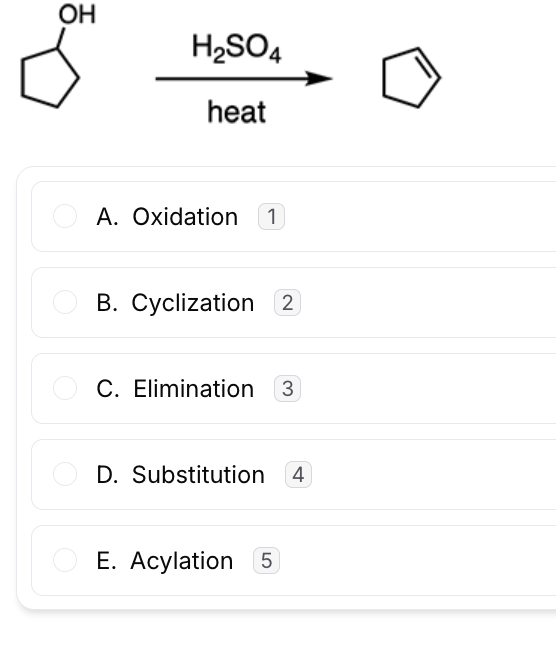
C. Elimination
When heated in the presence of concentrated acid such as H2SO4, alcohols undergo acid-catalyzed dehydration to form alkenes. This is an elimination reaction, as shown below.
Therefore, Option C is the correct answer.

Which of the following compounds would react with potassium tert-butoxide to form the desired product?
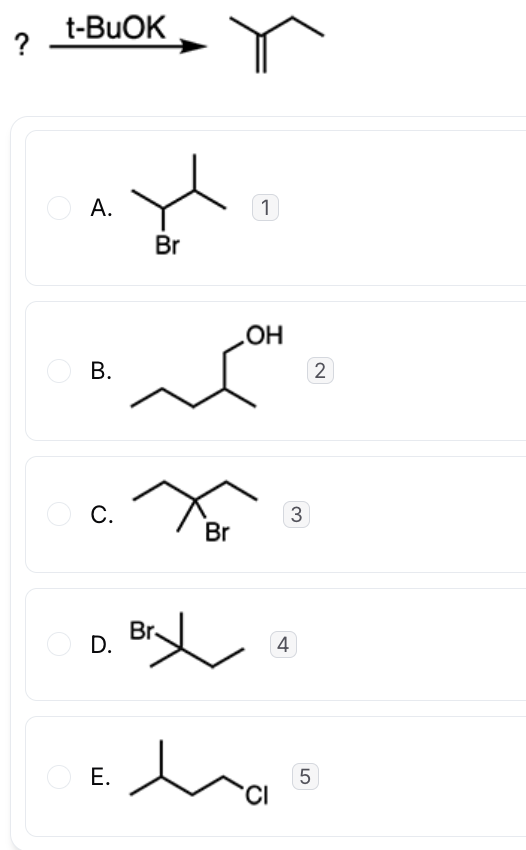
D
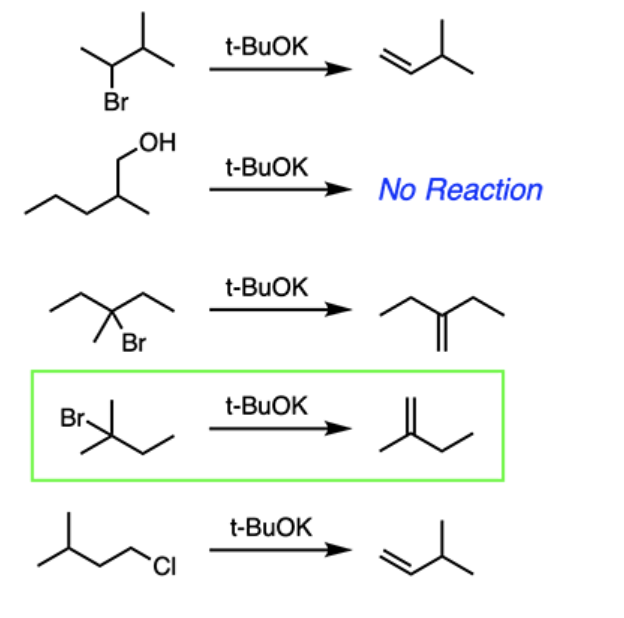
he product contains a carbon-carbon double bond, and t-BuOK is a strong base and a weak nucleophile. Therefore, we can determine that this is an E2 reaction. Potassium tert-butoxide is a sterically hindered base, so the Hofmann product will be produced in the E2 reaction. The diagram below indicates the product of the reaction for each option. The compound in option B will not undergo an E2 reaction because hydroxyl groups are poor leaving groups.
Which of the following options would double the rate of an SN2 reaction?
A. Double the concentration of the solvent
B. Double the concentration of the nucleophile
C. Double the concentration of the nucleophile and the alkyl halide
D. Halve the concentration of the nucleophile
E. Halve the concentration of the alkyl halide
B. Double the concentration of the nucleophile
To solve this question, analyze the rate equation for an SN2 reaction. The rate of reaction equation for an SN2 mechanism is defined as rate=k[nucleophile][alkyl halide]. Therefore, doubling the concentration of either the nucleophile or the alkyl halide would double the rate of reaction.
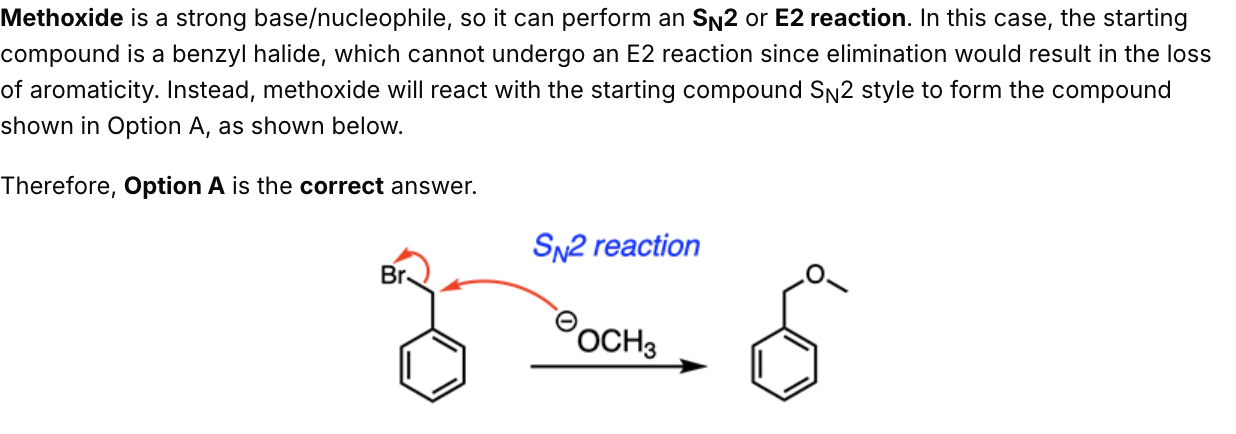
What is the product of the following reaction?
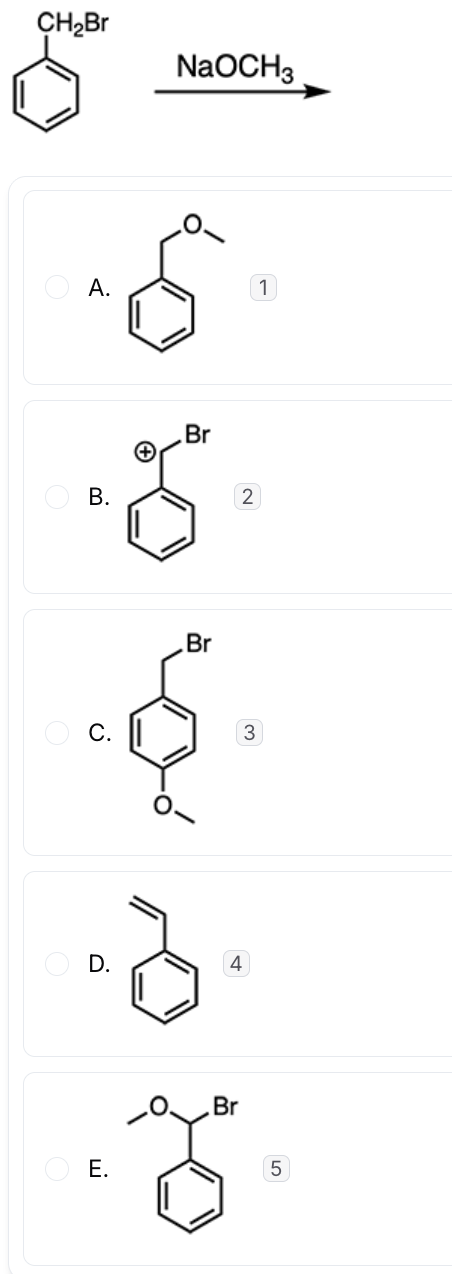
A
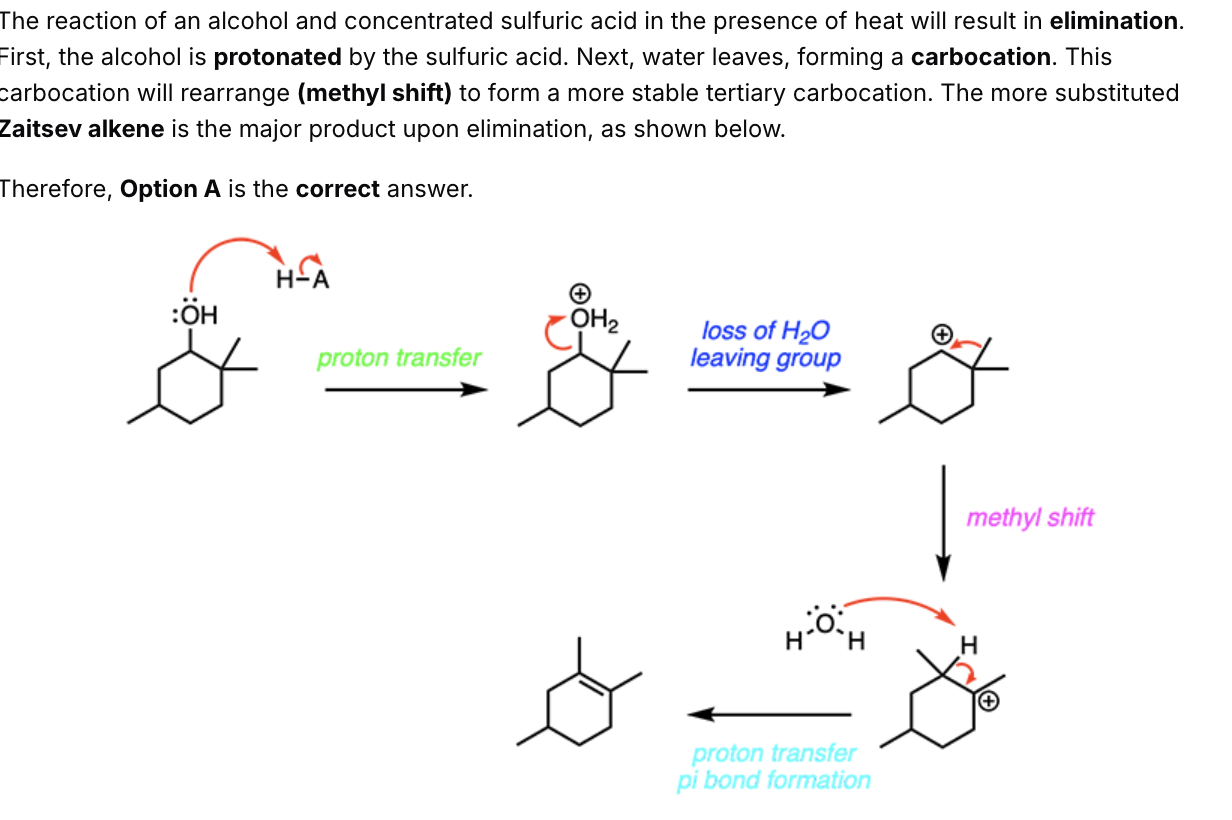
What is the major product when the following alcohol is reacted with concentrated sulfuric acid in hot conditions?
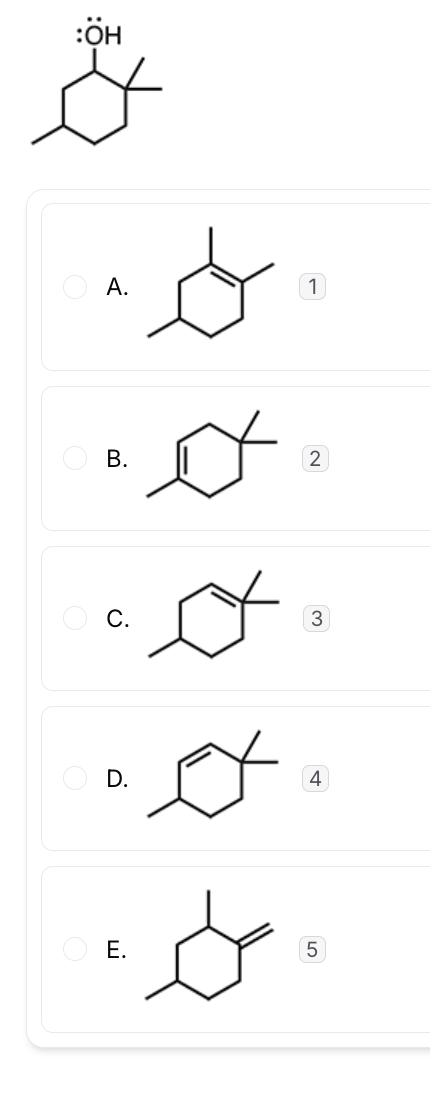
A
Which of the following compounds would cause a secondary alkyl halide to undergo an SN2 reaction?
A. NaH
B. NaSEt
C. NH3
D. DBU
E. EtOH
B. NaSEt
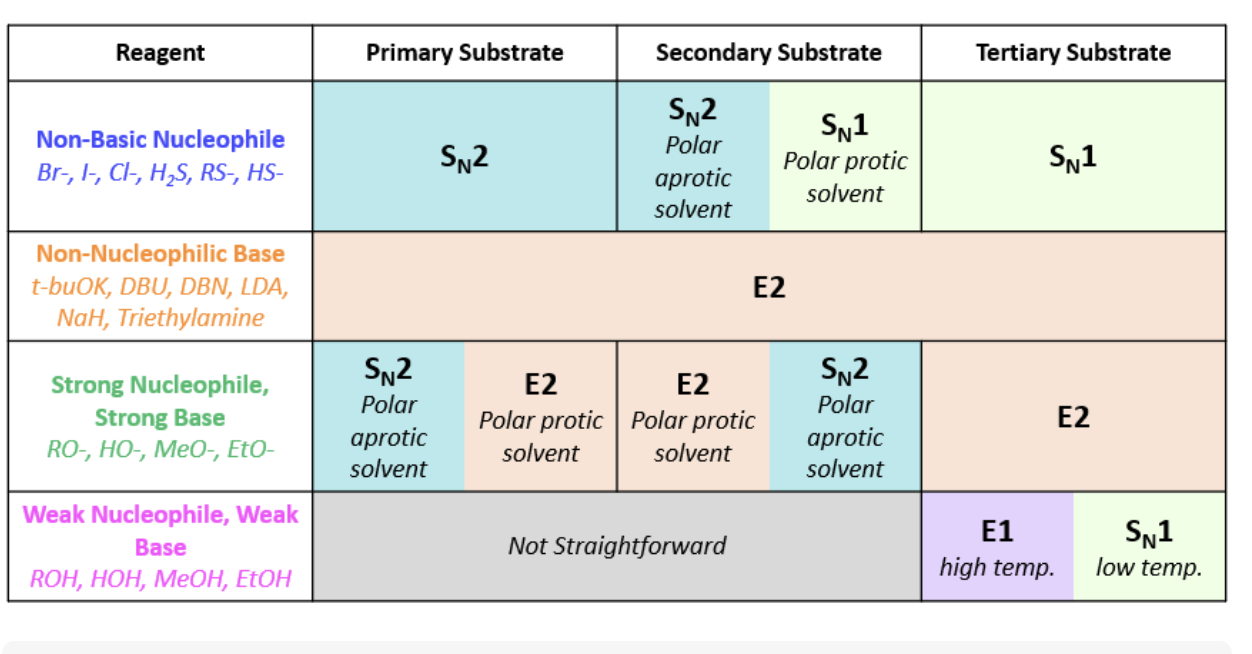
Which of the following compounds could function as a polar aprotic solvent?
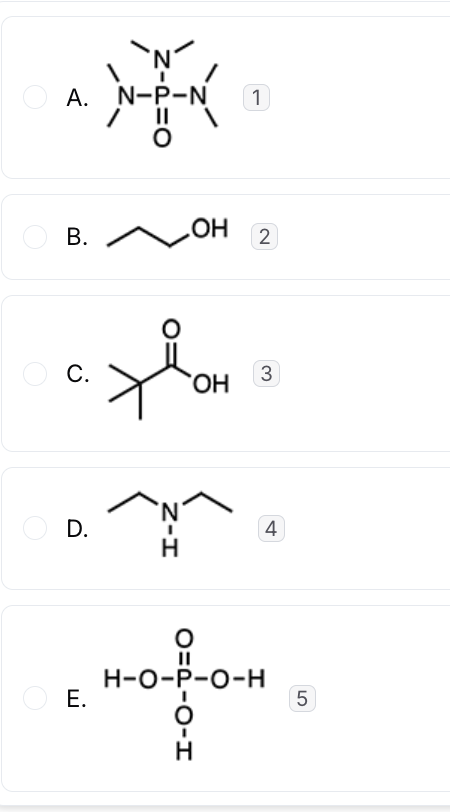
A
To decide which of the options is polar aprotic, it is helpful to determine which compounds lack the ability to form hydrogen bonds. To form a hydrogen bond, compounds must have a hydrogen atom directly bonded to N, F, or O atoms. Out of the options given, the only compound that is unable to form hydrogen bonds is choice A. Choice A lacks any hydrogen atoms bonded to electronegative atoms, so it can function as a polar aprotic solvent.
What solvent would be best for an SN2 reaction?
A. H2O
B. Acetone
C. Pentan-1-ol
D. Acetic acid
E. Potassium permanganate
B
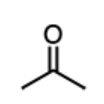
A polar aprotic solvent is the best solvent for an SN2 reaction because it does not engage in hydrogen bonding. When a solvent forms hydrogen bonds with a nucleophile, solvent molecules surround the nucleophile, and this makes the nucleophile less nucleophilic. The polar protic solvent also stabilizes the carbocation intermediate that forms during an SN1 reaction. Remember: aprotic solvents favor SN2 reactions, whereas protic solvents favor SN1 reactions. The only polar aprotic solvent listed is acetone.
The structure of acetone is shown below.
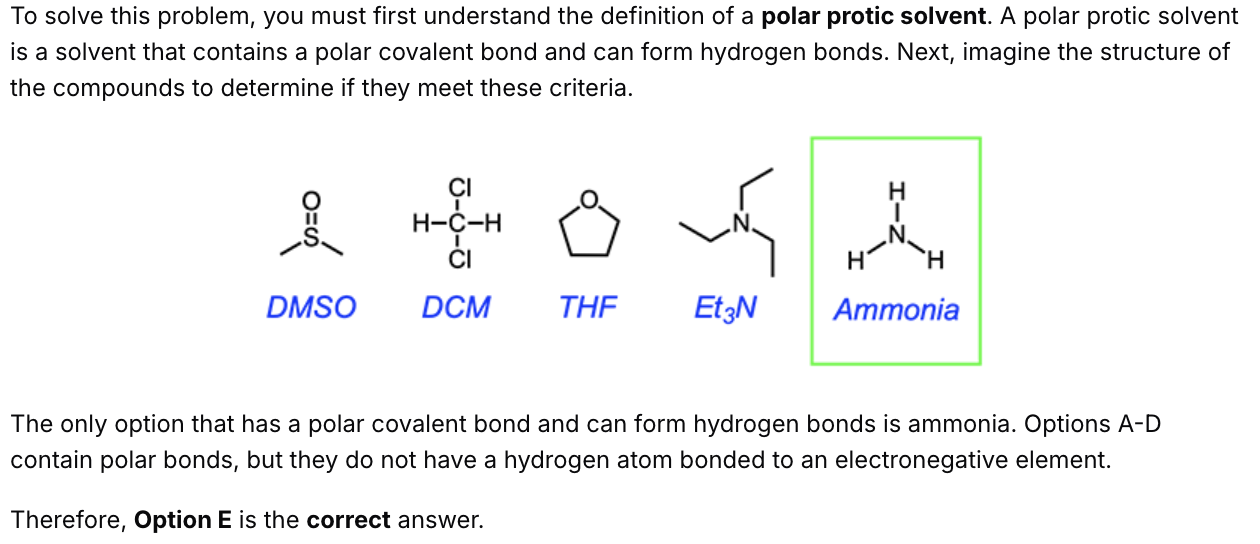
Which of the following is a polar protic solvent?
A. DMSO
B. DCM
C. THF
D. Et3N
E. Ammonia
E. Ammonia
Which of the following compounds would react with a primary alkyl halide through an E2 mechanism?
A. NaOMe
B. MeOH
C. NaI
D. t-BuOK
E. MeSH
D. t-BuOK