Acid Base Balance
 Call Kai
 Learn
Learn Practice Test
 Spaced Repetition
 Match
Match Flashcards
 Knowt Play
1/34

There's no tags or description
Looks like no tags are added yet.
Name | Mastery | Learn | Test | Matching | Spaced | Call with Kai | Chat |
|---|
No analytics yet
Send a link to your students to track their progress
35 Terms
Why is water neutral in pH?
There is no change in the ion/electron balance
Equal numbers of H+ and OH-
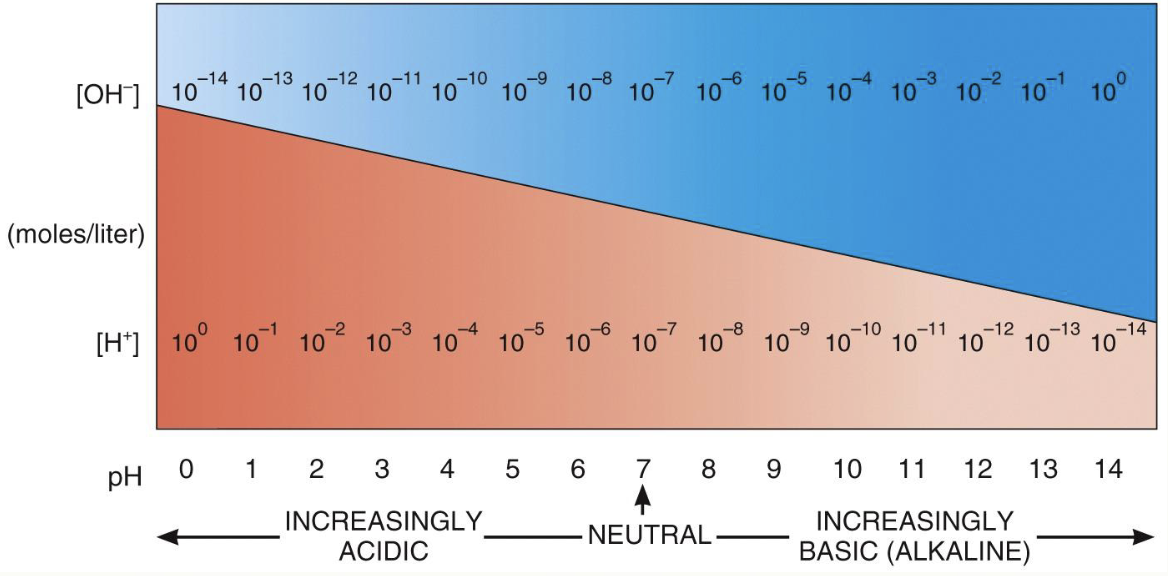
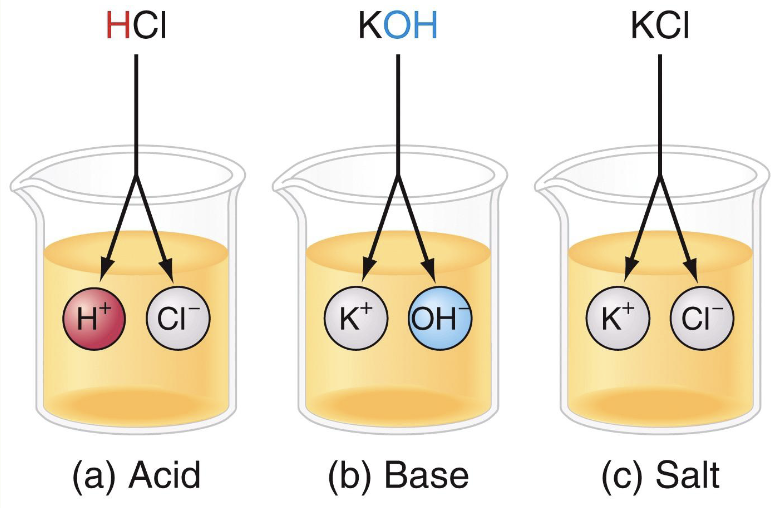
What is the electron difference between acids and bases?
Acids - higher H+ or lower OH-
Bases - higher OH- or lower H+
What is the pH scale based on?
The relative concentration of H+ ions
Acids - low pH
High H+
Base - high pH
Low H+
What are buffer systems used for?
Used to maintain body fluid homeostasis - if H+ is bound to a buffer, it doesn’t affect pH
Changes in pH affect enzymes and cell function in the body
Examples of buffer systems in the body - can bind H+ ions
Proteins - hemoglobin
Phosphates
Carbonic acid
Buffers are the fastest way for our bodies to maintain their homeostatic pH level
How do buffer systems operate?
Help regulate our pH by converting strong acids or bases into weak acids or bases
H+ + HCO3- ←→ H2CO3
Hydrogen + Bicarbonate ←→ Carbonic acid
If H+ ↓ or HCO3- ↑ - Alkalosis → body is too basic
Buffers will release H+ to lower pH
If H+ ↑ or HCO3- ↓ - Acidosis → body is too acidic
Buffer will bind H+ to remove H+ effect; remove from pH equation to raise pH
How does the carbonic acid equation function during acidosis?
H+ + HCO3- ←→ H2CO3 ←→ H2O + CO2
If the body is too acidic - reaction pushes to the right - produces more CO2 - respiration blows CO2 off to raise pH
How does the carbonic acid equation function during alkalosis?
H+ + HCO3- ←→ H2CO3 ←→ H2O + CO2
If the body is too alkalotic - reaction pushes to the left - more carbon dioxide combines with water (less CO2 to blow off) - carbonic acid releases H+ to lower pH
What does normal body pH look like?
pH of 7.38-7.42
H+ concentration is closely regulated by the buffer system
What are some things that abnormal pH does to the body?
Can alter the tertiary structure of proteins (denatures proteins)
Affects metabolism + anything metabolism does
Affects the nervous system
If the pH becomes abnormal, the entire body becomes affected
What is the difference between short-term and long-term pH correction?
Short-term - buffer binding
Long-term - ventilation or kidney

What are some sources of hydrogen ions (H+)?
Cell metabolism - CO2 production
Higher CO2 levels → higher H+ levels
Metabolic intermediate by-products
Lactic acid
Pyruvic acid
Acetoacetic acid
Fatty acids
Food products - break-down releases H+
Grains and nuts
Yogurt/dairy
Citric acid in fruit
Legumes
Meats
Medications - can stimulate HCl production by parietal cells of the stomach
Some disease processes
e.g. diabetes - improper fat metabolism, generation of ketoacids
What are some sources of bicarbonate ions (HCO3-)?
Fruits and veggies
The breakdown of some can produce bases - can help equalize acid production
Antacids
e.g. Tums
What are the 2 ways the body might increase it’s concentration of H+ ions?
An accumulation of acids
A loss of bases

What are the 2 types of pH disturbances and their effects?
Acidosis
Neurons become less excitable
CNS depression
Alkalosis
Hyperexcitability of the CNS
Tingling, twitches in the muscles + heart
How does pH affect potassium balance?
A change in pH levels will affect K+ balance
Affects nerve and muscle function
Affects enzyme activity
Potassium levels in plasma - maintained in a narrow range by aldosterone
What are the effects of abnormal potassium levels?
Hypokalemia - low blood potassium
Muscle weakness
Failure of respiratory muscles and heart
Hyperkalemia - high blood potassium
Cardiac arrhythmias
Why does pH affect potassium?
The kidney has a H+/K+ exchanger - excretes H+ and retains K+
With acidosis
[H+] is high → more H+ secreted → less K+ excretion
K+ retention affects cardiac function + other systems
How does pH affect enzyme activity?
pH changes (up or down) can alter the shape of the enzyme (denature)
Enzyme can become non-functional
Affects metabolic activity
How does acidosis/alkalosis occur?
Either metabolic or respiratory function
Metabolic - imbalance in the production and excretion of acids or bases
Caused by change in metabolism or kidney function
Respiratory - due to lung or breathing disorders (or environmental changes)
How might metabolic acidosis occur?
Metabolic organic acid production
Lactic acid (exercise)
Ketoacids - diabetes
Diarrhea
Organic acid intake in diet
How might respiratory acidosis occur?
Production of CO2 with decreased removal from lungs → accumulation of CO2 in the blood → acid production
e.g. caused by poor ventilation
How might metabolic alkalosis occur?
Vomitting → loss of acid
Dietary sources of bases - e.g. Tums
Pyloric stenosis
How might respiratory alkalosis occur?
Hyperventilation
e.g. caused by high altitudes
What do the terms acidemia and alkalemia mean?
Indicates a change in pH of the blood - can be acute or chronic
Acidemia - lower than normal blood pH
Alkalemia - higher than normal blood pH
Normal blood pH
7.35 - venous (deoxygenated)
7.45 - arterial (oxygenated)
Why does venous blood have a lower pH than arterial blood?
Venous blood removes CO2 from tissues, which can convert to H+ if it interacts with water
What 3 mechanisms are responsible for maintaining pH homeostasis in the body?
Buffers - combines or releases H+
Quickest corrrection
Ventilation - increase or decrease breathing rate
Also responsible for 75% of acid/base imbalances
Renal regulation - directly excreting/reabsorbing H+
Slowest of the 3 mechanisms
Describe buffers as a pH fixing mechanism
Fastest response to pH disturbances - within seconds
Combines with H+/releases H+ so pH isn’t affected
Phosphate
Protein - hemoglobin carriers
Bicarbonate equation
Describe respiratory compensations as a pH fixing mechanism
pH is adjusted by changing the rate and depth of breathing - response occurs within minutes
H+ + HCO3- ←→ H2CO3 ←→ H2O + CO2
Acidosis lowers pH → breathing increases → decreases blood CO2 and H+ → increases pH
Alkalosis raises pH → breathing decreases → increases blood CO2 and H+ → decreases pH

Describe renal compensation as a pH fixing mechanism
Kidneys can retain or eliminate H+ or HCO3- - response occurs within hours (slowest)
Apical Na+/H+ exchanger (NHE)
Reabsorbs Na+ while it removes H+
Na+/HCO3- symport
Reabsorbs HCO3- while it reabsorbs Na+
H+/ATPase
Removes or reabsorbs H+
H+/K+/ATPase
Reabsorbs K+ while it removes H+ (acidosis)
Reabsorbs H+ while it removes K+ (alkalosis)
Na+/NH4+ antiport
What are the body’s corrections for acidosis?
To raise body pH
Buffers bind to H+
Breathing increases
Decreases CO2 and H+ via carbonic acid
Kidneys excrete H+ and reabsorb HCO3-
What is the function of intercalated type A cells?
Type A intercalated cells function to correct for acidosis
Secrete H+ into the urine
Reabsorb HCO3-
What are the body’s corrections for alkalosis?
To lower body pH
Buffers release H+
Breathing slows
Retains CO2 and H+
Kidneys retain H+ and excrete HCO3-
What is the function of intercalated type B cells?
Type B intercalated cells function to correct for alkalosis
Secrete HCO3- into the urine
Reabsorb H+
What are the compensations for metabolic pH disturbances?
If the kidneys are causing the pH disturbance, the respiratory system can compensate
Kidneys excreting too much H+ in the urine (metabolic alkalosis) → breathing slows to reduce CO2 loss → less H+ is lost
Kidneys reabsorbing too much H+ (metabolic acidosis) → breathing increases to increase CO2 loss → more H+ is lost
What are the compensations for respiratory pH disturbances?
If the respiratory system is the problem, the kidneys can compensate
Breathing is too rapid → excessive loss of CO2 (respiratory alkalosis) → kidneys reabsorb more H+
Breathing is too shallow → keeping too much CO2 (respiratory acidosis) → kidneys secrete more H+ in the urine