PKP Kap. 8
 Call Kai
 Learn
Learn Practice Test
 Spaced Repetition
 Match
Match Flashcards
 Knowt Play
1/5

There's no tags or description
Looks like no tags are added yet.
Name | Mastery | Learn | Test | Matching | Spaced | Call with Kai | Chat |
|---|
No analytics yet
Send a link to your students to track their progress
6 Terms
How was a scientific taxonomy of personality traits established, why is it required, and why is the Big Five considered the best-supported taxonomy?
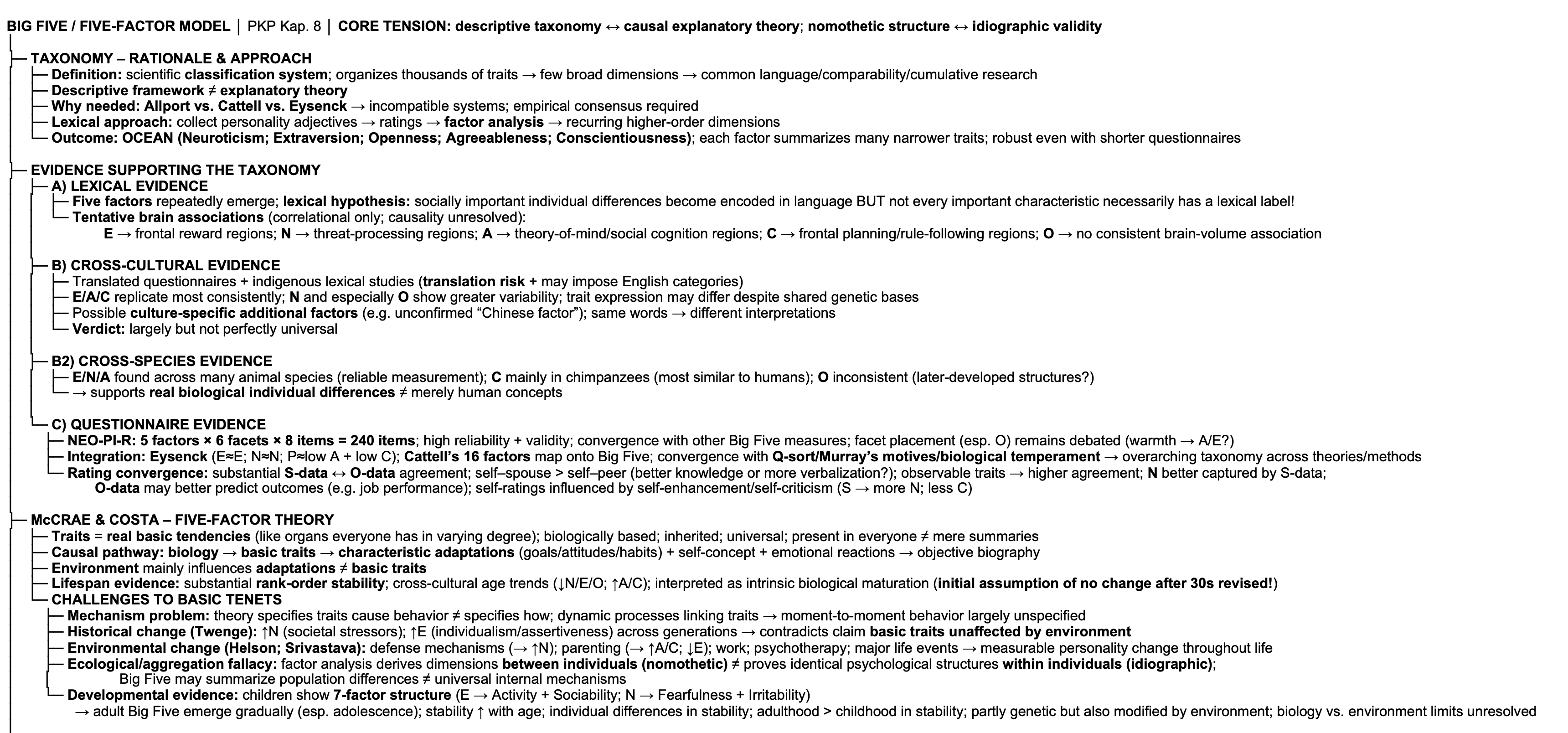
Taxonomy: scientific classification system; organizes thousands of traits into few broad dimensions → common language; comparability; cumulative research; descriptive framework ≠ explanatory theory.
Why required: early trait theorists agreed on stable traits but disagreed on number/organization (Allport vs. Cattell vs. Eysenck) → incompatible systems; empirical consensus needed.
Empirical approach: (1) natural language (lexical approach) → collect personality adjectives → ratings → factor analysis → recurring higher-order dimensions. → Outcome: OCEAN (Neuroticism; Extraversion; Openness; Agreeableness; Conscientiousness); each factor summarizes many narrower traits; robust even with shorter questionnaires.
Evidence supporting the taxonomy:
Lexical evidence: five factors repeatedly emerge; lexical hypothesis → socially important individual differences become encoded in language (though not every important characteristic necessarily has a lexical label).
(1.1) Tentative brain associations: E→frontal reward regions; N→threat-processing regions; A→theory-of-mind/social cognition regions; C→frontal planning/rule-following regions; O→no consistent brain-volume association; correlational only (causality unresolved).
Cross-cultural evidence: translated questionnaires + indigenous lexical studies (translation may impose English categories); E, A, C replicate most consistently; N and especially O show greater variability; trait expression may differ despite shared/genetic bases; possible culture-specific additional factors (e.g., unconfirmed “Chinese factor”), same words different interpretation etc. → largely, not perfectly, universal.
(2.1) Cross-species evidence: E, N, A found across many animals (reliable measurement!); C mainly in chimpanzees (most similar to humans); O inconsistent (later developed structures?) → supports real biological individual differences, not merely human concepts.
Questionnaire evidence: NEO-PI-R (5 factors → 6 facets each → 8 items each; 240 items); high reliability; validity; convergence with other Big Five measures; facet placement (especially Openness) remains debated.
(3.1) Integration of previous theories: Eysenck (E≈E; N≈N; P≈low A + low C); Cattell’s 16 factors map onto Big Five; convergence with Q-sort, Murray’s motives, biological temperament → overarching taxonomy across theories/methods.
(3.2) Rating convergence: substantial S-data ↔ O-data agreement (self–spouse > self–peer / better knowledge or more verbalization?); observable traits show higher agreement; Neuroticism better captured by S-data; O-data may better predict outcomes (e.g., job performance); self-ratings influenced by self-enhancement/self-criticism (S- more N, less C).
What evidence supports and challenges the assumption that personality traits are causal psychological structures?
Support (McRea & Costa’s Five-Factor Theory):
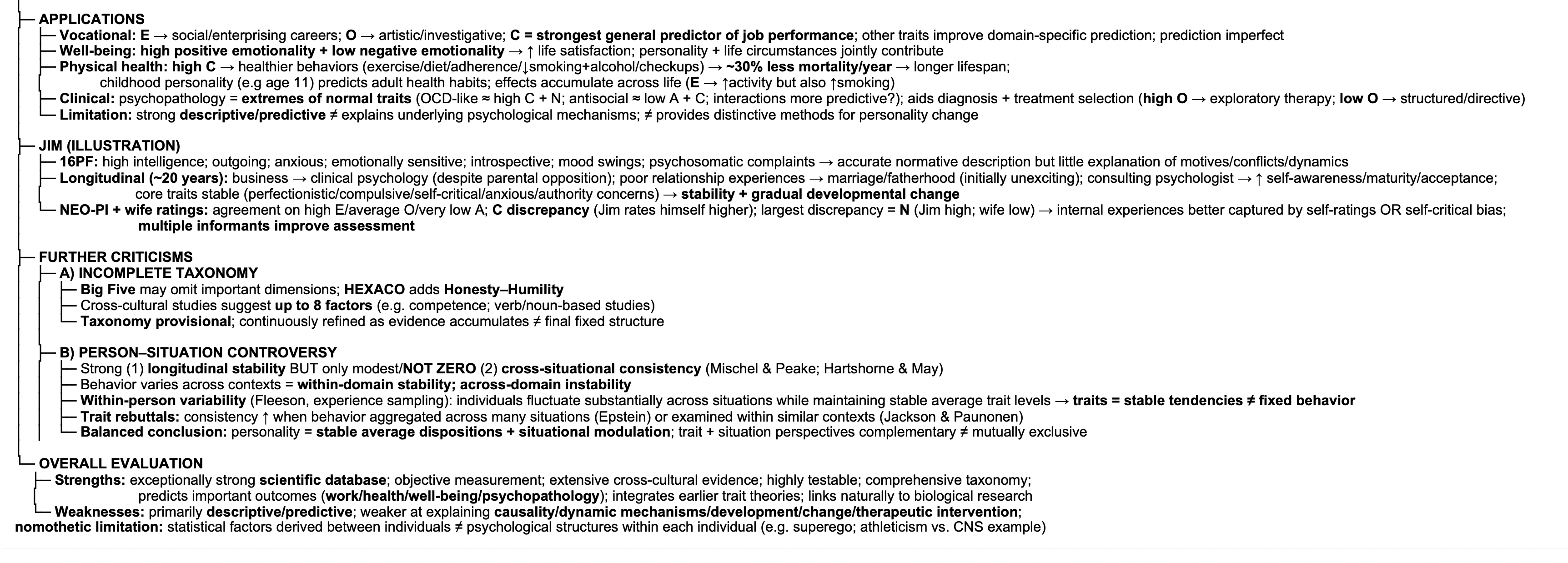
Traits = real basic tendencies (like organs everyone has in varying size); biologically based; inherited; universal; present in everyone (degree differs) ≠ mere summaries.
Causal pathway: biology → basic traits → characteristic adaptations (goals; attitudes; habits) + self-concept + emotional reactions → objective biography; environment mainly influences adaptations, not basic traits.
Growth & Development / Lifespan evidence: substantial rank-order stability; cross-cultural age trends (↓N/E/O; ↑A/C); interpreted as intrinsic biological maturation (but initial assumption of no change after 30s revised!).
Challenges:
Mechanism problem: theory specifies that traits cause behavior, not how; dynamic psychological processes linking traits → moment-to-moment behavior largely unspecified.
Historical change (Twenge): ↑Neuroticism (likely societal stressors); ↑Extraversion (greater individualism/assertiveness) across generations → contradicts claim that basic traits are unaffected by environment.
Environmental change: Helson; Srivastava; defense mechanisms (more → greater N later); parenting (greater A/C, less E); work; psychotherapy; major life events → measurable personality change; environment influences traits throughout life.
Ecological/aggregation fallacy: factor analysis derives dimensions between individuals (nomothetic) ≠ proves identical psychological structures within individuals (idiographic); Big Five may summarize population differences rather than represent universal internal mechanisms.
Developmental evidence: children show 7-factor structure (E → Activity + Sociability; N → Fearfulness + Irritability) → adult Big Five emerge gradually (especially during adolescence); personality becomes increasingly stable with age (individual differences in stability); adulthood > childhood in stability; remains partly genetically influenced but also modified by environmental experiences → precise limits of biology vs. environment remain unresolved.
What are the major applications of the Big Five, and how does Jim’s case illustrate both its usefulness and its limitations?
Applications:
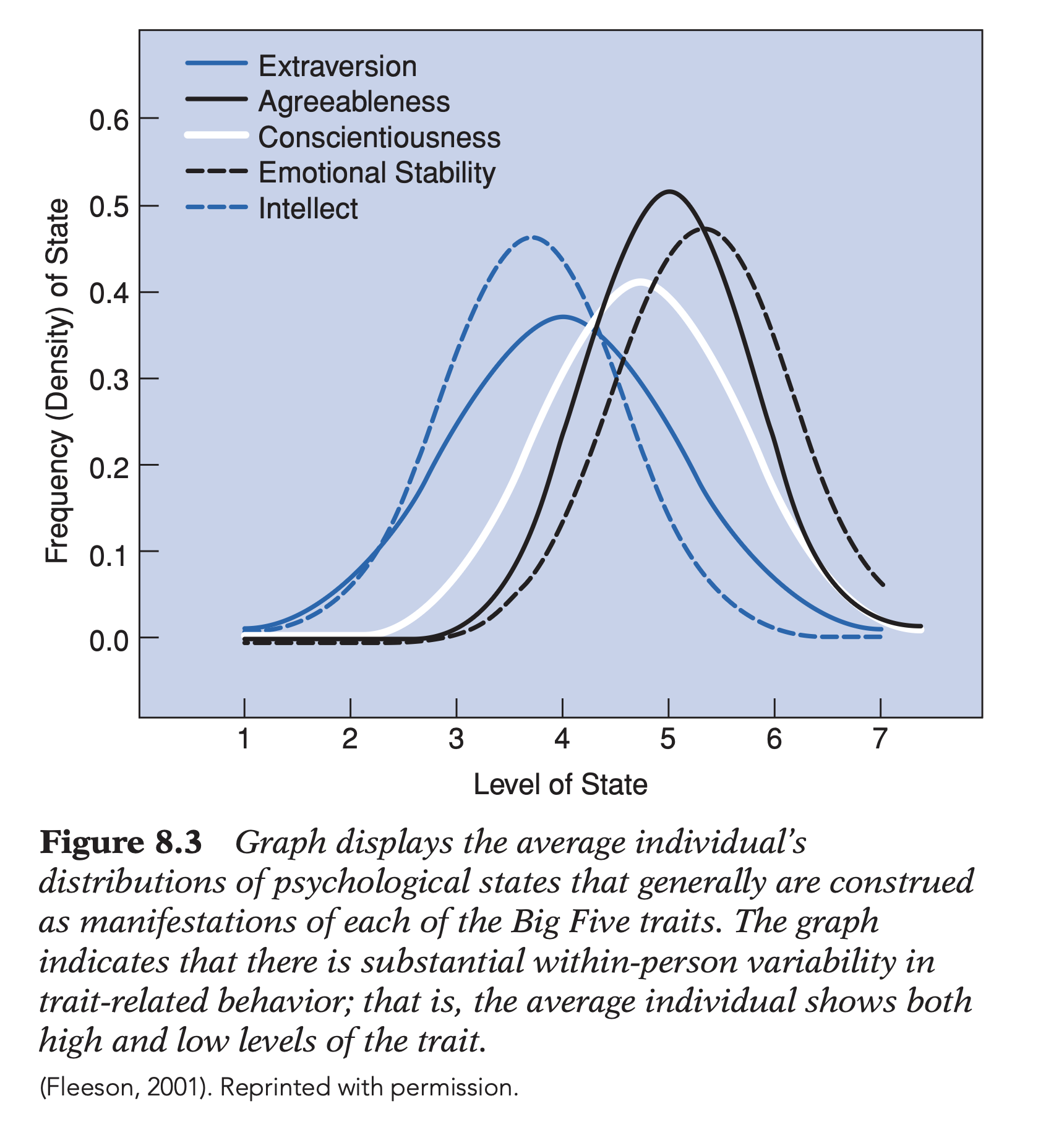
Vocational: predicts career preferences (E→social/enterprising; O→artistic/investigative); C = strongest general predictor of job performance; other traits improve domain-specific prediction; prediction imperfect!!
Well-being: high positive emotionality + low negative emotionality → greater life satisfaction; personality + life circumstances jointly contribute.
Physical health: high C → healthier behaviors (exercise; diet; adherence; ↓smoking/alcohol; checkups // -30% less mortality each year!) → longer lifespan; childhood (11 in study) personality predicts adult health habits; effects accumulate across life (E→↑activity but also ↑smoking).
Clinical: psychopathology viewed as extremes of normal traits (e.g., OCD-like ≈ high C + N; antisocial ≈ low A + C // Interactions more predictive?); aids diagnosis + treatment selection (high O→exploratory therapy; low O→structured/directive).
Limitation: strong descriptive/predictive framework ≠ explains underlying psychological mechanisms or provides distinctive methods for personality change.
Jim:
16PF: high intelligence; outgoing; anxious; emotionally sensitive; introspective; mood swings; psychosomatic complaints → accurate, normative description of stable traits but little explanation of motives/conflicts/dynamics.
Longitudinal course (~20 years): business → clinical psychology (despite parental opposition; business); relationships (poor experience, later “not as exciting“); communal self-growth; marriage; fatherhood; consulting psychologist → ↑self-awareness; maturity; acceptance of others; core traits remained stable (perfectionistic; compulsive; self-critical; anxious; authority concerns) → stability + gradual developmental change.
NEO-PI + wife ratings: agreement on high E; average O; very low A; minor C difference (Jim rates himself higher); largest discrepancy = N (Jim high; wife low) → internal experiences better captured by self-ratings or self-critical bias; multiple informants improve assessment.
Overall: Big Five reliably describes and predicts stable individual differences and real-world outcomes, but does not explain the psychological processes producing them.
What are further criticisms of trait theories, and how can they be evaluated overall?
Further criticisms:
Incomplete taxonomy: Big Five may omit important dimensions; HEXACO adds Honesty–Humility; further cross-cultural replicated studies suggest up to 8 factors (e.g., competence or based on verbs/nouns) → taxonomy remains provisional; personality classification is continuously refined as new empirical evidence accumulates rather than representing a final, fixed structure.
Person–situation controversy: strong (1) longitudinal stability but only modest, NOT ZERO, (2) cross-situational consistency (Mischel & Peake; Hartshorne & May); behavior varies across contexts ( = within-domain stability, across-domain instability!).
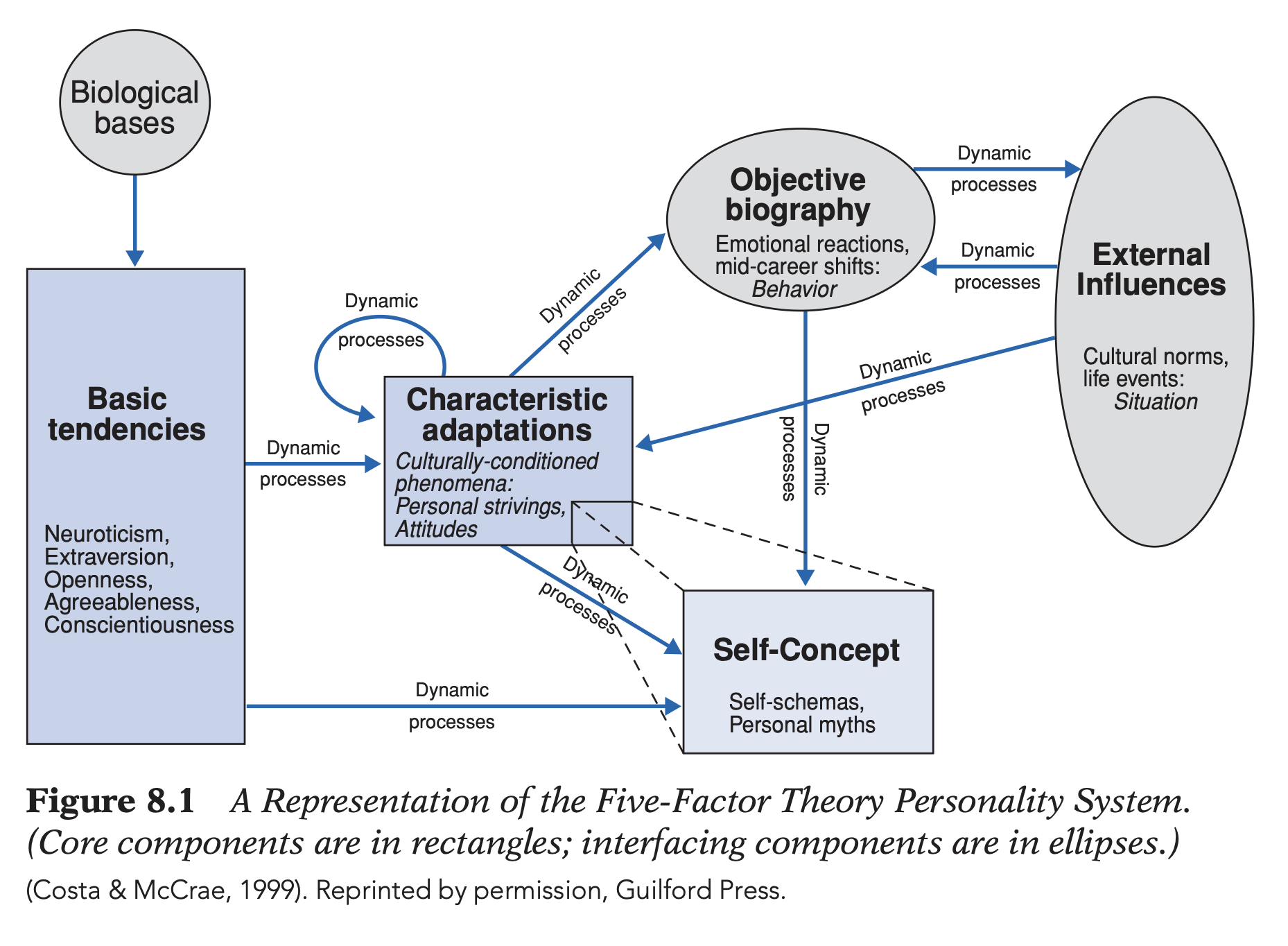
Within-person variability: Fleeson (Experience sampling study) → individuals fluctuate (variation) substantially across situations while maintaining stable average trait levels → traits = stable tendencies, not fixed behavior.
Trait rebuttals: consistency increases when behavior is aggregated across many situations (Epstein) or examined within similar contexts (Jackson & Paunonen).
Balanced conclusion: personality reflects stable average dispositions + situational modulation; trait and situation perspectives are complementary rather than mutually exclusive.
Evaluation:
Strengths: exceptionally strong scientific database; objective measurement; extensive cross-cultural evidence; highly testable hypotheses; comprehensive taxonomy; predicts important outcomes (work; health; well-being; psychopathology); integrates earlier trait theories; links naturally to biological research.
Weaknesses: primarily descriptive and predictive; weaker at explaining causality, dynamic psychological mechanisms/processes, personality development/change, and therapeutic intervention; nomothetic limitation: statistical factors derived between individuals may not represent psychological structures within each individual (i.e. structures like superego etc.; athleticism vs. CNS example).
Tree (PKP Kap. 8) 1/2
Tree (PKP Kap. 8) 2/2