Chemistry of Life 2.2: Water, Solutions, Acid/Base/PH,
 Call Kai
 Learn
Learn Practice Test
 Spaced Repetition
 Match
Match Flashcards
 Knowt Play
1/9

There's no tags or description
Looks like no tags are added yet.
Name | Mastery | Learn | Test | Matching | Spaced | Call with Kai | Chat |
|---|
No analytics yet
Send a link to your students to track their progress
10 Terms
What is a mixture?
Substances that are physically blended but not chemically combined. Each substance retains it’s own chemical properties.
Hydrophilic vs Hydrophobic
Hydrophilic is attracted to water, will dissolve within
Hydrophobic will not dissolve into water
Solutions
Particles of matter (solute) mixed into a more abundant substance (solvent)
The solute and solvent cannot be distinguished from one another
Usually transparent
They do not separate from one another
Colloids
Mixtures with larger molecules
Can be cloudy
Too large to pass through permeable membranes
Small enough to remain permanently mixed
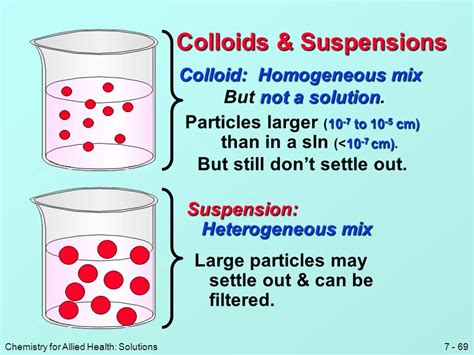
Suspension
Blood cells in bloom plasma
Are big
Too heavy to remain permanently suspended, so separate when standing still
Emulsion
Suspension of one liquid in another
oil and vinegar
Acid
Proton donor, molecules that release a proton into water
Base
Proton acceptor
pH Scale: Neutral, Acidic, Basic
Ranges from 0 - 14
Acidic: pH of 6 and below (milk 6.3 - 6.6, coffee, bread 5.0, bananas or tomatoes 4.7, wine/vinegar 2.4-3.5, lemon juice 2.3, gastric juice 0.9 - 3.0, and hydrolic acid 0)
Neutral: pH of 7 (water 7.0)
Basic: pH of 8 and higher (egg white 8, household bleach 9.5, household ammonia 10.5-11, oven cleaner or lye 13.4, sodium hydroxide 14)
What is the normal pH of blood?
7.35 - 7.45 - deviations can cause tremors, fainting, paralysis, or even death