International Strategic Management Flashcards
 Call Kai
 Learn
Learn Practice Test
 Spaced Repetition
 Match
Match Flashcards
 Knowt Play
1/51

Earn XP
Description and Tags
A comprehensive set of vocabulary flashcards covering the core concepts of International Strategic Management, including strategy design, competitive models, international expansion strategies, and performance measurement tools like the Balanced Scorecard.
Name | Mastery | Learn | Test | Matching | Spaced | Call with Kai | Chat |
|---|
No analytics yet
Send a link to your students to track their progress
52 Terms
VUCA
An acronym representing dynamics in the business world: Volatility, Uncertainty, Complexity, and Ambiguity.
4 Criteria for Core competencies
Valuable, Inimitable, Rare, Unsubstitutable
Strategy Design
A consistent set of measures aligning a company and its environment, with the overriding goal of creating value for all stakeholders in a balanced way.
Corporate level strategy
A strategic level that addresses in which businesses the organization will compete.
Business level strategy
A strategic level that focuses on how a firm competes in its businesses to achieve competitive advantages.
Functional level strategy
A strategic level that determines how to adopt a strategic plan in functional areas like marketing, finance, HR, and IT.
SMART
A mnemonic for setting objectives: Specific, Measurable, Actively Controllable, Realistic, and Terminated.
Related Diversification
A strategy involving an understanding of business and opportunities of core competencies to add complementary offerings to existing products or markets.
Unrelated Diversification
A strategy involving new or unrelated product lines or markets with no direct fit to the existing business.
Single-Product Strategy
Offering one product or service line, focusing all resources and efforts on its success ! product failure
Michael Porter competitive strategies
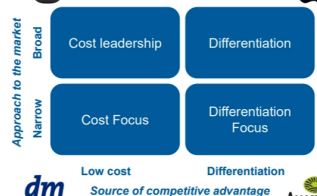
Differentiation
A business level strategy from Michael Porter focused on distinguishing from competitors through features like higher quality.
Focus strategy
A strategy that concentrates on a specific regional market, market segment, group of buyers, or product line using differentiation or cost leadership.
Market-oriented perspective
A view where success is determined by external factors in the company's environment, originating from industrial economics.
Resource-based view
A perspective originating from Penrose in 1959 where firm competitive advantage comes from bundles of valuable and rare resources and competencies that are difficult to imitate.
Strategy Design Definition
consistent set of measures aligning a company and its environment → goal: creating value for all stakeholders in a balanced way
3 Criteria for evaluating strategy
Potential contribution to target, feasibility, ethical issues
Strategy Design Modelling Approaches
Three methods: Linear process (top down/left to right), Network process (jumping between perspectives), and Pyramid approach (combining both).
Vision
target picture of a company - providing direction and inspiration internally
Mission
scope of the businesses operations in product and market terms — guiding and ensuring vision can be achieved
Criteria for Vision
Trendsetting, Convincing, Realizable, Concise
Values
shape behaviour within a company - basis for company culture
Corporate Philosophy
The combination of Vision + Mission + Values.
Type of Stakeholders
Customers, Suppliers, Complementors, Employees, Financiers, Society, Governments, Competitors
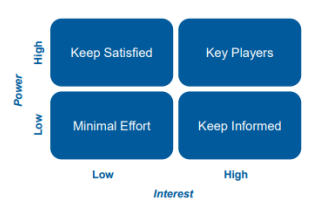
Stakeholder Mapping
A tool using a horizontal axis for the stakeholder's degree of interest and a vertical axis for the strength of influence.
STIEM-Model
understanding relation to stakeholders — Stakeholder, Typology, Influence, Expectations, Measures
International Strategy
An international strategy focused on selecting markets to export to with minimal risk and investment, but a loss of control over the product.
Multidomestic Strategy
A decentralized international strategy with tailor-made products for local markets and minimal central coordination — focused on competition within niche
Global Strategy
A centralized international strategy using product standardization across markets and one HQ-controlled strategy to leverage synergies and Economies of scale.
Transnational Strategy
An international strategy that maxes out local responsiveness and global efficiency through high standardization and selective customization.
PESTEL framework
A tool used to forecast macro environmental influences: Political, Economic, Socio-Cultural, Technological, Environmental, and Legal.
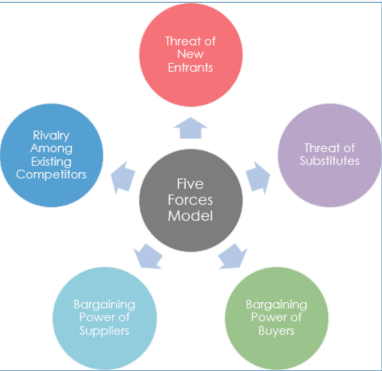
Porter’s 5-Forces Model
A model identifying forces that shape industry structure and determine the root causes of profitability.
Opportunity-Threat Radar
A recurrent tool categorizing impacts as Incremental, Radical, or Disruptive based on PESTEL-Analysis.
Benchmarking
The process of searching for best practices that lead to superior performance - evaluating strengths and weaknesses → concise, actionable, significant, authentic
SWOT Analysis
Provides strategic insight on recommendations by mapping Strengths, Weaknesses, Opportunities, and Threats.
Value Innovation
The ambition to dominate the market by offering a leap in value, combining cost reduction (eliminating outdated factors) and buyer value increase.
Blue Ocean Strategy
A strategy focused on opening up untapped market spaces for demand creation and highly profitable growth. X-attributes, Y-Values
ERRC
Eliminate, Raise, Reduce, Create
Ansoff-Matrix (Product-Market-Mix)
A matrix defining four growth strategies: Market Penetration, Innovation Strategy, Market Development, and Diversification.
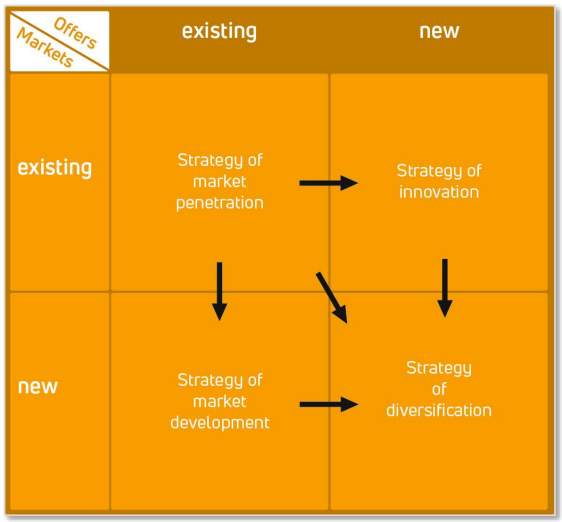
Market Penetration
intensify revenue with existing product/market — marketing, pricing policy, distribution, etc
Innovation Strategy
Existing markets supplied with new products — relaunch, innovation, product range, new features, etc.
Market development
New markets for existing products — new market segments, internationalization, distribution channels, advertising with new media
Diversification
investing in new products for new markets — horizontal, vertical and lateral diversification
DVC Framework
The Digital Value Creation framework comprising 6 elements: Platform, Services, Gratifications, Performance Groups, Transactions, and Interface.
SDERO
The Strategy Design Roadmap approach, a 4-step process using a time funnel to organize necessary actions.
RACI-Chart
A Linear Responsibility Matrix that assigns roles for actions: Responsible, Accountable, Consulted, and Informed.
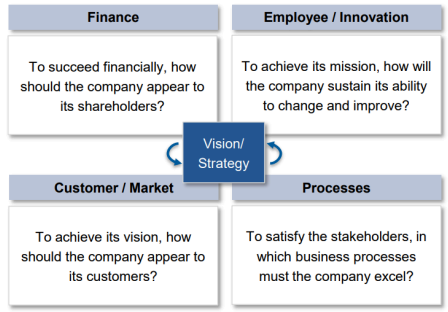
Balanced Scorecard (BSC)
An organization examination tool that ensures a balance between short-term and long-term objectives across 4 perspectives.
Business Model Canvas
A tool used to describe, think through, and develop business models covering 9 core elements across Infrastructure, Customers, Value Proposition, and Commercial Model.
Balanced Scorecard (BSC)
Helps organizations balance short-term and long-term objectives across financial, customer, internal process, and learning perspectives.
Business Model Canvas components
Framework for visualizing and designing business models, covering nine essential components: Key Partners, Key Activities, Key Resources, Value Proposition, Customer Relationships, Channels, Customer Segments, Cost Structure, and Revenue Streams.
Counter to VUCA
Vision, Understanding, Clarity, and Agility.
Difference between Strategy Design and Business Modelling
SD: measures all align to common strategic direction; comprehensive
BM: not aligned with strategic direction; not comprehensive - prioritised aspects; focus on value for specific customers and shareholders