Nervous System II
 Call Kai
 Learn
Learn Practice Test
 Spaced Repetition
 Match
Match Flashcards
 Knowt Play
1/81

There's no tags or description
Looks like no tags are added yet.
Name | Mastery | Learn | Test | Matching | Spaced | Call with Kai | Chat |
|---|
No analytics yet
Send a link to your students to track their progress
82 Terms
neurotransmitter removal
reuptake (brought back into terminal) and enzymatic breakdown
reuptake inhibitors
prevents reuptake, which increases amount of neurotransmitter
receptors
proteins that recognize chemical signals; neurotransmitters produce change
-based on receptor, neurotransmitters can be excitatory or inhibitory
ionotropic (ligand-gated) receptor
ion flow; charges membrane potential; FAST
metabotropic (G-protein coupled) receptor
second messenger system; intracellular signaling; changes cell activity (ex. gene txn); SLOW
acetylcholine (ACh) production
choline + acetyl CoA → acetylcholine
acetylcholine primary biosynthetic enzyme
choline acetyltransferase
acetylcholine receptors
-nicotine (ionotropic, fast)
-muscarinic (metabotropic, slower)
enzyme that breaks down acetylcholine
acetylcholinesterase (AChE)
-ACh → choline + acetate; choline pulled back into presynaptic terminal and recycled
major functions of acetylcholine
neuromuscular transmission, autonomic signaling, attention/memory in CNS
-ex. decreased levels in dementia
monoanime neurotransmitters
dopamine, norepinephrine, epinephrine, serotonin, histamine
-all stored in vesicles and released by exocytosis
dopamine (DA) production
tyrosine → L-DOPA → dopamine
dopamine primary biosynthetic enzyme
tyrosine hydroxylase
dopamine receptors
-D1-like receptors (metabotropic, modulates positively (increases activity); D1, D5
-D2-like receptors (metabotropic, modulates negatively (decreases activity); D2, D3, D4
dopamine signal termination
-MAO and COMT metabolize
-dopamine transporter (DAT) returns DA into cell
cocaine inhibits
dopamine transporter
major functions of dopamine
movement, reward, cognition
norepinephrine (NE) production
tyrosine → L-DOPA → dopamine → norepinephrine
norepinephrine primary biosynthetic enzyme
dopamine ß-hydroxylase
norepinephrine receptors
-alpha receptors (metabotropic; α1, α2)
-beta receptors (metabotropic; ß1, ß2, ß3)
noreprinephrine signal termination
-MAO and COMT metabolize
-norepinephrine transporter (NET) returns NE to cell
major functions of norepinephrine
arousal, cardiovascular regulation, stress response
epinephrine (E) production
tyrosine → L-DOPA → dopamine → norepinephrine → epinephrine
epinephrine receptors
same as norepinephrine
-alpha receptors (metabotropic; α1, α2)
-beta receptors (metabotropic; ß1, ß2, ß3)
epinephrine signal termination
same as norepinephrine
-MAO and COMT metabolize
-norepinephrine transporter (NET) returns to cell
major functions of epinephrine
fight or flight, elevated heart rate and blood pressure, bronchodilation, elevated blood glucose
serotonin (5-HT) production
tryptophan → 5-hydroxytryptophan → serotonin
serotonin primary biosynthetic enzyme
tryptophan hydroxylase
serotonin receptors
-5-HT3 receptors (ionotropic; Na+, Ca+ goes through)
-other receptors (metabotropic; 5-HT1-7 (no 3))
serotonin signal termination
-MAO metabolizes
-serotonin transporter (SERT) returns 5-HT to cell
major functions of serotonin
mood, sleep, appetite
GABA (γ-aminobutyric acid)
major inhibitory neurotransmitter in CNS; decreases neuronal activity
GABA production
glutamate → GABA; cleared from synaptic cleft by transporters
GABA primary biosynthetic enzyme
glutamate decarboxylase
GABA receptors
hyperpolarization
-ionotropic GABAA (fast inhibitory)
-metabotropic GABAB (slower modulatory)
GABA signal termination
-GABA-T and SSADH metabolize
-GABA transporter (GAT) reuptakes GABA
major functions of GABA
reduces neuronal excitability, anxiety reduction, sleep regulation, motor control
glutamate
major excitatory neurotransmitter in CNS
glutamate production
glutamine → glutamate
glutamate primary biosynthetic enzyme
glutaminase
glutamate receptors
-ionotropic (fast excitatory; AMPA, NMDA, Kainate)
-metabotropic (modulatory; mGluRs)
glutamate reuptake
EAAT transporters reuptake glutamate, converted to glutamine in glia
major functions of glutamate
excitatory neurotransmission, learning, synaptic plasticity, sensory transmission
parts of brain
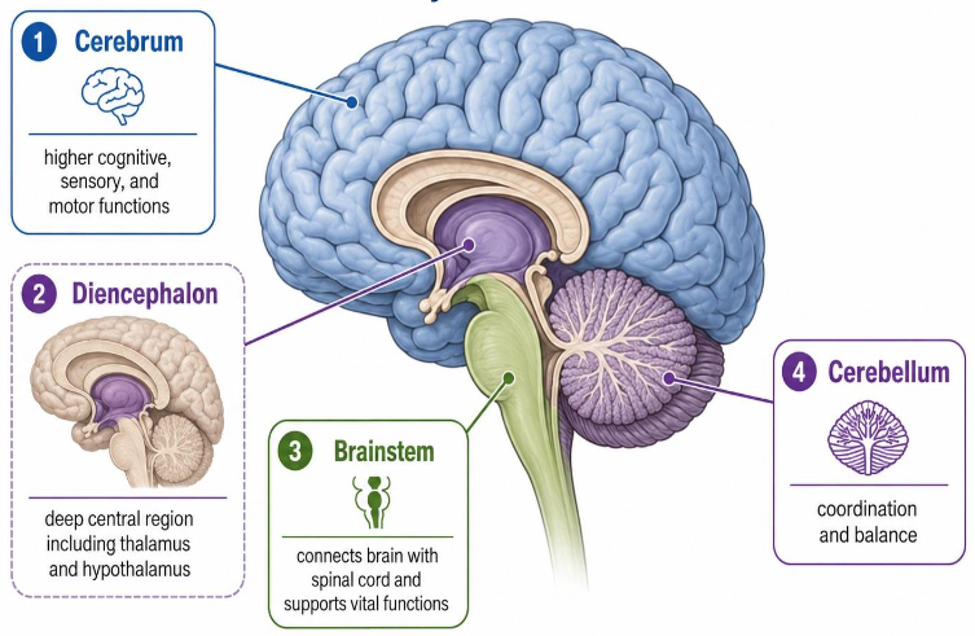
cerebrum
higher cognitive, sensory, motor neurons
-has left & right hemispheres
-has gray and white matter
gray matter
outer, cerebral cortex; made of dendrites, neuronal cell bodies
white matter
underlying; connects regions; made of axons
corpus callosum
connects hemispheres
diencephalon
deep central region including thalamus and hypothalamus
brainstem
connects brain with spinal cord and supports vital functions
cerebellum
coordination and balance
gyrus/gyri
ridge (bump) in brain
sulcus/sulci
groove in brain
fissure
deeper groove in brain
anterior
front
posterior
back
superior
top/above
inferior
bottom/below
lateral
away from midline
medial
toward midline
saggital plane
divides left & right hemispheres
coronal
divides anterior & posterior
axial
divides superior & inferior
brain lobes
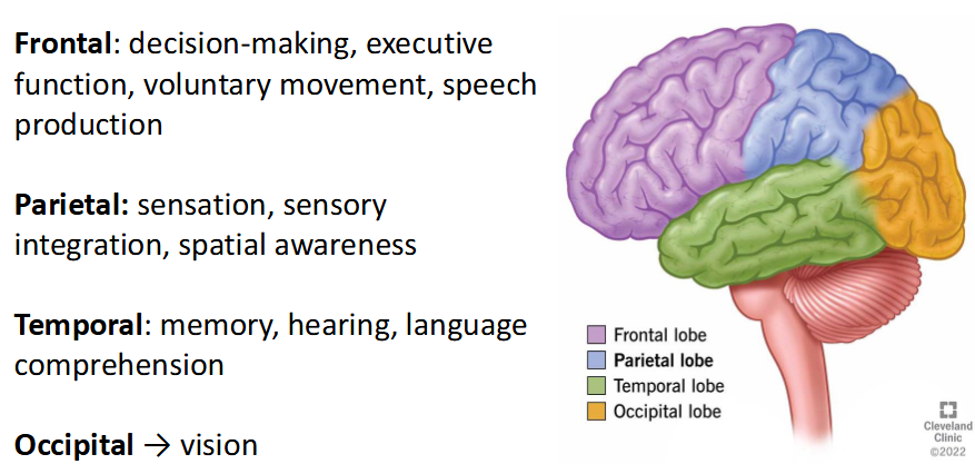
frontal lobe
decision making, speech, voluntary movement
parietal lobe
sensation, sensory, spatial awareness
temporal lobe
memory, hearing, language
occipital
vision
cortical functional areas
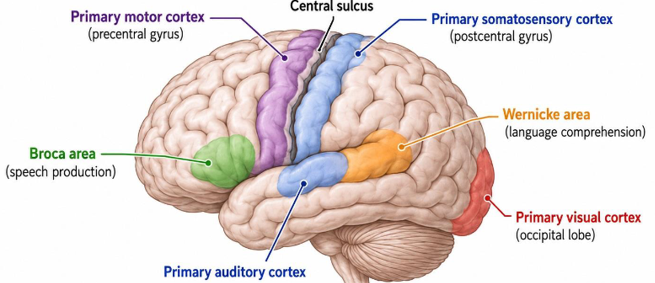
basal ganglia
regulation of movement
striatum
-major input region of ganglia
-caudate + putamen
hippocampus
learning, memory formation
thalamus
major relay/integration center, sensory info sent out
hypothalamus
homeostasis, autonomic & endocrine regulation, temperature, hunger, thirst
protection of CNS
DAP (dura, arachnoid mater, pia mater); subarachnoid space
dura
tough layer inside skull
arachnoid mater
middle layer
pia mater
thin inner layer
subarachnoid space
contains cerebrospinal fluid; between brain and pia mater
cerebrospinal fluid
absorbs shock, maintains chemical environment, waste removal
choroid plexus
produces cerebrospinal fluid
ventricles
lateral ventricles → third ventricle → cerebral aqueduct → fourth ventricle → subarachnoid space