Business Tax (Trading Profits, Income Tax)
 Call Kai
 Learn
Learn Practice Test
 Spaced Repetition
 Match
Match Flashcards
 Knowt Play
1/13

There's no tags or description
Looks like no tags are added yet.
Name | Mastery | Learn | Test | Matching | Spaced | Call with Kai | Chat |
|---|
No analytics yet
Send a link to your students to track their progress
14 Terms
Calculating trading profits
trading profit/loss =
Chargeable receipts − deductible expenses − capital allowances
sequence:
[company only] 1. full expensing (can be bought to lease out)
2. AIA (1M)
3. 40% FYA
4. 18% WDA on existing pool
_
-FYA - new stuff, can be bought to lease out. excess goes to pool subsequent year
![<p>trading profit/loss =<br><strong>Chargeable receipts − deductible expenses − capital allowances</strong><br><br><u>sequence:</u><br>[company only] <strong><em>1. full expensing </em></strong><em>(can be bought to lease out)</em><br>2. <strong>AIA </strong>(1M)<br>3. <strong>40% FYA</strong> <br>4. <strong>18% WDA </strong>on existing pool<br>_<br>-FYA - <em>new stuff, can be bought to lease out. excess goes to pool subsequent year</em></p>](https://assets.knowt.com/user-attachments/ad36a793-23e3-4b1e-9498-fe6047d3e036.jpg)
Trading losses — unincorporated businesses overview
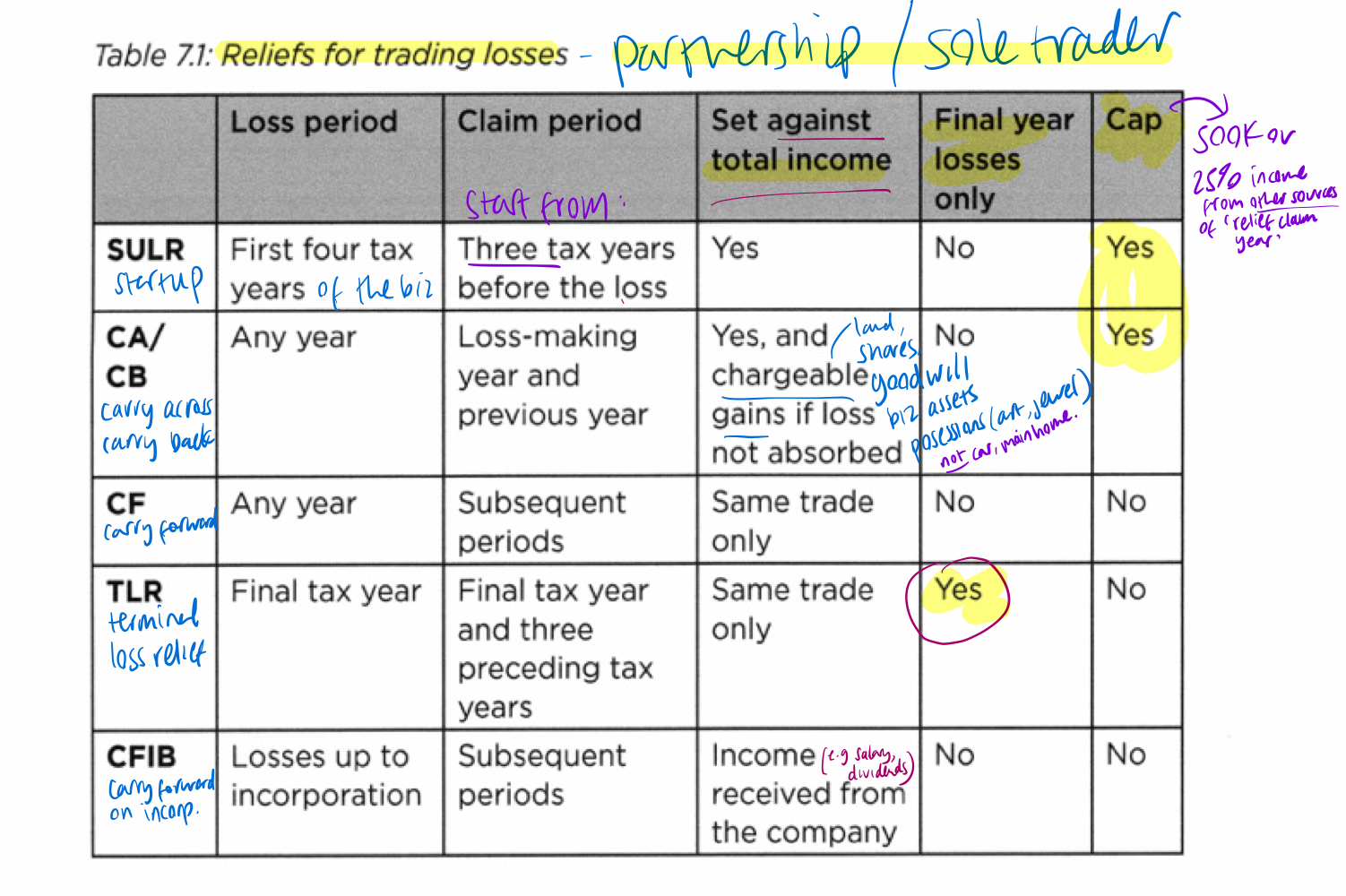
TABLE: reliefs for trading losses
_
Additional points:
• Cap applies only to SULR + CA/CB: greater of:
→£50,000 or
→25% of taxpayer's income from other sources in the relief claim year.
• These reliefs apply to sole traders + individual partners.
• For partnerships, each partner chooses relief separately for their own share of the loss.
• Reliefs are not automatic → taxpayer must claim.
• Same loss cannot be relieved twice.
• If one relief only uses part of the loss, another relief can be used for the balance.
• "Claim period" in the table means the tax years/income the loss can be set against — not the filing deadline.
_
Exam shortcut:
• start-up loss → SULR
• any-year loss against current/previous income → CA/CB
• business continues → CF
• business ends → TLR
• business incorporates → CFIB
Trading losses — general principles
A sole trader or individual partner may get tax relief for trading losses.
Effect:
• relief reduces taxable income, gains, or future trading profits
• this can reduce tax payable or produce a tax repayment
_
Key points:
• reliefs are not automatic → taxpayer must claim
• if more than one relief is available, taxpayer can choose the most useful one
• same loss cannot be relieved twice
• if one relief only absorbs part of the loss, another relief may be used for the remaining loss
Partnership point:
• each partner claims relief separately for their own share of partnership loss
• different partners may choose different reliefs depending on their personal income/tax position
_
Exam approach:
Ask what happened to the business:
• new business?
• continuing business?
• final year / ceasing trade?
• incorporated into company?
Start-up loss relief / early trade losses relief
Use where trading loss arises in the first 4 tax years of a new trade.
Effect:
• loss can be set against total income of the 3 tax years before the loss
• set against earliest year first
• useful where taxpayer had taxable income before starting the business, e.g. previous salary, previous business, rental income
Example:
Business starts in 2019/20 and makes first-year loss.
SULR can look back to:
• 2016/17
• 2017/18
• 2018/19
Use 2016/17 first, then move forward.
Other points:
• cap applies
• claim deadline = first anniversary of 31 January following end of loss-making tax year
Exam point:
Start-up + loss in first 4 tax years + previous taxable income = think SULR.
Carry-across / carry-back relief
Use where trading loss arises in any year.
Effect:
• loss can be set against total income of the loss-making tax year → carry-across
• loss can be set against total income of the previous tax year → carry-back
Taxpayer can choose order:
• loss year first, then previous year; or
• previous year first, then loss year
Chargeable gains point:
• if carry-across does not absorb the full loss, balance can be set against chargeable gains in the same tax year
Practical downside:
• loss is set against total income
• this may reduce income to zero and waste the personal allowance
Other points:
• cap applies
• claim deadline = first anniversary of 31 January following end of loss-making tax year
Exam point:
Any-year loss + current/previous total income = think CA/CB.
Carry-forward relief
Use where trading loss arises in any year and the same trade continues.
Effect:
• loss is carried forward
• loss is set against future profits of the same trade only
• earlier future years used first
• loss can be carried forward indefinitely until absorbed
Other points:
• no cap applies
• taxpayer must notify HMRC no more than 4 years after end of loss-making tax year
Practical effect:
• good where business is expected to become profitable later
• less useful if the trade never makes future profits
Example:
• Year 1 sole trader loss = £30,000
• Year 2 same trade profit = £50,000
• £50,000 − £30,000 = £20,000 taxable trading profit
Exam point:
Business continues + future same-trade profits = CF.
Terminal loss relief
Use where trading loss arises in final tax year / final year of trade.
Effect:
• loss can be set against profits of the same trade only
Claim period:
• final tax year
• 3 preceding tax years
Order:
• set against later years first
Other points:
• no cap applies
• claim deadline = no more than 4 years after end of loss-making tax year
Practical effect:
• business is ending, so normal carry-forward relief will not help
• TLR lets taxpayer look backwards and reclaim tax paid on earlier same-trade profits
Example:
Business stops in 2024/25 and makes terminal loss.
Use against same-trade profits in:
• 2024/25 first
• then 2023/24
• then 2022/23
• then 2021/22
Exam point:
Final year loss + business ceasing = TLR.
Carry-forward relief on incorporation of business
Use where an unincorporated business is transferred into a company.
Applies to:
• trading losses up to incorporation that have not been relieved
Conditions:
• business must be transferred wholly or mainly in return for shares; shares must be 80%+ of the consideration
Effect:
• loss can be carried forward
• loss can be set against income taxpayer receives from the company, e.g. → salary → director's fees → dividends
Other points:
• no cap applies
• claim deadline = no more than 4 years after end of loss-making tax year
Practical effect:
• after incorporation, taxpayer personally no longer earns sole trader profits from that business
• the company earns the trade profits instead
• CFIB lets old personal trading losses reduce the taxpayer's future personal income from the company
Exam point:
Old unincorporated loss + business becomes company + 80%+ shares = CFIB.
Trading loss reliefs — cap + claim deadlines
Cap applies only to:
• SULR
• CA/CB
Cap = greater of:
• £50,000; or
• 25% of taxpayer's income from other sources in the tax year for which relief is claimed
No cap applies to:
• CF
• TLR
• CFIB
_
Claim / notification deadlines:
SULR + CA/CB:
• claim by first anniversary of 31 January following end of loss-making tax year
Example:
• loss in 2019/20
• tax year ends 5 April 2020
• following 31 January = 31 January 2021
• first anniversary = 31 January 2022
• deadline = 31 January 2022
CF:
• notify HMRC no more than 4 years after end of loss-making tax year
TLR + CFIB:
• claim no more than 4 years after end of loss-making tax year
Exam point:
• cap = how much relief can be used
• deadline = when relief must be claimed/notified
VAT
20%
VAT registration threshold = £90,000 in any 12-month period.
VAT = "charged on any supply of goods or services made in the United Kingdom, where it is a taxable supply made by a taxable person in the course or furtherance of any business carried on by him".
VAT calculation:
• output tax − input tax = VAT payable to HMRC
• output tax = VAT business charges customers
• input tax = VAT business pays on its own purchases, e.g. raw materials
• if input tax exceeds output tax → business may get rebate
_
VAT registration:
• anyone making taxable supplies of more than £90,000 in any 12-month period must register and charge VAT
• below threshold → voluntary registration possible if making taxable supplies
• cannot register if business only makes exempt supplies
• exception / crossover = zero-rated business does not effectively charge VAT to customer, but can still recover input VAT
• examples of zero-rated businesses: bookshop, supermarket selling non-catering food
_
Exempt supplies:
• examples: health, education, insurance, residential land
• no VAT charged
• cannot register if only exempt supplies
• cannot recover input tax if only exempt supplies
_
Zero-rated supplies:
• examples: non-catering food, books, water
• VAT charged at 0%
• still a taxable supply
• business can register for VAT
• business can recover input tax
_
VAT invoices:
• VAT-registered business making taxable supply to taxable person must issue VAT invoice
• invoice should include VAT number, value of supply, and rate of VAT
_
Returns/payment:
• VAT return usually submitted quarterly
• VAT paid within 1 month from end of quarter
• full VAT records must be kept
_
• business supply of goods/services in UK → check VAT
• taxable supply + taxable person + VAT registration = charge VAT
• output tax − input tax = amount due to HMRC
*INCOME TAX - calculation (individual)
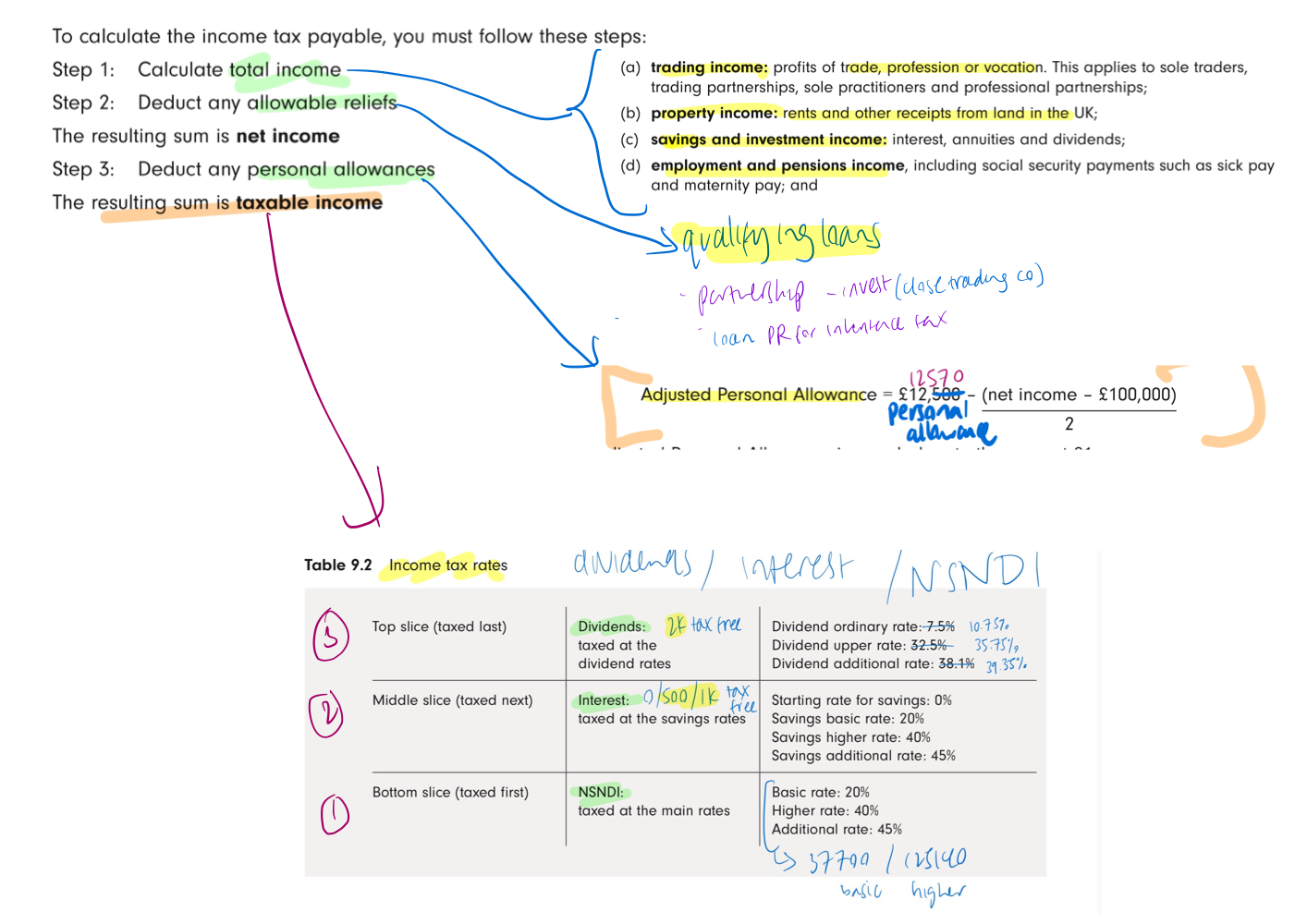
see diagram
_
Income tax bands as of 2026/27:
• personal allowance = £12,570
• basic rate band = first £37,700 of taxable income
• higher rate band = taxable income above £37,700 - £125,140
• additional rate = taxable income above £125,140
_
Income tax calculation structure:
• Step 1: calculate total income
↳ aggregate gross income from each source.
• Step 2: deduct allowable reliefs
↳ result = net income.
• Step 3: deduct personal allowance
↳ result = taxable income.
• Step 4: tax each source separately
↳ NSNDI first, savings income next, dividends last.
• Step 5: add the tax due and deduct tax already paid/deducted at source.
_
Income categories:
• NSNDI = non-savings, non-dividend income
↳ employment income, trading income, property income, pensions.
• savings income
↳ interest.
• dividend income
↳ dividends from shares.
_
NSNDI rates:
• basic rate = 20%
• higher rate = 40%
• additional rate = 45%
_
Savings income rates:
• starting rate for savings = 0% on £0/500/1000*
• savings basic rate = 20%
• savings higher rate = 40%
• savings additional rate = 45%
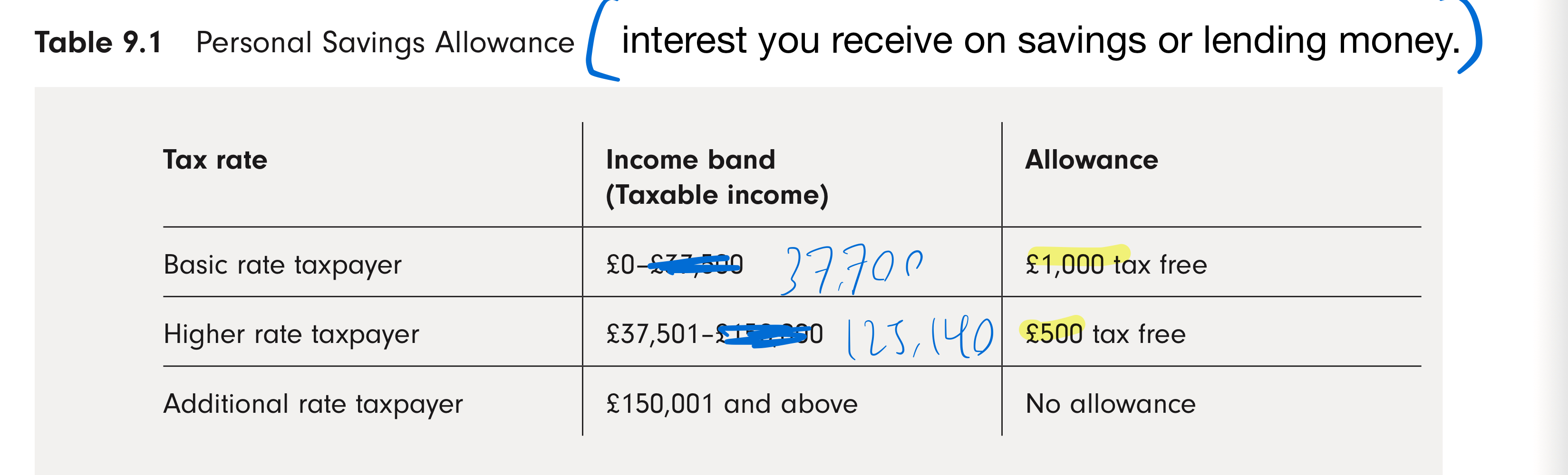
• *personal savings allowance:
↳ basic rate taxpayer = £1,000 at 0%
↳ higher rate taxpayer = £500 at 0%
↳ additional rate taxpayer = £0
_
Dividend income rates as of 2026/27:
• dividend allowance = £500 at 0%
• ordinary/basic dividend rate = 10.75%
• upper/higher dividend rate = 35.75%
• additional dividend rate = 39.35%
_
NB PSA and dividend allowance are nil-rate bands, not deductions.
They are taxed at 0%, but still count towards the cumulative income bands.
income tax:
adjusted personal allowance - formula ?
other allowances ?
Personal allowance is reduced when net income exceeds £100,000. FORMULA
marriage - 1250 transferable
blind 1250
gross trading property income - first 1k tax free
PSA personal savings allowance (interest on savings/lending) - 0/500/1000 tax free depending on income bracket
dividend allowance - first 2k tax free

personal savings allowance thresholds (first X tax free)
0/500/1000
income tax rates
NSNDI, interest, dividends
NSNDI = 20 / 40 / 45
interest = 0 starting rate, then 20 / 40 / 45
dividends = 10.75 / 35.75 / 39.35