Halogenoalkanes
 Call Kai
 Learn
Learn Practice Test
 Spaced Repetition
 Match
Match Flashcards
 Knowt Play
1/14

There's no tags or description
Looks like no tags are added yet.
Name | Mastery | Learn | Test | Matching | Spaced | Call with Kai | Chat |
|---|
No analytics yet
Send a link to your students to track their progress
15 Terms
Producing Halogenoalkanes: (3)
Alkanes: free - radical substitution
Alkenes: electrophilic addition of HX (or by reacting KBr with conc H2SO4 or H3PO3)
Alcohols: reactions with: PCl3, (H3PO3); PCl5, (HCl, POCl3); SO2, (HCl, SOCl2)
Reactions of Halo (4) tell me every single damn thing about amines
Alkenes: with NaOH (ethanolic), heat under reflux
Alcohols: with H2O/ NaOH (aq), aka, hydrolysis, heat under reflux
Nitriles, with KCN, HEAT under reflux
AMINES: WITH NH3 in excess, in ethanol, heat under pressure, + H2O
Markovnikov’s rule <3
Amines: How does it work / type of reaction? the “phile” ? The chemical equation
How does it work?
Nucleophilic substitution, side product + HX or none
Nucleophile: NH3
Product:
before: -amine + hydrohalogen
after: (when it’s in excess, Ammonia neutralises ACID)
| NH3 + HBr → NH4 Br
Chemical equation
CH3CH2Br + 2NH3 → CH3CH2NH2 + NH4Br
Conditions:
NH3 in ethanol
Heat
Sealed in container
Nitriles Niggrow nhớ sao?!?!, the “phile” in question, Side product, condition
Nucleophilic substitution, in turn X- ion is left out (side product)
Nucleophile: CN- ion
Chemical equation:
CH3CH2Br + CN- → CH3CH2CN + Br-
Conditions: Add KCN → NIGGROEW NHỚ BÔI KCN!!!
HEAT UNDER REFLUX
CYANO!! or Nitrile
Producing Halo (how many things?)
, which are:
Free radical substitution of Alkanes using Br, Cl
Electrophilic addition of alkene using X2 or HX (conditions: at room temp)
Substitution of Alcohol:
HX (or KX and H2SO4 or H3PO4)
PCl3 and heat: → halo + H3PO3
PCl5 and at room temp: → HCl + PCl3
Heat under reflux
Heating method using a condeser, prevent the vapour from reagents to escape
Alcohols (Nucleophile, conditions)
Hydrolysis (Add H2O) side product: HBr
OR through the reaction with NaOH (aq) (substitution reaction) aka dilute alkali
nucleophile: H2O or OH-
Conditions: Heat under reflux
Note: Hydrolysis slower
Identifying halogen: reagents, any conditions, add to what? Colour?
Slowly occurs by adding AgNO3 solution in a mixture of ethanol and water
Forms AgX precipitate
AgI - pale yellow
AgBr - cream
AgCl - white
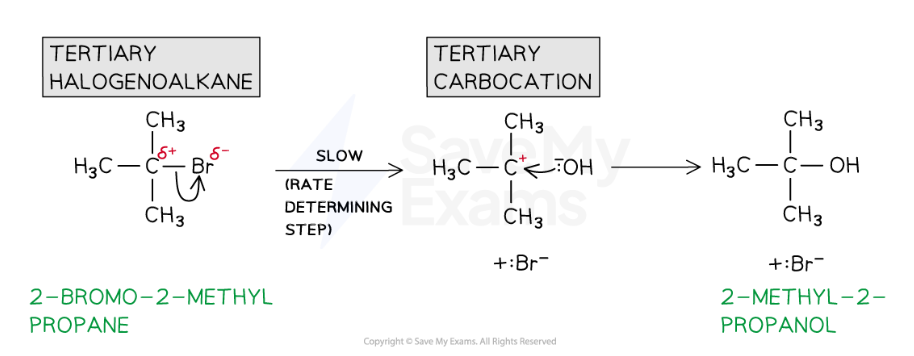
SN1
S & N: Substitution nucleophilic
1 or 2: order of reaction, how many factors determine the RoR
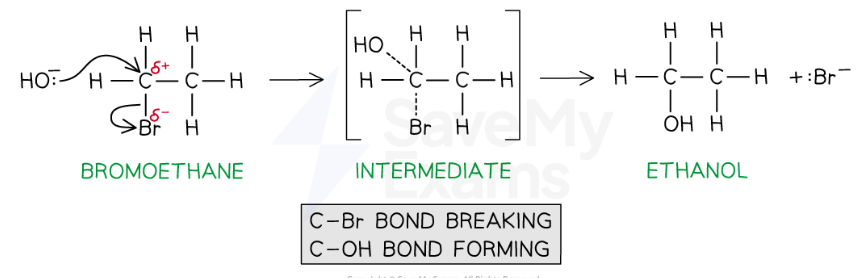
SN2
One stage, occurs with primary
central shows TRANSITION
How it works:
1st
Nu attacks the Carbon
Transition:
AT THE SAME TIME, Nu - - - - C and - - - - leaving group
Note: PARTIAL CHARGES BEFORE AND AFTER
Nu attacks from opposite side ‘cause Like charges repel
SN1
2 STAGES, HUHU NHỚ ATVNCG QUÁ ĐI MẤT
First:
electrons → X
Second:
Nu → C+ (Trigonal Planar intermediate)
ions left…
Involves Carbocations which is stabilised by the inductive effect
=> Tertiary
*HIGHLY IMPORTANT!!!: first step, there’s might not be no attack
Reactivity (electronegativity, bond length → ?)
Enegativity: decreases down the group
Size of Partial charges (GOING DOWN)
Bond length increases → Atomic size
Making Alkene (Does it include X or no?)
Elimination reaction, side product: NaX + H2O
reagents: NaOH
Conditions: NaOH(ethanol)
Heat under reflux