Adolescence
 Studied by 0 people
 Call Kai
 Learn
Learn Practice Test
 Spaced Repetition
 Match
Match Flashcards
 Knowt Play
1/40

There's no tags or description
Looks like no tags are added yet.
Name | Mastery | Learn | Test | Matching | Spaced |
|---|
No study sessions yet.
41 Terms
Physical Development in Adolescence
hormones influence cells and are a way in which genetic instructions are transformed into physical development
~7 or 8 pituitary gland (the gland that controls all other glands) signals the adrenal gland to increase the production of androgen (hormones) to start puberty
Puberty
The biological transition to adulthood in which hormones cause the body to physically mature and permit sexual reproduction
hormonal changes trigger puberty in late childhood and are marked by the adolescent growth spurt (i.e a rapid gain in height and weight)
generally, begins at about 10 in biological females and 12 in biological males
Physical Development in Adolescence: Growth Spurt
the cephalocaudal growth trend of infancy and childhood reverses
the extremities grow first, torso last
time for limbs and torso to catch up with brain
muscles grow stronger
internal organs mature
proportions of muscle and fat differ for males and females
males: don’t require specific body fat mass level to produce sperm
females: menstruation cannot happen until certain body mass is reached
Physical Development: Secondary Sex Characteristics
Physical traits that indicate sexual maturity but are not directly related to fertility
eg. armpit/pubic hair
Physical Development: Primary Sex Characteristics
The reproductive organs
eg. ovaries, uterus
Physical Development: Menarche
A biological female’s first menstrual period (~10-14 and the average age in Canada is ~12.7)
precocious puberty: very early puberty
likely to be treated as “older” by adults → detrimental to development
Physical Development: Spermarche
A male’s first ejaculation (~13 or 14 and produces very few sperm)
Biological and Contextual Influences on Pubertal Timing
genetics
weight and nutrition
stress (can alter hormone production)
socioeconomic status
secular trends (not related to religion): eg. younger periods over time
Trans Youth and Puberty
~75,000 or 0.24% of Canadians aged 15 and older are transgender (i.e gender differs from sex assigned at birth)
changes happening during puberty can be especially distressing when they are not in line with your gender
puberty blockers (i.e medications that block hormones associated with puberty can help relieve the distress)
Sexuality
Everything related to sexual feelings, thoughts, behaviors, etc.
sexual attraction: desire to have sex interactions with a person/people
Sexual Activity
sexual activity and relationships often emerge in adolescence
influenced by caregivers, peers, neighbourhood, media, SES, etc.
sexuality continues to be important throughout the life course
emerging cognitive abilities lead to curiosity, reflexivity and introspection about sexual feelings and behavior
lack of education leads to STIs, violence or when abstinence is suggested
Cognitive Development: Formal Operational Reasoning
Piaget’s 4th stage of cognitive development characterized by the ability to engage in abstract, logical and systematic thinking
better planning and perspective taking
starts ~11
allows adolescents to engage in hypothetico-deductive reasoning
Piaget theorized that cognitive development is universal
in reality, although adults are presumably capable of abstract reasoning, many fail hypothetical-deductive tasks
can also vary across task, situations, experience, context and motivation
Hypothetico-Deductive Reasoning
The ability to search methodically for the answer to a problem
adolescents learn that hypothetical thought is very interesting, but it makes the world much more complex
Cognitive Development: Elkind
Elkind hypothesized that aspects of hypothetico-deductive reasoning can include:
adolescent egocentrism: individuals believe their thoughts/ideas are unique
no one else understands
personal fable: the belief held by some adolescents that their experiences, feelings, and thoughts are unique and that they are special and invulnerable, meaning the rules of life don't apply to them
eg. not wearing a helmet
imaginary audience: the belief that ppl are constantly judging
Cognitive Development: Information Processing
enhanced control in attention
improvements in information processsing capacities and metacognition
decision-making responsibility increases
improved memory recall
Cognitive Development: Dual Process Model
the imbalance between control and reward systems in the brain
Transition to Secondary Education
Adolescents spend a lot of time in school
experience multiple transitions
can be exciting and/or stressful
adjustment difficulties tend to be temporary
Achievement
How children explain their own successes and failures is important for sustaining motivation and therefore influences their achievement
internal attributes: explaining a behavior or event as caused by a person's internal characteristics, like personality or effort,
external attributes: explains it as caused by outside, situational factors, such as luck or environment
fixed mindset: believing that characteristics are enduring and unchangeable
growth mindset: viewing skills and characteristics as malleable or changeable
Identity Questions
who are you?
how did you decide who you are?
what has influenced who you have become?
what words do you use to describe who you are?
are the descriptive words hierarchical or do you weigh them all equally?
what/who do you hope to become
Social and Personality Development: Freud
adolescents experience the genital stage (i.e the final stage of psychosexual development)
the task is to channel libido into a healthy sexual relationship
this is not end all or be all
Social and Personality Development: Erikson
changes caused by puberty cause existing identity to unravel and thus adolescents seek to achieve a sense of self-continuity during the identity vs role confusion stage of psychosocial development
once obtaining sense of self, no longer confused with who you are/roles
roles: culture, religion, relationships, in community, hobbies + interests
Identity
individuals need time and space to figure onself out
eg. think about what in childhood carries over
adolescents are best able to construct an identity when they experience psychosocial moratorium
a period in which the individual is free to explore identity possibilities before committing to an identity
parenting styles, relationships (friendship/romantic), culture, religion, politics have a large impact
Marcia’s Theory of Identity Achievement
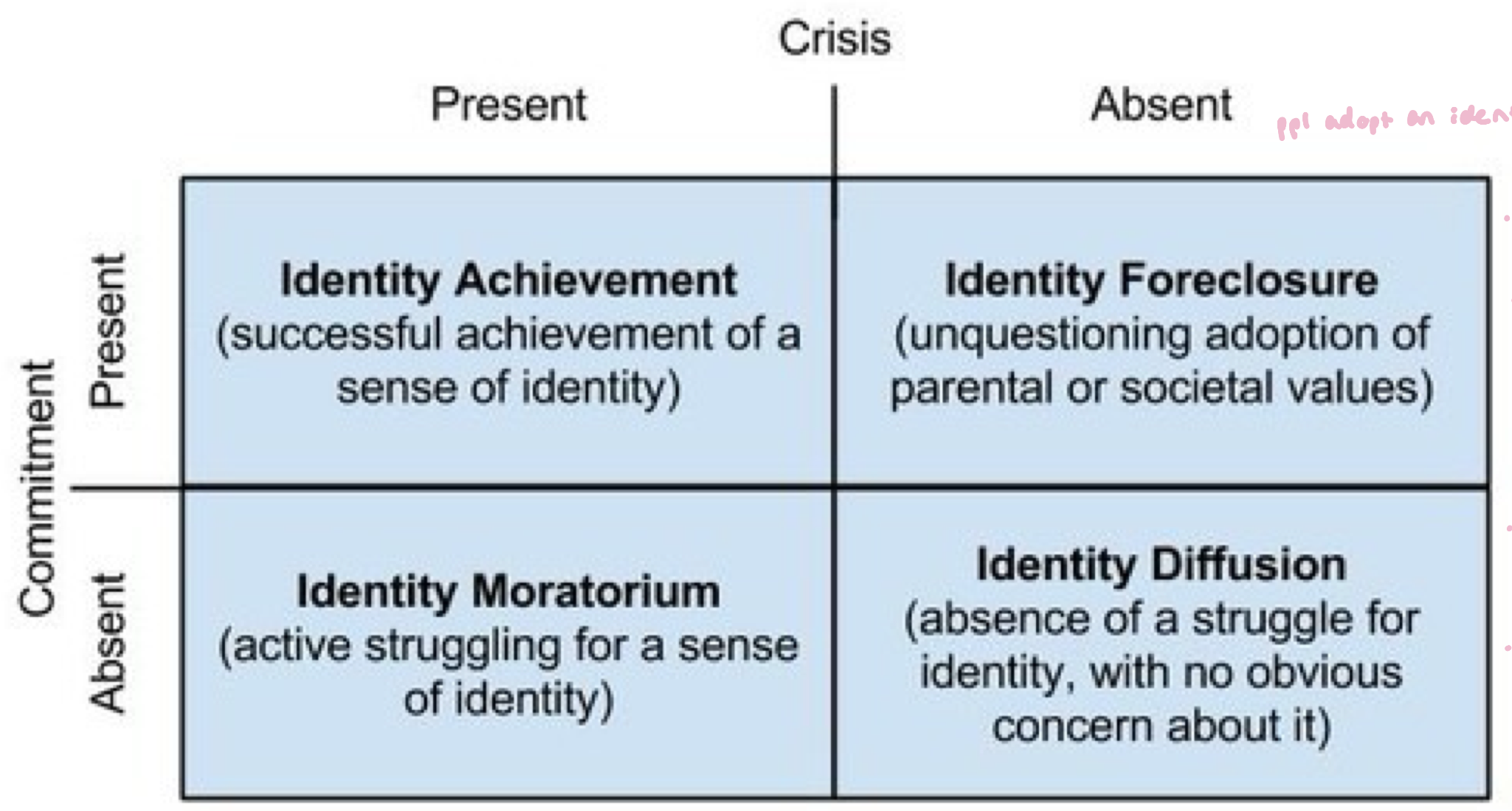
Adolescent identity formation consists of:
a crisis: period of time where existing values and choices are rethought
commitment: the outcome of the crisis is a commitment to specific roles, values, goals, ideology, etc.
eg. are you continuing or stopping?
Identity Status
The degree to which individuals have explored possible selves
Identity Status: Identity Foreclosure
Unquestioning adoption of parental or societal values
ppl adopt an identity that is given to them
no period of crisis → no commitment
often accepted, don’t question it
eg. authoritarian parents or collectivism society
Identity Status: Identity Diffusion
Absence of a struggle for identity, with no obvious concern about it
not engaged in re-evaluation, but no concern abt it
get too comfortable → disinterested in trying new things
Identity Status: Identity Moratorium
Active struggling for a sense of identity
active struggle in determining who you want to become
pros: can force people to try new things
people in identity moratorium tend to experience anxiety, feel puzzled with many choices
Identity Status: Identity Achievement
Successful achievement of a sense of identity
after undergoing to a period of exploration, a person commits to self-chosen values and goals
involves establishing a coherent sense of self after exploring a range of possibilities
adolescents who have developed advanced logical thinking and information processing skills are most likely to have attained identity achievement
Identity Status Figure
Intersecting Identities
our individual identities consist of multiple, intersecting factors, including but not limited to age, gender, race, religion, sexual orientation, socioeconomic status and ethinicty
these intersecting identities can present opportunities and challenges during adolescence
eg. women in stem
do you talk about different things with different people?
Influences on Identity Development
caregivers (eg. can provide funds for new experiences)
peers: classmates, friendships (can expose you to new things)
romantic relationships: can help with self expression
peers and romantic relationships can act as a mirror, helping you view yourself
Developmental Shifts in Identity
identity is not an all-or-nothing concept
people form a sense of identity in many different realms
identity commitments continue to change and evolve
occurs in mid adulthood and beyond
Identity Development Outcomes
identity development is associated with well-being and positive functioning
we tend to feel better when we know who we are and we think better of others
identity achievement and identity foreclosure are associated with:
positive functioning
prosocial behavior (helping others)
capacity for romantic attachments
an adaptive, mature sense of self
Self-Concept
developmental trajectory in adolescence
trend from childhood continues as adolescents’ self concepts continue to revolve around internal characteristics and self-definitions become more abstract
differenciation
self-esteem: influenced by adolescents’ perception of competence across their domains of self concept
Kohlberg’s Stages of Moral Development: Preconventional Reasoning
age <6
young children’s behavior is governed by the desire to avoid punishment and to gain rewards
not necessarily what they think is right/wrong
Stage 1: children are concerned with punishment as a motivator of moral judgements (eg. not hitting others)
Stage 2: Self-interest and concern about what others can do for them
motivated by rewards → alter behavior for it
Kohlberg’s Stages of Moral Development: Conventional Moral Reasoning
Moral decisions are based on conforming to social rules
stage 3: age 9-10, children uphold rules in order to please others and gain affection and/or sympahty
wanting others to view them in particular ways
stage 4: teens, adolescents buy into rules and standards b/c they are concerned with maintaining social order
eg. not playing soccer in lecture
Kohlberg’s Stages of Moral Development: Post-Conventional Moral Reasoning
Autonomous decision making based based on valuing respect for individual rights
stage 5: teens, most values are relative and laws are changeable, although rules should be upheld to preserve the social order
potential to change things (eg. advocating)
stage 6: abstract ethical principles are universal and valid regardless of law
justifying breaking the law for ethical principles
includes performative: doing smth so others perceive you in a certain way
Critiques of Kohlberg’s States
data based on hypothetical scenarios
participants were male (biased sample)
evidence doesn’t always support distinct stages
distinction b/w moral judgement and moral behavior
concern that justice is not necessarily that most fundamental moral principle
Moral Development: Cognitive Influences
chronological age
cognitive development (often but not always related to age)
the older we are, the more cognitively developed
moral development
Moral Development: Social Influences
family/caregivers and peer contexts
social interactions have a huge impact on moral development
high-quality parent-child/caregiver relationships predict advanced moral reasoning
peers have a similar influence
Moral Development: Cultural Influences
Western cultures tend to value the rights of the individual
Non-western cultures tend to value collectivism